Key takeaway
- How to set up a Jenkins CI/CD pipeline for a Laravel PHP application on AWS, from build to production, and what to check before you adopt it.
An AWS DevOps pipeline for a Laravel PHP application is an automated route that takes each code change through build, test and deployment to development, release and production environments running on AWS. Jenkins runs the pipeline, a MySQL database backs the application, and AWS supplies the servers and network.
This page is for teams that host Laravel or other PHP applications on AWS and still deploy by hand. It covers the problem, the setup, where AI agents fit, a comparison with manual releases, and what to check before you adopt it.
What is a CI/CD pipeline for a Laravel application on AWS?
Continuous delivery is described on the AWS continuous delivery page as code changes being automatically prepared for a release to production, so teams always have a deployment-ready build artefact that has passed a standardised test process. Jenkins, an open-source automation server, runs that process, and its Pipeline documentation describes pipelines defined as code in a Jenkinsfile kept in source control.
What problem does the pipeline solve?
Teams that run a PHP application in production usually need three things at once.
- A highly available, scalable production environment to deploy the application to.
- Automatic deployment to production, release and development environments through continuous integration and continuous delivery.
- Website configuration and administration for Apache or another web server, Git, MySQL and PHP.
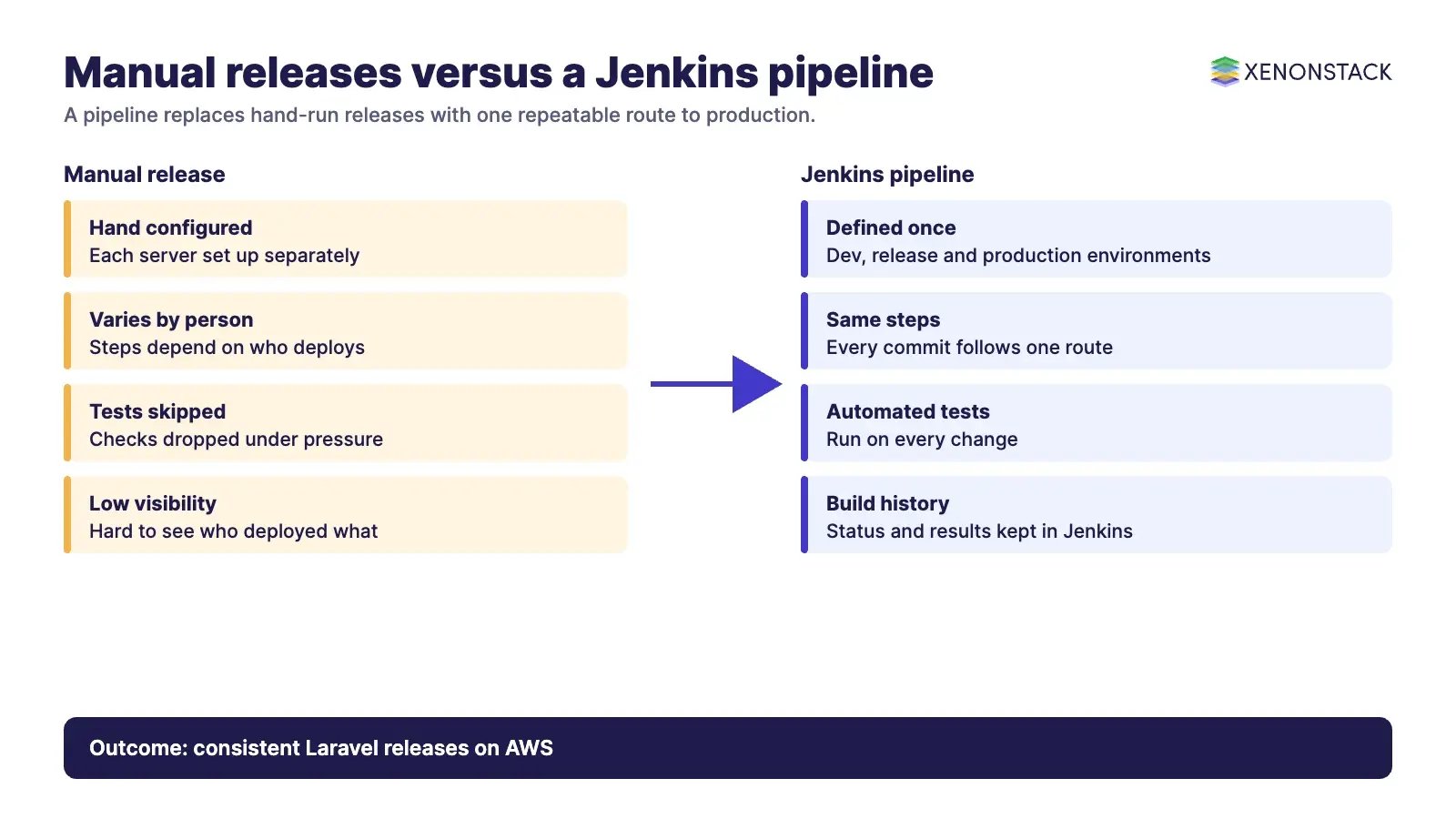
Doing this by hand means each release depends on who runs it. A pipeline makes the route the same every time.
How is the pipeline set up?
The solution uses three building blocks.
| Component | Role |
|---|---|
| AWS | Provides EC2 compute instances, a virtual private cloud (VPC) and security groups for each environment |
| MySQL | The database service for the application |
| Jenkins | Continuous build tool that automates the build, artefact management and deployment steps so the team can focus on development |
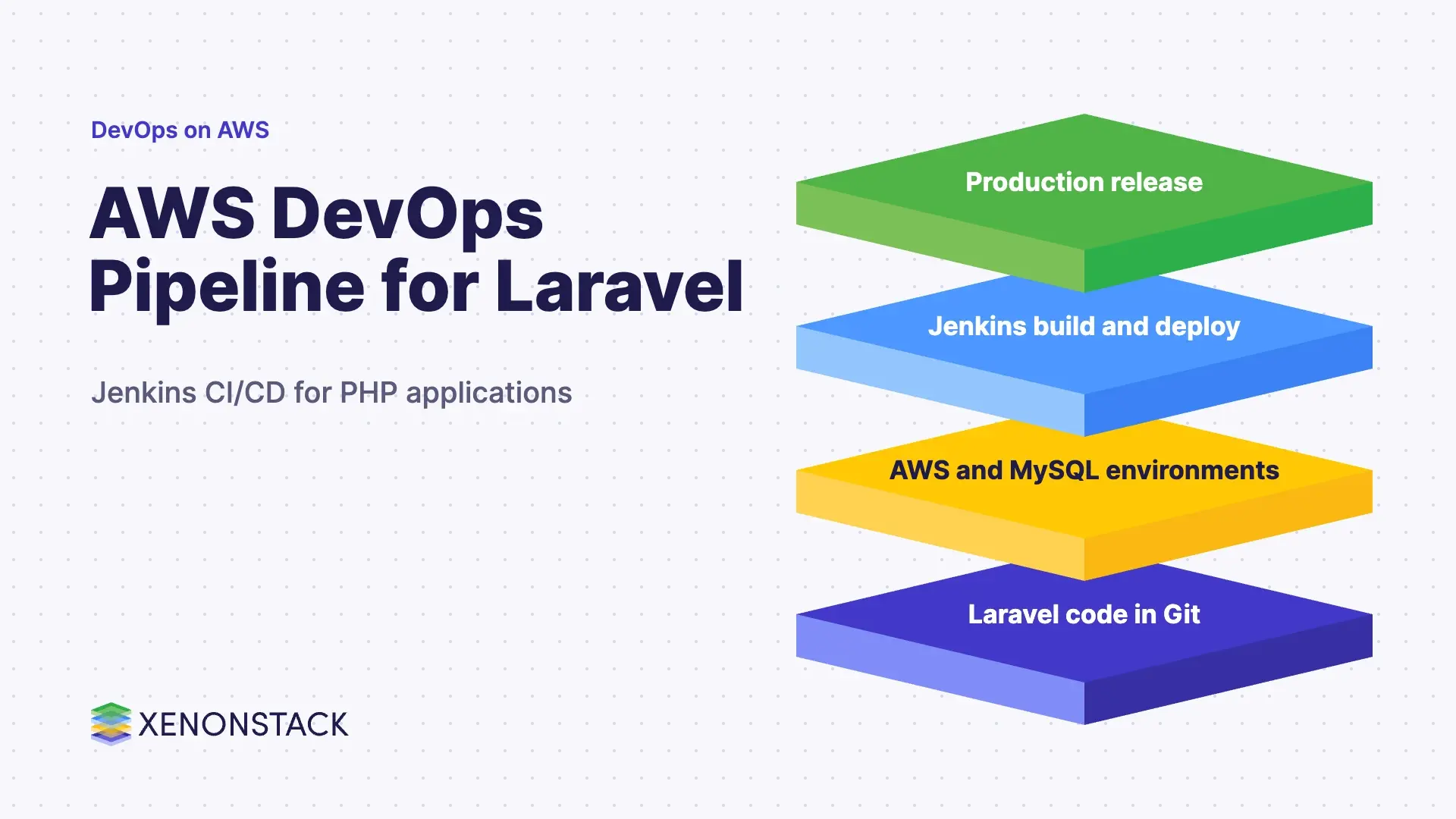
Jenkins watches the Git repository, builds each change, runs the tests and deploys the result to the next environment in order: development, then release, then production.
What should a Laravel deployment include?
The Laravel deployment documentation gives guidance a pipeline can automate. The deploy step can run the framework's optimisation command, which caches configuration, events, routes and views. Keep calls to the env function inside configuration files, because once the configuration is cached the .env file is no longer loaded. Set APP_DEBUG to false in production, and make sure the web server can write to the storage and bootstrap/cache directories.
The same page says the web server should serve the application from the public directory, never from the project root, and that long-running services such as queue workers should be restarted after a deployment so they run the new code. Laravel also provides a health route, served at /up by default, that returns 200 when the application has booted without exceptions, which a pipeline can call after deploying.
How does a manual release compare with an automated pipeline?
| Question | Manual release | Automated pipeline |
|---|---|---|
| Consistency | Depends on the person | Same steps every time |
| Environment setup | Configured by hand on each server | Defined once for development, release and production |
| Testing | Often skipped under time pressure | Runs on every change |
| Visibility | Hard to see who deployed what | Build history in Jenkins |
| Recovery | Ad hoc | Redeploy an earlier build |
Where do AI agents fit?
The pipeline decides whether a build passes. AI agents can help the people around it, for example by reading a failed build log, pointing to the likely cause and drafting a note for the owner of the change. Releases to production should still pass through an approval step. ElixirClaw is XenonStack's AI agents computing platform for running agents like this.
What should you check before adopting it?
- Which environments do you need, and who approves a production release?
- Is the operating system image for your EC2 instances still supported, and who patches it?
- Where do database credentials and application keys live? Jenkins can store credentials encrypted and let pipelines refer to them by ID.
- How will you run database migrations and restart queue workers during a release?
- Who maintains Jenkins and its plugins?
To map one decision your agents make, and the data and policy it depends on, book a Context Workshop. See what happens in the workshop.
Frequently asked questions
What does Jenkins do in this pipeline?
Jenkins automates the build, artefact management and deployment steps, so each commit follows the same route to the development, release and production environments.
Why use AWS for a Laravel application?
AWS provides EC2 compute, a virtual private cloud and security groups, which let you build a scalable, highly available production environment for the application.
Does Laravel need special deployment steps?
Yes. The Laravel documentation recommends caching configuration, routes and views, setting debug mode off in production, serving from the public directory and restarting long-running workers after a release.
What is the difference between continuous delivery and continuous deployment?
Continuous delivery prepares every change for release and usually keeps a manual approval before production. Continuous deployment removes that approval and releases automatically.
Ready to put AI agents to work? See an ElixirClaw demo: the agentic OS to build, orchestrate and govern AI agents across your enterprise systems.
Explore the XenonStack platform family: ElixirData · ElixirClaw · ElixirHub · NexaStack · MetaSecure · Neural AI · AgentGRC · AgentSRE · AgentAnalyst · AgentInstruct · AgentRAI · AgentScrum · AgentSearch · AgentForce · AI Aviator · SAIF Aviator · CohortIQ · XenonStack AI · XenonStack UAE