Key takeaway
- What are botnets, how they work and how enterprises detect and contain them. Defensive controls, takedown lessons and a response sequence for CISOs.
A botnet is a network of internet-connected devices that an attacker has infected with malware and can control remotely, usually without the owners knowing. The NIST glossary describes it as a network of computers taken over after infection with Trojan-style malware and managed remotely as "bots". For an enterprise, the risk is twofold: your devices can be recruited to attack others, and the same botnets can be pointed at you.
The practical answer is layered. Keep devices patched and protected with multi-factor authentication, watch outbound traffic for unexpected connections, segment networks so one infected device cannot reach everything, and rehearse a response to denial-of-service attacks. This guide covers how botnets work, what recent takedowns show, and which controls a security team should sequence first. It is defensive guidance only. For the wider detection picture, see our guide to anomaly detection for cyber network security.
What is a botnet and how does it work?
A botnet has a few moving parts. Understanding them tells defenders where to look and where to break the chain.
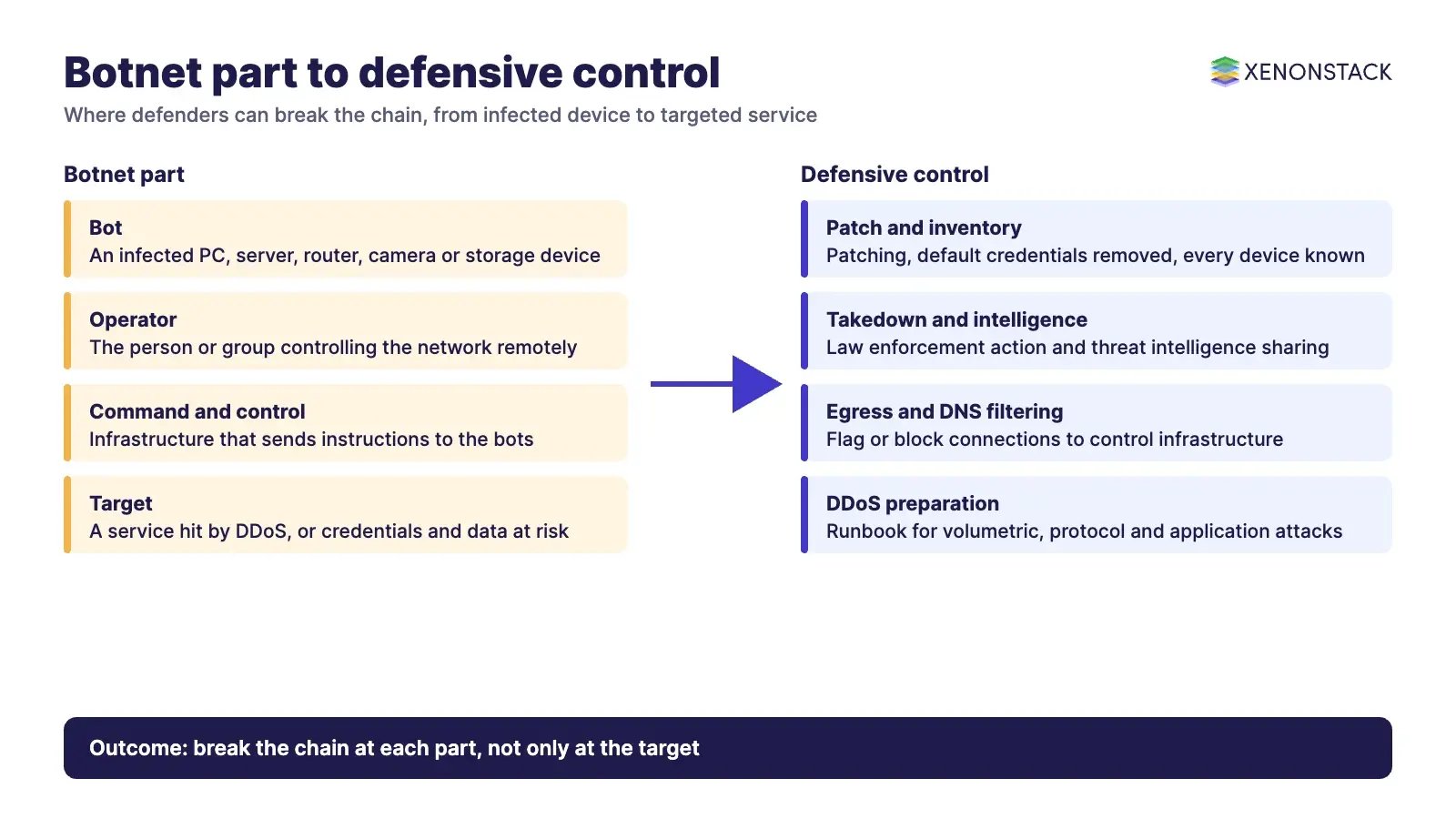
| Part | What it is | Where defenders can act |
|---|---|---|
| Bot | An infected device such as a PC, server, router, camera or storage device | Patching, endpoint protection, removing default credentials, device inventory |
| Operator (bot herder) | The person or group that controls the network from a remote location | Law enforcement and takedown action; threat intelligence sharing |
| Command and control (C&C) | The infrastructure the operator uses to send instructions to bots | DNS and egress filtering, blocking known infrastructure, network telemetry |
| Targets | The victims of the attack, which may include your own organisation | DDoS preparation, rate limiting, credential protection, monitoring |
The defining trait is remote control. Because the operator can send new instructions to every bot, the same network can be used for a denial-of-service attack one day and for something else the next. Botnets are generally organised either around central servers or as peer-to-peer networks, and many combine both. A peer-to-peer design has no single server to block, which is why defenders rely on several signals rather than one blocklist.
What can a botnet do to an enterprise?
| Abuse | What happens | What to protect |
|---|---|---|
| Distributed denial of service (DDoS) | Many bots send traffic or requests to exhaust bandwidth, protocols or an application. The joint CISA, FBI and MS-ISAC guide groups these as volumetric, protocol and application attacks. | Public websites, APIs and customer-facing services |
| Traffic relaying and proxying | Compromised devices route an attacker's traffic. SecurityWeek reported that the Raptor Train botnet could route traffic, run DDoS attacks and deliver other malware. | Network edge devices, IP cameras, storage devices |
| Malware delivery and spam | Bots download further malware or send unwanted mail | Email gateways, endpoint controls |
| Credential theft and fraud | Malware on a bot can capture passwords or drive click fraud | Identity systems, multi-factor authentication |
| Resource hijacking | Malware campaigns can install cryptomining software that uses the device's processing power, as CISA notes | Cloud spend, workstation performance |
What do recent botnet takedowns show?
Takedowns show that botnets are disrupted by coordinated action, and that infected devices still need cleaning afterwards.
| Operation | What was reported | Source |
|---|---|---|
| Operation Endgame, May 2024 | Between 27 and 29 May 2024, over 100 servers worldwide were taken down and four arrests were made. The malware families named were IcedID, SystemBC, Pikabot, Smokeloader and Bumblebee. | Europol press release |
| Raptor Train, September 2024 | A court-authorised US operation took control of the attacker's infrastructure and sent commands to disable the malware on infected devices. The botnet was reported to include about 260,000 routers, NAS devices and IP cameras over roughly four years, with a peak of more than 60,000 devices in June 2023. The FBI said it would notify device owners through their internet service providers. | As reported by SecurityWeek |
Two lessons follow for enterprise teams. First, the infected devices were often ordinary edge equipment such as routers and cameras, which many asset inventories miss. Second, a takedown removes the control channel but does not guarantee every device is clean, so your own detection and patching still matter.
How do you detect a botnet infection?
Botnets try to stay quiet, so detection combines host and network signals. None is conclusive alone.
| Signal | Where to look | Why it matters |
|---|---|---|
| Unexpected outbound connections | Firewall, proxy and flow logs | Bots must reach their control infrastructure |
| Unusual DNS queries | DNS logs and resolver telemetry | Control domains often appear here first |
| Sudden traffic spikes from one device | Network monitoring | A device may be taking part in an attack |
| Slow performance, high CPU, unexplained processes | Endpoint monitoring | Hijacked resources show up as load |
| Security tool alerts and failed tamper checks | EDR and antivirus consoles | A tool disabled or alarming is itself a signal |
| Devices with no owner or no patch record | Asset inventory | Unmanaged devices are easy to recruit |
Our guide to anomaly detection in cyber networks explains how to baseline normal behaviour so that these signals stand out, and self-healing SOC systems covers how a security operations centre can automate the first response.
How do you prevent and contain botnets?
The CISA cybersecurity best practices page lists the basics that also reduce botnet risk: keep software updated, enable multi-factor authentication, use strong passwords and think before clicking suspicious links. Add network controls on top.
| Control | What it does | Owner |
|---|---|---|
| Patch management | Closes the vulnerabilities that bots use to spread, including on routers and cameras | IT operations |
| Multi-factor authentication and strong passwords | Limits credential theft and reuse | Identity team |
| Change default credentials on devices | Removes an easy route to recruit IoT and edge devices | Network and facilities teams |
| Network segmentation | Stops one infected device reaching the whole estate | Network team |
| Egress and DNS filtering | Blocks or flags connections to control infrastructure | Security operations |
| Email and web protection | Reduces malicious attachments and links | Security operations |
| DDoS preparation | Plan for volumetric, protocol and application attacks as described in the CISA guide | Security and platform teams |
| Retire unsupported devices | Removes devices that can no longer be patched | IT operations |
For the DDoS part, read CISA, FBI and MS-ISAC guidance and confirm the current version on the official page. In delivery pipelines, the same discipline applies to code and dependencies: see DevSecOps in CI/CD, the DevSecOps checklist, SecDevOps and continuous security.
Which tools help against botnets?
| Tool category | Fits when | Limit |
|---|---|---|
| Network intrusion detection | You need visibility of suspicious traffic at the network layer | Encrypted traffic reduces what it can see |
| Endpoint detection and response | You need to find and contain infected hosts | Does not cover devices that cannot run an agent |
| DNS and egress filtering | You want to cut bots off from control infrastructure | Attackers change domains and addresses |
| DDoS mitigation service | Your public services must stay available under attack | Needs planning and testing before an incident |
| Network traffic analysis | You want to spot unmanaged devices behaving oddly | Needs a baseline and tuning |
Product features and pricing change, so confirm them on each vendor's own page before buying.
How should an enterprise sequence its botnet defences?
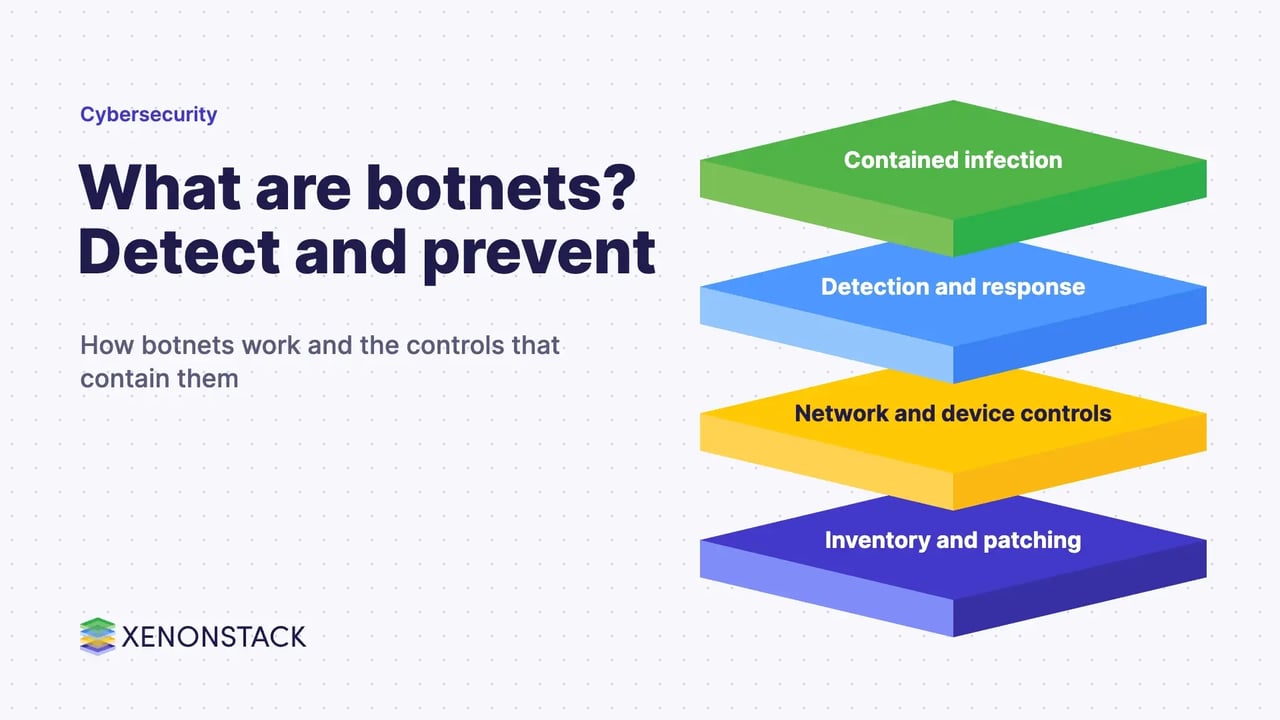
Start with what you can measure. Build an inventory that includes routers, cameras and storage devices, then patch and remove default credentials. Next, turn on egress and DNS logging and alert on unexpected destinations. Then segment networks and write a DDoS runbook with named owners. Finally, test the runbook.
Where AI agents help with triage, they need clear limits. ElixirData keeps governed context, versioned policy and decision traces in one decision layer above AI agents, and AgentGRC keeps autonomous agent actions inside policy, with the audit trail risk teams need. ElixirClaw is an agentic OS platform to build, orchestrate and govern AI agents and automation workflows while keeping humans in control. Our agentic AI cybersecurity guide and zero trust security architecture post cover the controls in more depth.
When are these controls not enough?
Controls reduce risk but do not remove it. Unmanaged and unpatchable devices stay exposed, large volumetric attacks can exceed what an on-premises link can absorb without a mitigation service, and encrypted command traffic is hard to inspect. Aggressive blocking can also disrupt legitimate services, so test changes before enforcing them. Treat a suspected infection as an incident: isolate the device, preserve logs and follow your response plan.
To map one security decision your agents should make, and the context and policy it depends on, book a Context Workshop. See what happens in the workshop.
Frequently asked questions
What is a botnet in simple terms?
A botnet is a group of infected devices that an attacker controls remotely, usually without the owners knowing. The NIST glossary describes them as machines taken over by Trojan-style malware and managed as bots.
What are botnets used for?
Common uses include distributed denial-of-service attacks, relaying traffic, delivering more malware, sending spam, stealing credentials and cryptomining. CISA groups DDoS attacks as volumetric, protocol or application attacks.
How can a company tell if a device is part of a botnet?
Look for unexpected outbound connections, unusual DNS queries, sudden traffic spikes, high resource use and devices that have no owner or patch record. No single signal is conclusive, so combine host and network data.
Does a takedown remove a botnet for good?
Not always. Operation Endgame in May 2024 took down over 100 servers and led to four arrests, according to Europol, and the Raptor Train operation disabled the malware on infected devices, as reported by SecurityWeek. Operators can rebuild, and devices can stay vulnerable, so patching and monitoring still matter.
What is the first thing to do about botnet risk?
Build a full device inventory, including routers, cameras and storage devices, then patch them, remove default credentials and enable multi-factor authentication, in line with CISA's best practices.
Explore the XenonStack platform family: ElixirData · ElixirClaw · ElixirHub · NexaStack · MetaSecure · Neural AI · AgentGRC · AgentSRE · AgentAnalyst · AgentInstruct · AgentRAI · AgentScrum · AgentSearch · AgentForce · AI Aviator · SAIF Aviator · CohortIQ · XenonStack AI · XenonStack UAE