Key takeaway
- How AI and ML models track phishing attacks, threats, complaints and incident cost in a security dashboard, and what to check before trusting predictions.
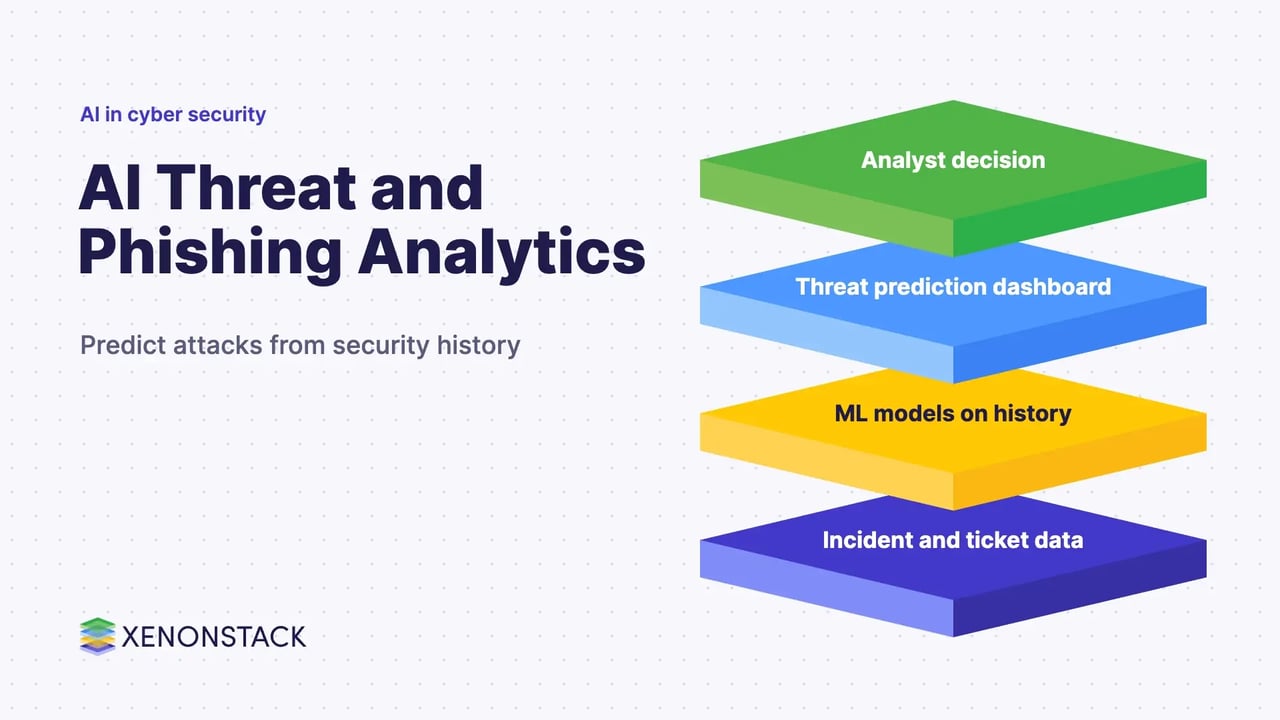
AI in cyber security analytics uses machine learning models on historical security data to track attacks, phishing attempts and user complaints, and to predict which threats are likely to come next. The results sit in a dashboard so security teams can see status at a glance.
This page is for security and risk leaders. It covers what a threat and phishing analytics model answers, how the solution works, how it compares with manual reporting, where AI agents fit and what to check before you rely on predictions. For the wider topic, read AI in cyber security.
What is AI in cyber security analytics?
Security teams and their customers want clear information about phishing attacks and complaints. They also want to know which classes of threat are most common, which sectors see the most attacks, what incidents cost and how incident numbers change from year to year. An AI and ML model learns from the organisation's historical security data and turns it into a view of current status and a prediction of what is likely next.
What problem does it solve?
Security data is spread across ticketing tools, incident logs and complaint records. Reviewing it by hand makes it slow to answer simple questions such as how many tickets are open, which attack class is growing or what last month's incidents cost. Phishing adds to the load: the CISA guidance on phishing describes it as a scam in which criminals try to trick people into opening harmful content or giving up personal information, by email, text, social media or phone. A team that can only look backwards will always respond late.
How does the solution work?
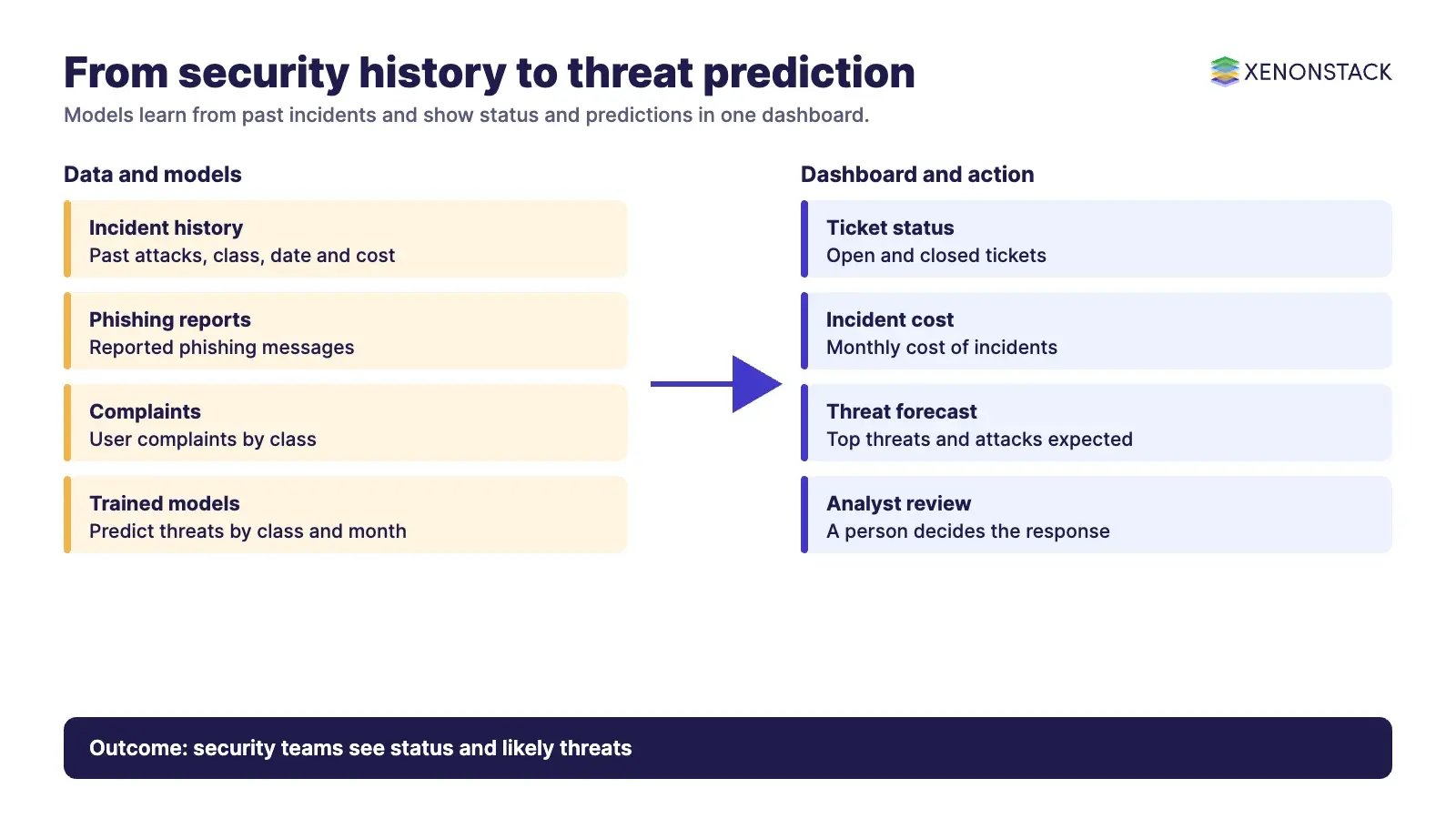
- Collect history. Gather the organisation's past incidents, phishing reports, complaints and ticket records, with their class, date and cost.
- Prepare the data. Clean and label it so that attacks and complaints can be grouped by class and subclass.
- Train the models. Build predictive models on that history so they can estimate threats by class and attacks by month.
- Serve the results. Show open and closed tickets, phishing activity, complaints and incident cost in one dashboard.
- Review and retrain. Compare predictions with what happened, and update the model as new incidents arrive.
With the right support, a team can build accurate predictive models on real-time data to better understand where complaints and attacks fall across all classes. For a demo of the approach, see the XenonStack machine learning prediction model.
What does the dashboard show?
- Threats, phishing attacks and complaints, with the cost of incidents each month
- Complaints and security incidents by quarter and by year
- Open and closed tickets for attacks and phishing attacks
- Subclasses of threat within each class
- Predictions of top threats, attacks by class and attacks expected each month
Users can see the status of all their security information in one place. Because the model learns from the organisation's own history, it gives the team an idea of where attacks have clustered before.
How does AI-driven analytics compare with manual reporting?
| Question | Manual reporting | AI and ML analytics |
|---|---|---|
| Data view | Separate tools and spreadsheets | One dashboard over historical data |
| Looking ahead | Past incidents only | Predicted threats by class and month |
| Ticket status | Compiled on request | Open and closed tickets always visible |
| Phishing tracking | Case by case | Tracked as a class with history |
| Effort to refresh | Rebuilt each period | Updated as new data arrives |
Neither replaces analysts. The model highlights where to look, and people decide what to do.
Where do AI agents fit?
An AI agent can act on what the model surfaces. It can open a ticket for a predicted spike, gather the related past incidents, check a reported message against known phishing patterns, and draft a note for the analyst who owns the case. The agent works only within permissions the security team grants, and a person approves any action that changes systems or blocks users. ElixirClaw is the AI agents computing platform from XenonStack.
What should you check before relying on predictions?
The NIST AI Risk Management Framework is voluntary guidance for managing the risks AI poses to individuals, organisations and society, and it aims to help build trustworthiness into how AI is designed, developed, used and evaluated. Apply that thinking to a security model.
- Data quality. Check that incident classes, dates and costs are recorded consistently.
- Bias in history. Attacks that were never detected are missing from the data, so predictions can understate them.
- Validation. Compare predictions with actual incidents before the team depends on them.
- Human oversight. Decide which actions an agent may take alone and which need approval.
- Access. Limit who can see incident and complaint data, and log every access.
To map one security decision your agents make, and the data and policy it depends on, book a Context Workshop. See what happens in the workshop.
Frequently asked questions
What is AI in cyber security analytics?
It uses machine learning models on historical security data to track attacks, phishing and complaints, and to predict which threats are likely to come next.
What does a cyber security AI dashboard show?
It shows threats, phishing attacks and complaints, incident cost by month, open and closed tickets, threat subclasses and predictions of attacks by class and month.
What is phishing?
CISA describes phishing as a scam in which criminals try to trick people into opening harmful content or giving up personal information, by email, text, social media or phone.
Can AI predict cyber attacks?
A model trained on an organisation's history can estimate which classes of threat are likely and when, but it only reflects what was recorded, so predictions need validation by analysts.
How do AI agents help security teams?
They can open tickets, gather related incidents, check reported messages and draft notes, while a person approves any action that changes systems.
Ready to put AI agents to work? See an ElixirClaw demo: the agentic OS to build, orchestrate and govern AI agents across your enterprise systems.
Explore the XenonStack platform family: ElixirData · ElixirClaw · ElixirHub · NexaStack · MetaSecure · Neural AI · AgentGRC · AgentSRE · AgentAnalyst · AgentInstruct · AgentRAI · AgentScrum · AgentSearch · AgentForce · AI Aviator · SAIF Aviator · CohortIQ · XenonStack AI · XenonStack UAE