Key takeaway
- Site reliability engineering explained for enterprise leaders: SLIs, SLOs, error budgets, toil limits, on-call rules, SRE vs DevOps and how to adopt SRE.
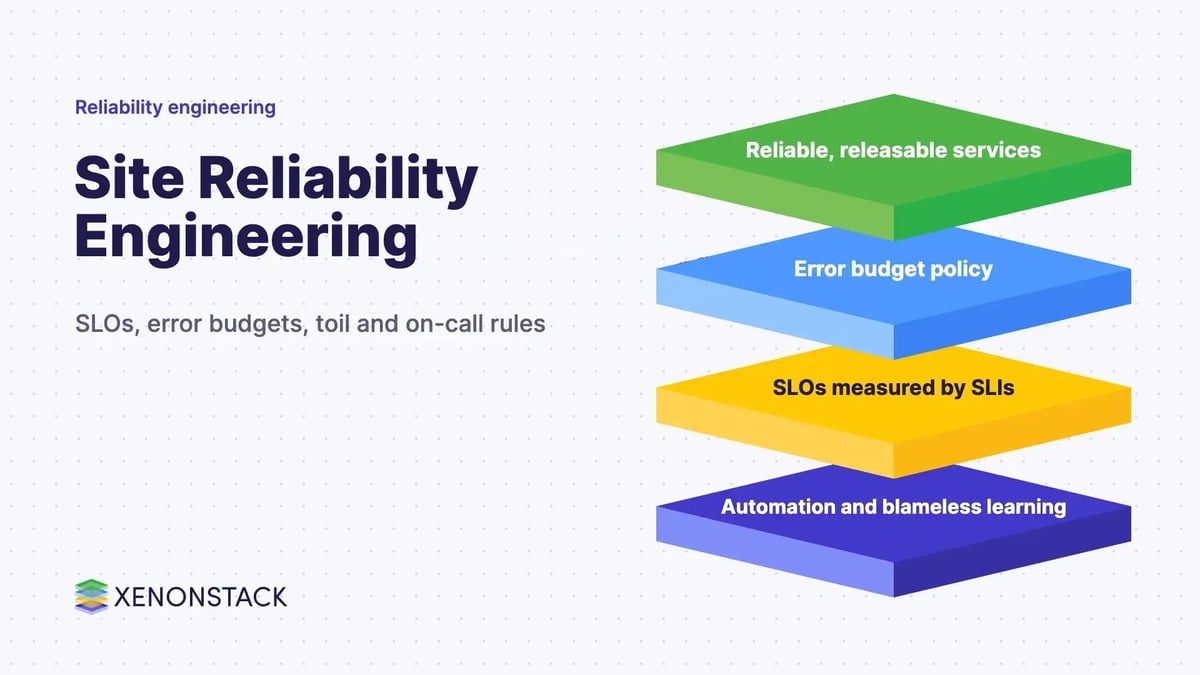
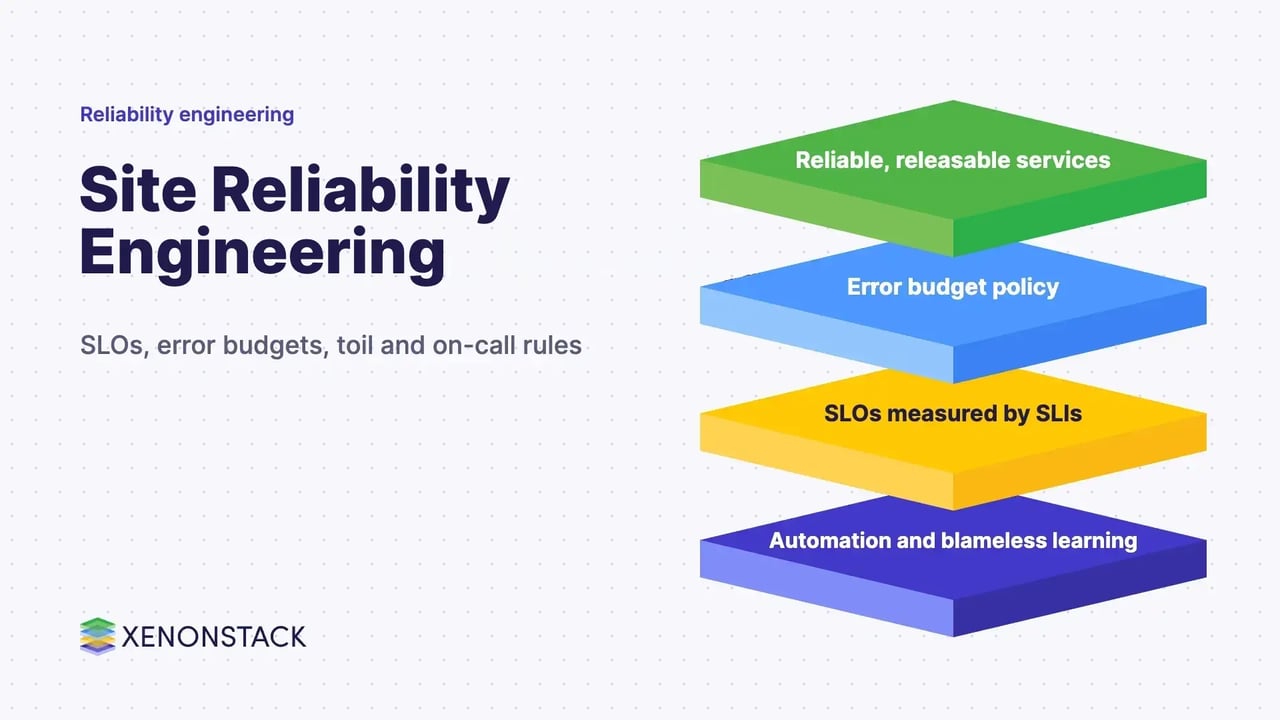
Site reliability engineering (SRE) is a way of running production services by applying software engineering to operations. SRE teams set a measurable reliability target for each service, measure it, and use the gap between target and reality to decide how fast to release and where to invest in automation. The idea comes from Google, where, in its own words, SRE is "what happens when you ask a software engineer to design an operations team" (Google SRE book, Introduction).
For enterprise leaders the practical question is how to adopt SRE without copying Google wholesale. This guide covers the vocabulary (SLIs, SLOs, SLAs, error budgets), the working rules Google publishes, the challenges teams meet, how SRE differs from DevOps (see our SRE vs DevOps comparison), and where AI agents fit when they act inside governed limits.
What is site reliability engineering and what does an SRE do?
An SRE team owns the availability, latency, performance, capacity and incident response of the services it supports. Rather than staffing operations linearly as a system grows, SREs write code to automate the work. Google describes the model as a cap on operational work: ops work (tickets, on-call, manual tasks) is held to 50% of an SRE's time, and the rest goes to development, with any excess redirected to the development teams (Introduction).
The role sits close to platform engineering and DevOps, but its defining tools are numerical: service level objectives and error budgets. Typical skills are Linux, version control, CI/CD, troubleshooting, monitoring and diagnostics, plus the non-technical ability to turn reliability trade-offs into business language.
How do SLIs, SLOs, SLAs and error budgets fit together?
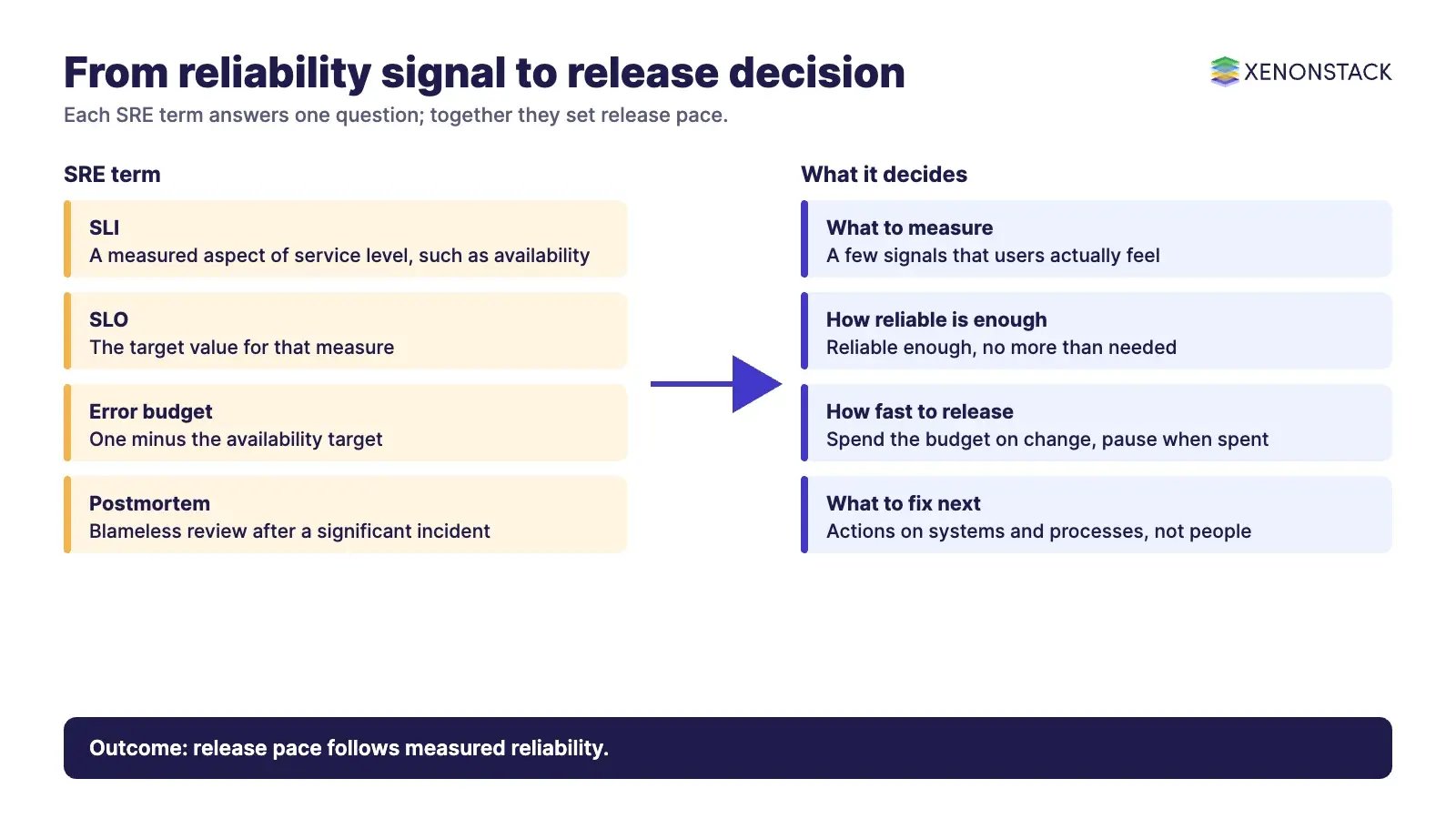
An SLI is what you measure, an SLO is the target for it, an SLA is the contract with consequences, and the error budget is the room the SLO leaves for failure. Google's definitions are in the SRE book chapter on service level objectives.
| Term | Definition (Google SRE book) | How leaders use it |
|---|---|---|
| SLI (service level indicator) | "A carefully defined quantitative measure of some aspect of the level of service that is provided." | Pick a few signals users feel, such as availability or latency. |
| SLO (service level objective) | "A target value or range of values for a service level that is measured by an SLI." | Agree the target with product owners; it sets the risk the business accepts. |
| SLA (service level agreement) | "An explicit or implicit contract with your users" that attaches consequences to meeting or missing SLOs. | A legal and commercial commitment with stated consequences. |
| Error budget | One minus the availability target. A 99.99% target leaves a 0.01% budget (Introduction). | Spend it on launches and change; slow down when it is used up. |
Google's guidance on choosing targets is worth following: do not base targets on current performance, keep SLIs simple, avoid absolute goals, use as few SLOs as possible, and start loose and tighten over time. It also states that the aim is not 100%: a service should be reliable enough, but no more reliable than it needs to be (Embracing Risk).
What working rules does Google publish for SRE teams?
Google's published rules are guidance from one very large operator, not a standard. Treat them as defaults to adapt.
| Rule | What the source says | Source |
|---|---|---|
| Limit toil | Toil is manual, repetitive, automatable, tactical, adds no enduring value and scales with service growth. The goal is to keep it below 50% of each SRE's time. | Eliminating Toil |
| Protect on-call | A maximum of two incidents per 12-hour on-call shift; at least eight engineers for single-site on-call, and a reasonable minimum of six per team for dual-site. | Being On-Call |
| Write blameless postmortems | Identify contributing causes without blaming people; define objective triggers (user-visible impact, data loss, on-call intervention, long resolution) before incidents happen. | Postmortem Culture |
| Use error budgets to govern change | Budget remaining allows launches; a depleted budget is a reason to pause risky change. | Embracing Risk |
What challenges do SRE teams face and how are they handled?
Most challenges come from scale and unclear ownership rather than from tooling gaps. The table lists the common ones and the practice that addresses each.
| Challenge | Why it happens | Practice that helps |
|---|---|---|
| Observability gaps | Microservices, hybrid cloud and multiple clusters spread signals across tools | Unified telemetry and tracing; see what is observability and cloud-native observability tools |
| Noisy alerts | Alerts fire on causes, not on user impact | Alert on SLO burn and symptoms; review and delete alerts that never lead to action |
| Toil growth | Manual steps scale with traffic and service count | Measure toil, automate the top items, keep the 50% cap visible |
| Release risk | Pressure to ship meets fear of outages | Error budgets as a shared, objective rule for release pace |
| Incident learning | Fixes are local and lessons are lost | Blameless postmortems with tracked actions; see incident management |
| Untested resilience | Failure modes are found in production | Controlled failure testing; see chaos engineering |
| Unclear metrics | Teams report uptime but not delivery health | Pair SLOs with delivery metrics; see DevOps metrics |
How does SRE differ from DevOps?
Google's SRE workbook puts it as "class SRE implements interface DevOps". DevOps is a broad philosophy and culture across the organisation. SRE is a narrower, service-oriented role with prescriptive tools such as SLOs and error budgets. Both favour small, frequent changes, collaboration, measurement and blameless postmortems. For a fuller comparison of roles, see SRE vs DevOps.
How do you adopt SRE step by step?
Google was first to adopt SRE, but its structure will not suit every organisation. Size, technology and culture decide what to copy. A sequence that works for most enterprises:
Analyse the current state. List services, incident history, on-call load and where operational work goes.
Pick one or two services. Choose services with clear users and an owner who will agree an SLO.
Define SLIs and SLOs. Start loose, measure for a quarter, then tighten.
Agree an error budget policy. Decide in advance what happens when the budget is spent.
Fix on-call and postmortems. Set incident triggers, a blameless review format and a sustainable rota.
Measure and cut toil. Track it, automate the largest items, and widen to more services.
Decide the team model. Embedded SREs, a central team or a consulting model; hire engineers who can code and train existing staff.
Which tools support site reliability engineering?
SRE does not depend on a particular product. Teams combine tools by function, and the choice should follow the SLOs you need to measure.
| Function | Examples teams commonly use | What to check |
|---|---|---|
| Source control and delivery | Git, Jenkins, CircleCI | Can you roll back quickly and trace each change? |
| Infrastructure as code | Terraform, Ansible | Is drift detected and reviewed? |
| Metrics, logs and dashboards | Grafana, Kibana | Do dashboards show SLIs, not only resource use? |
| Work and incident tracking | Jira | Are postmortem actions tracked to closure? |
How do runbook automation and AI agents help SRE teams?
Runbook automation removes repetitive steps such as service restarts or log collection, so incidents are handled consistently and engineers spend more time on engineering. Our guide to AI runbook automation covers the agentic version of this pattern, and the SRE AI agents page describes how we apply it to reliability work.
Agents add risk as well as speed, so give them the same discipline as people: defined scope, approval limits and a record of every action. ElixirClaw is an agentic OS platform to build, orchestrate and govern AI agents and automation workflows while keeping humans in control, and AgentGRC keeps autonomous agent actions inside policy, with the audit trail risk teams need. A sensible start is read-only diagnosis and drafted remediation, with a human approving anything that changes production.
When is SRE not the right move?
SRE adds cost. It is a poor fit where a service has few users and low reliability needs, where no one owns the service level, or where leaders want a rebadged operations team without time to automate. Chasing 100% is also a trap: the Google book calls it the wrong target for nearly everything, because users rarely notice the difference and cost rises steeply. Start with the services where an outage is most expensive and expand once error budgets are trusted.
To map one reliability decision your agents should make, and the context and policy it depends on, book a Context Workshop. See what happens in the workshop.
Related on XenonStack
- SRE AI agents: incident response and reliability with agents.
- Agentic ITSM: AI agents for IT service management.
- CloudOps AI agents: cloud operations run by governed agents.
Frequently Asked Questions (FAQs)
What is site reliability engineering in simple terms?
SRE applies software engineering to operations. Teams set reliability targets (SLOs), measure them with SLIs, and automate repetitive work so services stay reliable as they grow.
What is an error budget?
Per the Google SRE book, it is one minus the availability target. A 99.99% target leaves a 0.01% budget that teams can spend on change before they must slow down.
What is toil and how much is acceptable?
Toil is manual, repetitive, automatable work that adds no lasting value and grows with the service. Google's goal is to keep it below 50% of each SRE's time.
How many incidents should an on-call engineer handle?
Google's SRE book gives a maximum of two incidents per 12-hour on-call shift and a minimum of eight engineers for single-site on-call (six per team for dual-site).
How is SRE different from DevOps?
DevOps is a broad culture across the organisation; SRE is a service-oriented role with prescriptive tools such as SLOs and error budgets. Google says class SRE implements interface DevOps.
Can AI agents do SRE work safely?
They can help with diagnosis and runbook steps when scope, approval limits and audit records are defined. Start read-only and keep a human approving production changes.
Explore the XenonStack platform family: ElixirData · ElixirClaw · ElixirHub · NexaStack · MetaSecure · Neural AI · AgentGRC · AgentSRE · AgentAnalyst · AgentInstruct · AgentRAI · AgentScrum · AgentSearch · AgentForce · AI Aviator · SAIF Aviator · CohortIQ · XenonStack AI · XenonStack UAE