Key takeaway
- How ServiceNow AI agents support banking operations: platform layers, what to automate, human gates, governance and an adoption sequence for CIOs.
ServiceNow AI agents for banking are autonomous software agents that run repetitive operations work, such as onboarding, servicing and dispute handling, on the same platform that holds the bank's workflows and data. According to its site, the banking page positions Financial Services Operations for Banking as a way to "deliver frictionless onboarding and servicing on one AI platform", and describes AI agents as systems that gather data, make decisions and perform tasks.
For a CIO or head of operations the real question is not whether agents can act, but which decisions they may take, on what data, and where a person signs off. This guide maps ServiceNow's banking offer to that question, with a decision table, a governance checklist and an adoption sequence. It complements our posts on ServiceNow AI agents for IT service management and ServiceNow AI agents for autonomous operations.
What do ServiceNow AI agents do in banking operations?
According to ServiceNow's banking page, the offer spans three themes: customer experience (acquisition, onboarding and servicing), risk and compliance (ongoing risk monitoring and automated controls) and operational resilience. The page describes AI agents as "autonomous systems designed to complete repetitive work that would otherwise need to be done by a human" and names Now Assist as its generative AI offering. A generative AI assistant that summarises or drafts is one thing; an agent that carries a task through several steps is a different risk profile, and banks should treat the two differently.
The banking page lists these products for the sector: Financial Services Operations for Banking, ServiceNow Disputes Management built with Visa, Integrated Risk Management, Security Operations, IT Service Management, IT Operations Management, App Engine and Service Bridge for Financial Service Operations.
Which platform components sit under the agents?
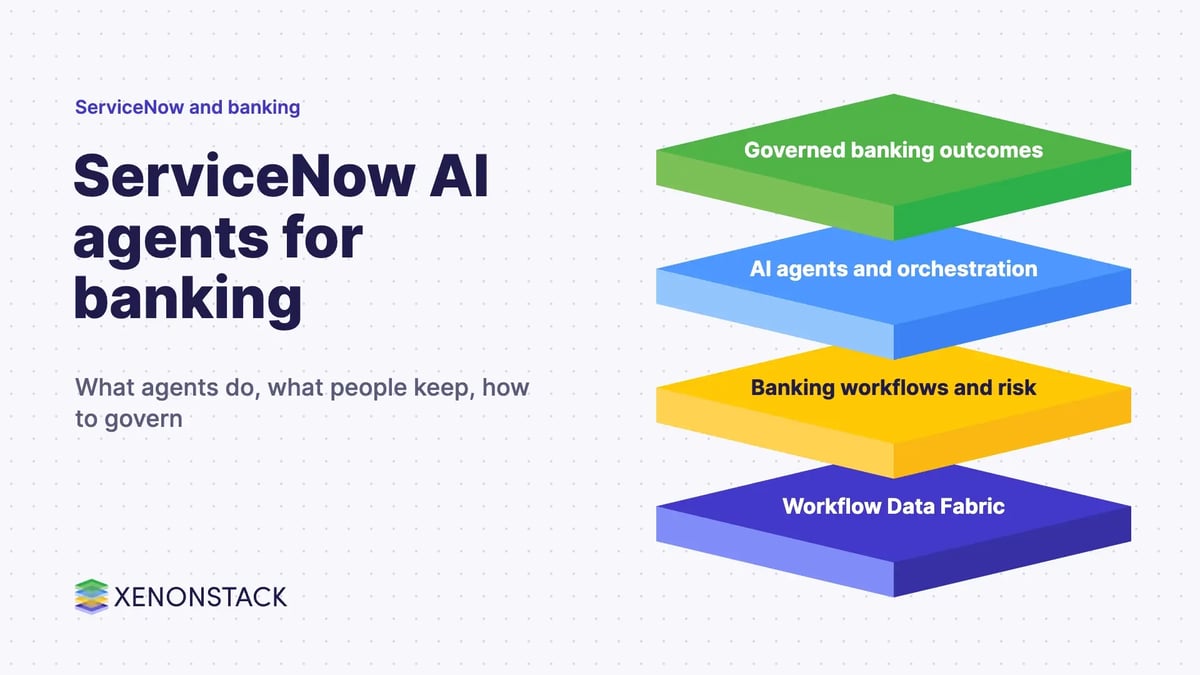
On its AI Agents page, ServiceNow describes four pieces that matter to an architect. AI Agent Studio lets teams build and customise agents. The AI Agent Orchestrator "coordinates collaboration among teams of AI agents to successfully achieve specific goals". Workflow Data Fabric gives workflows, AI and analytics live access to information from many sources. Super Intelligence Control Tower is positioned as a central hub to "manage, monitor, and optimize any AI".
For a bank, the useful design test is simple: every agent should have a named owner, a defined data scope and a place where its actions are monitored. The Control Tower and the platform's risk products are where ServiceNow places that oversight. Our agentic workflows guide covers the wider design pattern.
Which banking operations problems fit an agent, and what should a person keep?
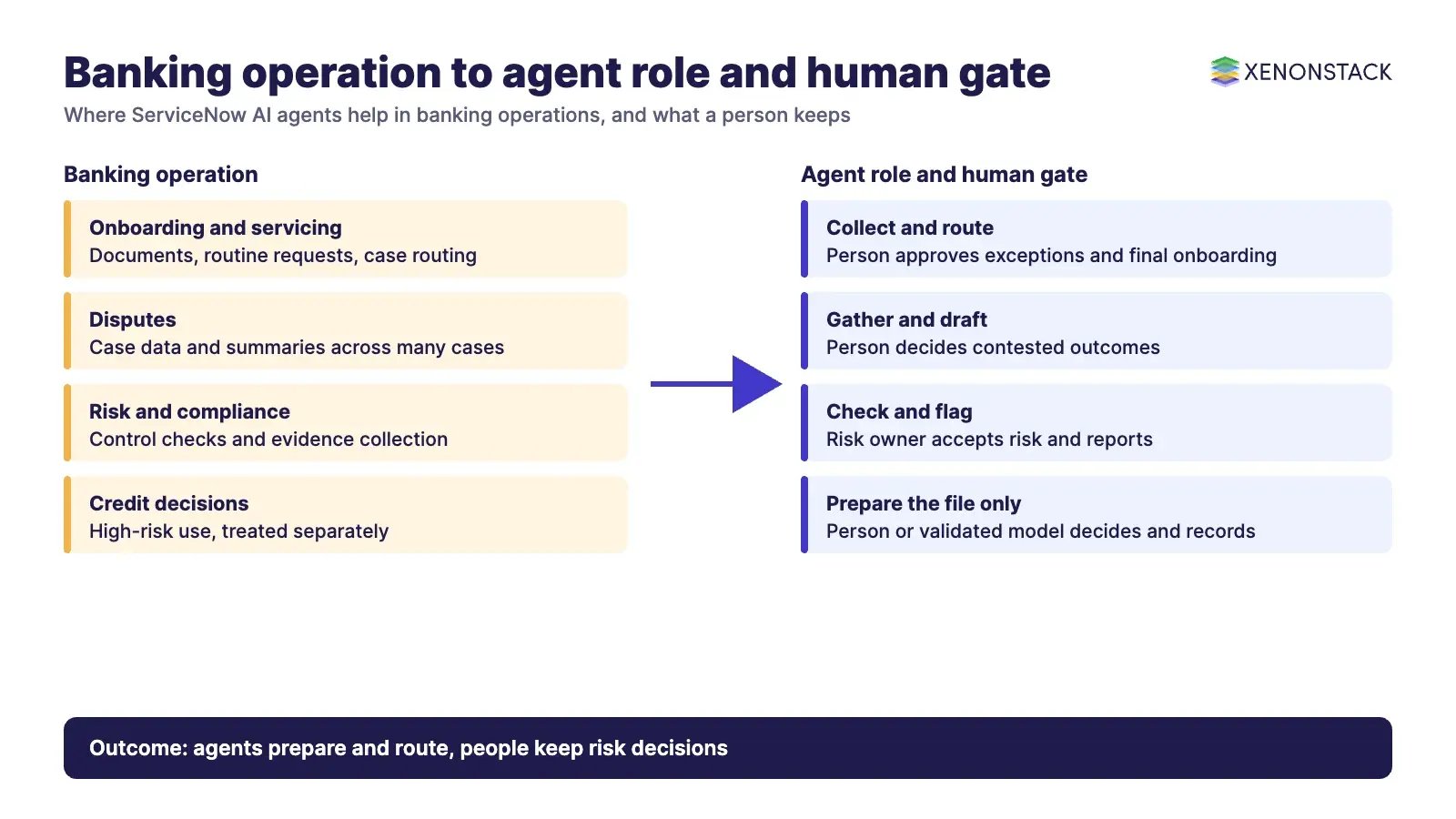
The table below combines what ServiceNow says on its banking page with a practical split of work. The last column is our recommendation, not a ServiceNow claim.
| Operations area | What ServiceNow says (according to its site) | Where an agent fits | What a person keeps |
|---|---|---|---|
| Onboarding and servicing | Financial Services Operations for Banking: frictionless onboarding and servicing on one AI platform | Collecting documents, answering routine requests, routing cases | Exceptions, vulnerable-customer handling, final onboarding approval |
| Disputes | ServiceNow Disputes Management, built with Visa, to speed dispute resolution and support cardholder experiences | Gathering case data, drafting summaries, routing | Outcome decisions and customer communication on contested cases |
| Risk and compliance | Integrated Risk Management to support governance, risk and compliance; ongoing monitoring and automated controls | Control checks, evidence collection, issue routing | Risk acceptance, regulator-facing reporting |
| Operational resilience | Manage disruption with fewer resources and lower operating cost | Incident triage and change impact using IT operations workflows | Major incident calls, high-risk changes |
| Employee and IT requests | Agents for IT and employee experience use cases on the AI Agents page | Request fulfilment, policy and benefits questions | Access to sensitive systems, policy exceptions |
What have banks reported from ServiceNow deployments?
ServiceNow's banking page carries customer stories. According to its site, BMO reports a "200% year-over-year increase in self-service", and Jefferies reports "90% faster resolution of high-risk exceptions" and "95% faster audit response" while preparing for T+1 trade processing. These are vendor-published results from named customers; your own baseline, data quality and process design will decide whether you see anything similar, so measure before and after on one process.
Should AI agents make credit decisions?
Treat credit decisions as a separate, higher-risk class of work. The European Commission AI Act page lists AI used to give access to essential services as high risk and gives credit scoring that denies a citizen a loan as an example. The same page says the Annex III high-risk use cases have been extended to 2 December 2027 under the AI Omnibus. Dates and scope can change and this is not legal advice, so confirm with counsel and your regulator.
A sound pattern is to let agents prepare the file (collect data, check completeness, summarise) while a trained person or a validated decision model, under your model risk process, makes and records the decision. Alternative data such as social media or mobile behaviour needs particular care for fairness and consent, and nothing in the platform removes the need to test for bias.
How do you govern, secure and cost banking agents?
ServiceNow points to its responsible AI commitments and to Integrated Risk Management for governance, risk and compliance workflows. Beyond the platform, banks usually need an independent record of what each agent decided and why. A decision layer such as ElixirData Context OS, which keeps governed context, versioned policy and decision traces in one decision layer above AI agents, can sit alongside the platform for that purpose, and AgentGRC keeps autonomous agent actions inside policy, with the audit trail risk teams need.
| Control | What to check | Owner |
|---|---|---|
| Agent scope | Which systems, data and actions each agent may use; least privilege | Platform owner and CISO |
| Human gates | Which actions need approval before they run | Process owner and risk |
| Audit trail | Who or what acted, on which data, under which policy version | Internal audit |
| Monitoring | Central view of agent behaviour, failures and overrides | Operations |
| Cost | Licence and usage by process, compared with a measured baseline | Finance and CIO |
For approvals in finance workflows, the Approval Agent on ElixirData signs off requests that meet policy, routes exceptions to the right approver and records each decision's reasoning, according to its page. See also our guide to agentic AI risk management.
What is a sensible adoption sequence?
- Pick one high-volume, low-risk process, such as a request or case type with clear rules.
- Measure the current handling time, error rate and rework before changing anything.
- Connect the data the agent needs and set its scope, owner and approval points.
- Run it in assist mode, where a person approves each action, and review overrides weekly.
- Widen autonomy only for the steps where overrides are rare, and keep decisions that affect customers' credit, money or rights with a person.
- Add the next process, reusing the controls and traces from the first.
When is this the wrong approach?
Agents add little where the process itself is unclear, where source data is unreliable, or where each case is rare and judgement-heavy. In those cases fix the process and data first. Banks already standardised on another platform for case management should also weigh integration effort against the benefit of one platform. For the employee side of the same platform, see ServiceNow AI agents for HR service delivery and ServiceNow AI agents on user experience.
To map one banking decision your agents should make, and the context and policy it depends on, book a Context Workshop. See what happens in the workshop. If you are building agent teams across functions, ElixirClaw is an agentic OS platform to build, orchestrate and govern AI agents and automation workflows while keeping humans in control.
Frequently asked questions
What are ServiceNow AI agents for banking?
According to ServiceNow's banking page, AI agents are autonomous systems designed to complete repetitive work that would otherwise need to be done by a human. In banking they support onboarding, servicing, disputes, risk and operations workflows on the ServiceNow AI Platform.
Which ServiceNow products does the banking page list?
It lists Financial Services Operations for Banking, ServiceNow Disputes Management built with Visa, Integrated Risk Management, Security Operations, IT Service Management, IT Operations Management, App Engine and Service Bridge for Financial Service Operations.
Can AI agents approve loans on their own?
Credit decisions are a high-risk area. The European Commission's AI Act page gives credit scoring that denies a loan as a high-risk example. Keep the decision with a person or a validated model under your model risk process, and take legal advice on your obligations.
How should banks govern AI agents?
Give each agent an owner, a data scope and approval points, monitor behaviour centrally and keep an audit trail of actions and the policy applied. ServiceNow positions its Control Tower and Integrated Risk Management for oversight.
What results has ServiceNow published for banks?
According to its banking page, BMO reports a 200% year-over-year increase in self-service, and Jefferies reports 90% faster resolution of high-risk exceptions and 95% faster audit response. These are vendor-published customer results.
Explore the XenonStack platform family: ElixirData · ElixirClaw · ElixirHub · NexaStack · MetaSecure · Neural AI · AgentGRC · AgentSRE · AgentAnalyst · AgentInstruct · AgentRAI · AgentScrum · AgentSearch · AgentForce · AI Aviator · SAIF Aviator · CohortIQ · XenonStack AI · XenonStack UAE