Key takeaway
- How ServiceNow AI agents and Virtual Agent shape user experience: what the vendor says, design choices, trade-offs, governance and an adoption sequence.
How do ServiceNow AI agents change user experience?
ServiceNow AI agents change user experience by moving the first response from a ticket form to a conversation, and by letting agents take actions behind that conversation. According to its site, an AI agent "can make decisions, take actions, and interact with their environment without continuous human intervention", and the ServiceNow AI Agents page lists IT, customer service and HR as places where agents streamline incident management, request fulfilment and enquiries. The ServiceNow Virtual Agent page describes a conversational chatbot for employees and customers with a hand-off that passes chat history and context to a live agent.
For a CIO or platform lead the useful question is not whether the chat feels modern. It is which requests the agent may close on its own, which it must pass to a person, and what evidence you keep. This guide covers what the vendor says, where user experience gains come from, the trade-offs, and an adoption sequence. It pairs with our posts on ServiceNow AI agents for IT service management and building a governed knowledge base, because answer quality depends on the knowledge behind the agent.
What does ServiceNow say its AI agents and Virtual Agent do?
The table below lists only claims from ServiceNow's own pages, read on 12 November 2026. We state no performance figures because neither page gives any.
| Capability | What the page says (according to its site) | Why it matters for user experience |
|---|---|---|
| AI agents | Plan tasks within an agentic workflow, gather data, reason, then act using scripts, flows and generative AI skills; monitor results and refine over time | Users get an outcome, not a list of articles |
| AI Agent Orchestrator | Coordinates collaboration among teams of AI agents towards specific goals | One request can span several steps without the user chasing each one |
| AI Agent Studio | Build and customise agents with a natural language interface, with guardrails set in that environment | Teams shape agent behaviour to their own policies |
| Super Intelligence Control Tower | A central hub to manage, monitor and optimise AI across the enterprise; agents are described as secured and governed by it | Gives owners one place to review what agents do |
| Virtual Agent | Conversational AI for employees and customers; users reach it in portals and apps such as Slack and Microsoft Teams; phone requests can be transcribed and resolved | Help appears where people already work |
| Hand-off to a live agent | Chat history and context transfer to staff for faster resolution | The user does not repeat the problem |
| Generative AI answers | Multi-turn conversations, synthesised responses and multiple languages; powered by ServiceNow Otto | Natural questions get direct answers |
ServiceNow also lists Brazil as its current release, with Australia, Zurich and Yokohama before it. Confirm which release your instance runs before you plan features, because the ServiceNow AI Agents page describes the latest platform.
Where do the user experience gains come from?
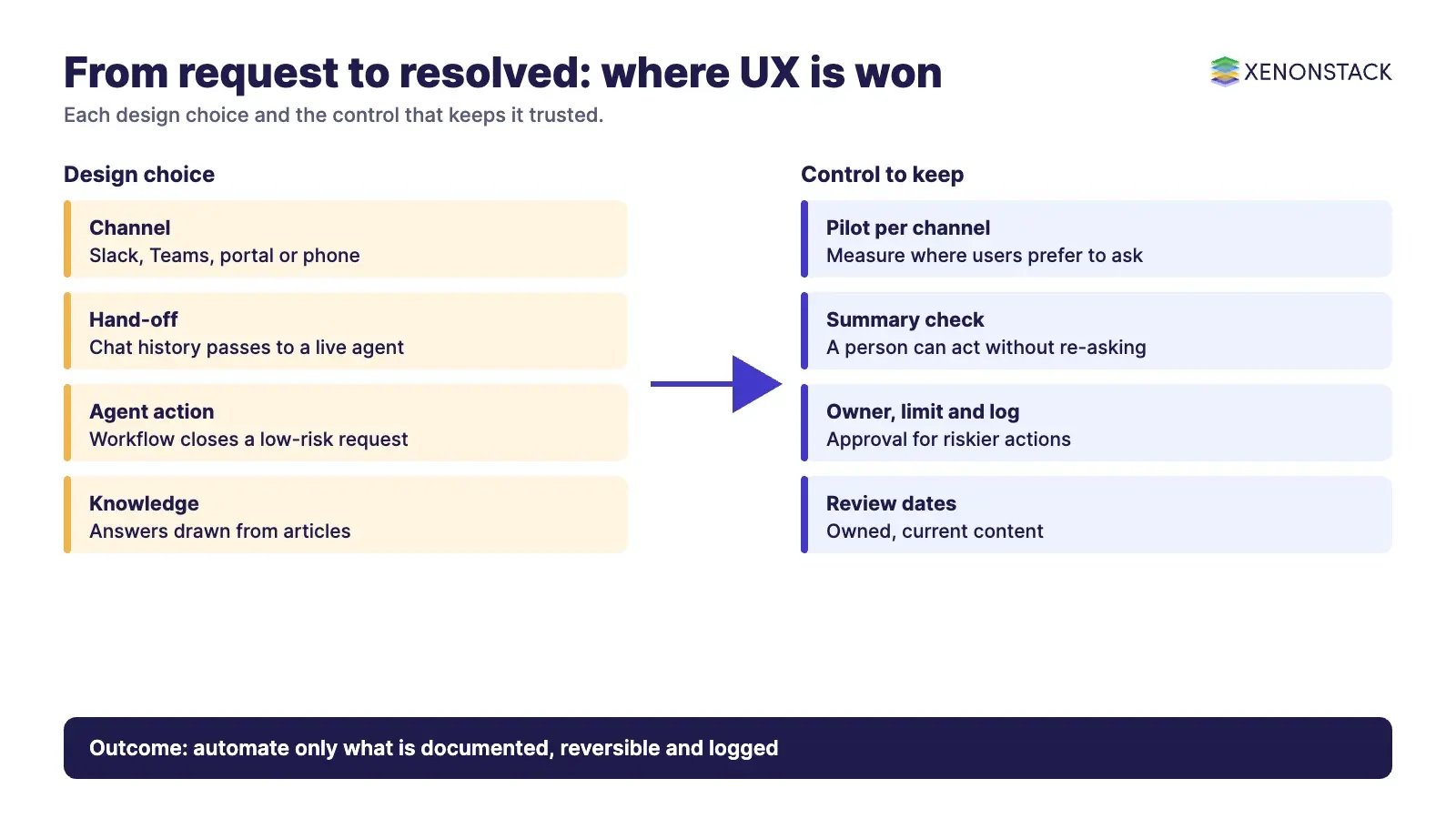
Most gains come from four design choices rather than from the model itself. They are worth testing one at a time.
Answers in the channel people already use
Employees ask in Slack, Microsoft Teams, a portal or by phone, and the vendor says Virtual Agent supports those channels. Measure which channel your users prefer before you invest in all of them.
Context that survives the hand-off
A person who has already explained the issue to a bot should not explain it again. The vendor describes transferring chat history and context to agents. Check in a pilot that the summary a human sees is complete enough to act on.
Agents that finish the job
Question answering is only part of the experience. ServiceNow says users can trigger automated workflows performed by AI agents from Virtual Agent. Each workflow that an agent can close, such as a request or a status update, removes a wait. Each one also needs an owner, a permission boundary and a log.
Knowledge the agent can trust
A fluent answer from stale content is a worse experience than a ticket. Keep articles owned, reviewed and linked to incidents, as covered in knowledge management with Now Assist and knowledge bases in managed services.
Which user experience should you design for each audience?
| Audience | Typical request | Agent role to consider | Keep a human for |
|---|---|---|---|
| Employees (IT) | Access, device and incident help | Triage, answer, update tickets; see IT service management agents | Changes with business risk |
| Employees (HR) | Policies, benefits, HR requests | Answer and submit requests; see HR service delivery | Sensitive or personal cases |
| Customers | Routine enquiries and processes | Handle routine requests, escalate complex ones | Complaints, disputes, exceptions |
| Security teams | Alerts and response | Assist analysts; see autonomous security operations | Containment and approvals |
What are the trade-offs, and when should you not automate?
Agents are a poor fit where the knowledge base is thin, where permissions are unclear, or where an error would harm a customer or an employee before anyone can intervene. A conversational front end can also hide failure: users may stop using a channel that gives wrong answers without telling you. Track hand-off rate, repeat contacts and user feedback, not only deflection.
| Decision | Choose | Avoid when |
|---|---|---|
| Let an agent resolve a request end to end | Low-risk, well-documented, reversible requests | Money, access or personal data is involved without approval |
| Add a new channel | Users already work there | You cannot staff the hand-off |
| Use generative answers | Content is current and owned | Articles are duplicated or outdated |
How do you govern agents so the experience stays trusted?
ServiceNow places governance in its Control Tower and sets guardrails in AI Agent Studio, according to its site. Whatever platform you use, decide four things before launch: the actions each agent may take, who approves exceptions, how decisions are logged, and how you review failures. A governed context layer such as ElixirData Context OS keeps governed context, versioned policy and decision traces in one decision layer above AI agents, and ElixirClaw is an agentic OS platform to build, orchestrate and govern AI agents and automation workflows while keeping humans in control. For knowledge retrieval across unstructured content, AgentSearch describes itself as context-aware enterprise search across unstructured knowledge bases. See also our guide to generative AI for the enterprise and our ServiceNow services.
What is a sensible adoption sequence?
Audit knowledge. Fix the top request categories, owners and review dates first.
Start with answers and summaries. Pilot one channel and one audience, with a visible route to a person.
Add actions. Allow agents to close low-risk requests, each with a log and an owner.
Measure and widen. Review hand-offs, repeat contacts and user feedback before adding channels or agents.
To map one service request your agents should handle, and the context and policy it depends on, book a Context Workshop. See what happens in the workshop.
FAQ
Is Virtual Agent the same as ServiceNow AI agents?
No. According to ServiceNow, Virtual Agent is a conversational chatbot, and users can trigger automated workflows performed by AI agents through it. AI agents are described separately as acting to get work done.
Which channels does ServiceNow Virtual Agent support?
According to its site, users can reach it in collaboration tools, portals and apps such as Slack and Microsoft Teams, and phone requests can be understood, transcribed and resolved.
What happens when the bot cannot resolve a request?
ServiceNow says chat history and context are transferred to live agents for faster resolution. Test in a pilot that the summary is complete.
How are ServiceNow AI agents governed?
The vendor describes guardrails set in AI Agent Studio and a Super Intelligence Control Tower for managing and monitoring AI across the enterprise.
Does ServiceNow publish resolution or cost figures for these agents?
Neither the AI agents page nor the Virtual Agent page we read on 12 November 2026 states performance figures, so measure results in your own pilot.
Where should we start?
With knowledge quality and one audience. Add actions only after answers are accurate and hand-offs work.
Follow XenonStack on LinkedIn: XenonStack on LinkedIn for new guides on agentic AI, data and platform engineering.
Explore the XenonStack platform family: ElixirData · ElixirClaw · ElixirHub · NexaStack · MetaSecure · Neural AI · AgentGRC · AgentSRE · AgentAnalyst · AgentInstruct · AgentRAI · AgentScrum · AgentSearch · AgentForce · AI Aviator · SAIF Aviator · CohortIQ · XenonStack AI · XenonStack UAE