Key takeaway
- Legacy application modernization explained: the seven migration strategies, the strangler fig approach, how to pick a partner, and where AI agents help.
Legacy application modernization is the process of updating or replacing ageing software so it can run on current platforms, change faster and be maintained at reasonable cost. It ranges from moving an application unchanged to a new host, through to re-architecting it as microservices on cloud-native foundations.
This guide is for IT and business leaders at SMEs, startups and enterprises who need to decide how to modernise and who should help. It covers the main strategies, the incremental approach, what to ask a modernisation partner, and how AI agents change the work. XenonStack works on application modernisation, and the choice of approach matters more than the choice of vendor.
Why do legacy applications hold organisations back?
Applications that once ran the business can struggle with scalability, security exposure and rising maintenance cost, which makes it harder to change them when the business changes. The aim of modernisation is not newer technology for its own sake. Set business objectives and measures first, then choose the technical route that serves them.
What are the main legacy modernization strategies?
The AWS Prescriptive Guidance migration strategies page lists seven options, often called the 7 Rs. Each application can take a different route.
| Strategy | What it means (AWS wording) | Fits when |
|---|---|---|
| Retire | Decommission or archive the application | Nobody needs it any more |
| Retain | Keep it in the source environment, or you are "not ready to migrate" | Risk or cost of moving is too high for now |
| Rehost | Move it to the cloud "without making any changes" (lift and shift) | You need speed and will optimise later |
| Relocate | Transfer many servers at once from an on-premises platform to a cloud version of the platform | The platform has a cloud equivalent |
| Repurchase | Replace it with a different version or product (drop and shop) | A packaged product meets the need |
| Replatform | Move it and introduce some optimisation to run efficiently or use cloud capabilities (lift, tinker and shift) | Small changes bring real benefit |
| Refactor or re-architect | Modify the architecture to take full advantage of cloud-native features | The business needs agility and scale |
Choosing among these is a portfolio decision. Our guide to application modernization strategy goes deeper.
Why modernise gradually instead of rewriting?
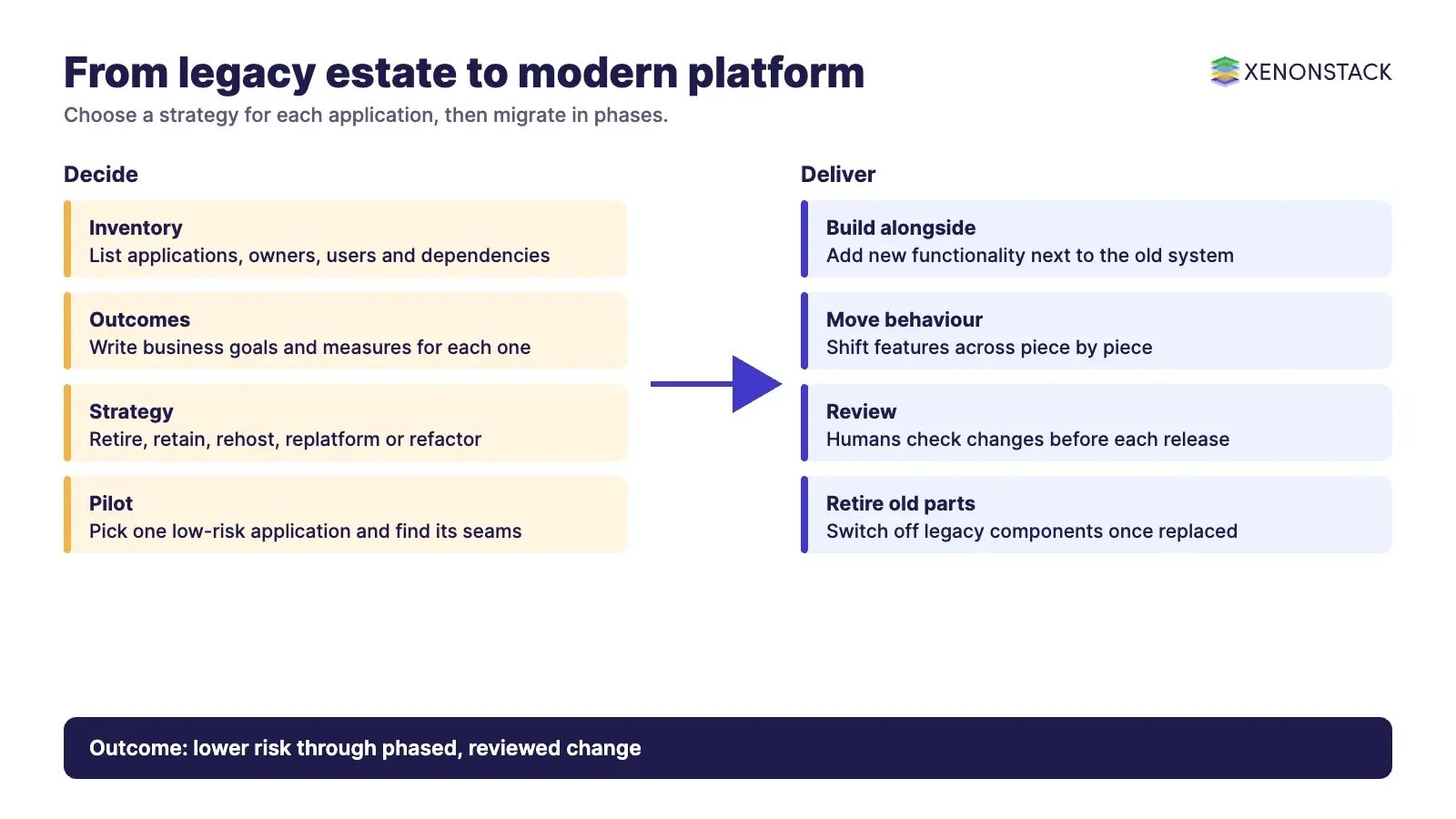
Martin Fowler describes the strangler fig pattern as a gradual approach to legacy modernization. Teams build new functionality alongside the old system, find "seams" where components can be replaced independently, and move behaviour across piece by piece. Of a full replacement, he writes that "we've seen this simple-sounding plan go down in flames most of the time". The cost of the gradual route is temporary transitional architecture so old and new can coexist, which he considers worth paying.
This matches four practical principles: define business outcomes and KPIs first, align the work with the wider digital strategy, deliver in phases, and prepare the organisation for data-driven decisions and closer work between IT and business teams.
What do modernisation services include?
| Service area | Typical activities |
|---|---|
| Strategy and consulting | Roadmap aligned to business goals, risk assessment and return analysis |
| Architecture modernisation | Microservices and API-based re-engineering, cloud-native and serverless designs |
| Platform and tooling | Container platforms based on Kubernetes, data pipelines and machine learning tooling |
| Security and compliance | Threat detection, access control and mapping to the compliance frameworks that apply to you |
| Managed services | Performance monitoring, continuous integration updates and ongoing optimisation |
How do you choose a modernisation partner?
Rankings of vendors age quickly and say little about your systems, so judge partners on evidence you can check.
| Criterion | What to ask for |
|---|---|
| Industry experience | Work on systems like yours, and references you can speak to |
| Scalability and flexibility | How the proposed design handles growth and change |
| Security and compliance | Current attestations and how controls are tested |
| Delivery approach | Phased plan, exit points and how old and new systems coexist |
| Support and training | Handover, documentation and how your team learns the system |
| Cost and return | A costed plan with assumptions you can test against your own baseline |
How do AI agents change legacy modernization?
Agents can read old code and documentation, map dependencies, draft tests that capture current behaviour, propose refactoring steps and monitor the new system after each release. They do not remove the need for human review, because behaviour that looks unwanted may be relied on by a user or a regulator. Give each agent a narrow task, keep a record of what it changed and why, and review before release. ElixirClaw is XenonStack's AI agents computing platform for building and running such agents.
What should you do first?
- Inventory your applications and note owner, users, age and dependencies.
- Write the business outcome and measures for each one.
- Assign each application a strategy from the table above.
- Pick one low-risk application as a pilot and define its seams.
- Set review points before you commit to the full programme.
To map one decision your agents make, and the data and policy it depends on, book a Context Workshop. See what happens in the workshop.
Frequently asked questions
What is legacy application modernization?
It is updating or replacing ageing software so it can run on current platforms, change faster and be maintained at reasonable cost.
What is the difference between rehosting and refactoring?
Rehosting moves an application to the cloud without changes, while refactoring modifies its architecture to take full advantage of cloud-native features.
What is the strangler fig pattern?
It is a gradual approach where new functionality is built alongside the legacy system and behaviour is moved across piece by piece until the old system can be retired.
How do I choose a modernization partner?
Judge partners on relevant experience, a phased delivery plan, security evidence, handover and a costed plan you can test, rather than on vendor rankings.
Can AI agents modernize legacy code on their own?
Agents can speed up analysis, testing and refactoring suggestions, but humans should review changes because existing behaviour may be relied on.
Follow XenonStack on LinkedIn: XenonStack on LinkedIn for new guides on agentic AI, data and platform engineering.
Ready to put AI agents to work? Explore ElixirClaw, the agentic OS platform to build, orchestrate and govern AI agents.
Explore the XenonStack platform family: ElixirData · ElixirClaw · ElixirHub · NexaStack · MetaSecure · Neural AI · AgentGRC · AgentSRE · AgentAnalyst · AgentInstruct · AgentRAI · AgentScrum · AgentSearch · AgentForce · AI Aviator · SAIF Aviator · CohortIQ · XenonStack AI · XenonStack UAE