

Key takeaway
- Generative AI in legal work: research, drafting, contract review and eDiscovery, plus ABA Opinion 512, the EU AI Act and the controls firms need.
Generative AI in legal work means using large language models to research, summarise, draft and review legal content, with a lawyer verifying every output before it is relied on. The fastest adoption is in legal research, contract review, document summaries and eDiscovery, where the work is text-heavy and repetitive. The main risks are fabricated citations, confidentiality breaches and over-reliance, and professional rules already apply to all three.
This guide covers where generative AI helps legal teams today, what the ABA and the EU AI Act expect, and how to build a workflow that partners and general counsel can defend.
Where is generative AI used in legal work today?
| Use case | What the AI does | What the lawyer still owns |
|---|---|---|
| Legal research | Finds and summarises cases, statutes and commentary from a defined corpus | Checking every authority exists and says what is claimed |
| Contract review | Extracts clauses, flags deviations from the playbook and suggests redlines | Risk judgement and negotiation position |
| Drafting | Produces first drafts of letters, memos, clauses and briefs | Accuracy, tone and strategy of the final text |
| eDiscovery and investigations | Classifies and summarises large document sets | Privilege calls and defensible review method |
| Knowledge management | Answers questions from precedents and internal know-how | Keeping precedents current and approved |
| Compliance monitoring | Tracks regulatory change and maps it to policies | Interpretation and remediation decisions |
In-house teams and firms use specialist legal platforms as well as general assistants. For examples, see our guides to agentic AI in law firms, legal research with AI agents and legal services with Microsoft Copilot.
How does a governed legal AI workflow run?
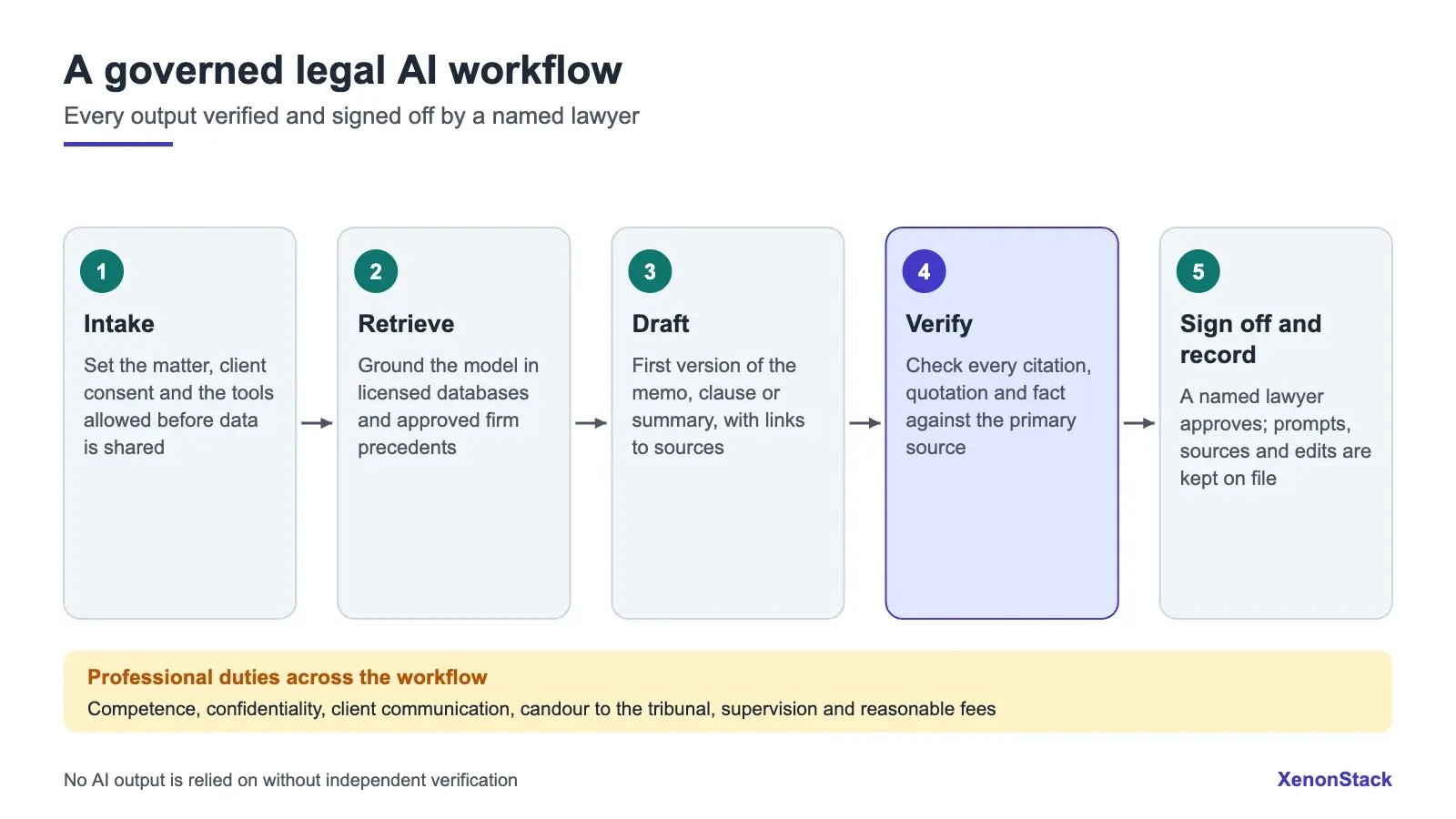
- Intake: the matter, client and permitted tools are set before any data is shared.
- Retrieve: the model works from approved sources such as the firm's precedents and licensed databases, not the open web.
- Draft: the AI produces a first version with links to the sources it used.
- Verify: every citation, quotation and fact is checked against the source.
- Sign off and record: a named lawyer approves the output, and the prompt, sources and changes are kept for the file.
What do the professional rules say about generative AI?
On 29 July 2024 the American Bar Association issued Formal Opinion 512, Generative Artificial Intelligence Tools. It applies the existing Model Rules rather than creating new ones, and covers competence, confidentiality, communication with clients, candour to the tribunal, supervision and fees. Its central point is that lawyers must not rely on AI output without an appropriate degree of independent verification.
Courts have already sanctioned lawyers who filed briefs containing citations invented by a chatbot, starting with Mata v. Avianca in New York in 2023. Many courts now require lawyers to disclose or certify the use of AI in filings.
In the European Union, the AI Act (Regulation (EU) 2024/1689) lists AI systems intended to help a judicial authority research and interpret facts and the law, and apply the law to facts, as high-risk in Annex III. Tools used by courts or on their behalf therefore carry obligations on risk management, data governance, human oversight and logging.
What are the main risks of generative AI for legal teams?
- Fabricated authority: a model can invent cases or misstate holdings with complete confidence.
- Confidentiality: client data pasted into a consumer tool may be stored or used outside the firm's control.
- Privilege and waiver: careless sharing with third-party services can put privilege at risk.
- Bias and stale law: models trained on older or unbalanced material may miss recent changes.
- Billing: fees must reflect the work actually done, a point Opinion 512 addresses directly.
- Accountability gaps: without records, a firm cannot show who checked what before advice went out.
How should legal teams govern generative AI?
- Approve a short list of tools, with contracts that rule out training on client data.
- Ground research and drafting in licensed databases and the firm's own precedents.
- Make citation and fact checking a mandatory step, with a named reviewer.
- Tell clients how AI is used on their matters and obtain consent where the rules require it.
- Keep a record of prompts, sources, outputs and approvals for each matter.
- Train lawyers and staff, and review the policy as rules and tools change.
Our guide to agentic AI governance and compliance covers the wider control framework.
Where does XenonStack fit in legal AI?
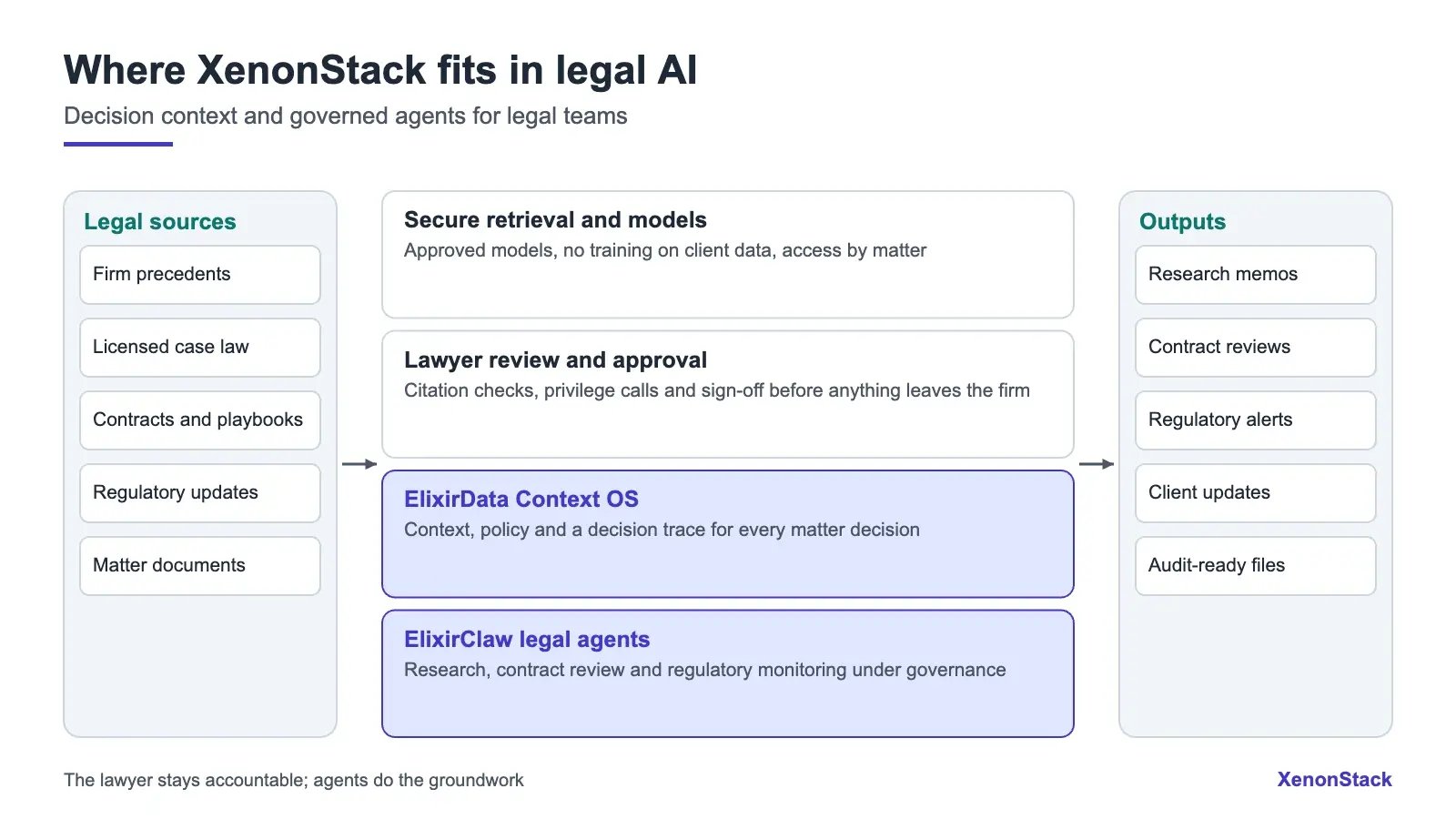
Legal work is a chain of decisions: which clause to accept, which authority to rely on, what to tell the client. ElixirData Context OS captures the context and policy behind each of those decisions and keeps a decision trace for the matter file. ElixirClaw runs governed legal agents for research, contract review and regulatory monitoring, with a lawyer approving anything that leaves the firm.
To map one legal decision your agents should support, and the context and policy it depends on, book a Context Workshop. See what happens in the workshop.
Frequently asked questions
Can lawyers use generative AI ethically?
Yes, provided they understand the tool, protect client confidentiality, verify every output, communicate with clients about its use where required and charge reasonable fees. ABA Formal Opinion 512 sets out these duties under the existing Model Rules.
Will generative AI replace lawyers?
No. It automates first drafts, summaries and document review, but legal judgement, advocacy, negotiation and accountability to the client and the court stay with lawyers.
What is the biggest risk of using ChatGPT for legal research?
Fabricated or misstated authorities. General-purpose chatbots can invent cases that look real, so every citation must be checked against a primary source before it is relied on or filed.
Is legal AI high-risk under the EU AI Act?
AI systems intended to be used by or on behalf of a judicial authority to research and interpret facts and law, and apply the law to facts, are listed as high-risk in Annex III of the EU AI Act. Many law-firm productivity tools fall outside that category but still need sound governance.
How do law firms keep client data safe with AI tools?
They approve specific tools, sign contracts that prohibit training on client data, restrict which matters and documents can be shared, use enterprise deployments with access controls and keep audit records of use.
Follow XenonStack on LinkedIn: XenonStack on LinkedIn for new guides on agentic AI, data and platform engineering.
Explore the XenonStack platform family: ElixirData · ElixirClaw · ElixirHub · NexaStack · MetaSecure · Neural AI · AgentGRC · AgentSRE · AgentAnalyst · AgentInstruct · AgentRAI · AgentScrum · AgentSearch · AgentForce · AI Aviator · SAIF Aviator · CohortIQ · XenonStack AI · XenonStack UAE








