Key takeaway
- Agentic AI in law firms: where agents help legal workflows, what ABA, SRA and UK courts expect, and the controls that keep lawyers accountable.
Agentic AI in a law firm or legal department means software agents that take a legal task from intake to a reviewable draft, using the firm's own matter files, research sources and policies, while a named lawyer approves anything that leaves the building. It differs from a template tool or a chatbot because an agent plans steps, calls tools and passes work between specialist agents, in the way described in our guide to AI agents and to agentic workflows.
The decision for a managing partner, general counsel or CIO is not whether agents can draft a clause or summarise a case file. It is where an agent may act on its own, where a lawyer must approve, and what evidence the firm keeps. Regulators and courts have already said that responsibility stays with the lawyer, so the controls matter as much as the model. This article is a technology guide and not legal advice.
What do AI agents do in legal work, and what stays with the lawyer?
Most legal work is a chain of document-heavy steps: intake, research, review, drafting, compliance checks and client updates. Agents fit the repeatable steps in that chain. The table sets out where an agent can do the first pass and where a lawyer must decide. The split is a working pattern for design, not a regulatory rule.
| Legal workflow | What an agent can do | What the lawyer decides | Main risk to control |
| Client and matter intake | Collect facts and documents, check for missing information, route to the right team | Whether to accept the matter and the conflict position | Client data held in the wrong place |
| Legal research | Search firm-approved sources, summarise authorities, list the citations used | Whether each authority exists, applies and is current | Fabricated or misdescribed citations |
| Contract and document review | Tag clauses, flag missing or unusual terms against a playbook, suggest wording | Which flags matter and what is sent to the counterparty | Missed clauses; over-reliance on the first pass |
| Compliance and regulatory monitoring | Track named sources for changes and map them to internal policies | What a change means for the client or the firm | Alerts without an owner |
| eDiscovery and litigation support | Prioritise documents for review, build timelines from matter files | What is relevant, privileged or disclosed | Privilege errors; unexplained rankings |
| Matter reporting | Pull turnaround, workload and spend figures from systems of record | What the figures mean and what changes | Wrong source data |
How is agentic AI different from existing legal technology?
Law firms already run document automation, research platforms, eDiscovery tools, contract lifecycle management (CLM) systems and regulatory monitoring. Agents do not replace these systems of record. They sit above them and coordinate work across them. The table shows the relationship.
| Existing tool category | What it does well | What an agent layer adds | When to keep the tool alone |
| Document automation | Fills approved templates from structured inputs | Chooses the template, gathers inputs from the matter file and asks for missing facts | Standard documents with fixed inputs |
| Legal research platforms | Authoritative search over statutes and case law | Runs several searches, drafts a note and lists sources for checking | One-off lookups by a lawyer |
| eDiscovery platforms | Processes and reviews large document sets | Prepares prioritisation and timelines for lawyer review | Where the platform's own review workflow is enough |
| CLM platforms | Holds contracts, versions, approvals and renewals | Reviews incoming drafts against a playbook and prepares redlines for approval | Low contract volume |
| Regulatory monitoring and chatbots | Alerts and rule-based answers | Links an alert to affected clients, policies and owners | Public FAQs with no matter data |
The practical difference is the loop. A tool waits for an input. An agent plans the next step, calls a tool, checks its own result and hands over to a person at a defined gate. That loop is also why risk rises, which is covered in agentic AI risk management and, for security threats, in agentic AI cybersecurity.
What does a multi-agent legal architecture look like?
A workable design has four layers. Data sources feed an orchestrator, the orchestrator delegates to specialist agents, and the outputs go to a lawyer for approval. Keeping the layers separate lets a firm limit each agent to the data and tools its task needs.
- Data sources: the case or matter management system, licensed research databases, client communications, and document repositories for contracts and policies.
- Orchestrator agent: receives the request, splits it into tasks, sends each to the right specialist, combines the results and applies the approval rules.
- Specialist agents: research, document review, compliance, client interaction and analytics, each with its own narrow tools and permissions.
- Lawyer approval and output: a reviewed draft, advice note or client update, with the sources used and the steps taken kept on record.
Client confidentiality is the design question law firms face first: an agent working on one matter should not see another client's files, so permissions follow the matter and the person, not the agent. A related pattern for firm knowledge is described in our agentic AI knowledge base guide.
What have regulators and courts said about AI in legal practice?
The sources below are official pages read in November 2026. They show a consistent position: the lawyer remains responsible, and checking comes before reliance. They are summaries for planning, so confirm the position for your jurisdiction with your own counsel or regulator.
| Source | Date | What it says |
| ABA Formal Opinion 512 (US) | 29 July 2024 | The ABA's first formal ethics opinion on generative AI. It applies the existing Model Rules, including competence (1.1), confidentiality (1.6), communication (1.4) and fees (1.5). Lawyers must understand the benefits and risks of the tools they use. |
| Ayinde v Haringey and Al-Haroun v Qatar (England and Wales) | 6 June 2025, [2025] EWHC 1383 (Admin) | In one case, 18 of 45 citations in witness statements did not exist. The court said lawyers must check AI research output against authoritative sources, remain responsible for material put before the court, and cannot rely on a lay client for the accuracy of citations. |
| AI guidance for judicial office holders (England and Wales) | 31 October 2025 | Information from an AI tool must be checked before it is relied on, and tools may invent cases, citations or quotes. All legal representatives are responsible for the material they put before the court. |
| Solicitors Regulation Authority (SRA) authorisation of Garfield.Law | 6 May 2025 | The SRA says it authorised the first purely AI-based firm for regulated legal services. It checked quality control, confidentiality, conflicts and hallucination risk. The system takes a step only when the client approves it, cannot propose relevant case law, and named solicitors remain accountable. |
| EU AI Act, per the European Commission page on the AI Act | Applicable 2 August 2026, with exceptions | The page lists AI used in the administration of justice and democratic processes as a high-risk area. It says the AI Omnibus, in force since 27 July 2026, moved Annex III high-risk deadlines to 2 December 2027. Whether a given firm use falls in scope is a question for counsel. |
Two themes run through every row. First, an agent's output is a draft until a lawyer has verified it. Second, the firm must be able to show how work was checked. The Garfield.Law case is a useful design reference: the regulator's stated safeguards were client approval at each step, a ban on proposing case law, and supervision with extra oversight at launch.
How do you govern legal agents?
Governance for legal agents is the set of controls that keep each agent action inside policy and leave a record a lawyer, auditor or regulator can read. Our internal solution work on legal case analysis and retrieval points the same way: legal workflows are valuable, but their accuracy and review requirements are demanding. The controls below follow the common risk themes in agentic AI risk management.
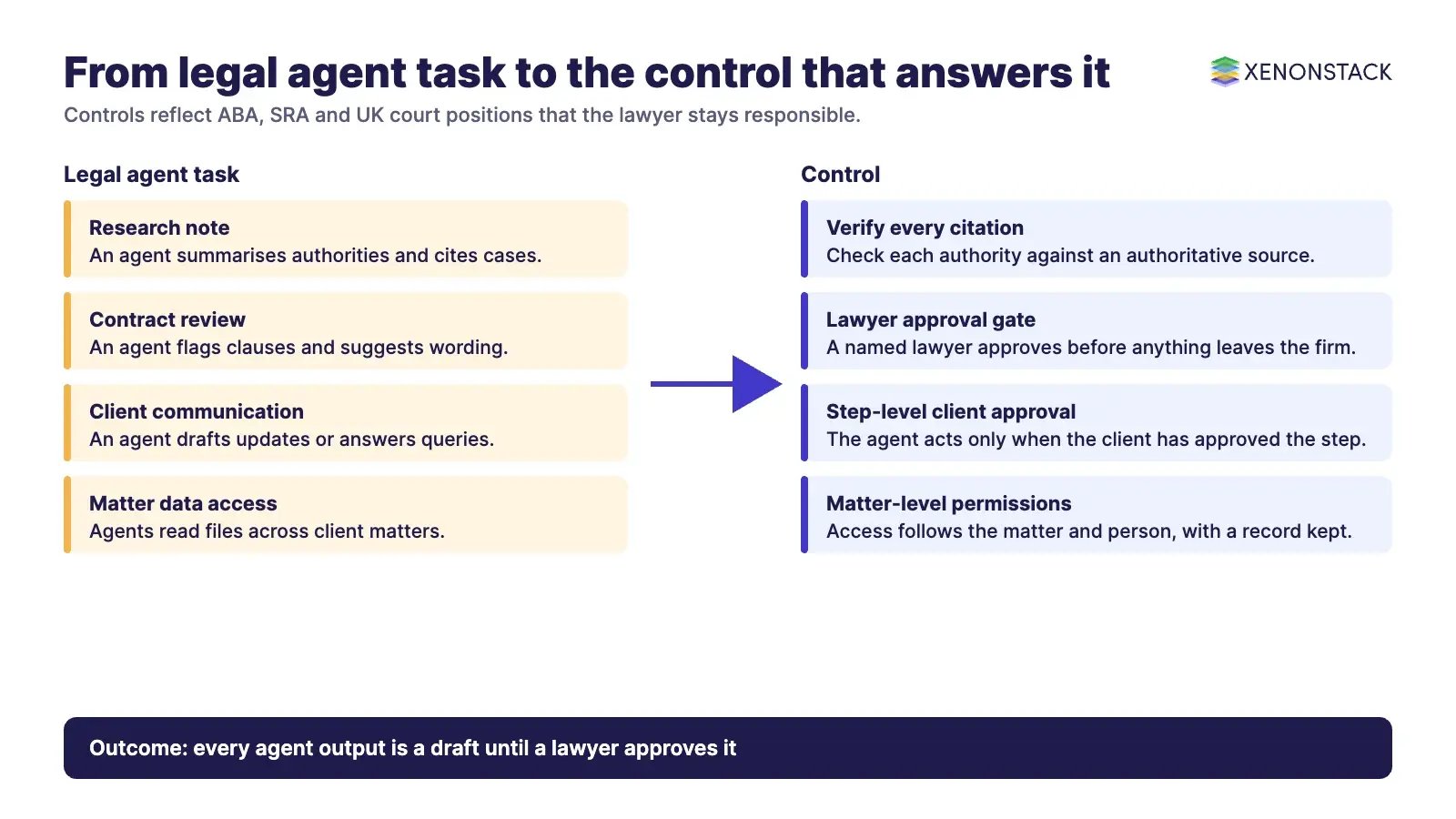
| Control | What it means in a law firm | Evidence to keep |
| Matter-level access | Each agent sees only the matter, client and document set it is assigned, with ethical walls respected | Access grants per agent and per matter |
| Citation and source verification | Every authority an agent cites is checked against an authoritative source before use | Source list and the name of the checker |
| Approval gates | Nothing is sent to a client, court or counterparty without a named lawyer's approval | Approver, time and version approved |
| Confidentiality rules | Client information is kept out of public AI tools and handled under the firm's approved tool policy | Tool register and policy version |
| Decision record | The inputs, policy applied, agent steps and outcome are stored per task | Decision trace per task |
| Review of outcomes | Samples of agent work are reviewed for errors and inconsistent results | Review notes and corrective actions |
Products can help with the record-keeping layer. ElixirData Context OS keeps governed context, versioned policy and decision traces in one decision layer above AI agents. The ElixirData Audit Agent pulls together each decision's lineage, the policy version in force, the approvals and the authority chain, according to its page, which also says full lineage applies only to decisions made through Context OS. AgentGRC keeps autonomous agent actions inside policy, with the audit trail risk teams need, and the Decision Review Agent reviews decisions after they are made, according to its site.
How should a firm adopt legal agents in sequence?
- Start with an inventory. List the tasks that are repeatable, document-heavy and reviewable, such as intake summaries, clause flagging and research notes.
- Run in assist mode. The agent drafts and a lawyer approves every output. Measure error types, not only speed.
- Set the gates. Decide in writing which actions need approval, which need review after the fact, and which an agent may never take.
- Limit data and tools. Give each agent the minimum matter data and the narrowest tools its task needs.
- Keep the record. Store the sources, steps and approver for each task so a supervising lawyer can reconstruct it.
- Widen scope only on evidence. Move a task to lighter oversight only after review samples show stable results.
What are the trade-offs, and when should you not use agents?
- Fabricated citations. The Ayinde judgment shows the cost of unchecked output. Where a task depends on exact authority and cannot be verified cheaply, keep a lawyer in the research step.
- Confidentiality. If matter data cannot be kept inside an approved environment, do not send it to an agent.
- Low volume. For rare, bespoke work, the effort of setting playbooks and gates may exceed the time saved.
- Unclear accountability. If no named lawyer owns an agent's output, do not deploy it.
- Consumer-facing advice. A client-facing agent that gives legal advice raises regulatory questions. Check your regulator's rules first.
The same trade-offs appear in other regulated sectors, for example in healthcare and in financial analysis.
What will change in agentic legal technology over the next few years?
Three shifts are visible from the sources above, and none is a forecast of market size. First, regulation is becoming specific: the EU AI Act's high-risk obligations for Annex III uses now have a stated deadline of 2 December 2027, so firms serving EU clients should map their uses well before then. Second, courts and regulators are asking firms to prove checking, not only to state a policy, because the Divisional Court said leaders and regulators must take practical steps and may inquire into whether they have. Third, regulators are testing new models: the SRA authorised an AI-based firm with client approval at each step. Firms that already keep decision records will find each of these easier to meet.
To map one legal decision your agents should make, and the context and policy it depends on, book a Context Workshop. See what happens in the workshop.
Related on XenonStack
- AgentGRC AI governance: inventory, risk ratings and running controls for AI.
- ElixirClaw: run governed AI agents with decision boundaries and human approvals.
- RAG and LLM development services: grounded answers that cite their sources.
Frequently asked questions
What is agentic AI in a law firm?
Agentic AI in a law firm means software agents that plan and carry out legal tasks such as intake, research, document review and compliance checks across the firm's systems, with a named lawyer approving what leaves the firm.
Can AI agents replace lawyers?
The official sources read for this article keep responsibility with the lawyer: the ABA, the Divisional Court, the UK judicial guidance and the SRA. Agents prepare drafts and first passes; lawyers verify and decide.
What went wrong in the Ayinde and Al-Haroun cases?
The court found that filings relied on non-existent authorities. In Al-Haroun, 18 of 45 citations did not exist. The court said lawyers must check AI research output against authoritative sources and cannot rely on a lay client for citation accuracy.
Is legal AI regulated under the EU AI Act?
The European Commission page lists AI used in the administration of justice and democratic processes as a high-risk area, and says Annex III high-risk deadlines moved to 2 December 2027. Whether a particular law-firm use is in scope should be checked with counsel.
What controls should a firm put around legal agents?
Matter-level access, verified citations, named-lawyer approval gates, confidentiality rules, a decision record for each task and regular review of samples of agent work.
Follow XenonStack on LinkedIn: XenonStack on LinkedIn for new guides on agentic AI, data and platform engineering.
Ready to put AI agents to work? Explore ElixirClaw, the agentic OS platform to build, orchestrate and govern AI agents.
Explore the XenonStack platform family: ElixirData · ElixirClaw · ElixirHub · NexaStack · MetaSecure · Neural AI · AgentGRC · AgentSRE · AgentAnalyst · AgentInstruct · AgentRAI · AgentScrum · AgentSearch · AgentForce · AI Aviator · SAIF Aviator · CohortIQ · XenonStack AI · XenonStack UAE