Key takeaway
- Enterprise DevOps explained for CTOs and CIOs: operating model, DORA metrics, governance, AI impact and a step-by-step adoption sequence for large teams.
Enterprise DevOps is DevOps run as an operating model across many teams, platforms and regulated environments, with shared standards for delivery, security and governance. A single team can get by with good habits; an enterprise needs common pipelines, clear ownership, and one way of measuring whether delivery is getting faster and safer. This guide sets out what that takes, in the order most enterprises can adopt it.
It is written for CTOs, CIOs, heads of engineering, platform leads and architects. For the lifecycle itself, read our guide to the DevOps process and the 6 C's; for the toolchain, see DevOps tools; for security in the pipeline, see DevSecOps. This post focuses on the enterprise layer above them: operating model, measurement, governance and adoption sequence.
What is enterprise DevOps and how does it differ from team-level DevOps?
Team-level DevOps improves how one product team builds and releases. Enterprise DevOps applies the same practices, continuous integration and delivery, automated testing, infrastructure as code and monitoring, across dozens or hundreds of teams, so that each team does not reinvent them. The practices are the same; the difference is standardisation, governance and ownership.
| Dimension | Team-level DevOps | Enterprise DevOps |
|---|---|---|
| Pipelines | Each team builds its own | Shared, versioned templates teams reuse and extend |
| Environments | Created by hand or per project | Provisioned from code, with the same controls everywhere |
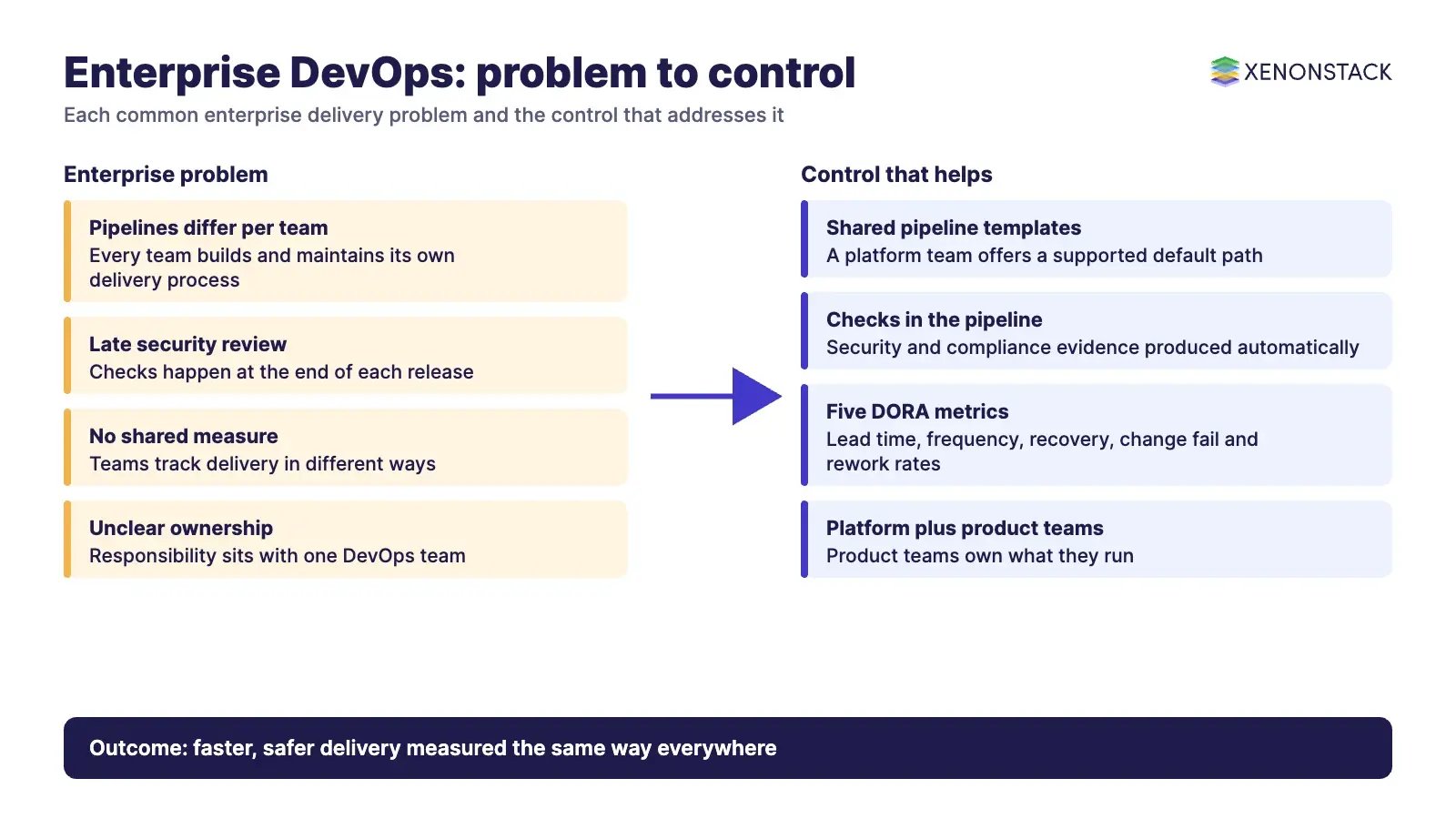
| Security and compliance | Reviewed late, per release | Checks built into the pipeline and evidenced automatically |
| Measurement | Local dashboards | One set of delivery metrics compared across teams |
| Ownership | Informal | Named platform team, product teams own what they run |
| Change approval | Ad hoc | Policy-based, with an audit trail |
Source: XenonStack practitioner view; the metrics referred to are defined by DORA below.
What has changed in enterprise DevOps recently?
- Measurement has been standardised. DORA now describes five software delivery metrics: change lead time, deployment frequency, failed deployment recovery time, change fail rate and deployment rework rate, grouped into throughput and instability. Its guidance states that speed and stability are not trade-offs (source: DORA metrics guide).
- AI has become part of delivery. The 2025 DORA report on AI-assisted software development describes AI as an amplifier that magnifies an organisation's existing strengths and weaknesses, and says the greatest returns come not from the tools themselves (source: DORA 2025 report). Weak pipelines and unclear ownership become more costly, not less, when code is produced faster.
- Desired-state operations are formalised. The OpenGitOps principles say the desired state must be declarative, versioned and immutable, pulled automatically, and continuously reconciled (source: OpenGitOps). That gives enterprises a clean basis for audit and rollback.
How should an enterprise measure DevOps performance?
Use one metric set for every team and review it by portfolio, not by league table. The five DORA metrics are the most widely recognised starting point.
| Metric | What it measures | Group |
|---|---|---|
| Change lead time | Time for a change to go from committed to version control to deployed in production | Throughput |
| Deployment frequency | Number of deployments over a period, or time between deployments | Throughput |
| Failed deployment recovery time | Time to recover from a deployment that fails and needs immediate intervention | Throughput |
| Change fail rate | Ratio of deployments that need immediate intervention after release | Instability |
| Deployment rework rate | Ratio of unplanned deployments that result from a production incident | Instability |
Source: dora.dev, read 11 November 2026.
DORA's guidance is that top performers do well across all five and low performers do poorly, so a team that is fast but unstable has not succeeded. Use the numbers to find constraints, such as long lead times caused by manual approvals, rather than to rank people.
What is the adoption sequence for enterprise DevOps?
Most enterprises succeed by changing one value stream at a time, with executive sponsorship and a small team doing the work. A workable order:
- Pick one value stream and baseline it. Record the five metrics above before changing anything.
- Agree ownership. Product teams own what they run; a platform team owns the shared pipelines, environments and guardrails.
- Automate build, test and deploy. Start with continuous integration and automated tests, then move to continuous delivery. See our guide to CI/CD.
- Provision environments from code. Use infrastructure as code and, where it fits, GitOps so that changes are versioned and reviewable.
- Build security and compliance into the pipeline. Automate checks and keep evidence, rather than reviewing at the end.
- Add monitoring and feedback. Connect incidents back to the changes that caused them.
- Scale through a paved path. Offer teams a supported default so that joining is easier than opting out.
- Review the metrics each quarter and retire practices that do not move them.
Which practices matter most at enterprise scale, and when do they fit?
| Practice | When it fits | What to watch |
|---|---|---|
| Test automation | Every team; start with unit and integration tests, add load and regression tests for critical paths | Flaky tests erode trust, so fix or remove them |
| Configuration and environment management as code | Many environments, audit requirements, frequent rebuilds | Drift between code and live systems |
| Continuous integration | Shared repositories with frequent commits | Slow builds; keep feedback fast |
| Progressive delivery (canary, blue-green, feature flags) | High-traffic or regulated services where a failed release is costly | Needs good monitoring to decide to proceed or roll back |
| Continuous deployment | Services with strong automated tests and easy rollback | Not every regulated change should deploy without approval |
| Observability | Distributed systems where failures cross services | Cost of data volume; define what you need to answer first |
| Value stream management and feedback loops | Delivery spans several teams and approval steps | Metrics without action become reporting overhead |
The toolchain choices behind these practices, for example Jenkins, GitLab, Ansible, Terraform, Docker and Kubernetes, are covered in our DevOps tools guide. Choose tools your teams can support, and integrate them rather than collecting them.
How do governance, security and cost fit into enterprise DevOps?
Automation without governance can ship faster and fail faster. The controls that matter are policy as code for approvals, least-privilege access to pipelines and environments, signed and traceable builds, and an audit trail of who changed what and why. These belong in the platform, so that product teams inherit them. Our DevSecOps guide covers the pipeline controls in detail.
As AI agents begin to act in delivery and operations, for example opening changes, triggering deployments or remediating incidents, the same question applies: which actions are allowed, under which policy, with what evidence. AgentGRC keeps autonomous agent actions inside policy, with the audit trail risk teams need, and ElixirClaw is an agentic OS platform to build, orchestrate and govern AI agents and automation workflows while keeping humans in control.
On cost, track the spend of pipelines and environments per team, switch off idle non-production environments, and compare the cost of delay (long lead times) against the cost of the platform that removes it.
How is AI changing enterprise DevOps operations?
The XenonStack view is that AI is most useful in operations first: correlating alerts, finding probable root causes and drafting remediation, with people approving changes. See our guides to AIOps and ML and AI in DevOps. AgentSRE describes a fleet of AI agents that automates detection, root cause analysis and remediation for incident management. Adopt it behind the same guardrails as any other change: scoped permissions, approval for high-risk actions and a record of every decision.
What are the main challenges, trade-offs and when should you not push DevOps hard?
| Challenge | Why it happens | What helps |
|---|---|---|
| Cultural shift | Teams are measured on different goals (change versus stability) | Shared metrics and joint ownership of incidents |
| Legacy systems | Tightly coupled, manual releases, little test coverage | Start with the systems that change most; wrap the rest |
| Tools without practice | Tools bought before processes are agreed | Fix the flow first, then automate it |
| Governance gaps | Automation outpaces control | Policy as code and automated evidence |
| One DevOps team for everything | Responsibility is pushed to a single group | Platform team plus product teams that own what they run |
| Monitoring blind spots | Logging added late | Define service-level objectives before choosing tools |
When not to push hard: systems that change rarely and carry high safety or regulatory risk may be better served by careful, approved releases than by daily deployment. Continuous delivery means being able to release safely at any time, not that you must release constantly. Also avoid forcing a single toolchain on teams whose workloads differ widely; standardise the controls and the metrics, not every tool.
How does XenonStack support enterprise DevOps?
XenonStack helps enterprises design the operating model, build the delivery platform and run it. See our DevOps managed services for hybrid cloud and our cloud native DevOps with Kubernetes guide.
To map one delivery or operations decision your agents should make, and the context and policy it depends on, book a Context Workshop. See what happens in the workshop.
Frequently asked questions about enterprise DevOps
What is enterprise DevOps?
Enterprise DevOps is DevOps applied as an operating model across many teams, with shared pipelines, security and compliance controls, ownership and delivery metrics, rather than as practices left to each team.
Which metrics should we use to measure DevOps?
The five DORA metrics: change lead time, deployment frequency, failed deployment recovery time, change fail rate and deployment rework rate. DORA groups the first three as throughput and the last two as instability, and says speed and stability are not trade-offs.
How should an enterprise start with DevOps?
Choose one value stream, baseline the five metrics, agree ownership between a platform team and product teams, then automate build, test and deployment before adding infrastructure as code, pipeline security and monitoring.
How does AI affect enterprise DevOps?
The 2025 DORA report describes AI as an amplifier of an organisation's existing strengths and weaknesses. Enterprises with sound pipelines and ownership gain more; those without them see problems magnified, so fix the delivery system first.
Should every service use continuous deployment?
No. Continuous deployment suits services with strong automated tests and easy rollback. Services with higher regulatory or safety risk may keep an approval step while still using continuous integration and automated delivery pipelines.
Follow XenonStack on LinkedIn: XenonStack on LinkedIn for new guides on agentic AI, data and platform engineering.
Explore the XenonStack platform family: ElixirData · ElixirClaw · ElixirHub · NexaStack · MetaSecure · Neural AI · AgentGRC · AgentSRE · AgentAnalyst · AgentInstruct · AgentRAI · AgentScrum · AgentSearch · AgentForce · AI Aviator · SAIF Aviator · CohortIQ · XenonStack AI · XenonStack UAE