Key takeaway
- How to keep generative AI health records accurate and auditable on AWS: Bedrock Guardrails, HealthLake, access, audit, HIPAA and India DPDP basics.
Data integrity for generative AI in healthcare means that every record a model reads, drafts or changes stays accurate, complete, traceable and protected from improper alteration. On AWS, you build it from four controls: validated source data (AWS HealthLake), checks on model output (Amazon Bedrock Guardrails), permission-aware access, and an audit trail that links each AI action to a person and a source.
One status change matters before you design anything. According to its documentation, Amazon Q Business is no longer open to new customers, and AWS recommends Amazon Quick for similar capabilities (AWS availability notice). This guide therefore treats Q Business as an existing deployment and focuses on controls that apply to any generative AI assistant, including Gen AI agents that write records.
What does data integrity mean for generative AI in healthcare?
In the HHS summary of the HIPAA Security Rule, integrity is a technical safeguard under 45 CFR 164.312(c). Covered entities must have policies and procedures that stop electronic protected health information (ePHI) being improperly changed or destroyed, and electronic measures that confirm it has not been. The same page lists access control (164.312(a)) and audit controls (164.312(b)). The page was last reviewed on 7 August 2026.
Generative AI adds three new ways to break integrity. A model can state something that is not in the source, which is a hallucination. A summary can drop a fact and still read well. An agent with write access can change a record faster than any reviewer can notice. Each needs a control that a traditional records system never needed.
Which AWS service covers which integrity control?
The table maps each control to the AWS feature its own documentation describes. It is a starting point, not a compliance claim: AWS says that using HIPAA-eligible services alone does not make an organisation compliant.
| Integrity control | AWS feature | What its documentation says | Watch for |
|---|---|---|---|
| Validated source data | AWS HealthLake (AWS HealthLake documentation) | Stores and exchanges data using FHIR R4, with standard resource validation. Listed as a HIPAA Eligible Service. | Non-FHIR data (for example CSV or C-CDA) needs conversion first. |
| Output validation | Bedrock Guardrails (Amazon Bedrock Guardrails documentation) | Contextual grounding checks detect responses not grounded in the source. Automated Reasoning checks validate responses against logical rules. Sensitive information filters block or mask PII. | Grounding checks need a trusted source passage, so they suit retrieval-based answers. |
| Permission-aware access | Amazon Q Business (Amazon Q Business documentation) | Answers are based on content the end user has permission to access, with citations to sources. | No longer open to new customers; plan the move to Amazon Quick. |
| Audit trail | AWS CloudTrail, via AWS HealthLake documentation | Tracks HealthLake user activity and API usage. | Audit trails need retention and review, not only collection. |
| Transport security | AWS HealthLake documentation | Connections use HTTPS over TLS by default and stored customer content is encrypted. | Key management is outside that page; confirm in your design. |
How do you validate generative AI output before it reaches a record?
Treat model output as a draft, never as a record. According to the Amazon Bedrock Guardrails documentation, contextual grounding checks flag responses that are factually inaccurate, add information not in the source, or do not answer the question. Automated Reasoning checks can also detect hallucinations and suggest corrections. In the AWS for Industries post on a HIPAA-ready generative AI architecture (16 June 2026), grounding scores are compared with a threshold and responses below it are blocked.
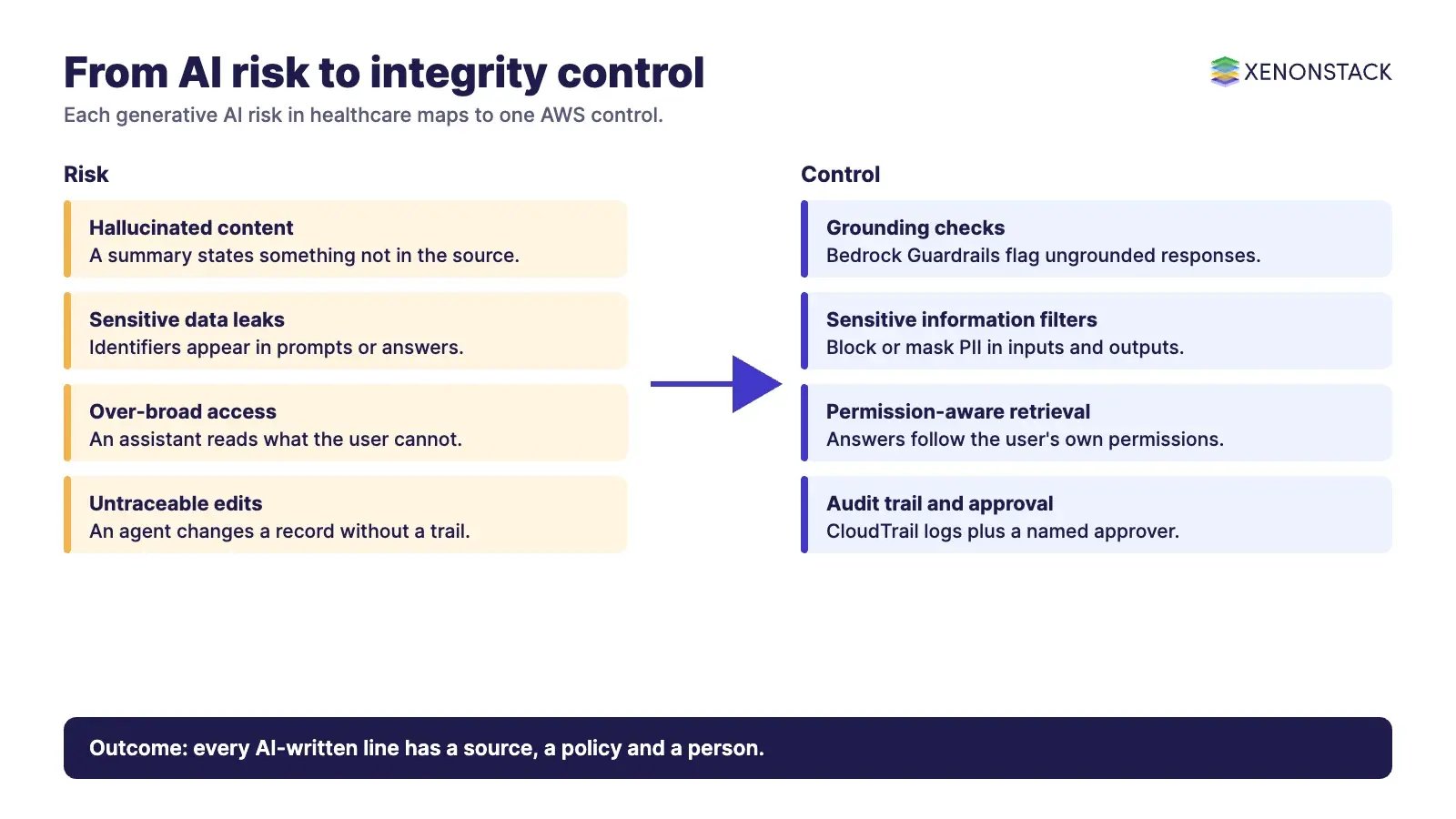
- Ground every clinical summary on a named source document, and reject output with no source.
- Mask identifiers with sensitive information filters before text leaves the trusted boundary.
- Route low-confidence or blocked output to a clinician queue instead of silently retrying.
- Keep the model version, guardrail version and threshold with every draft, so a later review can reproduce the decision.
How do you keep lineage and an audit trail for AI-written content?
Lineage answers one question: which source, model, policy and person produced this line in the record? The AWS for Industries post on a HIPAA-ready generative AI architecture describes carrying a single session identifier across CloudTrail events, observability traces, guardrail evaluations and HealthLake access records, so one patient interaction can be reconstructed. The same post notes that it does not cover training-data lineage or clinical-accuracy validation beyond grounding, so those remain your own design work.
For retention, that post describes S3 Object Lock in compliance mode with a six-year minimum for audit logs. Confirm the period that applies to your organisation against the HHS summary of the HIPAA Security Rule and your counsel. For the product view of this layer, ElixirData Context OS keeps governed context, versioned policy and decision traces in one decision layer above AI agents.
How should you govern records written by AI agents?
This section is our delivery practice, not an AWS claim. The rule is simple: an agent proposes, a person or a policy approves, and the system records both. Use the matrix below to decide how much freedom each agent action gets.
| Agent action | Default control | Who approves | Evidence kept |
|---|---|---|---|
| Read a record to answer a question | Permission-aware retrieval with citations | None, if the user already has access | Query, user, sources cited |
| Draft a summary or note | Grounding check and PII masking | Clinician before filing | Draft, source, guardrail result |
| Update a coded field (diagnosis, medication) | Deny by default | Named clinician, every time | Before and after values, approver |
| Delete or merge a record | Not allowed for agents | Records officer | Request, decision, reason |
AgentGRC keeps autonomous agent actions inside policy, with the audit trail risk teams need. For the wider clinical context, read our guides on agentic AI in healthcare and responsible AI in healthcare.
What do HIPAA and India's DPDP Act expect?
HIPAA, through the Security Rule, expects access control, audit controls and integrity measures for ePHI (HHS summary of the HIPAA Security Rule). India's Digital Personal Data Protection Rules, 2025 were notified on 14 November 2025, with an 18-month period for phased compliance, according to the Press Information Bureau release on the DPDP Rules, 2025. The same release says Data Fiduciaries must inform affected individuals of a breach without delay, issue a purpose-specific consent notice, and answer access, correction and erasure requests within ninety days. It also says failing to keep reasonable security safeguards can attract penalties of up to Rs 250 crore under the Act.
This is not legal advice. Confirm the commencement dates and your obligations on the official pages, and with counsel, before you rely on this summary.
In what order should you adopt these controls?
| Step | Action | Exit check |
|---|---|---|
| 1 | Inventory the sources an assistant may read and the records it may touch | Every source has an owner and a purpose |
| 2 | Land clinical data in a validated store such as HealthLake | Resources pass FHIR validation on import |
| 3 | Add grounding and masking checks to every generated answer | Ungrounded answers are blocked in a test set |
| 4 | Tie access to the user, not to the application | A user cannot retrieve what they cannot open directly |
| 5 | Join logs with one session identifier | You can replay one patient interaction end to end |
| 6 | Open limited write access with human approval | Every write has an approver and a before and after value |
When is generative AI the wrong tool for a record?
Do not let a model write structured fields that drive billing, prescribing or legal documents without a named human approver. Do not use a grounding check where there is no trusted source text, because it cannot judge what it cannot compare. Do not assume a vendor service is available: check product status first, as the Amazon Q Business notice shows.
To map one record-writing decision your agents should make, and the context and policy it depends on, book a Context Workshop. See what happens in the workshop.
Frequently asked questions
What is data integrity in healthcare generative AI?
It is the assurance that records a model reads, drafts or changes stay accurate, complete and free from improper alteration. HIPAA frames it as a Security Rule safeguard under 45 CFR 164.312(c).
Is Amazon Q Business still available?
According to AWS documentation, Amazon Q Business is no longer open to new customers, and AWS recommends Amazon Quick. Existing customers can keep running applications, and AWS says it will continue bug fixes and security updates.
How do Bedrock Guardrails help with data integrity?
Per AWS documentation, contextual grounding checks detect responses not grounded in the source, Automated Reasoning checks validate responses against logical rules, and sensitive information filters block or mask PII.
Does AWS HealthLake use FHIR?
Yes. AWS documentation says HealthLake supports the FHIR R4 specification and is a HIPAA Eligible Service.
When does India's DPDP framework apply?
The DPDP Rules, 2025 were notified on 14 November 2025 with an 18-month period for phased compliance, according to the Press Information Bureau. Confirm exact dates on the official page.
Follow XenonStack on LinkedIn: XenonStack on LinkedIn for new guides on agentic AI, data and platform engineering.
Ready to put AI agents to work? Explore ElixirClaw, the agentic OS platform to build, orchestrate and govern AI agents.
Explore the XenonStack platform family: ElixirData · ElixirClaw · ElixirHub · NexaStack · MetaSecure · Neural AI · AgentGRC · AgentSRE · AgentAnalyst · AgentInstruct · AgentRAI · AgentScrum · AgentSearch · AgentForce · AI Aviator · SAIF Aviator · CohortIQ · XenonStack AI · XenonStack UAE