

Key takeaway
- How AI network automation cuts fault time, energy use and cost for telecom operators: TM Forum levels, results, data needs and when not to automate.
AI network automation helps operators in three measurable ways: faster fault resolution, lower energy use in the radio network, and fewer manual changes and field visits. Operators including AT&T, Vodafone and Rakuten Mobile have reported shorter repair times, a majority of network issues resolved automatically, and lower radio energy use. These come from different networks and measurement methods, so they show direction rather than a benchmark you can promise your board.
This guide is for network, operations and technology leaders at operators, and the architects who connect automation to OSS and network systems. It covers what operators have measured, how mature they are, what data automation needs, and when not to automate. For how agents work in network operations, see our guide to agentic AI for network operations; for governance and adoption steps, see agentic AI in the telecom industry.
What is AI network automation?
It is software that detects a network problem, decides what to do and carries out the action, with limits set by people. Older automation follows fixed rules written for known cases. AI network automation adds models that correlate alarms across systems, predict faults and propose or execute changes for cases nobody wrote a rule for. TM Forum describes the maturity in levels from 0 to 5. At Level 4, per TM Forum, the network self-adapts, self-optimises and self-heals with minimal human intervention, and humans set the intent and the limits.
How does closed-loop network automation work?
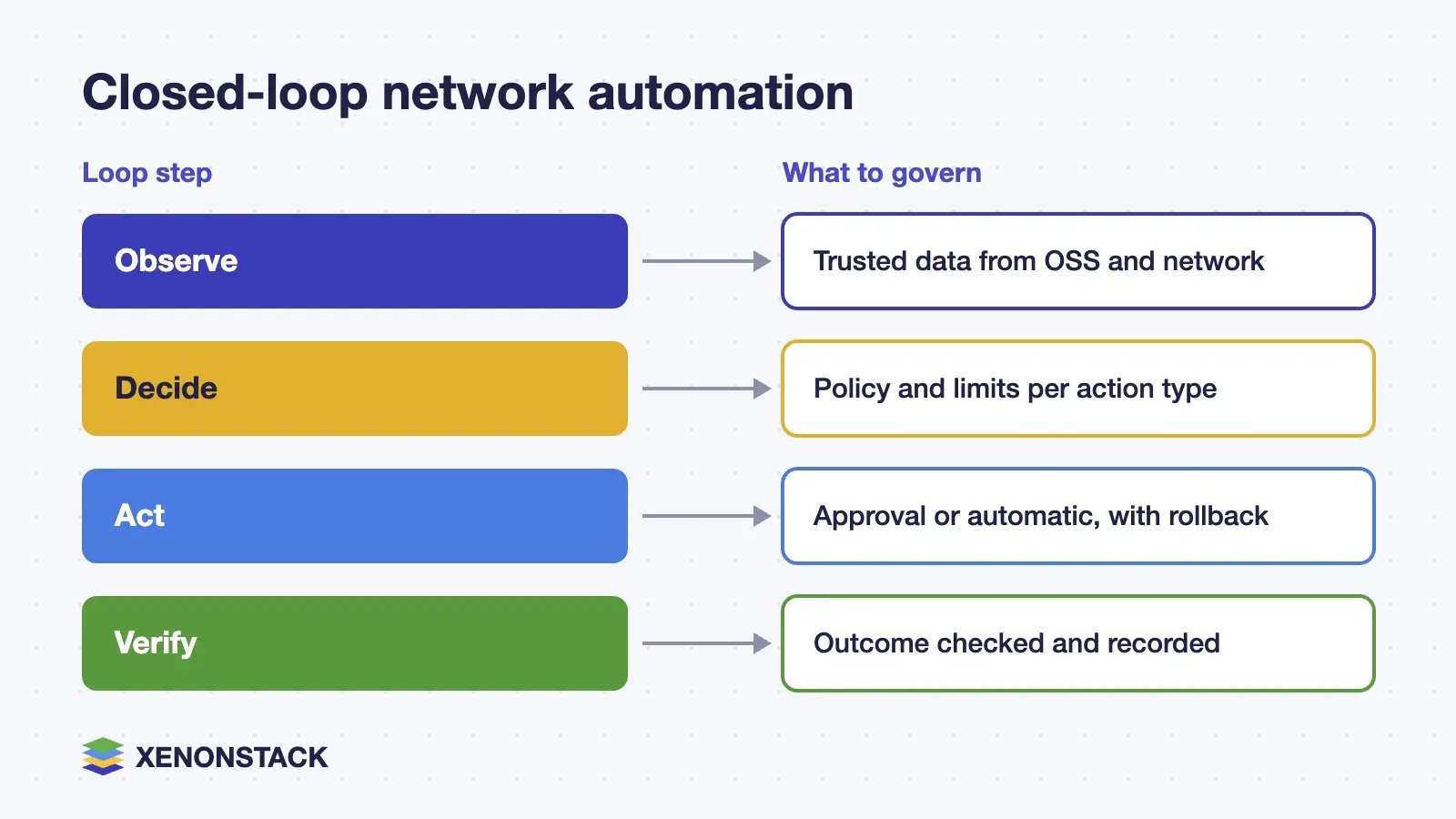
A closed loop observes the network, correlates events into one problem, decides within the policy people set, acts, then verifies the effect and rolls back if it fails. Our network operations guide walks through that loop and its reference architecture. Here is what matters for buyers: keep the guardrails inside the loop, not around it. That means limits on what may change, a dry run on a digital twin where possible, and automatic rollback.
TM Forum Catalyst projects show the integration points. One 2026 Catalyst used TM Forum Open APIs including TMF642 for alarm management, TMF656 for service problem resolution and TMF921 for intent-based control to link fault management across domains.
What results have operators reported?
| Operator | Reported result | Source type | Caveat |
|---|---|---|---|
| AT&T | Shorter average repair time for faults and complaints; a large number of technician dispatches avoided | Trade report on a July 2026 operator report | Very large network; definitions vary |
| Vodafone | A majority of network issues resolved automatically; much lower cost per unit of capacity from centralised management | Trade report on FY2026 results | Cost result also reflects other changes |
| NTT DOCOMO | Markedly faster response to complex network faults after an AI-agent maintenance system went live in February 2026 | Trade report | Operator-reported |
| Deutsche Telekom | RAN Guardian identified a very large number of network events in early 2026; major incident handling reduced from hours to about a minute | Opinion piece by a Google Cloud author | Vendor partner source; confirm with Deutsche Telekom |
| Rakuten Mobile | A meaningful radio energy saving with no impact on customer experience KPIs; TM Forum validated Level 4 for RAN energy efficiency | Blog by Rakuten Symphony | Vendor source; single use case |
| Verizon | Tens of millions of autonomously executed configuration changes in 2025 | Trade roundup | Count of changes, not outcomes |
| Telefónica | Several Level 4 use cases in production across Spain, Brazil and Germany by end of 2025 | Trade reports | Use-case count, not savings |
These sources are trade press and vendor material, and an industry article notes the results reflect different networks, periods and definitions and are not directly comparable. Use them to choose where to look, then measure on your own network.
Where do operators start?
TM Forum reporting puts the mobile radio network first, then the IP network. The radio network is complex and, per a Rakuten Symphony source, accounts for most of a network's energy use, which makes energy saving a clear early case. Others start with alarm correlation and fault triage, where cross-domain events create the most noise. NVIDIA's 2026 telecom survey, reported by trade press, found autonomous networks were the top-ranked AI return on investment case among operators surveyed.
How mature are operators today?
A TM Forum operator survey, as reported by Samsung, found a minority planning Level 4 systems by 2027 and a large majority targeting Level 4 or above by 2030. GSMA Intelligence, as summarised by trade press, reported most operators still at Level 2. Counterpoint's July 2026 report says most operators work at assisted or partial autonomy, with Level 4 deployments now validated in specific domains. The picture is consistent: Level 4 exists in selected use cases, not across whole networks.
What data and integration does network automation need?
- Unified, current data. GSMA Intelligence puts AI-ready data foundations first, and an Analysys Mason index of 50 Tier 1 operators notes that model-ready data and common data platforms are still lacking.
- A topology and inventory you can trust. A loop that acts on a wrong inventory acts wrongly.
- Multi-vendor interfaces. Use standard APIs where possible so the automation is not locked to one equipment vendor.
- A safe place to test. A digital twin or staging network to check impact before a change goes live.
- A decision record. Each automated action logged with its inputs, the policy applied and the outcome.
How should you evaluate a network automation platform or partner?
- Which use case, and how will you measure it: time to repair, alarms per incident, energy per site, field visits?
- Which actions does it take alone, which need approval, and which are never allowed?
- How does it connect to your OSS, element managers and telemetry across vendors?
- Can it dry-run a change and roll back automatically?
- Can you reproduce why it made any given change from the record?
- What happens to the loop when data goes missing or a model drifts?
When should you not automate a network function?
- The data is incomplete or the inventory is unreliable.
- The action cannot be reversed or has a wide customer impact.
- The procedure is fixed and rare, so a runbook does the job.
- You have not agreed who owns the decision when the loop gets it wrong.
Gartner has predicted that over 40% of agentic AI projects will be cancelled by the end of 2027 and has warned of vendors relabelling existing tools as agentic, so ask for a live demonstration on your own data.
How can you run a pilot?
Pick one domain and one measure, run the loop in recommend-only mode for several weeks, compare its proposals with what engineers decided, then allow automatic action on the lowest-risk change type with rollback. Raise autonomy by action type once the record shows it is safe.
To agree which network changes a loop may make alone and what record each must leave, book a Context Workshop or see what happens in the workshop. Want to scope a first closed-loop use case? Book a strategy call.
Frequently asked questions
What is AI network automation in telecom?
Software that detects, decides and acts on network problems with limits set by people, rather than only following fixed rules.
What is a Level 4 autonomous network?
In TM Forum's scale, a network that self-adapts, self-optimises and self-heals with minimal human intervention, where people set intent and limits.
How much can operators save?
Operators such as AT&T and Rakuten Mobile have reported shorter repair times and lower radio energy use. Results differ by network and method, so measure your own.
Does network automation replace NOC engineers?
It changes the work. A Vodafone leader described a move from network operations engineers to network automation engineers.
Where should an operator start?
With one use case that has good data and reversible actions, such as alarm correlation or radio energy saving.
What are the main risks?
Poor data, actions that cannot be reversed, vendor lock-in and missing audit records. Governance steps are in our agentic AI in telecom guide.
Follow XenonStack on LinkedIn: XenonStack on LinkedIn for new guides on agentic AI, data and platform engineering.
Ready to put AI agents to work? Explore ElixirClaw, the agentic OS platform to build, orchestrate and govern AI agents.
Explore the XenonStack platform family: ElixirData · ElixirClaw · ElixirHub · NexaStack · MetaSecure · Neural AI · AgentGRC · AgentSRE · AgentAnalyst · AgentInstruct · AgentRAI · AgentScrum · AgentSearch · AgentForce · AI Aviator · SAIF Aviator · CohortIQ · XenonStack AI · XenonStack UAE


