

Key takeaway
- How small agent skills combine into bigger workflows, plus sourced forecasts from Gartner, McKinsey and Stanford for 2026 to 2035, in plain words.
The future of agentic AI is likely to be built from small, reusable skills that agents combine into larger workflows, with people still setting the rules and approving the risky steps. A skill is a folder of written instructions that tells an AI agent how to do one job well, and several skills can work together on one task.
This post is for anyone who has heard about agent skills and found the files confusing. You will learn what a skill is in plain words, how skills are combined, what analysts and researchers forecast for the next few years, and what does not change. Every source below was read on 13 November 2026.
What is an agent skill, in plain words?
Think of a recipe card. The card does not cook anything. It tells the cook what to do, in what order, and what to check. A skill is a recipe card for an AI agent.
Anthropic describes skills as organised folders of instructions, scripts and resources that agents find and load when they need them. According to the Claude Help Center page "What are skills?", they are written as Markdown instructions, with optional scripts for more advanced work.
Every skill has one required file, called SKILL.md. At the top it has a name and a description. The description says what the skill does and when to use it. Below that sit the instructions. The agentskills.io specification limits the name to 64 characters and the description to 1,024.
Skills are loaded in stages, so the agent is not weighed down by pages it does not need. According to the Agent Skills overview in Claude's documentation, only the name and description of each skill are read at start-up, about 100 tokens each. A token is a small chunk of text, roughly a short word. The full instructions load only when a task matches, and extra files or scripts load only if needed.
Availability matters too. According to the Help Center, skills work on the Free, Pro, Max, Ultra, Team and Enterprise plans and in Claude Code, and they need code execution switched on. The Agent Skills overview adds that custom skills do not sync between claude.ai, the API and Claude Code, so each place needs its own copy.
What does it mean to combine skills into a workflow?
One skill is like one page of a job manual. A workflow is the whole manual: several pages used in the right order. Anthropic's skills announcement, dated 16 October 2025, says multiple skills can work together on one task and that Claude identifies which ones are needed and coordinates them.
Here is an everyday illustration, not a real case. Suppose a team wants a monthly report prepared. Four small skills could share the work:
| Small skill | The one job it does |
|---|---|
| Gather figures | Says which files to read and how to name each number |
| Check figures | Lists the tests the numbers must pass before anyone uses them |
| Write the summary | Sets the tone, length and layout of the text |
| Prepare for approval | Packs the result for a named person to review |
The benefit is the same as with any manual. Each page can be fixed, tested and reviewed by itself, and one page can be reused in many workflows.
How do small skills combine into a bigger workflow?
The documentation already describes the building blocks. None of them is a promise about the future. They are how skills work today.
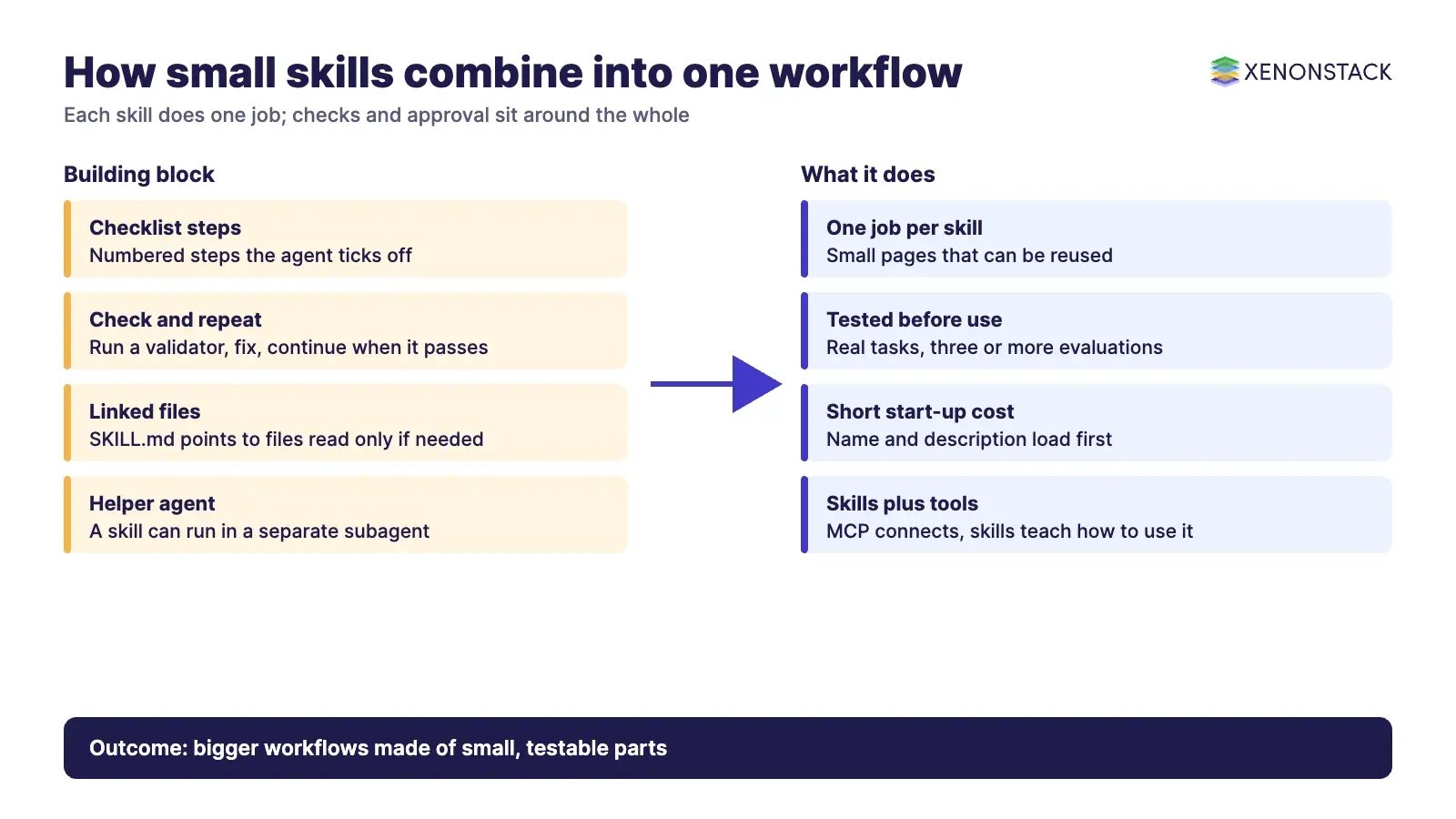
- Checklists inside a skill. The best practices page suggests breaking a complex task into numbered steps that the agent can tick off, and sending the agent to different sections depending on the task.
- Checks and repeats. The same page describes a loop: run a validator, fix the errors, and continue only when the check passes.
- Links to other files. A SKILL.md can act like a table of contents that points to longer files, one level deep, so the agent reads them only when needed.
- Helpers. According to the Skills in Claude Code page, a skill can be run inside a separate helper agent (a subagent) using a setting called context: fork. A helper can also be given a list of skills to load when it starts.
- Tools. The Help Center page explains that MCP connects Claude to outside services and data, while skills explain how to use those tools well.
A skill is also the right size for a repeated routine, such as a report or a review. It is a poor fit for a one-off question. That is where a careful look at how agents use data and decisions, for example in agentic analytics, helps you choose what is worth writing down.
What do analysts and researchers forecast for 2026 to 2035?
The figures below are forecasts or survey results from the sources named. They are not guarantees, and the sources do not agree on every point.
| Source | What it says | Type |
|---|---|---|
| McKinsey, "The state of AI in 2026" | 40% of large organisations (over US$1 billion revenue) report scaling AI agents in at least one function, up from 27%. Nearly three-quarters of high performers have redesigned workflows around AI. | Survey, May to June 2026 |
| Stanford AI Index 2026 | On the OSWorld computer-use test, agents rose from about 5% in 2024 to 66.3% in 2025, still below the 72.35% human baseline. | Measured result |
Read together, the sources point to more agents inside more software by 2028, and also to many dropped projects. McKinsey's survey links stronger results to redesigned workflows, not only added tools. That reading is ours, not a forecast from any one source.
None of the pages we opened forecasts agent skill files themselves beyond 2029. Anthropic's engineering post states a hope that, in time, agents will create, edit and evaluate skills on their own. It describes this as an aspiration, not a feature available today.
What will not change as skills get more powerful?
A skill tells an agent how to work. It does not decide whether an action is allowed. Permission, approval and a record of what happened must come from policy and audit around the agent.
The Claude Code documentation shows why. A skill can list tools to pre-approve for one turn, but that does not restrict other tools, and the user's deny and ask rules still win. Rules that matter must be enforced outside the skill.
The security advice is also firm. According to the Agent Skills overview, use skills only from trusted sources, audit everything bundled inside, and treat them like installing software. It warns that malicious skills can misuse tools and leak data, and that skills which fetch outside web pages can be risky. Anthropic's announcement gives the same advice: stick to trusted sources.
The best practices page adds a quality point. Test with real tasks, write at least three evaluations, and compare results with and without the skill. Composing skills multiplies both the benefit and the risk, so each part should be tested before the whole.
Related reading
These posts in the series cover the neighbouring questions.
- The Skill Layer for Agentic AI Explained: Where the skill layer sits between the model, tools and rules.
- Reusable AI Skills for Enterprise Automation: How one skill is reused across teams and tools, and what does not travel.
- From Prompts to Execution: AI Agent Skills: The path from a single prompt to a governed workflow.
Try it on one decision first
ElixirData is a XenonStack product company, so this is our own offer. If you want to see where reusable agent capabilities fit with policy and audit, bring one live decision to the free half-day Context Workshop. ElixirData architects help your team map it, and you leave with a one-page decision map and a go or no-go call. You can request a Context OS demo or book the Context Workshop.
Sources
- Agent Skills overview (Claude documentation)
- Skill authoring best practices (Claude documentation)
- Extend Claude with skills (Claude Code documentation)
- What are skills? (Claude Help Center)
- Introducing Agent Skills (Anthropic, 16 October 2025)
- Equipping agents for the real world with Agent Skills (Anthropic Engineering)
- Agent Skills specification
- The state of AI in 2026 (McKinsey)
- The 2026 AI Index Report (Stanford HAI)
Frequently asked questions
What is a composable skill?
It is a small skill that does one job and can be used on its own or together with other skills. Anthropic says several skills can work together on one task.
Will skills let agents run a business on their own?
Not by themselves. A skill guides how work is done and does not grant permission.
Do I need to code to build a skill workflow?
No. Skills are mostly written instructions in Markdown. Scripts are optional and are used when a step is better done by a program.
Are skills safe to install?
Only from trusted sources. According to the documentation, audit every file in a skill that you did not write yourself, and treat it like installing software.
Are skills only for Claude?
No. Anthropic published Agent Skills as an open standard, documented at agentskills.io, so other tools can use the format. Check that your platform supports it.
Follow XenonStack on LinkedIn: XenonStack on LinkedIn for new guides on agentic AI, data and platform engineering.
Ready to put AI agents to work? Explore ElixirClaw, the agentic OS platform to build, orchestrate and govern AI agents.
Explore the XenonStack platform family: ElixirData · ElixirClaw · ElixirHub · NexaStack · MetaSecure · Neural AI · AgentGRC · AgentSRE · AgentAnalyst · AgentInstruct · AgentRAI · AgentScrum · AgentSearch · AgentForce · AI Aviator · SAIF Aviator · CohortIQ · XenonStack AI · XenonStack UAE


