Key takeaway
- Artificial intelligence explained for enterprise leaders: types of AI, key applications, EU AI Act dates, NIST risk guidance and how to adopt AI.
What is artificial intelligence?
Artificial intelligence (AI) is software that infers, from the input it receives, how to produce outputs such as predictions, content, recommendations or decisions. The OECD uses this wording for an "AI system" in its 2023 revision, and adds that systems differ in how autonomous and adaptive they are after deployment. For an enterprise, that means AI is not one product: it is a family of techniques, from forecasting models to generative AI models and AI agents, each with a different risk and a different owner.
Every AI system in production today is narrow: it is built and trained for a defined class of tasks. General and super intelligence remain research goals, not products you can buy. The practical question for a CEO, CTO or CIO is therefore not "do we use AI?" but "which kind of AI, for which decision, under which controls?".
How is AI different from machine learning, deep learning and generative AI?
The terms are nested. AI is the broad field. Machine learning is the part of AI where systems learn patterns from data instead of following hand-written rules. Deep learning is machine learning with multi-layer neural networks. Generative AI uses such networks to produce new text, images, code or audio. Agentic AI wraps a model in tools, memory and a goal so that it can plan and act across several steps. Our guide to machine learning trends covers the shifts in the learning layer in more detail.
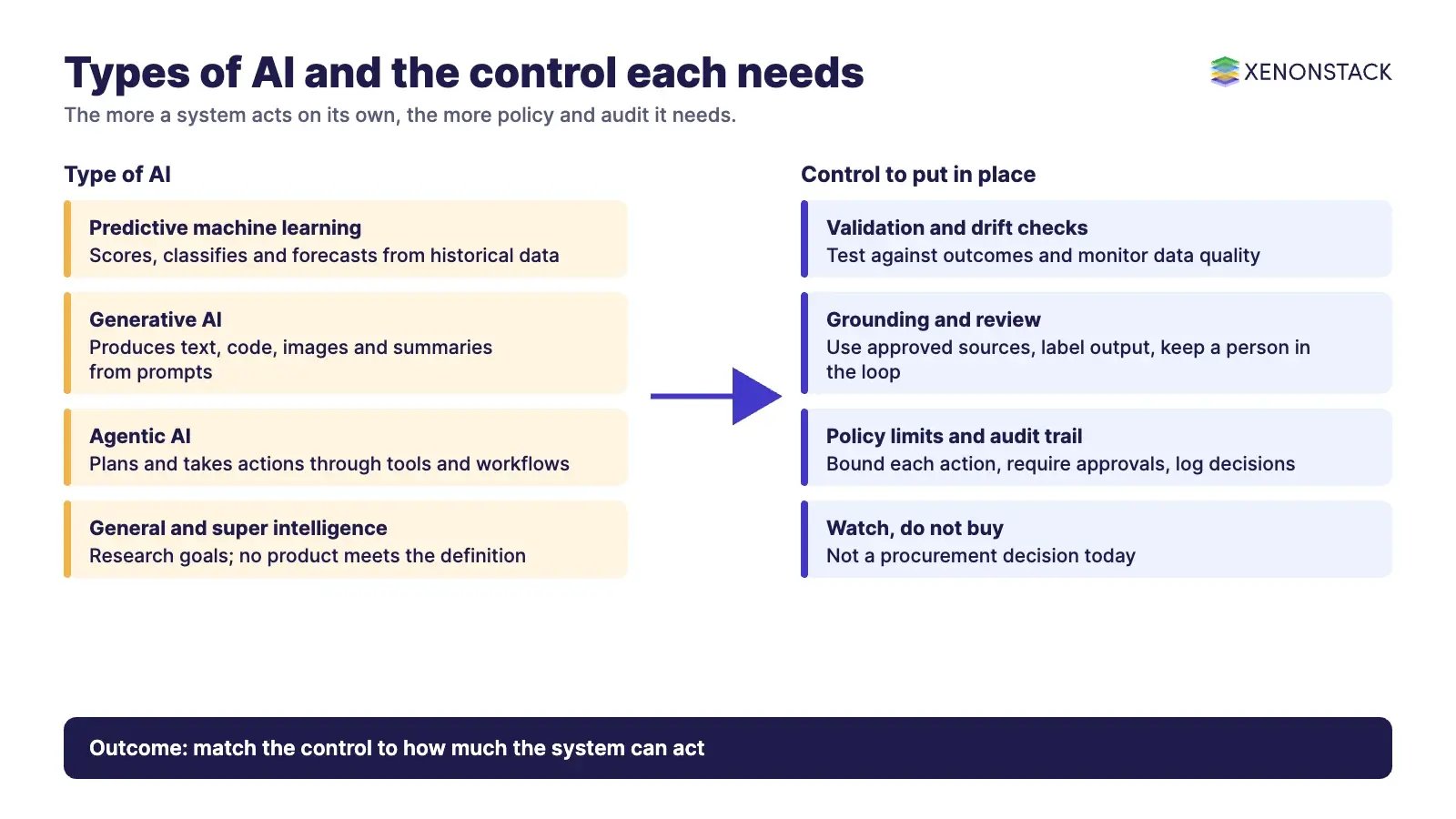
| Type | What it does | When it fits | Typical status in the enterprise |
|---|---|---|---|
| Predictive machine learning | Scores, classifies and forecasts from historical data | Demand forecasting, fraud and risk scoring, predictive maintenance | Mature; needs data quality, validation and drift monitoring |
| Generative AI | Produces text, code, images and summaries from prompts | Drafting, search over documents, coding assistance, customer replies | Widely piloted; needs grounding, review and content controls |
| Agentic AI | Plans and takes actions through tools and workflows | Multi-step processes where each step can be bounded and approved | Early production; needs policy limits, approvals and audit trails |
| Artificial general intelligence (AGI) | Would match human ability across most tasks | Not applicable to a buying decision today | Research goal; no product meets this definition |
| Artificial super intelligence (ASI) | Would exceed human ability | Not applicable | Hypothetical |
What has changed in AI recently?
- From answers to actions. The focus has moved from models that answer questions to agents that carry out tasks. That raises the bar for governance, because an action has a cost that an answer does not.
- Regulation is now dated. The EU AI Act entered into force on 1 August 2024 and its obligations are phasing in (see the table below).
- Governance is trailing capability. The Stanford HAI 2026 AI Index reports a widening gap between what AI can do and how prepared organisations are to govern and evaluate it.
- Risk frameworks exist. NIST published the AI Risk Management Framework 1.0 on 26 January 2023 and a Generative AI Profile (NIST-AI-600-1) on 26 July 2024, so a recognised structure is available for risk reviews.
Which AI applications matter most to enterprises?
The useful way to read the list of applications is by the decision they support, not by technology. Each row below is a common use, the kind of AI behind it and the main control to put in place.
| Application | AI behind it | Decision supported | Main control |
|---|---|---|---|
| Natural language processing and assistants | Language models | Customer replies, summaries, document search | Grounding in approved sources and human review |
| Recommendation and personalisation | Predictive ML | What to show or offer a customer | Bias testing and consent for data use |
| Predictive analytics and forecasting | Predictive ML | Demand, risk, maintenance and pricing | Validation against outcomes and drift monitoring |
| Computer vision and speech | Deep learning | Inspection, recognition, transcription | Accuracy testing on your own data; privacy review |
| Robotics and autonomous vehicles | Perception, planning and control models | Movement and handling in physical settings | Safety cases and a defined fallback to a person |
| Cybersecurity | Anomaly detection and classification | Which alerts need action | Human approval for containment steps; see our guide to AI and cyber security |
| AI agents and agentic systems | Models with tools and memory | Multi-step work across systems | Policy limits, approvals and an audit trail |
How is AI used across industries?
- Healthcare: support for diagnosis, image analysis, drug discovery and treatment planning, always with clinician oversight.
- Finance: credit scoring, fraud detection, risk assessment and trading analytics, where model explainability is a regulatory concern.
- Manufacturing: quality inspection, predictive maintenance and supply chain planning.
- Retail and e-commerce: recommendations, search, marketing automation and customer service.
- Transportation and logistics: route optimisation, fleet maintenance and driver-assistance systems.
- Agriculture: crop monitoring, weed and nutrient-deficiency detection using computer vision.
- Human resources and legal: screening and contract analysis, both areas where decisions affect people and need a human in the loop.
- Media and gaming: generative content, game characters and personalised experiences.
What should AI do for the business?
Four goals recur in enterprise programmes. Each should have a named owner and a measure before a model is built.
- Automate workloads: route requests and handle routine steps so that people spend time on exceptions. In IT, this is the AIOps pattern, covered in our guide to AIOps for IT operations.
- Improve data management: analyse large data sets and give a usable view of assets, customers and operations. This depends on data engineering, not only on models.
- Improve customer service: virtual assistants that give real-time support and pass difficult cases to people.
- Support revenue decisions: forecasts and risk signals that help teams act earlier. See also AI for DevOps use cases from AWS.
How do you govern AI, and what do regulators expect?
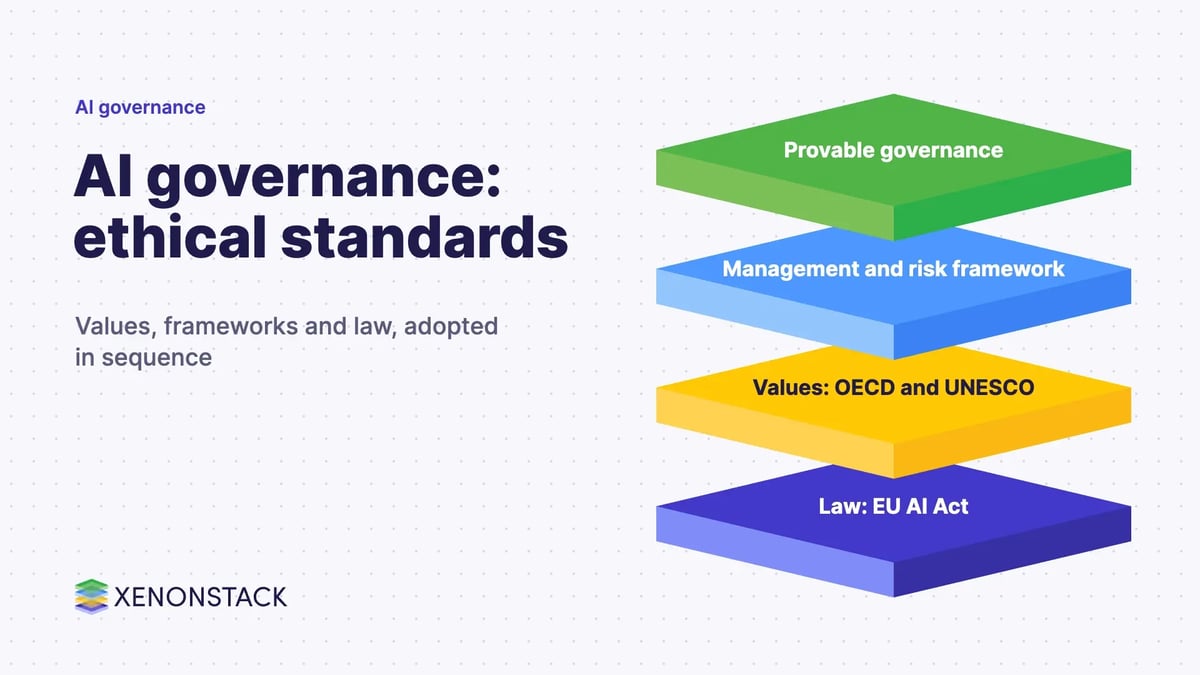
The EU AI Act sorts AI into four risk levels: unacceptable (banned), high risk, transparency risk and minimal risk. According to the European Commission, the timeline is as follows.
| Obligation | Date | What it means for your programme |
|---|---|---|
| Act in force | 1 August 2024 | Start an inventory of AI systems |
| Prohibited practices (first eight) | 2 February 2025 | Confirm none of your use cases fall in a banned category |
| General-purpose AI model obligations | 2 August 2025 | Check what your model providers document |
| Transparency duties (for example, telling people they are talking to a chatbot) | August 2026 | Label chatbots and generated content |
| High-risk systems in Annex III areas (such as employment, education, biometrics, critical infrastructure) | 2 December 2027 | Plan risk management, logging and human oversight |
| High-risk AI embedded in regulated products (Annex I) | 2 August 2028 | Align with product conformity processes |
The later high-risk dates come from the AI Omnibus, which the Commission states entered into force on 27 July 2026. Outside the EU, the NIST AI Risk Management Framework gives a voluntary structure of four functions: Govern, Map, Measure and Manage. In practice, governance means three things: an inventory of AI systems with an owner each, versioned policy that says what each system may do, and a decision record that shows why an output or action was allowed. ElixirData Context OS keeps governed context, versioned policy and decision traces in one decision layer above AI agents, and AgentGRC keeps autonomous agent actions inside policy, with the audit trail risk teams need.
Responsible AI: who needs to be involved?
A responsible AI framework needs active cooperation between policymakers, industry, researchers, ethicists and the wider public. Inside a company, the same applies: legal, security, data, engineering and the business owner of each use case should agree on the standard before a system goes live. That is how ethical use, data privacy and accountability are built into delivery rather than added afterwards.
What is the best adoption sequence for AI?
- Pick decisions, not technologies. List the decisions where speed or consistency is the problem.
- Check the data. Confirm that the data behind each decision is accessible, accurate and permitted for the purpose.
- Start with predictive or generative use with a person in the loop.
- Add agents only where each action can be bounded. Set limits, approvals and logging first. ElixirClaw is an agentic OS platform to build, orchestrate and govern AI agents and automation workflows while keeping humans in control.
- Measure and review. Track outcomes, drift and incidents, and retire what does not deliver.
When should you not use AI?
Do not use AI where a simple rule gives the same result, where the data is poor or you have no right to use it, where an error cannot be reversed and no person reviews it, or where you cannot explain the decision to a regulator or customer. In those cases, fix the process or the data first. For a wider view of services, see our artificial intelligence services and consulting page and our guide to generative AI in software development.
To map one AI decision your agents should make, and the context and policy it depends on, book a Context Workshop. See what happens in the workshop.
Frequently asked questions
What is artificial intelligence in simple terms?
It is software that infers from its input how to produce predictions, content, recommendations or decisions, in line with the OECD definition of an AI system.
Is any AI today general intelligence?
No. Systems in use today are narrow, built for defined tasks. General and super intelligence are research goals, not products.
What is the difference between generative AI and agentic AI?
Generative AI produces content from a prompt. Agentic AI uses a model with tools and memory to plan and take actions, so it needs limits, approvals and audit trails.
When do the EU AI Act high-risk rules apply?
According to the European Commission, 2 December 2027 for Annex III use cases and 2 August 2028 for AI embedded in regulated products, after the AI Omnibus.
Which framework can we use to manage AI risk?
The NIST AI Risk Management Framework, released on 26 January 2023, organises the work into Govern, Map, Measure and Manage, with a Generative AI Profile published on 26 July 2024.
Follow XenonStack on LinkedIn: XenonStack on LinkedIn for new guides on agentic AI, data and platform engineering.
Explore the XenonStack platform family: ElixirData · ElixirClaw · ElixirHub · NexaStack · MetaSecure · Neural AI · AgentGRC · AgentSRE · AgentAnalyst · AgentInstruct · AgentRAI · AgentScrum · AgentSearch · AgentForce · AI Aviator · SAIF Aviator · CohortIQ · XenonStack AI · XenonStack UAE