Key takeaway
- Agentic AI use cases in travel and hospitality: bookings, invoices, guest service and pricing, with the governance and EU AI Act rules leaders need.
Agentic AI in travel and hospitality means software agents that take a goal, such as confirming a booking request, resolving a refund question or matching an invoice to a purchase order, and carry it through the systems involved, escalating to a person when a decision falls outside policy. The sensible starting points are repetitive, high-volume work with clear rules: reservation handling, guest messaging, supplier invoices and stock replenishment.
The harder question for a CIO or head of digital is control. A guest-facing agent speaks for the brand, and a tribunal ruling has already made that plain (see below). This guide sets out which use cases fit, how the main workflows run, what to govern and in what order to adopt. For the wider pattern, read our guides to agentic process automation and contact centres with agentic AI.
What is agentic AI in travel and hospitality, and how is it different from a chatbot?
A scripted chatbot or rule-based bot follows a fixed path and fails when the input changes. An AI agent reads the request, plans the steps, calls the booking, property management, finance or inventory system, and checks the result before it moves on. Our comparison of agentic AI, AI agents and automation explains where each approach fits, and agentic workflows covers how the steps are chained and supervised.
In hospitality the value comes from joining systems that rarely talk to each other: the reservation system, the channel manager, the ERP, the payment gateway and the guest messaging channel. The agent works across them; the policy decides how far it may go on its own.
Which agentic AI use cases fit travel and hospitality first?
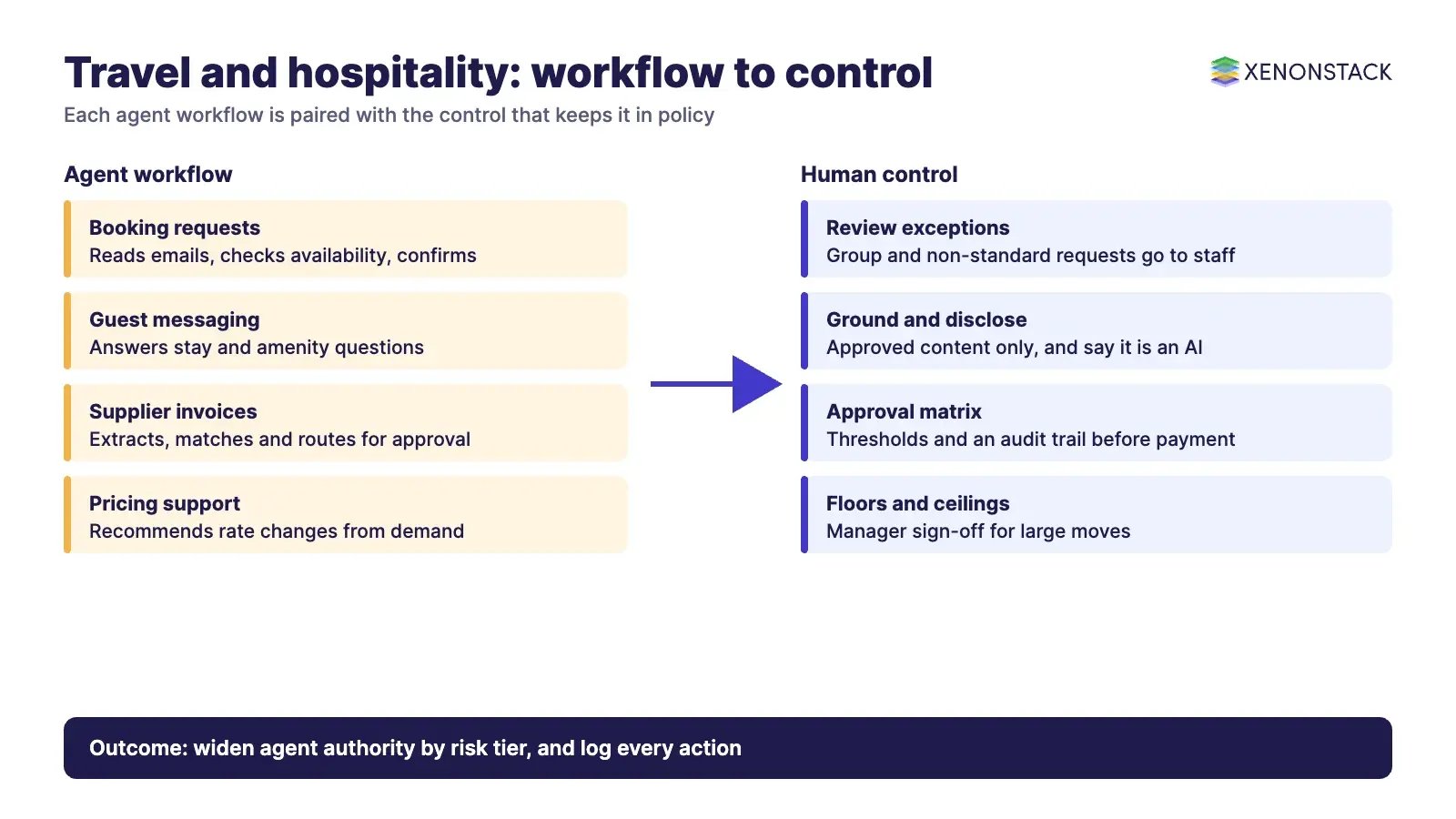
Start where the data is structured, the action is reversible and a person can review exceptions. The table ranks the common use cases by how readily they fit that test.
| Use case | What the agent does | When it fits | Human control |
|---|---|---|---|
| Reservation and booking requests | Reads agent or guest emails, checks availability, updates the reservation system, sends confirmations | High request volume, clear room and rate rules | Review group, amended and non-standard requests |
| Guest messaging and virtual concierge | Answers questions on stays, amenities, timings and local options in several languages | Answers can be grounded in approved property content | Escalate refunds, complaints and anything touching policy |
| Supplier invoice processing | Extracts vendor, amount, due date and tax; matches to orders; routes for approval | Many vendors, mixed invoice formats | Approval thresholds and an audit trail |
| Revenue and pricing support | Monitors demand, competitor rates and occupancy; recommends or sets rate changes within limits | Existing revenue management discipline and clean data | Rate floors and ceilings; manager sign-off for large moves |
| Inventory and procurement | Reads replenishment requests, updates stock, alerts when items fall below thresholds | Consumables and supplies with set minimums | Purchase approval above a set value |
| Check-in, check-out and billing | Sends pre-arrival messages, prepares folios and invoices, handles digital keys through the property system | Property systems expose reliable interfaces | Front desk handles identity checks and disputes |
| Review and feedback analysis | Groups guest reviews by theme and routes issues to the owning team | Large review volume across channels | Team reviews themes before service changes |
| Maintenance and staffing | Flags likely equipment faults from operating data; suggests rosters from forecast demand | Sensor and occupancy data available | Managers approve rosters and work orders |
There is no sourced industry-wide figure here for savings or conversion, so treat any vendor percentage with care and measure the result on your own properties.
What problems in the industry do agents address?
The pressures are well known: many departments work from separate systems, staff turnover is high, guests expect fast and personal service, and online travel agencies and new entrants keep competition tight. The practical effect is manual rekeying and slow responses. Agents target the rekeying and the waiting, not the hospitality itself.
- Operational complexity. Housekeeping, front desk, finance and procurement each hold part of the picture. An agent can read across them and raise a task for the right team.
- Labour pressure. Agents take routine requests so staff spend time on guests. They do not remove the need for trained people at the front line.
- Fragmented data. Agents are only as good as the data they can reach. Our guide to agentic AI in data democratisation covers governed access to shared data.
- Security and privacy. Guest and payment data raise the bar for access control, which the governance section below addresses.
How do the main workflows run end to end?
Reservation requests from travel agents
Traditionally a travel agent emails a request, a manager checks availability and someone keys the booking. With an agent, the request is read, the room and rate rules are applied, availability is checked in the reservation system, the booking is entered and the confirmation goes back to the sender. Exceptions, such as group blocks or unusual rate requests, go to a person with the context attached.
Supplier invoice processing
- Collect invoices from the shared mailbox and store attachments.
- Extract vendor name, invoice number, amount, due date and tax details.
- Match to the purchase order or goods receipt and flag mismatches.
- Enter the data in the finance system.
- Route for approval under the approval matrix before payment.
- Archive the record so auditors can trace every step.
Approval logic is where governance bites. The ElixirData Approval Agent describes approving requests within policy boundaries and escalating exceptions with context, and recording which policy version applied, which is the pattern finance and audit teams look for.
ERP reconciliation and tax reporting
On a schedule, the agent pulls transactional data from the ERP, applies the tax rules the finance team has set, prepares the reconciliation for review and files the output in a controlled folder. Tax rates and rules must come from the finance team, never from the model. For questions on the resulting numbers, AgentAnalyst lets teams ask questions of enterprise data in plain language and, according to its site, records queries as decision traces so the figures can be checked.
Inventory and replenishment
The agent reads replenishment requests, updates stock, compares levels with the minimum set for each item and alerts the buyer when an item runs low. A daily summary goes to the responsible team. Keep purchase approval with a person above a set value.
Pricing and revenue support
Pricing agents combine demand signals, competitor rates and occupancy to recommend rate changes. Treat them as decision support first. Set floors and ceilings, log every change with its reason and let revenue managers widen the agent's authority only once results are reviewed.
See an airline refund query resolved by AI agents
ElixirClaw video: an airline refund query handled by AI agents.
To build and govern agents of this kind, ElixirClaw is an agentic OS platform to build, orchestrate and govern AI agents and automation workflows while keeping humans in control. For robotic and physical automation in properties, see agentic AI in robotics.
What should leaders govern before a guest-facing agent goes live?
A guest-facing agent speaks for the business. In Moffatt v. Air Canada (2024 BCCRT 149, decided 14 February 2024), the British Columbia Civil Resolution Tribunal found the airline liable for negligent misrepresentation after its website chatbot gave a customer wrong information about bereavement fares. Air Canada argued that the chatbot was a separate entity responsible for its own actions; the tribunal rejected this, saying it should be obvious that the company is responsible for all the information on its website. The lesson is practical: answers must be grounded in current, approved policy, and the company owns what its agent says. Source: Civil Resolution Tribunal decision.
| Risk | Control | Source or status |
|---|---|---|
| Agent states a wrong fare, refund or policy | Ground answers in approved policy content; escalate refunds and exceptions to staff; log what the agent said | Moffatt v. Air Canada, 2024 BCCRT 149 |
| Guests do not know they are talking to a machine | Disclose that the guest is dealing with an AI system | The European Commission states that people using chatbots should be made aware they are interacting with a machine; transparency rules apply from August 2026 (European Commission, AI Act) |
| Payment data exposed to the agent | Keep card data out of prompts and logs; limit the agent to tokenised payment steps | PCI DSS applies to entities that store, process or transmit cardholder data (PCI Security Standards Council) |
| Agent acts beyond its authority | Least-privilege access, spend and rate limits, human approval for high-value actions | See agentic AI risk management |
| Cannot explain a decision | Keep a decision trace: input, policy version, action and approver | Needed for audit and dispute handling |
Legal obligations differ by country and by use case, so take advice for your own markets. This post is not legal advice.
What is changing in the standards and rules around travel AI?
| Area | What the official source says | Why it matters |
|---|---|---|
| EU AI Act | Per the European Commission, the Act entered into force on 1 August 2024; transparency rules and general application take effect from 2 August 2026; the AI Omnibus moved Annex III high-risk obligations to 2 December 2027 | Guest-facing agents need disclosure; check whether any use, such as staff scheduling, is a high-risk category |
| IATA NDC | IATA describes NDC as a data exchange format based on offer and order management processes; the NDC 24.1 generation was introduced in 2024 | Airline and agency agents can work with structured offers and orders instead of screen scraping |
| PCI DSS | Published by the PCI Security Standards Council; covers entities handling cardholder data; the page refers to v4.x | Sets the baseline for any agent that touches payment steps |
Dates were read from the Commission, IATA and PCI SSC pages in November 2026. Check them again before relying on them for a compliance plan.
How should a hotel group or travel business adopt agentic AI?
- Pick one workflow with clear rules. Booking requests or supplier invoices are usual first choices.
- Map the decision, the data and the policy behind it. Write down who approves what and at what limit.
- Run the agent in shadow mode. It proposes; staff compare against what they would have done.
- Add autonomy by risk tier. Low-value, reversible actions first; refunds, rate changes and payments stay with people longest.
- Measure on your own data. Handling time, error rate, escalation rate and guest complaints, per property.
- Extend to the next workflow only when the controls and logs hold up in review.
When agentic AI is the wrong choice
- The process is rare, high-stakes and changes every time, such as large group contracts or crisis rebooking.
- The source systems have no reliable interface and the agent would depend on fragile screen steps.
- The guest decision is sensitive, such as a complaint with legal or safety implications.
- You cannot yet log, review and roll back what the agent does.
What will the next few years look like?
Three shifts are visible from the official sources above. Disclosure duties for guest-facing AI start applying in the EU from August 2026. Structured offer and order standards such as IATA NDC give agents cleaner data to work with in airline retail. And integration with property and building data, such as equipment and occupancy signals, will extend agents from messages into operations. Expect the winners to be the businesses with clean data and clear approval rules, not the ones with the most agents.
To map one decision your travel or hospitality agents should make, and the context and policy it depends on, book a Context Workshop. See what happens in the workshop.
Frequently asked questions
What are the best agentic AI use cases in travel and hospitality?
Reservation and booking request handling, guest messaging, supplier invoice processing, inventory replenishment, review analysis and pricing support are the usual starting points because the data is structured and exceptions can go to staff.
Is a company responsible for what its AI chatbot tells customers?
In Moffatt v. Air Canada (2024 BCCRT 149), a Canadian tribunal held the airline liable for negligent misrepresentation after its chatbot gave wrong bereavement fare information, and rejected the argument that the chatbot was a separate entity. This is one tribunal decision, not legal advice for every country.
Do guests have to be told they are talking to an AI agent?
The European Commission says people using chatbots should be made aware they are interacting with a machine, and that AI Act transparency rules apply from August 2026. Check the rules in each market you serve.
What is IATA NDC and why does it matter for AI agents?
IATA describes NDC as a data exchange format based on offer and order management processes. Structured offers and orders give airline and agency agents cleaner data than free-text emails or screens.
Which tasks should stay with people?
Refunds, complaints, high-value rate changes, payment approvals and anything with legal or safety implications should stay with staff until logs and reviews show the agent handles them reliably.
Follow XenonStack on LinkedIn: XenonStack on LinkedIn for new guides on agentic AI, data and platform engineering.
Explore the XenonStack platform family: ElixirData · ElixirClaw · ElixirHub · NexaStack · MetaSecure · Neural AI · AgentGRC · AgentSRE · AgentAnalyst · AgentInstruct · AgentRAI · AgentScrum · AgentSearch · AgentForce · AI Aviator · SAIF Aviator · CohortIQ · XenonStack AI · XenonStack UAE