Key takeaway
- Agentic AI for tabular data: orchestrated agents, when they beat SQL, BI and tree models, the controls to apply and a staged rollout for enterprises.
Agentic AI for tabular data means a set of governed agents that clean, transform, analyse, visualise and report on rows-and-columns data under an orchestrator, instead of a fixed chain of hand-written queries and ETL rules. It fits best where schemas change, questions arrive in plain language and several teams depend on the same tables. It does not replace SQL, BI tools or the models that already work well on your tables.
This guide covers the architecture, a decision table for choosing between SQL, tree models, tabular foundation models and agents, the controls to apply before an agent touches production tables, and a staged rollout. It sits alongside our guides to agentic AI for data management and data quality agents; this one focuses on the tabular layer itself.
What is tabular data, and why does it still run most enterprise decisions?
Tabular data is structured data arranged in rows and columns, as in a spreadsheet or relational table. Each column holds one attribute with a defined type, and each row is one record, such as a sales order with an order ID, customer, product, quantity and date. Keys link tables together, which is what makes relational queries, reporting and forecasting possible.
That structure is also what makes it fit for machine learning: forecasting, anomaly detection and recommendations all start from tables. The difficulty is not the format. It is keeping the data clean, consistent and explainable as sources, schemas and questions change.
Where do traditional tabular pipelines break down?
Most estates still rely on manual cleaning, SQL written for a fixed schema, rule-based ETL and BI dashboards refreshed on a schedule. Each works until the inputs move.
| Stage | Traditional approach | Where it strains |
|---|---|---|
| Cleaning | Manual fixes for missing values, errors and duplicates | Repetitive, slows time to insight and depends on a few analysts |
| Transformation | Static ETL rules and hand-written SQL | A schema or business-logic change means rewriting queries and pipelines |
| Analysis | Statistical models on prepared data | Needs well-prepared inputs and adapts slowly to shifting patterns |
| Reporting | BI dashboards on periodic refresh | Reports arrive after the event, so decisions lag changes |
| Access | Requests to a central data team | Business users wait for answers; silos give fragmented customer views |
The customer impact follows from the same causes: delayed answers, forecasts built on poor-quality data and generic personalisation because pipelines cannot adapt quickly.
What does an agentic architecture for tabular data look like?
A typical design has four layers: data sources, a master orchestrator, specialised agents and governed outputs. The orchestrator sequences work and enforces dependencies. Each specialised agent does one job, and each hands a result and a record of what it did to the next.
| Layer or agent | What it does | Control to attach |
|---|---|---|
| Data sources | CSV files, relational databases and cloud warehouses, APIs and spreadsheets | Read-only service accounts; source catalogue entry for every table |
| Master orchestrator | Triggers agents on new data or a schedule, orders tasks and passes results on | Allow-list of agents and tools; every run logged |
| Data cleaning agent | Detects missing values, duplicates and outliers; imputes or flags for review | Flag rather than overwrite; keep the original values |
| Data transformation agent | Standardises dates and currency, encodes categories, joins and enriches | Versioned transformation logic; lineage kept |
| Data analysis agent | Applies statistics, builds predictive models, drafts insights | Model and metric versions recorded; human review of material findings |
| Visualisation agent | Builds dashboards and charts for each audience | Row-level and column-level access follows the viewer |
| Reporting agent | Compiles and distributes reports on a schedule | Approval before external or high-impact distribution |
In practice these agents sit above the warehouse and BI stack, not in place of it. For example, AgentAnalyst states that it lets teams ask questions of enterprise data in plain language and connects to platforms such as Databricks, Snowflake, Looker, Power BI and Tableau, according to its site.
Which approach fits which tabular task?
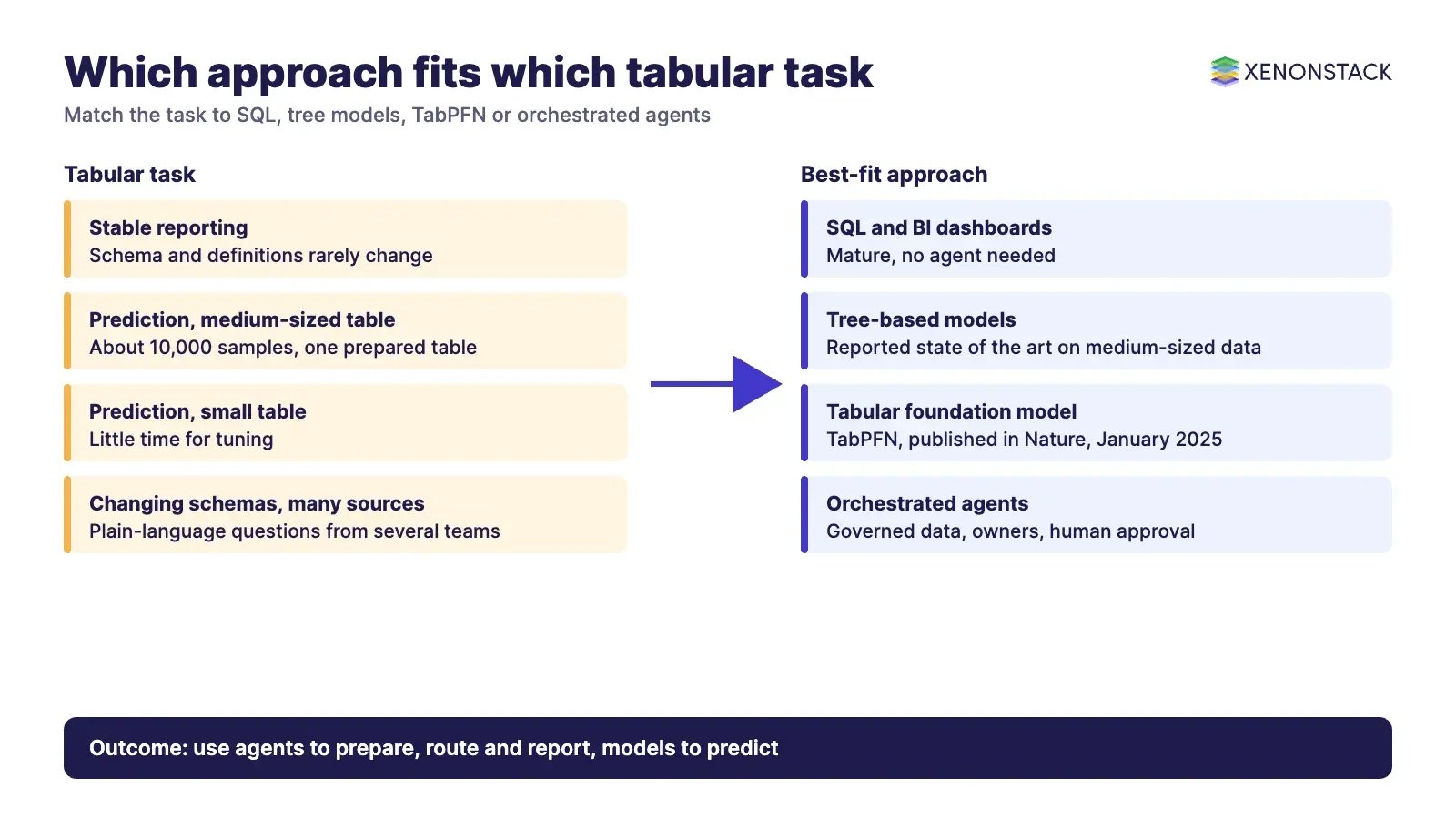
Agents are one option among several, and often the wrong one for a single well-defined prediction. Use the table to match the task to the tool.
| Task | Best-fit approach | When it fits | Evidence and status |
|---|---|---|---|
| Stable, repeated reporting | SQL and BI dashboards | Schema and definitions rarely change | Mature; no agent needed |
| Prediction on a single well-prepared table | Gradient-boosted or other tree-based models | Medium-sized data (about 10,000 samples) | Grinsztajn, Oyallon and Varoquaux (2022) report that tree-based models remain state of the art on medium-sized data |
| Prediction on small tables with little tuning time | Tabular foundation model such as TabPFN | Up to about 10,000 samples | Published in Nature, January 2025; the abstract reports it beating a tuned ensemble in 2.8 seconds on a classification task versus 4 hours of tuning |
| Changing schemas, many sources, plain-language questions | Orchestrated agents over governed data | Several teams, evolving inputs, an owner for each agent | Newer; accuracy on enterprise SQL needs testing (see below) |
| Multi-step analysis across warehouses | Agents that write and run SQL or code | Complex joins and workflows, with review | Hard benchmark: see the Spider 2.0 result below |
Agents can also call the models in the second and third rows as tools. That is often the strongest pattern: the agent handles the cleaning, joining and reporting, and a purpose-built model handles the prediction.
Which tabular use cases suit AI agents?
The pattern is the same across sectors: cleaning and transformation agents prepare the data, an analysis agent models it and a reporting agent delivers the result. The table shows where each use case sits and what the agent does.
| Use case | Data the agents work on | What the agents do | Read more |
|---|---|---|---|
| Fraud detection (finance) | Transaction amount, location, time and frequency | Flag unusual patterns for alerts and review | Agentic AI in banking and finance |
| Recommendations (e-commerce) | Purchase history, browsing behaviour, demographics | Predict likely next purchases from user data | Retail recommendations on Amazon RDS |
| Patient outcome prediction (healthcare) | Age, history, test results | Build models for readmission or progression risk, for clinical review | Predictive analytics in patient care |
| Inventory management (supply chain) | Stock levels, sales forecasts, lead times | Prepare data from several sources and predict demand to set order quantities | Supply chain platform |
| Sales forecasting (retail) | Historical sales, seasonality, promotions | Model trends for planning and pricing | Retail solutions |
| Customer segmentation (marketing) | Behaviour, purchases, site interactions | Cluster customers into groups for targeting | Agentic AI for marketing |
In regulated settings such as the healthcare and finance rows, the agent supports a person who decides; it does not replace them. Agentic workflows explains how that hand-off is designed.
Video: AI trend analysis of a fall in order value, explained in six minutes.
What controls does an agent need before it touches production tables?
The main risk is an agent with more access than the task needs. OWASP LLM06:2025 Excessive Agency names three causes: excessive functionality, excessive permissions and excessive autonomy. Its listed mitigations map directly onto tabular work.
| Risk | Control for tabular agents | Source |
|---|---|---|
| Agent can call tools it does not need | Limit tools to the minimum; prefer narrow, purpose-built tools over open-ended ones | OWASP LLM06:2025 |
| Agent holds broad database rights | Read-only access where possible; run queries in the user's own context with minimum privileges | OWASP LLM06:2025 |
| High-impact action taken without review | Human approval before writes, deletions or external distribution | OWASP LLM06:2025 |
| Model decides what is allowed | Enforce authorisation in the downstream database and warehouse, not in the prompt | OWASP LLM06:2025 |
| No evidence after the fact | Log every query and action; OWASP notes logging limits damage but does not prevent it | OWASP LLM06:2025 |
| No agreed risk process | Map, measure and manage risk with a recognised framework | NIST AI RMF (voluntary) |
The NIST AI Risk Management Framework is voluntary and was released as version 1.0 on 26 January 2023, with a Generative AI Profile (NIST-AI-600-1) published on 26 July 2024. Our guide to agentic AI risk management shows how to apply it to agents. A decision layer such as ElixirData Context OS keeps governed context, versioned policy and decision traces in one place above the agents, according to its site, which is what an audit of an analytical answer needs.
What does the evidence say about accuracy, cost and project risk?
Treat any promise of fixed percentage savings with caution. Two independent sources set a sober baseline.
| Finding | Source | What it means for you |
|---|---|---|
| On Spider 2.0, 632 real-world enterprise text-to-SQL workflow tasks, an o1-preview-based code agent solved 21.3%, against 91.2% on Spider 1.0 and 73.0% on BIRD (submitted November 2024, revised March 2025) | arXiv:2411.07763 | Real warehouse workflows are much harder than classroom benchmarks; test agents on your own schemas and keep review in the loop. Newer models may score differently |
| Gartner predicts more than 40% of agentic AI projects will be cancelled by the end of 2027, citing escalating costs and unclear business value; it also says many vendors rebrand chatbots as agentic (25 June 2025) | Gartner prediction, as reported by Reuters | Pick one measurable use case and prove value before scaling |
How should enterprises adopt agents on tabular data?
Adopt in stages, widening autonomy only as evidence builds.
Inventory and certify the tables. List sources, owners and definitions. A catalogue such as those in our enterprise data catalogue tools guide gives agents a trusted map.
Start read-only. Let one agent answer questions and draft analysis with no write access.
Add cleaning and transformation with flags. Agents propose fixes; people approve them. Our guide to testing data quality with agentic AI covers rule checks.
Introduce the orchestrator. Sequence agents, log every run and set owners and service levels.
Automate low-risk reporting. Scheduled reports first; approvals for anything external or financial.
Measure. Track answer accuracy against reviewed samples, time to insight and rework, then decide whether to extend.
For a platform to build, orchestrate and govern the agents, ElixirClaw describes itself as an agentic OS platform to build, orchestrate and govern AI agents and automation workflows while keeping humans in control, according to its site.
When should you not use agents on tabular data?
Skip agents for stable reports that SQL and BI already serve, for one-off predictions where a tree-based model or tabular foundation model is simpler to validate, and for data nobody owns or has defined. An agent on unmanaged tables only automates the confusion. Also avoid full autonomy wherever a wrong number triggers a payment, a clinical decision or a regulatory filing.
To map one tabular decision your agents should make, and the context and policy it depends on, book a Context Workshop. See what happens in the workshop.
Frequently asked questions
What is agentic AI for tabular data?
It is a design in which an orchestrator coordinates specialised agents that clean, transform, analyse, visualise and report on structured rows-and-columns data, with logging, access controls and human approval where the impact is high.
Do agents replace SQL, BI tools or tree-based models?
No. Stable reports stay in SQL and BI. Grinsztajn, Oyallon and Varoquaux report that tree-based models remain state of the art on medium-sized tabular data of about 10,000 samples, so agents are best used to prepare data, call such models and report results.
How accurate are AI agents on enterprise SQL?
On the Spider 2.0 benchmark of 632 real-world enterprise text-to-SQL workflow tasks, an o1-preview-based code agent solved 21.3% of tasks, against 91.2% on Spider 1.0 and 73.0% on BIRD. Test any agent on your own schemas before relying on it.
What controls should a tabular data agent have?
Minimum tools, read-only or least-privilege access, human approval for high-impact actions, authorisation enforced in the downstream database and full logging, following OWASP LLM06:2025 Excessive Agency and a risk process such as the NIST AI RMF.
Why do agentic AI projects fail?
Gartner predicts more than 40% of agentic AI projects will be cancelled by the end of 2027, citing escalating costs and unclear business value, as reported by Reuters. A single measurable use case reduces that risk.
Where should we start?
Pick one high-value table set with a named owner, run a read-only agent against it, measure accuracy against reviewed samples and add cleaning, orchestration and automated reporting only after that.
Follow XenonStack on LinkedIn: XenonStack on LinkedIn for new guides on agentic AI, data and platform engineering.
Explore the XenonStack platform family: ElixirData · ElixirClaw · ElixirHub · NexaStack · MetaSecure · Neural AI · AgentGRC · AgentSRE · AgentAnalyst · AgentInstruct · AgentRAI · AgentScrum · AgentSearch · AgentForce · AI Aviator · SAIF Aviator · CohortIQ · XenonStack AI · XenonStack UAE