Key takeaway
- How an agentic AI image synthesis pipeline orchestrates latent diffusion, rectified flow and refinement agents, with governance and cost trade-offs.
An agentic AI image synthesis pipeline uses several specialised agents to curate data, choose a generative model, refine the output and score the result, instead of relying on one model for every image. The underlying image models are the same families the research community already publishes: latent variable models, latent diffusion and rectified flow transformers. What the agent layer adds is stage-by-stage selection, evaluation and a record of why each image passed or failed.
For enterprise leaders the decision is not whether diffusion can make sharp images. It can. The decision is whether the extra orchestration, GPU scheduling and governance are worth the cost for your use case. This guide sets out which model fits which stage, how the agents split the work, what the published evidence supports, and when a single model is the better choice. For the wider model landscape, see our guide to generative AI models.
What is an agentic AI image synthesis pipeline?
It is a workflow in which agentic AI components each own one stage of image creation: data curation, generation, refinement and evaluation. A planning component picks the model for each request, passes intermediate results between stages and decides whether to retry. The agents do not replace the image models. They decide which model runs, with what settings, and whether the output meets a defined standard.
A single-model setup is simpler to operate. A multi-agent setup is more flexible when requests vary widely, for example product visuals, stylised campaign art and synthetic training images in the same programme.
Which model architecture fits which stage?
The three papers below are the research base most teams build on. The claims in the table are the authors' own, taken from their abstracts.
| Approach | What the authors claim | Where it fits in a pipeline | Source and status |
|---|---|---|---|
| Latent diffusion models | Diffusion applied in the latent space of a pretrained autoencoder, which cuts the compute needed compared with pixel-space diffusion; cross-attention allows text or box conditioning | Default generation stage where cost and speed matter | Rombach et al., CVPR 2022 (arXiv 2112.10752) |
| Rectified flow transformers | A transformer with separate weights for image and text tokens; outperforms established diffusion formulations in the authors' large-scale study | Prompts that need accurate text rendering and composition | Esser et al., March 2024 (arXiv 2403.03206) |
| Taming transformers | Combines a convolutional model that learns an image vocabulary with a transformer that composes it; first reported megapixel results with transformers for semantically guided synthesis | Controlled, semantically guided generation; mainly a research reference today | Esser, Rombach and Ommer, 2020 (arXiv 2012.09841) |
Read the table as a menu, not a ranking. The papers use different benchmarks and years, so the agent layer should choose by test results on your own prompts, not by paper claims alone. Sources: latent diffusion, rectified flow transformers and taming transformers.
How do the agents split the work?
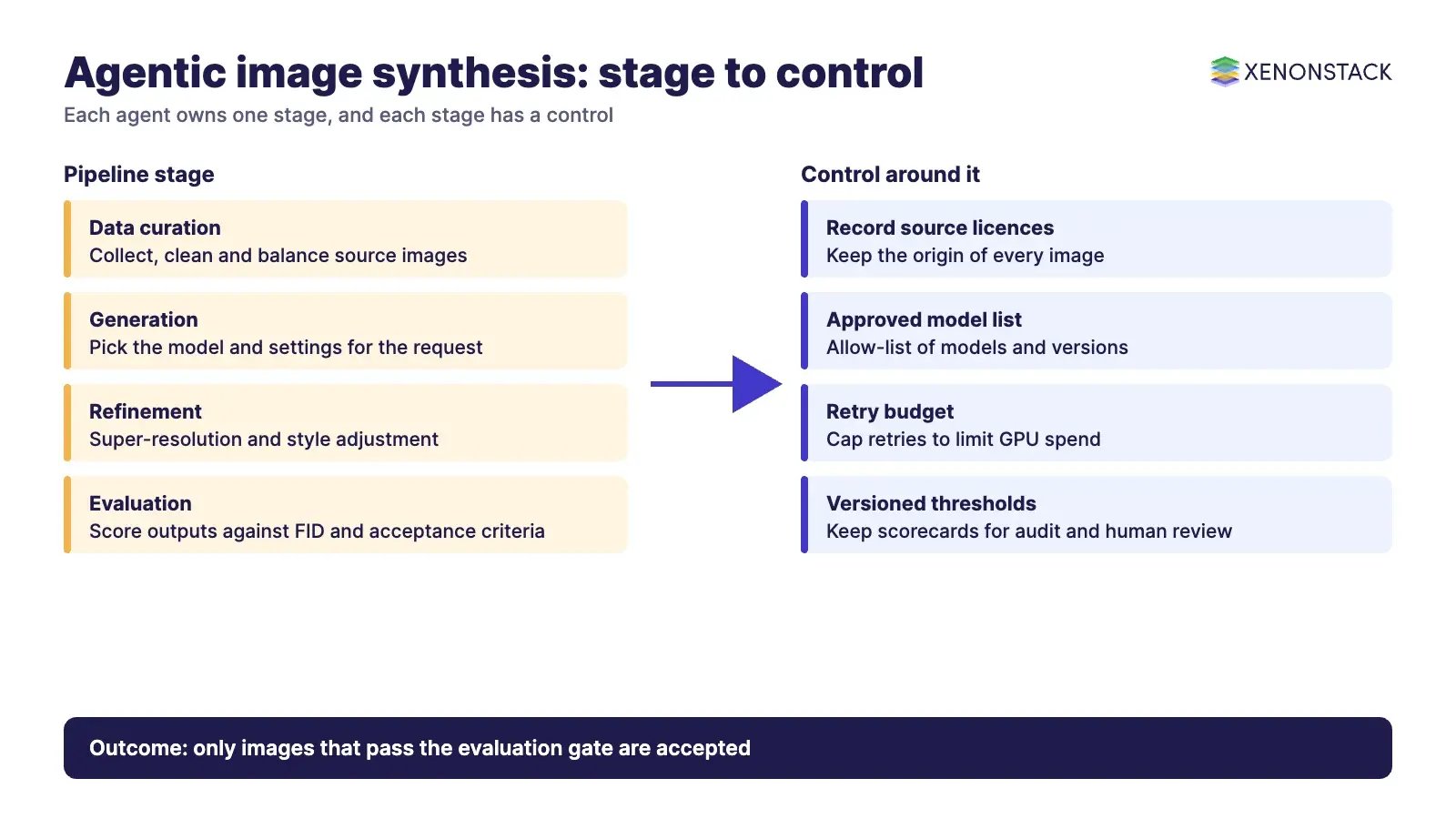
| Agent | Job | Control to put around it |
|---|---|---|
| Data curation agent | Collects, cleans and balances training and reference images, using synthetic data where real data is scarce | Record the licence and origin of every source image |
| Generation agent | Chooses the model and settings for the request, as one of the AI agents in the pipeline | Allow-list of approved models and versions |
| Refinement agent | Applies super-resolution and style adjustments to improve texture and edges | Cap the number of retries to limit GPU spend |
| Evaluation agent | Scores outputs against benchmarks such as FID and your own acceptance criteria, and triggers a retry or a human review | Keep scorecards and thresholds versioned so decisions can be audited |
The evaluation agent is the part most teams underbuild. ElixirData's AgentEvaluation describes scoring and benchmarking enterprise AI agents against real workflows, with scorecards that show when an agent can be given more autonomy.
How does adaptive scaling build high resolution in stages?
Rendering an ultra-high-resolution image in one pass is expensive. A staged sequence usually works better: generate at a balanced resolution to fix the layout, apply a super-resolution model to sharpen texture and edges, then run a transformer-based refinement for balance. Each stage can be checked before the next one spends more GPU time. This is a common engineering pattern rather than a published guarantee, so measure artefact rates and cost per accepted image on your own workload.
Do diffusion models still beat GANs?
The 2021 paper Diffusion Models Beat GANs on Image Synthesis reported FID scores on ImageNet of 2.97 at 128 by 128, 4.59 at 256 by 256 and 7.72 at 512 by 512, and said diffusion could match BigGAN-deep with as few as 25 forward passes per sample. That result is specific to the benchmark and the models of the time. GANs still have a place where speed matters, and our post on where GANs still fit in 2026 covers it. GANs can generate quickly but are known to suffer from mode collapse, while large transformer models need substantial compute.
What do governance, security and cost need?
- Provenance: log the model, version, prompt, seed and reviewer for each accepted image, so a visual can be traced and withdrawn.
- Data rights: confirm the licence of training and reference data before generation, and keep the evidence with the record.
- Review gates: require a human sign-off for regulated outputs, such as synthetic medical or pharmaceutical imagery used for research or training.
- Cost control: set a retry budget and GPU quota per request class, because refinement loops can multiply spend.
- Agent governance: keep agent actions inside policy with an audit trail. ElixirClaw is an agentic OS platform to build, orchestrate and govern AI agents and automation workflows while keeping humans in control.
Which industries benefit first?
| Sector | Typical use | Main caution |
|---|---|---|
| Media and marketing | Concept art, campaign assets, product visuals | Brand consistency and rights to training data |
| Medical and pharmaceutical research | Synthetic images for training and analysis | Expert validation before any clinical use |
| Travel and hospitality | Destination visuals, virtual tours | Accuracy of what is shown to customers |
| Manufacturing | Prototype and process visualisation | Visuals must not be mistaken for engineering data |
| Insurance | Scenario visuals for claims and risk analysis | Synthetic images must never be treated as evidence |
When is a multi-agent pipeline the wrong choice?
If your requests are uniform, a single tuned latent diffusion model with a fixed refinement step is cheaper to run and easier to audit. Multi-agent orchestration earns its cost when prompt types vary, quality thresholds differ by use case, or you need an evaluation record for governance. Avoid adding agents only to make the architecture look advanced.
What adoption sequence works?
- Pick one image type and write acceptance criteria with the business owner.
- Run a single-model baseline and record quality, cost and rejection rate.
- Add the evaluation agent first, then the refinement agent.
- Add model selection only when the baseline shows one model cannot serve all request types.
- Version thresholds, models and prompts, and review them on a fixed schedule.
What changes next?
The rectified flow paper reports that its architecture follows predictable scaling trends, with lower validation loss tracking better image quality. If that holds in production, teams can forecast quality against compute more reliably. The wider direction is towards pipelines that merge rectified flow transformers and latent diffusion in one model, with the agent layer handling selection, evaluation and policy. Treat any forecast beyond the published results as a hypothesis to test.
To map one image-generation decision your agents should make, and the context and policy it depends on, book a Context Workshop. See what happens in the workshop. ElixirData's Context OS keeps governed context, versioned policy and decision traces in one decision layer above AI agents.
Related on XenonStack
- RAG and LLM development services: grounded answers that cite their sources.
- AI Trust Score: score AI for fairness, explainability and robustness.
- Edge and vision AI: computer vision agents at the edge.
FAQ: agentic AI for image synthesis
What is agentic AI image synthesis?
It is image generation run by several specialised agents that curate data, pick a model, refine the output and evaluate it, instead of one model handling every step.
Which model should the generation stage use?
Latent diffusion is the usual default because it reduces compute against pixel-space diffusion. Rectified flow transformers are claimed by their authors to do better on text rendering and human preference. Test both on your own prompts.
Do diffusion models beat GANs?
On the 2021 ImageNet benchmarks reported by Dhariwal and Nichol, yes. GANs can still be faster, so the answer depends on your quality and latency needs.
How is the output quality measured?
Teams use benchmarks such as FID plus their own acceptance criteria, and keep human review for regulated or customer-facing images.
When should we not use multiple agents?
When requests are uniform and a single tuned model meets quality and cost targets, because extra agents add GPU cost and audit overhead.
Follow XenonStack on LinkedIn: XenonStack on LinkedIn for new guides on agentic AI, data and platform engineering.
Explore the XenonStack platform family: ElixirData · ElixirClaw · ElixirHub · NexaStack · MetaSecure · Neural AI · AgentGRC · AgentSRE · AgentAnalyst · AgentInstruct · AgentRAI · AgentScrum · AgentSearch · AgentForce · AI Aviator · SAIF Aviator · CohortIQ · XenonStack AI · XenonStack UAE