Key takeaway
- Agentic AI on an AWS data lake: which jobs agents can own, how Lake Formation, Macie and Glue keep them governed, and how to adopt them in stages.
Agentic AI on an AWS data lake means software agents that watch the lake, decide on a next step and act through AWS services, inside permissions you define. The jobs that fit best are repetitive and rule-bound: classifying new data, checking quality, tuning storage cost and preparing data for analysts. Access policy, audit and approval for risky actions stay with Lake Formation, IAM and your own change process.
For a CDO, CTO or platform lead the question is not whether an agent can run an AWS Glue job. It is which decisions the agent may take alone, which need a human, and where the evidence of each decision is kept. This post sets out the patterns, the AWS services involved, the governance controls and an adoption sequence. It builds on our wider guide to agentic AI frameworks, tools and use cases.
What does agentic AI add to a data lake on AWS?
A traditional lake relies on scheduled jobs and people who react to alerts. An agentic AI layer adds a loop: observe lake metadata and events, plan a step, call a tool, check the result and record what happened. The tools are the AWS services you already run, so the agent adds judgement and sequencing rather than new storage or compute.
Three properties matter to an architect. The agent works through scoped permissions, so its reach is set by IAM and Lake Formation. Each step is a logged API call. And the agent can be limited to propose-only, where a person approves before anything changes.
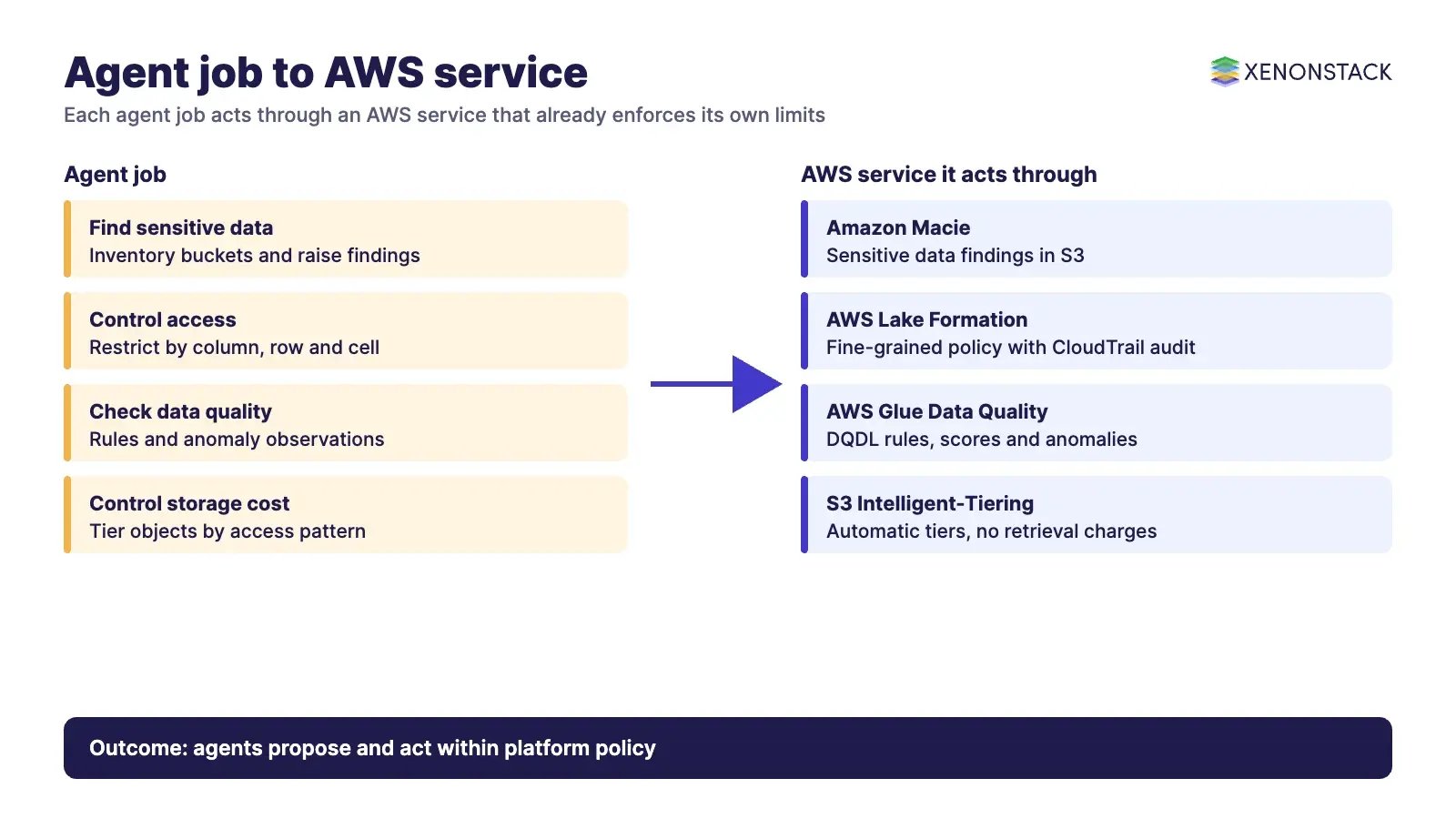
Which AWS services does each agent job use?
| Agent job | AWS service it acts through | When it fits | Source for the service |
|---|---|---|---|
| Find sensitive data | Amazon Macie | Buckets receive data from many teams and nobody has inventoried it | Macie discovers sensitive data in S3 and raises a finding for each detection |
| Control access | AWS Lake Formation and IAM | Many tables, roles and accounts share one lake | Lake Formation restricts access down to column, row and cell level |
| Check data quality | AWS Glue Data Quality | Rules are needed per table and drift must be caught | Rules are written in DQDL; anomaly detection raises observations |
| Manage table storage | Amazon S3 Tables | Analytics tables in Apache Iceberg format | S3 runs compaction, snapshot management and file clean-up automatically |
| Control storage cost | S3 Intelligent-Tiering | Access patterns are unknown or change | Objects move between tiers by access; no retrieval charges |
| Build and run agents | Amazon Bedrock AgentCore | You need a managed platform for production agents | AWS describes it as a platform for production AI agents, with Gateway and Policy controls |
How do agents keep a data lake governed and secure?
Governance should sit in the platform, not in the agent's prompt. AWS Lake Formation gives its own permissions model that augments IAM, with policies down to database, table, column, row and cell level, LF-Tags to scale policy across many resources, and CloudTrail audit logs that show who tried to reach which data and when. An agent that works as a Lake Formation principal inherits those limits.
Amazon Macie inventories S3 buckets and finds sensitive data in objects, using managed and custom data identifiers. An agent can read the findings, propose the tag or permission change that follows, and route it for approval. Our primer on identity and access management covers the role design behind this. For the agent's own actions, AgentGRC keeps autonomous actions inside policy, with the audit trail risk teams need.
How do agents improve ingestion and data quality?
AWS Glue Data Quality measures data against rules written in Data Quality Definition Language, reports a score as the share of rules that pass, and uses machine learning to flag anomalies as observations. For Data Catalog tables, its advanced rule recommendations use Amazon Bedrock to draft rules from table metadata and sampled rows. An agent can sit above this: read a failing score, find the upstream change, and propose a fix or quarantine rule.
Keep the agent's authority narrow. Quarantining a bad batch is a reasonable autonomous action. Rewriting source records is not, because it changes what the business treats as fact. For teams that need test data while rules mature, see synthetic data generation with agentic AI.
Where do agents help with analytics and cost?
On analytics, the useful pattern is a question-to-query agent that works over catalogued, permissioned tables, so analysts ask in plain language and the lake's access rules still apply. AgentAnalyst lets teams ask questions of enterprise data in plain language and get real-time insights.
On cost, S3 Intelligent-Tiering already moves objects between access tiers by use, with no retrieval charges, and AWS recommends it for data with unknown or changing access patterns such as data lakes. Amazon S3 Tables adds automatic compaction, snapshot management and unreferenced file removal for Iceberg tables. An agent's role is to report where these settings are not applied, and to propose changes with the cost effect stated, rather than to replace them.
What has changed in AWS agent tooling?
AWS states that you can no longer sign up for Amazon Bedrock Agents, now called Amazon Bedrock Agents Classic, though existing users can continue, and it points new builds to Amazon Bedrock AgentCore with the Strands Agents SDK. The AgentCore page describes a platform for production agents, with a Gateway that manages agent connections to MCP servers, APIs and Lambda functions, and Policy controls enforced at the platform layer. If an older design of this kind names Bedrock Agents, check it before you build on it. Source pages read 12 November 2026.
How should you sequence adoption?
| Stage | Agent authority | Exit test |
|---|---|---|
| 1. Observe | Read-only on metadata, findings and quality scores | Reports match what stewards find by hand |
| 2. Propose | Drafts tags, rules and tiering changes for approval | Approval rate is high and rejections are understood |
| 3. Act on low-risk items | Quarantine a failing batch, apply an approved tag | Every action is reversible and logged in CloudTrail |
| 4. Widen scope | More domains and accounts, same approval rules | Policy is versioned and reviewed on a schedule |
When should you not use autonomous agents on the lake?
Avoid autonomy where an action cannot be undone, where regulated data is changed or deleted, or where no one can explain the decision afterwards. Do not give an agent broad admin roles to save design time. If your tables lack owners, tags or quality rules, fix that first: an agent working over unlabelled data will only make confident mistakes faster. Autonomous ETL and cross-service orchestration with Lambda, EMR or Athena are workable, but start with propose-only until the evidence supports more.
To map one data lake decision your agents should make, and the context and policy it depends on, with ElixirData Context OS keeping governed context, versioned policy and decision traces in one decision layer above AI agents, book a Context Workshop. See what happens in the workshop.
Frequently asked questions
What is agentic AI in a data lake?
It is software that observes lake metadata and events, plans a step, calls AWS services and records the result, within permissions you set.
Which AWS service controls what an agent can read?
AWS Lake Formation, alongside IAM. It supports policies down to column, row and cell level and logs access through CloudTrail.
Can an agent find sensitive data in S3?
Amazon Macie finds sensitive data in S3 objects and raises a finding for each detection. An agent can act on those findings, with approval for changes.
Is Amazon Bedrock Agents still open to new users?
AWS says you can no longer sign up for it, now Bedrock Agents Classic, and points new builds to Amazon Bedrock AgentCore.
Should agents change data automatically?
Only for reversible, low-risk actions such as quarantining a failing batch. Changes to source records or regulated data should need approval.
Follow XenonStack on LinkedIn: XenonStack on LinkedIn for new guides on agentic AI, data and platform engineering.
Ready to put AI agents to work? Explore ElixirClaw, the agentic OS platform to build, orchestrate and govern AI agents.
Explore the XenonStack platform family: ElixirData · ElixirClaw · ElixirHub · NexaStack · MetaSecure · Neural AI · AgentGRC · AgentSRE · AgentAnalyst · AgentInstruct · AgentRAI · AgentScrum · AgentSearch · AgentForce · AI Aviator · SAIF Aviator · CohortIQ · XenonStack AI · XenonStack UAE