Key takeaway
- How AI video analytics detects illegal parking: vehicle detection, tracking, zone and dwell rules, dashboards, and what to check before you deploy it.
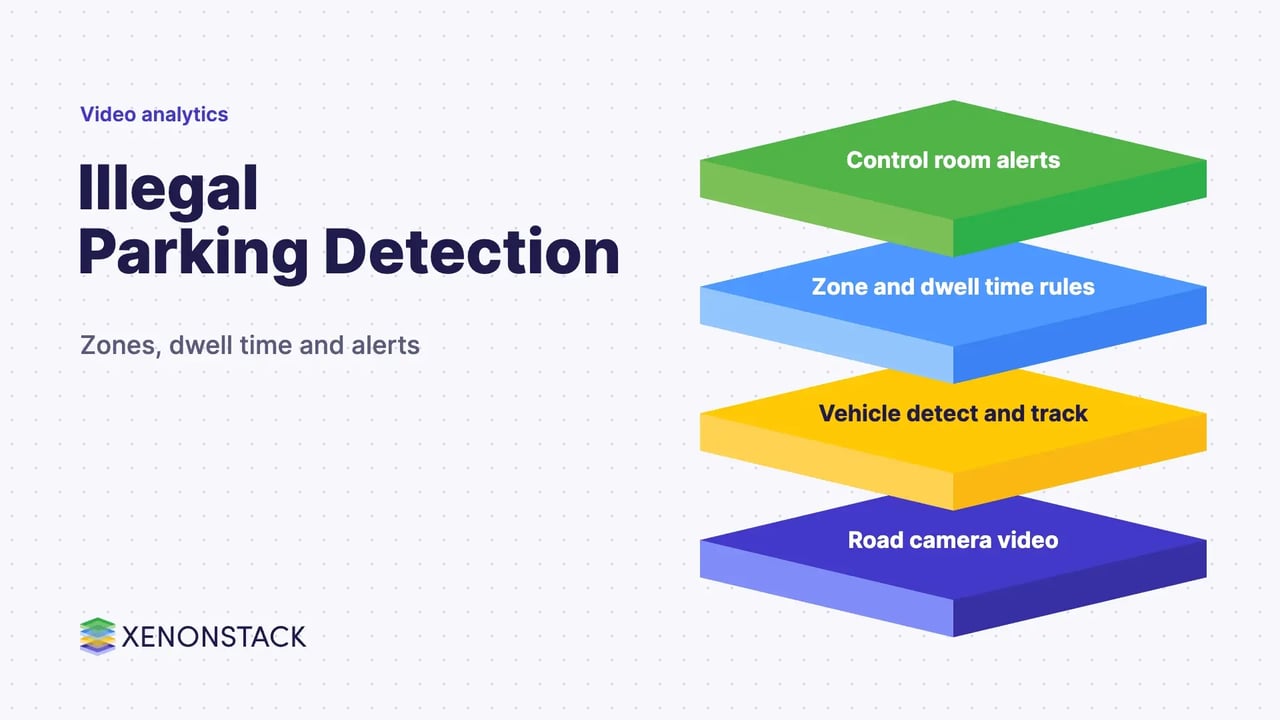
Illegal parking detection with video analytics uses cameras and computer vision to spot vehicles that stop where parking is not allowed, and to raise an alert without an officer having to watch every feed. The same system can show authorities where violations cluster and where parking space is free.
This page is for road authorities, city transport teams and parking operators. It covers the problem, how detection works, an example rule, where AI agents fit, a manual versus automated comparison, and what to check before you deploy it.
What problem does illegal parking create?
As population and vehicle numbers grow, roads face more congestion, suspicious activity and accidents. Road monitoring authorities find it hard to keep track of everything with people alone. Government and road management authorities have begun to use Artificial Intelligence and video surveillance to reduce road incidents. A useful system does more than track moving objects: it interprets patterns of behaviour and alerts the right people early.
How does AI detect illegal parking?
Research on real-time systems, such as the illegal parking detection paper on arXiv, describes a common pattern: detect vehicles with a neural network, track them from frame to frame, and time how long each one stays still inside a region of interest. The same paper notes that the region of interest is marked manually because it varies by scene.
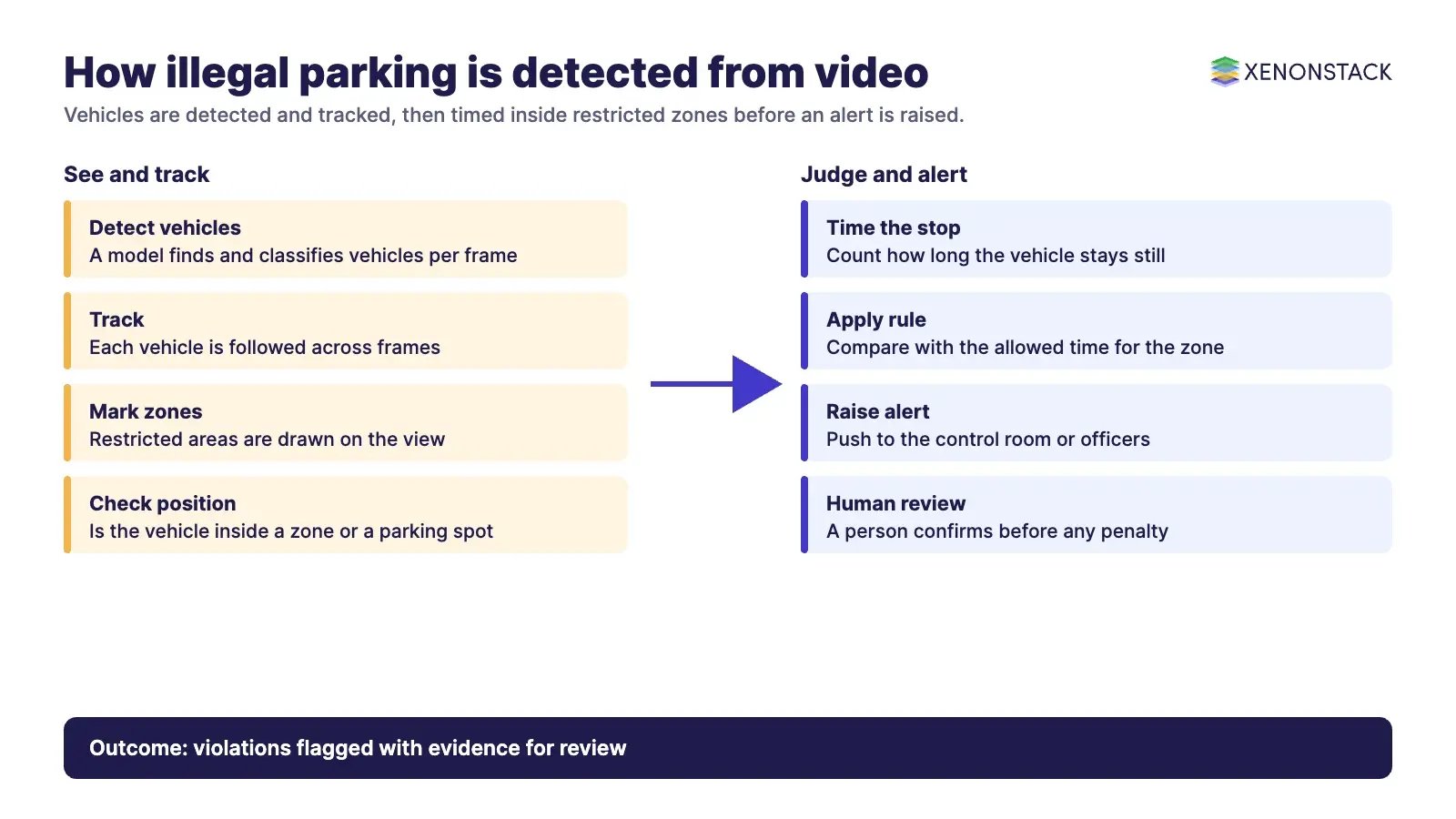
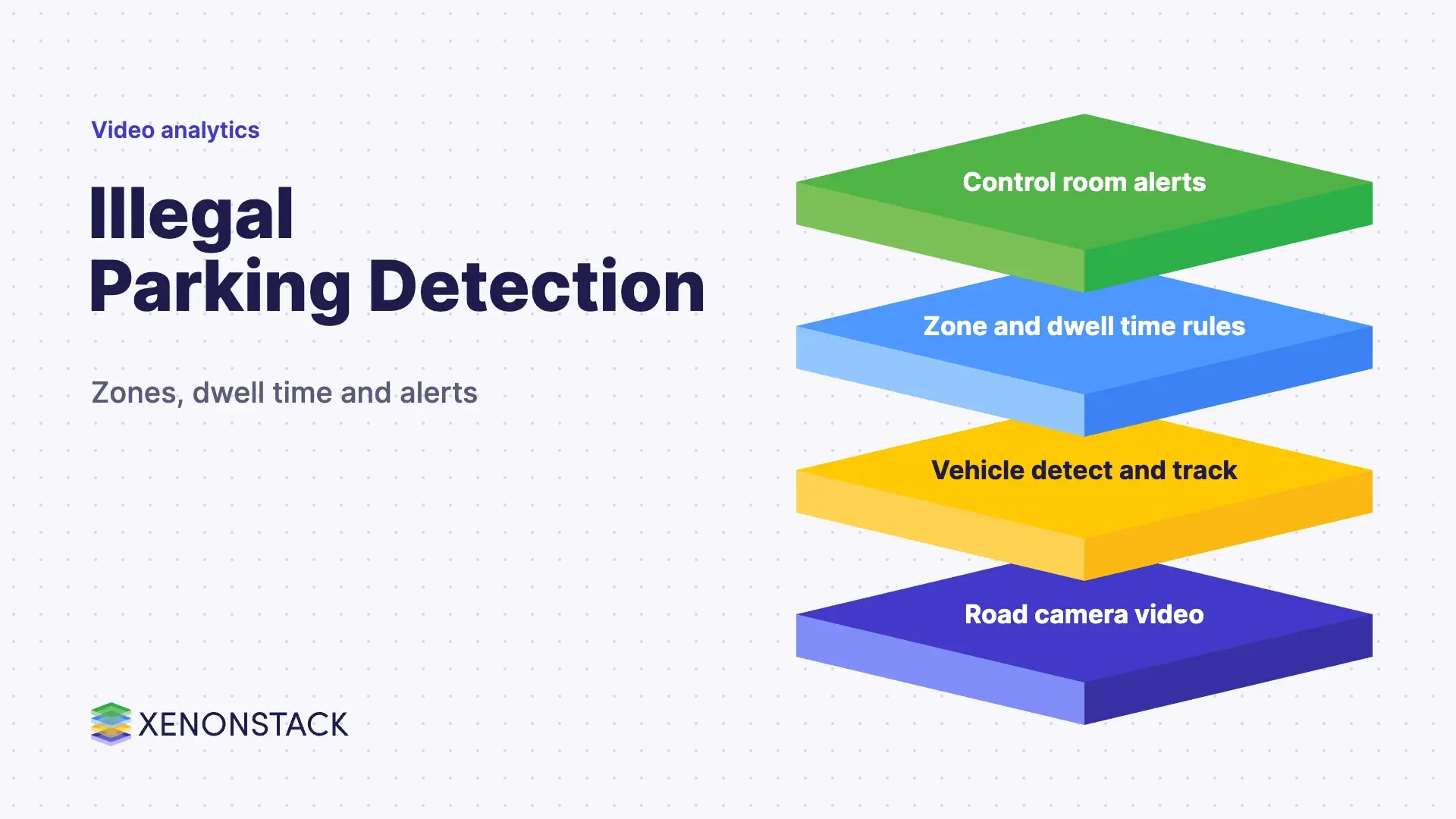
- Detect: a model finds and classifies vehicles in each video frame.
- Track: each vehicle is followed across frames, with detection repeated periodically to catch new arrivals.
- Define zones: restricted areas, such as a fire lane or a bus stop, are drawn on the camera view.
- Time the stop: the system counts how long a vehicle stays in a restricted zone.
- Alert: when the allowed time is exceeded, an alert goes to the control room or to officers, and the alert clears if the vehicle moves on.
What is an example rule?
The rule used in this use case is simple. If a car is above a parking spot and the distance between them is less than 50 pixels, the location counts as parked. Otherwise, if a vehicle stops for more than 5 seconds and is not in a designated parking spot, it is considered illegally parked. These are example thresholds for the demonstration. A camera vendor description of illegal parking detection shows that allowed time depends on the zone, for example a loading zone against a fire lane, so set thresholds with your enforcement policy.
What does the dashboard show?
A sample analytics dashboard lets the concerned department see the number of illegally parked vehicles and the vehicle types in different areas. The organisation also sees information on empty parking spaces for particular regions. Wider coverage can include vehicle classification, parking status, oversized vehicles, object detection, dangerous driving, and pedestrian and cyclist monitoring.
How does it compare with manual monitoring?
| Question | Manual patrol and viewing | AI video analytics |
|---|---|---|
| Coverage | Limited by staff and camera operators | Every configured camera view can be checked |
| How is a violation decided? | By an officer's judgement | By a zone and time rule you define |
| How does an alert reach people? | When someone notices | Pushed to the control room or officers |
| What evidence exists? | Notes and photos taken on site | Snapshots, clips and timestamps from the system |
| What insight is available? | Anecdotal | Counts by area and vehicle type on a dashboard |
Where do AI agents fit?
The detection model produces events: this vehicle stayed in this zone for this long. An AI agent can take the next steps. It can check the zone rules, group repeated events, assemble the evidence for an officer, and route the case to the right team. Keeping a person in charge of the final enforcement decision is sensible. ElixirClaw is XenonStack's AI agents computing platform for building and running agents of this kind.
What should you check before deploying it?
- Zones: who draws them, who approves changes, and how they are tested for each camera.
- Thresholds: set stop times by zone and policy, and allow for legitimate short stops.
- Scope: the arXiv paper evaluates cars only, so confirm which vehicle types your system covers.
- Conditions: test at night, in rain and from the camera angles you will actually use.
- Evidence: decide what is stored, for how long, and who can view it.
- Legal basis: confirm that automated alerts, plate reading and fines are permitted where you operate.
- Review: keep a human check on alerts before any penalty is issued.
XenonStack offers a demo of video analytics for transport monitoring: request a demo. Related guides: Azure computer vision, AWS computer vision, Google computer vision and Computer Vision Services and Solutions.
To map one decision your agents make, and the data and policy it depends on, book a Context Workshop. See what happens in the workshop.
Frequently asked questions
How does illegal parking detection work?
A model detects and tracks vehicles, and the system times how long each one stays still in a restricted zone. When the allowed time is exceeded, it raises an alert.
What is a region of interest?
It is the area of the camera view where the system checks vehicles. Research systems mark it manually because it differs for each scene.
What rule does this use case apply?
A car within 50 pixels of a parking spot counts as parked. A vehicle that stops for more than 5 seconds outside a designated spot is treated as illegally parked.
Can the system do more than detect parking?
Yes. The wider system can classify vehicles, flag oversized vehicles, detect dangerous driving and monitor pedestrians and cyclists.
Should a person review alerts?
Yes. Keep a human check on alerts before any penalty is issued, and test the system in your own conditions first.
Ready to put AI agents to work? See an ElixirClaw demo: the agentic OS to build, orchestrate and govern AI agents across your enterprise systems.
Explore the XenonStack platform family: ElixirData · ElixirClaw · ElixirHub · NexaStack · MetaSecure · Neural AI · AgentGRC · AgentSRE · AgentAnalyst · AgentInstruct · AgentRAI · AgentScrum · AgentSearch · AgentForce · AI Aviator · SAIF Aviator · CohortIQ · XenonStack AI · XenonStack UAE