Key takeaway
- Agentic AI data migration explained: where agents fit in ETL pipelines, how to validate, govern and cut over, with AWS, Azure and CDC facts.
Agentic AI data migration uses software agents to plan, run and check the moving of data between systems, while deterministic tools do the actual copying and humans approve the risky steps. It matters because a migration is no longer a one-off project: hybrid estates, new platforms and audit duties keep data moving. For the ETL and ELT background behind these pipelines, see our guides to data ingestion vs ETL and EtLT vs ELT.
The practical question for a CIO, CDO or data platform lead is where an agent adds value and where it must not act alone. This page sets out the migration lifecycle, what the cloud providers' own migration services already cover, how to validate, and a sequence for adopting agents safely.
What is agentic AI data migration?
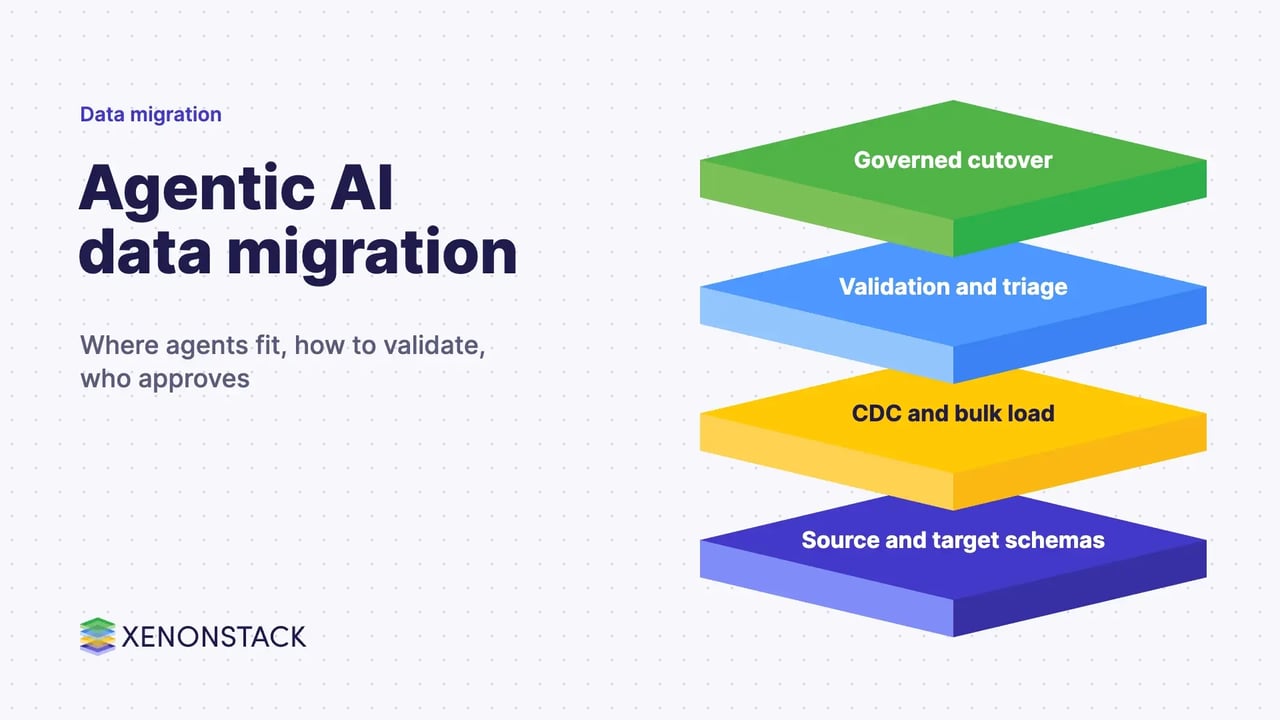
It is a migration run in which agents take on the planning and checking work around the data movement: reading source and target schemas, proposing mappings, watching a running pipeline for drift or failure, and preparing evidence for sign-off. The movement itself still runs on proven engines such as change data capture and bulk load. The agent proposes, the policy decides what it may do on its own, and a person approves anything irreversible, such as a cutover.
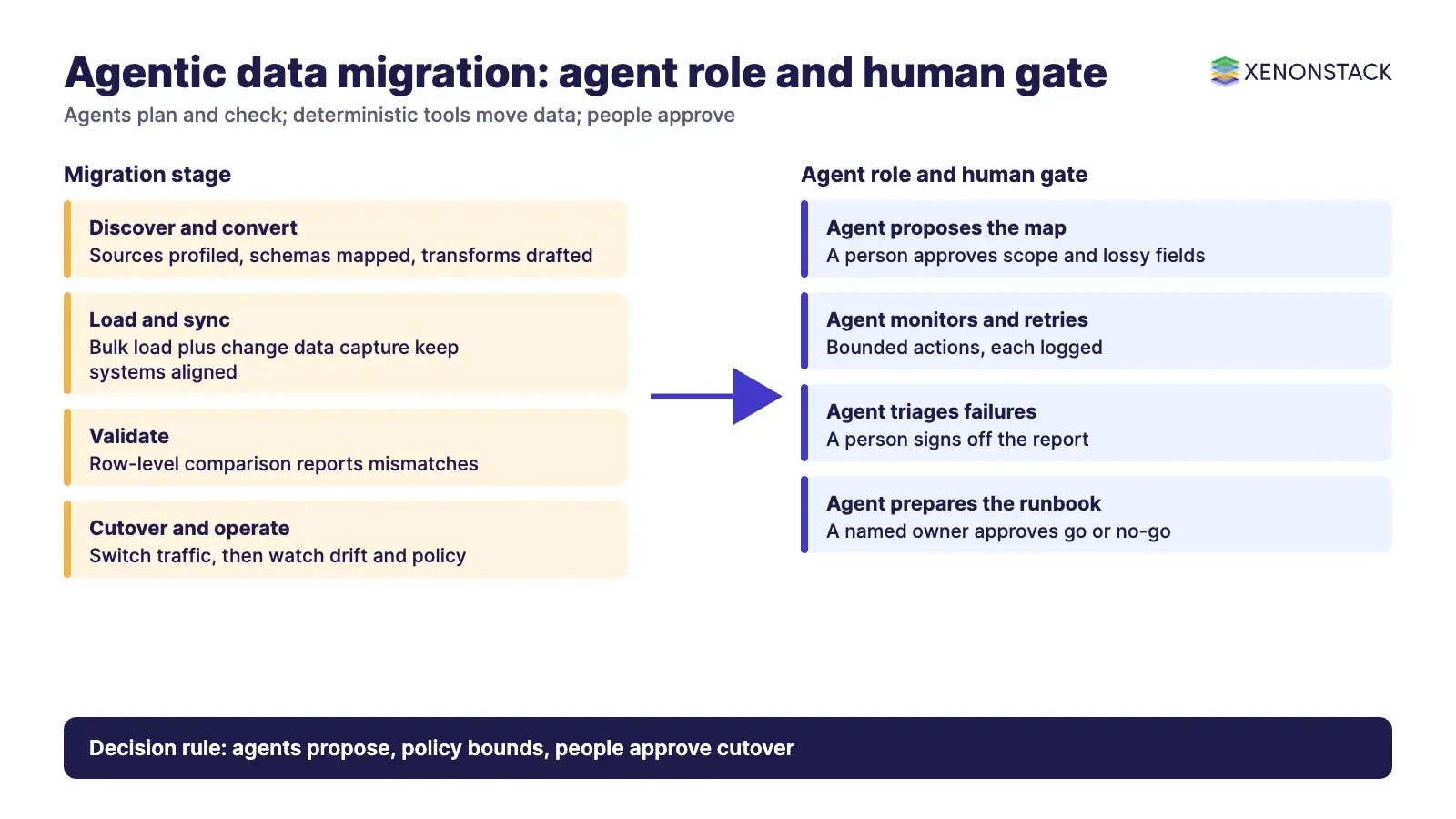
This is different from a script, which repeats fixed steps, and from a fully autonomous system, which nobody should trust with production cutover. For the wider pattern, see agentic workflows.
Why do traditional data migrations fail?
The causes are mostly about knowledge and change, not about copying bytes. The table is our practitioner summary, not a sourced statistic.
| Pain point | What goes wrong | Where an agent can help |
|---|---|---|
| Undocumented legacy schemas | Joins, codes and business rules live in application code, so mappings miss them | Profile sources, propose mappings and flag columns with no clear target for a person to decide |
| Schema drift during a long project | A source changes mid-migration and the pipeline breaks or silently drops data | Detect the change, assess impact and open a ticket or pause the task |
| Weak validation | Row counts match but values differ | Run and triage row-level comparisons, group failures by cause |
| Long cutover windows | The business stops while data catches up | Keep source and target in sync with change data capture and rehearse the cutover |
| Compliance evidence gathered afterwards | Auditors ask who moved what and under which rule | Record each action and the policy applied as it happens |
Where do agents fit in the migration lifecycle?
Agents work best on the judgement-heavy edges of the lifecycle. The bulk movement should stay on deterministic, tested tooling.
| Stage | What the agent does | What stays deterministic | Human gate |
|---|---|---|---|
| Discover | Inventories sources, profiles data, drafts a schema map | Catalogue and profiling queries | Approve the scope and the map |
| Convert | Suggests transformation logic and target tables | Schema conversion tooling and tested transforms | Review unmapped or lossy fields |
| Load and sync | Monitors tasks, retries, reports lag | Bulk load and change data capture | Approve retry limits and any rollback |
| Validate | Triages mismatches and proposes fixes | Row-level comparison and reconciliation | Sign off the validation report |
| Cutover | Checks readiness criteria and prepares the runbook | The cutover switch itself | Approve go or no-go |
| Operate | Watches drift, quality and policy after go-live | Scheduled pipelines and alerts | Approve policy changes |
What do migration services already cover?
Before adding agents, check what your platform vendor already provides. According to its docs, AWS Database Migration Service supports one-time migrations or ongoing replication of changes, heterogeneous migrations between supported engines, and schema conversion through DMS Schema Conversion or the AWS Schema Conversion Tool (AWS DMS docs, read 13 Nov 2026). According to Microsoft Learn, Azure Database Migration Service is a managed service whose online migrations are designed for minimal downtime; its current scope is SQL targets, and some features such as assessment are not offered in the portal version (Azure DMS overview, read 13 Nov 2026). Confirm current support on the vendor page before you plan.
| Option | What it does, according to its site | When it fits |
|---|---|---|
| AWS Database Migration Service | One-time migration or ongoing replication, schema conversion, validation | Database moves into AWS |
| Azure Database Migration Service | Managed migration to Azure SQL targets, online or offline depending on target | SQL Server style estates moving to Azure SQL |
| Debezium | Open source change data capture that streams each committed row-level change to Kafka, Debezium Server or an application | Keeping systems in sync during and after a migration |
| Agents on top | Plan, monitor, triage and document around these engines | When scale or change rate makes manual tracking the bottleneck |
Debezium describes itself as an open source distributed platform for change data capture, with 18 source connectors and 26 sink connectors listed on its site (debezium.io, read 13 Nov 2026).
How should an agent-assisted migration be validated?
Treat validation as a gate that agents help with but do not replace. According to the AWS DMS docs, validation compares each source row with its target row after a full load, can compare ongoing changes for change data capture tasks, and adds query load on source and target (AWS DMS data validation, read 13 Nov 2026). The same page lists limits that matter in planning: tables need a primary key or unique index, views are not supported, rows that change continuously cannot be validated, and validation stops if more than 10,000 failed or suspended records are found.
An agent is useful after that point: it groups failures by cause, links them to a schema change or a transformation rule, and proposes a fix for a person to approve. For which quality fixes are safe to automate, see agentic AI for data quality.
What about governance, security and cost?
| Concern | What to put in place | Note |
|---|---|---|
| Policy and audit | Log every agent action with the rule applied and the data touched | Product link: AgentGRC keeps autonomous agent actions inside policy, with the audit trail risk teams need |
| Personal and regulated data | Decide which fields agents may read, mask or move, and where processing runs | Confirm GDPR, HIPAA and sector rules with counsel and on the official pages; this page is not legal advice |
| Least privilege | Give agents read access to metadata by default and scoped write access per task | Revoke access when the migration ends |
| Cost | Budget for validation queries, dual running and extra network use | AWS notes validation consumes source and target resources |
| Context and decisions | Keep versioned policy and decision traces next to the pipeline | ElixirData keeps governed context, versioned policy and decision traces in one decision layer above AI agents |
How do we adopt agents in a migration step by step?
We suggest this sequence. It is a recommended practice, not a standard.
- Start read-only: agents inventory, profile and propose, but change nothing.
- Pilot on one low-risk domain with full row-level validation.
- Allow bounded actions such as retries and pausing a task, each logged.
- Add drift detection and impact analysis across a wave of systems.
- Keep cutover and rollback decisions with named owners.
- Move from project to operations: the same agents watch quality and policy after go-live. See DataOps AI agents.
When is an agent the wrong tool?
| Situation | Better choice | Why |
|---|---|---|
| A single small database with a clean schema | The cloud provider's migration service | Little judgement work to automate |
| Tables without keys or with continuously changing rows | Redesign or a planned freeze window | Row-level validation cannot cover them, per the AWS docs |
| Irreversible cutover | Human decision | Accountability must be named |
| No audit logging available | Fix logging first | Agent actions would be untraceable |
Where migration is part of a wider move, see our cloud migration strategy guide.
To map one migration decision your agents should make, and the context and policy it depends on, book a Context Workshop. See what happens in the workshop.
Frequently asked questions
What is agentic AI data migration?
It is a migration where agents plan, monitor and check the work around the data movement, while deterministic tools move the data and people approve irreversible steps such as cutover.
Does an agent replace AWS DMS or Azure Database Migration Service?
No. According to their docs, these services handle the movement, schema conversion and, for AWS, validation. Agents sit around them to plan, triage and document.
How do we keep source and target in sync during migration?
Change data capture is the usual method. Debezium, for example, streams each row-level change as it is committed, according to its site.
What are the limits of automated row-level validation?
According to the AWS DMS docs, tables need a primary key or unique index, views are not supported, and continuously modified rows cannot be validated.
What should agents never do alone?
Approve cutover, delete source data, change access rights or widen the scope of personal data they handle. Keep those with named owners.
Is this legal or compliance advice?
No. Confirm GDPR, HIPAA and sector requirements with counsel and on the official pages.
Migration is now a continuous practice, so the lasting value is a governed, observable pipeline that agents help run. Ready to plan yours? Start with one domain and one validation gate.
Ready to put AI agents to work? See an ElixirClaw demo: the agentic OS to build, orchestrate and govern AI agents across your enterprise systems.
Explore the XenonStack platform family: ElixirData · ElixirClaw · ElixirHub · NexaStack · MetaSecure · Neural AI · AgentGRC · AgentSRE · AgentAnalyst · AgentInstruct · AgentRAI · AgentScrum · AgentSearch · AgentForce · AI Aviator · SAIF Aviator · CohortIQ · XenonStack AI · XenonStack UAE