Key takeaway
- LLMOps managed services explained: the pipeline stages, open-source tools, what a provider should own, and the OWASP and NIST controls to apply.
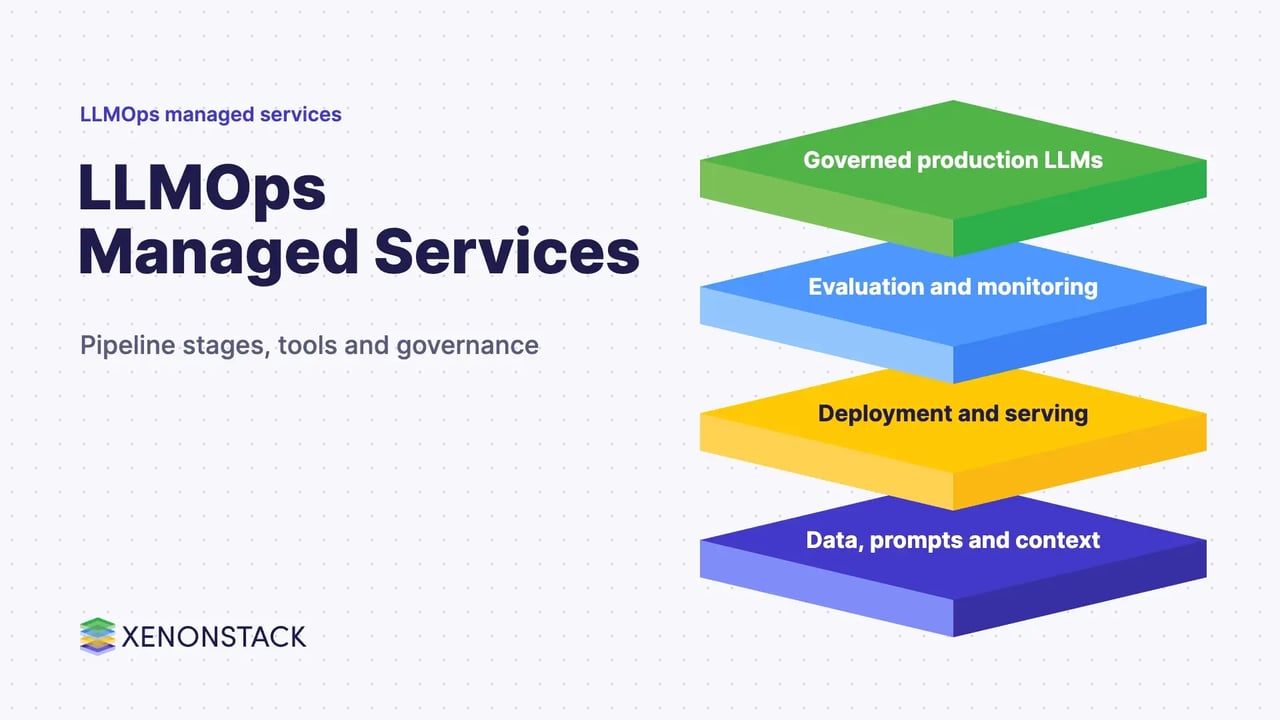
LLMOps is the set of practices and tooling that takes a large language model from experiment to a governed production service: data and prompt management, fine-tuning, deployment, evaluation, monitoring and cost control. A managed LLMOps service means a provider runs part or all of that pipeline for you, while your enterprise keeps ownership of the data, the policies and the sign-off on what goes live.
This guide covers what a pipeline contains, which open-source tools fit each stage, what to ask a managed provider, and the security and governance controls to put in place. It builds on our guides to generative AI platforms and AgentOps and AI lifecycle management, and to our AI managed services offer.
What is LLMOps and how does it differ from MLOps?
LLMOps applies MLOps discipline (versioning, automation, monitoring) to large language models, and adds the parts that are specific to them: prompts as versioned assets, retrieval and context pipelines, output evaluation that cannot rely on a single accuracy number, token-based cost, and safety controls for generated text. If you already run MLOps, you extend it rather than replace it. For the security side of the MLOps foundation, see our MLOps security layers guide.
| Area | Classic MLOps | LLMOps adds |
|---|---|---|
| Assets to version | Data, features, model artefacts | Prompts, retrieval indexes, adapters and fine-tuning sets |
| Quality checks | Metrics against a labelled test set | Evaluation of generated output, including model-based judges and human review |
| Runtime signals | Latency, drift, errors | Traces of prompts, retrievals and tool calls, plus token usage |
| Main risks | Drift, bias, data leakage | Prompt injection, sensitive information disclosure, excessive agency, unbounded consumption |
What stages does an LLMOps pipeline contain?
A practical pipeline has six stages. Each should produce an artefact you can version and audit.
| Stage | What happens | Artefact to keep |
|---|---|---|
| 1. Data and context | Ingest, clean and validate documents and datasets; build retrieval indexes | Dataset and index versions, data quality results |
| 2. Adaptation | Choose a base model; prompt, retrieve or fine-tune for the domain | Prompt versions, adapter or fine-tuned weights, experiment record |
| 3. Evaluation | Test quality, safety and cost on a fixed evaluation set before release | Evaluation report tied to the release |
| 4. Deployment | Package and serve the model behind an API, in your cloud or on premises | Deployment manifest, rollback target |
| 5. Monitoring | Trace requests, track quality, cost and drift, collect user feedback | Traces, dashboards, alert history |
| 6. Governance | Access control, audit logs, policy checks, incident handling | Audit trail, approvals, risk register |
Which open-source tools fit each stage?
Open-source tooling lets you avoid lock-in, but each tool covers only part of the pipeline. The table lists tools whose own documentation we read for this guide. Always confirm current versions and licences on the project page before you standardise.
| Stage | Tool | What its documentation says |
|---|---|---|
| Evaluation, tracing, prompt management | MLflow | Tracing that it describes as compatible with OpenTelemetry and that captures prompts, retrievals and tool calls; LLM judges for output quality; prompt versioning and comparison |
| Model serving | vLLM | A library for LLM inference and serving, with PagedAttention for attention memory, continuous batching and an OpenAI-compatible API server |
| Telemetry standards | OpenTelemetry GenAI semantic conventions | The OpenTelemetry site states these conventions have moved to a dedicated repository; check that repository for their current status before relying on specific attribute names |
Other layers, such as experiment tracking, data validation, feature stores, orchestration and drift detection, have several good open-source options. Pick them by your cloud, your team's skills and your audit needs, and verify each against its own documentation.
What should a managed LLMOps service cover?
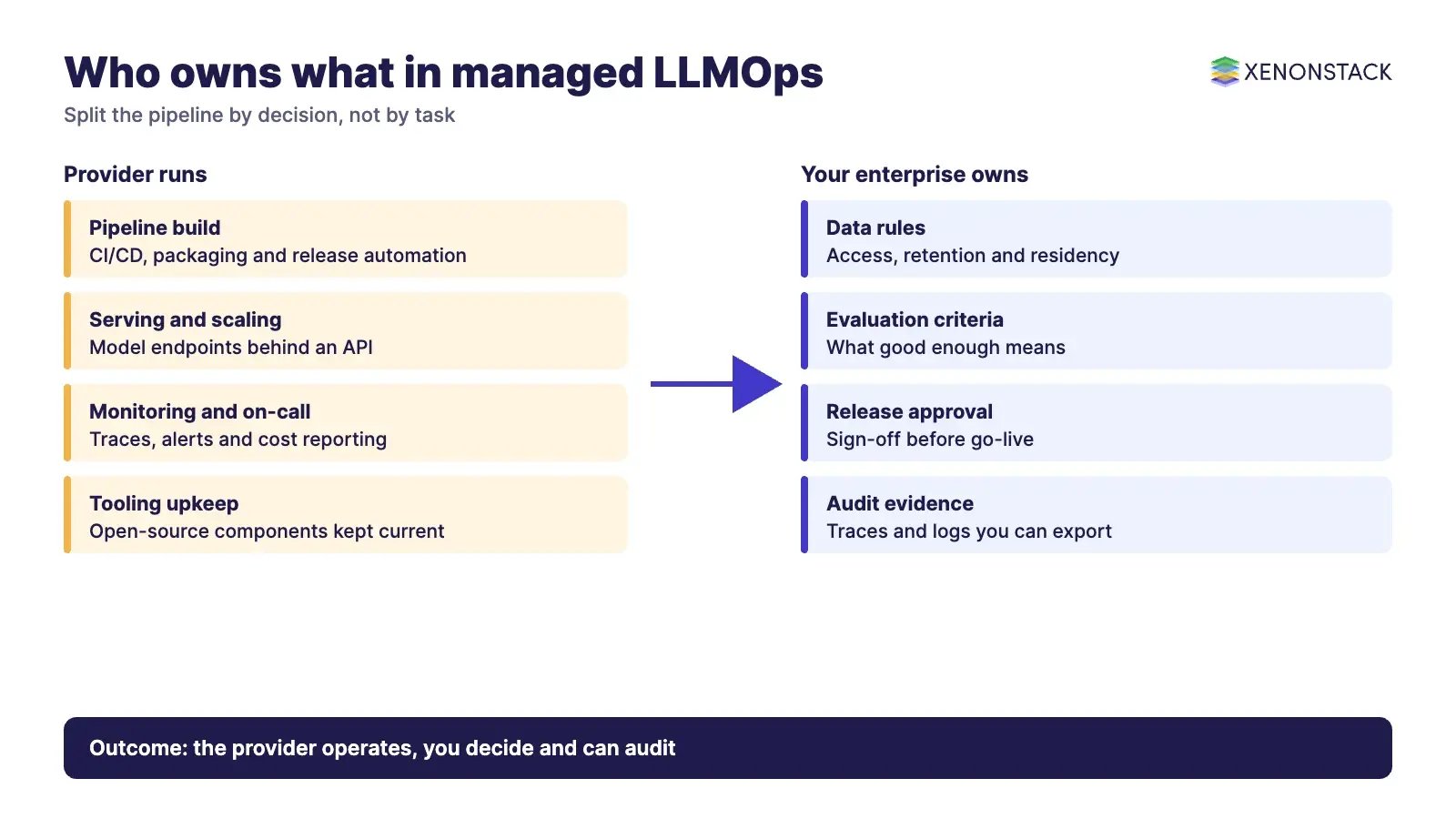
The useful question is not "who runs the pipeline" but "who owns each decision". Use this split when you scope a managed service, including XenonStack's LLMOps use case.
| Responsibility | Typical owner | Why |
|---|---|---|
| Pipeline build, CI/CD, serving and scaling | Provider | Repeatable engineering work that benefits from a dedicated team |
| Monitoring, on-call and cost reporting | Provider, with your sign-off on thresholds | Needs round-the-clock coverage |
| Data access, retention and residency rules | Your enterprise | Legal accountability stays with the data owner |
| Evaluation criteria and release approval | Your enterprise, with provider support | Defines what "good enough" means for your business |
| Incident response and audit evidence | Shared, written into the contract | Both sides need the same trace |
How do you monitor and evaluate LLMs in production?
Monitor the request, not just the server. Capture a trace for each call that includes the prompt version, retrieved context, tool calls, latency and token use, then score a sample of outputs against your evaluation set. MLflow's documentation describes tracing and LLM judges for this purpose. Treat model-based judges as a screening aid and keep human review for high-impact outputs.
Which signals matter first?
Start with four: answer quality on a fixed sample, retrieval relevance, latency and cost per request. Add drift and safety flags once the baseline is stable.
What security and governance controls does an LLM pipeline need?
The OWASP Top 10 for LLM Applications (2025) lists ten risks: prompt injection, sensitive information disclosure, supply chain, data and model poisoning, improper output handling, excessive agency, system prompt leakage, vector and embedding weaknesses, misinformation and unbounded consumption. Map each to a control in your pipeline, for example input and output filtering, least-privilege tool access, signed model artefacts and per-tenant usage limits.
For risk management, NIST published the AI Risk Management Framework on 26 January 2023 and its Generative AI Profile (NIST-AI-600-1) on 26 July 2024. NIST's page notes the framework is voluntary and is being revised, so check it for the current version. For agent-specific controls, see our guide to agentic AI risk management. Regulatory duties such as GDPR, HIPAA or ISO 27001 certification depend on your data and sector; confirm them on the official pages and with your counsel.
When is managed LLMOps the wrong choice?
- You have one low-risk model and a team that already runs it well.
- Your data cannot leave a boundary the provider cannot operate inside.
- You want the provider to decide evaluation criteria or release approvals. Those belong to you.
- The contract does not give you the traces, logs and artefacts needed to move to another provider.
How should you sequence adoption?
- Inventory the models, prompts and data sources already in use, and name an owner for each.
- Build the evaluation set and release gate first, before scaling traffic.
- Add tracing and cost reporting to one production workload.
- Apply the OWASP and NIST mapping to that workload and record the controls.
- Extend the pipeline to further workloads, then review whether to run it yourself or with a provider.
What comes after LLMOps?
As teams move from single model calls to agents that use tools, the operational question widens from "is the model good" to "was each action allowed and traceable". That is the focus of AgentOps, covered in our AgentOps guide. ElixirClaw is described on its site as an agentic OS platform to build, orchestrate and govern AI agents and automation workflows while keeping humans in control, and AgentGRC keeps autonomous agent actions inside policy, with the audit trail risk teams need.
To map one LLM or agent decision, and the context and policy it depends on, book a Context Workshop. See what happens in the workshop.
Frequently asked questions
What is LLMOps?
LLMOps is the practice of managing large language models in production: versioning prompts and data, evaluating outputs, deploying and serving models, monitoring quality and cost, and enforcing governance.
How is LLMOps different from MLOps?
It extends MLOps with prompts and retrieval indexes as versioned assets, evaluation of generated text, token-level cost tracking and LLM-specific security risks such as prompt injection.
Which open-source tools can an LLMOps pipeline use?
MLflow covers tracing, LLM judges and prompt versioning, and vLLM serves models with an OpenAI-compatible API, according to their documentation. Other layers have several options to verify per project.
What should we keep when we use a managed LLMOps provider?
Keep ownership of data rules, evaluation criteria and release approval, and make sure the contract gives you traces, logs and artefacts.
Which security risks apply to LLM applications?
The OWASP Top 10 for LLM Applications (2025) lists prompt injection, sensitive information disclosure, supply chain, data and model poisoning, improper output handling, excessive agency, system prompt leakage, vector and embedding weaknesses, misinformation and unbounded consumption.
Explore the XenonStack platform family: ElixirData · ElixirClaw · ElixirHub · NexaStack · MetaSecure · Neural AI · AgentGRC · AgentSRE · AgentAnalyst · AgentInstruct · AgentRAI · AgentScrum · AgentSearch · AgentForce · AI Aviator · SAIF Aviator · CohortIQ · XenonStack AI · XenonStack UAE