Key takeaway
- AWS Private 5G reached end of support in May 2025. What enterprises can use instead for private 5G with AWS, how the architecture works and how to choose.
AWS no longer sells its own private 5G service: AWS Private 5G reached end of support on 20 May 2025. Enterprises that want private 5G with AWS now combine a private network delivered by a telecom operator or network vendor with AWS edge and cloud services such as AWS Outposts, Local Zones and the AWS Regions. AWS also lists an Integrated Private Wireless on AWS programme of operator offerings.
This guide explains what changed, how a private 5G architecture on AWS works today, and how to choose a model, so older guides about AWS Private 5G do not lead to a dead end.
What happened to AWS Private 5G?
AWS Private 5G bundled radio units, SIM cards and a managed core so that an enterprise could order a small private network from the AWS console. AWS listed it as reaching end of support on 20 May 2025 on its service changes page. Industry coverage linked the decision to spectrum and hardware challenges, and Microsoft also announced the retirement of Azure Private 5G Core. The private 5G market has moved towards operators and network vendors, with hyperscalers providing the compute, storage and applications.
How does private 5G with AWS work now?
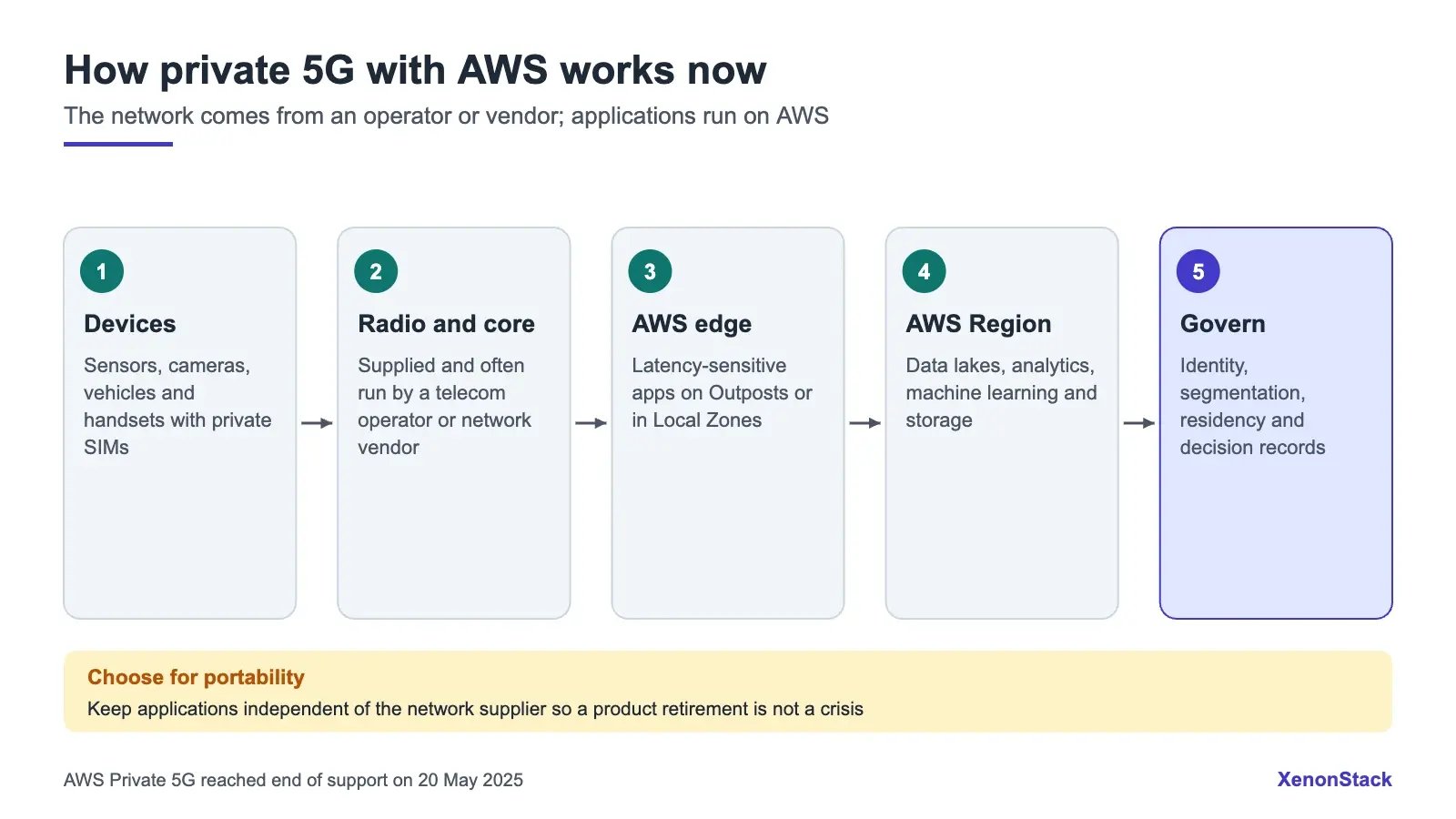
- Devices with private SIMs connect to radio units deployed on site.
- Radio access and core are supplied and often operated by a telecom operator or network vendor.
- Edge compute runs latency-sensitive applications close to the network, for example on AWS Outposts or in a Local Zone.
- Region services handle data lakes, analytics, machine learning and long-term storage.
- Governance covers identity, network segmentation, data residency and the decisions applications make.
Which options replace AWS Private 5G?
| Model | Who runs the network | Where AWS fits | Best for |
|---|---|---|---|
| Operator-managed private network | Telecom operator | Applications and data on AWS edge and Regions | Enterprises that want a managed service and service levels |
| Integrated Private Wireless on AWS offerings | Participating operators | Validated integration with AWS services | Buyers who want a pre-integrated path; check current availability |
| Vendor network, enterprise-operated | Enterprise IT with a network vendor | Core or applications on Outposts or in a Region | Large sites with in-house network skills |
| Network slice on a public 5G network | Operator | Applications in Regions or Local Zones | Wide-area mobility where a dedicated site network is not needed |
Spectrum is often the deciding factor. In the United States, the shared 3.5 GHz Citizens Broadband Radio Service band uses a three-tier model coordinated by Spectrum Access Systems, as the FCC explains.
What are the benefits of running 5G applications on AWS?
- One platform for applications: the same services, tooling and security model at the edge and in the Region.
- Local processing: computer vision, robotics and control loops run near the devices.
- Elastic analytics: network and device data flow into data lakes and machine learning services.
- Independence from the network supplier: applications stay portable if the operator or vendor changes.
For related patterns, see edge computing with 5G and 5G in manufacturing.
What should enterprises check before choosing?
- Spectrum: which bands are available at your sites and who holds them.
- Devices: which sensors, cameras, vehicles and handsets support the bands you will use.
- Operating model: who monitors, patches and supports the network, and under what service levels.
- Data residency and security: where traffic is processed and how it is segmented.
- Exit plan: how you would move if a supplier retires a product, as AWS did with Private 5G.
Comparisons with 4G are covered in 4G vs 5G networks.
Where does XenonStack fit?
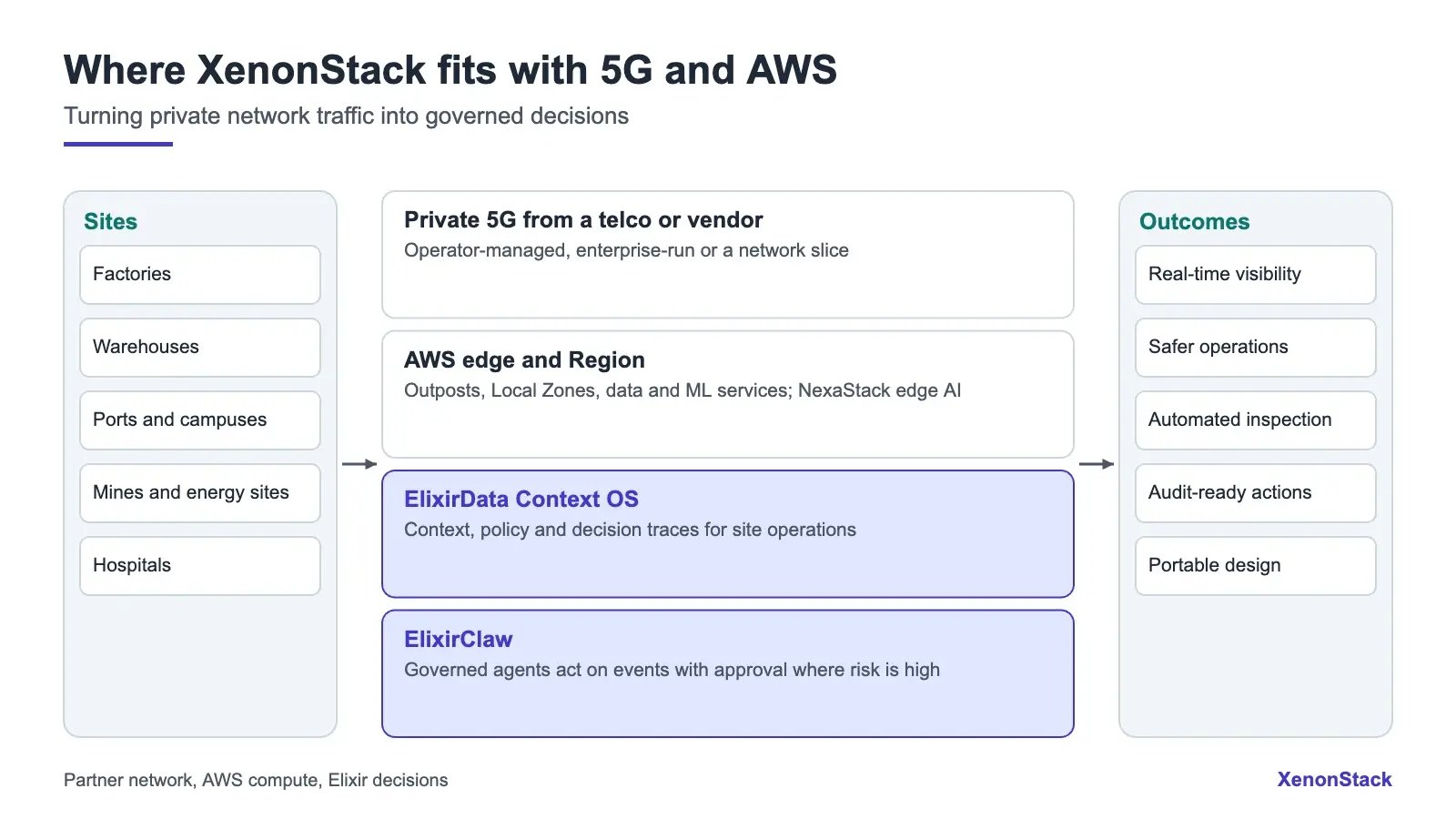
XenonStack builds the edge and data platforms that turn private 5G traffic into decisions. NexaStack runs edge and physical AI workloads close to the network, ElixirData Context OS holds the context and policy behind each operational decision, and ElixirClaw runs governed agents that act on events with human approval where the risk is high.
To map one site or network decision your agents should make, and the context and policy it depends on, book a Context Workshop. See what happens in the workshop.
Frequently asked questions
Is AWS Private 5G still available?
No. AWS lists AWS Private 5G as having reached end of support on 20 May 2025. Enterprises now use private networks from operators or network vendors and run their applications on AWS.
What can I use instead of AWS Private 5G?
An operator-managed private network, a vendor network you operate yourself, an operator offering listed under Integrated Private Wireless on AWS, or a slice of a public 5G network, combined with AWS edge and cloud services.
Does AWS still support 5G edge applications?
Yes. Applications can run on AWS Outposts, in Local Zones or in AWS Regions, connected to a private or public 5G network supplied by an operator or vendor.
Did other cloud providers exit private 5G?
Microsoft also announced the retirement of Azure Private 5G Core. Cloud providers now mostly support private 5G through partnerships with operators rather than their own network products.
What is CBRS?
The Citizens Broadband Radio Service is shared spectrum in the 3.5 GHz band in the United States, managed in three tiers by Spectrum Access Systems. Enterprises can use it to build private LTE and 5G networks.
Follow XenonStack on LinkedIn: XenonStack on LinkedIn for new guides on agentic AI, data and platform engineering.
Explore the XenonStack platform family: ElixirData · ElixirClaw · ElixirHub · NexaStack · MetaSecure · Neural AI · AgentGRC · AgentSRE · AgentAnalyst · AgentInstruct · AgentRAI · AgentScrum · AgentSearch · AgentForce · AI Aviator · SAIF Aviator · CohortIQ · XenonStack AI · XenonStack UAE