Key takeaway
- Compare ten serverless computing platforms by execution model, limits and status, then pick between functions, containers and edge isolates.
Which serverless computing platform should you choose?
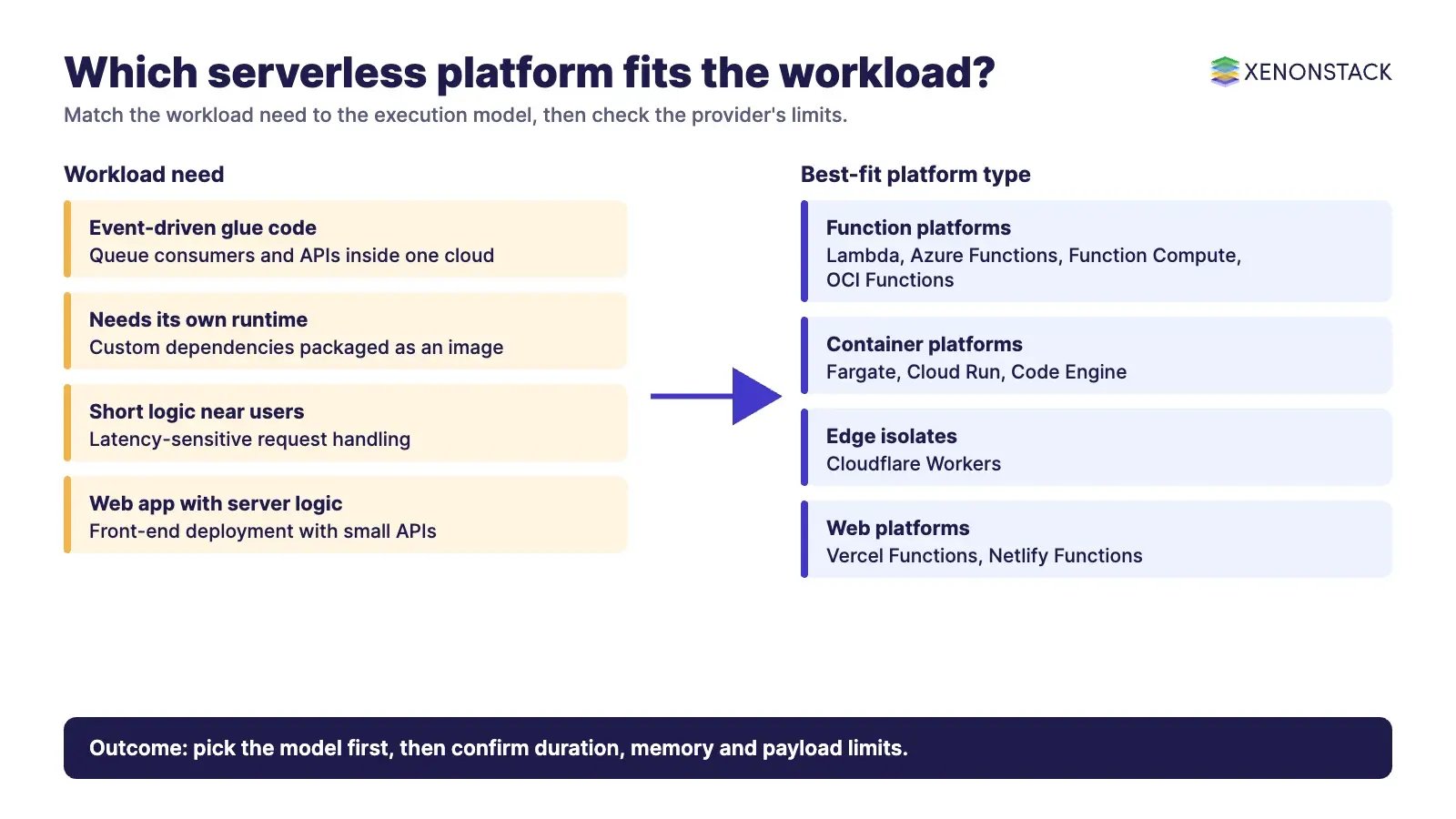
Pick the platform by the unit you want to deploy, not by the provider's brand. Functions suit event-driven code, containers suit workloads that need their own runtime, and edge isolates suit short logic that runs close to users. This guide compares ten platforms on that basis. For a deeper single-cloud view, see our guides to AWS serverless computing and Azure serverless computing.
Several platforms in older lists have been renamed, retired or capped since they were written, so each limit below comes from the provider's own documentation, read on 12 November 2026. If your question is where code should run, rather than which provider, read serverless vs edge computing first.
What are serverless computing platforms?
A serverless platform runs your code or container without you provisioning servers. The provider scales capacity and bills for usage. The older phrase for this was functions as a service, but the category now includes container services and edge runtimes, and each has different limits on duration, memory and payload size.
The Google Cloud view is covered in our Google Cloud serverless computing guide, and the security side in What is Serverless Security?.
Which serverless platform fits which workload?
| Platform | Execution model | Fits when | Status to note |
|---|---|---|---|
| AWS Lambda | Functions, event-driven | Event-driven code on AWS with up to 900 seconds per invocation | Runtime deprecations are scheduled; check the runtimes page |
| AWS Fargate | Containers, no servers | You have container images and want no cluster nodes to manage | Supports ECS and EKS; EKS availability varies by region |
| Azure Functions | Functions, several hosting plans | You work in the Microsoft ecosystem and need VNet integration or long runs | Flex Consumption is recommended for new apps; Linux Consumption retires 30 September 2028 |
| Google Cloud Run | Containers, services, jobs and functions | You want one platform for HTTP services, batch jobs and event functions | Cloud Run functions is the current name for event functions |
| IBM Code Engine | Containers, jobs and functions | You run on IBM Cloud with containerised or event-driven work | Functions are short-running, two minutes or less. IBM Cloud Functions status not confirmed |
| Alibaba Function Compute | Functions, event-driven | Workloads triggered by Alibaba Cloud OSS, HTTP or message queues | GPU-accelerated instances are offered |
| OCI Functions | Functions on the open source Fn Project | You run on Oracle Cloud Infrastructure and want portable function tooling | Formerly named Oracle Functions |
| Cloudflare Workers | V8 isolates on a global network | Short, latency-sensitive logic close to users | 128 MB per isolate |
| Vercel Functions | Functions for web frameworks | Front-end teams deploying web apps with server-side logic | Runs on Fluid compute; bundle limits are enforced by AWS |
| Netlify Functions | Functions plus background functions | Web sites needing small APIs and asynchronous jobs | Lambda compatibility mode is deprecated |
On the agentic side, ElixirClaw is an agentic OS platform to build, orchestrate and govern AI agents and automation workflows while keeping humans in control, which matters once functions start calling agents rather than only responding to events.
How do the platform limits compare?
| Platform | Duration | Memory and size | Billing basis | Source |
|---|---|---|---|---|
| AWS Lambda | Up to 900 seconds | 128 to 10,240 MB; 250 MB unzipped package; 6 MB synchronous payload | Requests and GB-seconds; 1 million requests and 400,000 GB-seconds free tier | AWS Lambda quotas and pricing pages |
| Azure Functions (Flex Consumption) | Default 30 minutes, no stated maximum | 512, 2,048 or 4,096 MB; up to 1,000 instances | On-demand executions and memory GB-seconds, or always ready baseline | Microsoft Learn |
| Google Cloud Run | Up to 60 minutes per request | Up to 32 GiB and 8 vCPU per instance; 1,000 concurrent requests per instance | Request-based or instance-based, in 100 ms increments | Google Cloud docs |
| Cloudflare Workers | CPU time 10 ms free; 30 seconds default and up to 5 minutes paid | 128 MB per isolate; 64 MiB worker size | Free plan 100,000 requests a day; paid has no request limit | Cloudflare docs |
| Vercel Functions | 300 seconds default; 800 seconds maximum on Pro and Enterprise | 2 GB default; 4 GB on Pro and Enterprise; 250 MB bundle; 4.5 MB payload | Active CPU time and provisioned memory time | Vercel docs |
| Netlify Functions | Synchronous 60 seconds, fixed; background up to 15 minutes | 1,024 MB default; up to 4,096 MB on some plans; 6 MB buffered payload | Plan-based | Netlify docs |
| OCI Functions | Configurable | 6 MB request and response payloads, fixed | Resources consumed during execution | Oracle docs |
Fargate prices on vCPU, memory, operating system, CPU architecture and storage. Alibaba Function Compute bills on the resources configured for a function and its execution duration. Limits change, so treat these figures as a snapshot and confirm them on the provider's page before committing.
What has changed since older serverless platform lists?
- Azure Functions Consumption is now treated as a legacy plan. Linux Consumption hosting retires on 30 September 2028, and Flex Consumption is the recommended choice for new apps.
- Google Cloud's event functions now appear under the name Cloud Run functions, alongside Cloud Run services, jobs and worker pools.
- Oracle Functions is now named OCI Functions.
- Netlify's Lambda compatibility mode is deprecated. From 1 July 2027, deploys that contain functions in that mode will no longer be accepted.
- Vercel Functions now run on Fluid compute, and billing follows active CPU time rather than wall-clock time, so waiting for I/O does not count.
- AWS Lambda has standardised billing for the INIT phase since 1 August 2025.
- We could not confirm the status of IBM Cloud Functions, and older price figures for IBM and Oracle have been removed.
How do functions, containers and edge isolates differ?
Function platforms
Lambda, Azure Functions, Alibaba Function Compute and OCI Functions take your code and an event trigger. They fit glue logic, queue consumers and APIs where the event source and the provider's other services sit in the same cloud. The trade-off is that the function model is tied to that provider's triggers and limits.
Container platforms
Fargate, Cloud Run and Code Engine run images you build. You keep control of the runtime and dependencies, and the provider manages the capacity. Cloud Run also scales to zero when there are no requests, so the first request after idle can add latency unless you set minimum instances.
Edge and web platforms
Cloudflare Workers uses V8 isolates, which Cloudflare says can start about a hundred times faster than a Node process in a container or virtual machine. Vercel and Netlify package serverless logic with web deployment. These suit short request handling, and the memory, payload and duration limits above are tighter than on the hyperscaler platforms.
What about serverless databases?
The compute platform is only half the design. Amazon Aurora Serverless v2 can pause to zero capacity units when idle and resume in about 15 seconds, although storage is still charged. Check each database's pause, resume and connection behaviour, because a function that scales to thousands of instances can overwhelm a database that does not.
How should you manage cost, security and lock-in?
- Cost: model the billing basis for your traffic shape, since per-request, per-GB-second and active CPU billing reward different workloads.
- Security: apply least privilege to every function role and keep secrets out of code, as AWS recommends in its IAM best practices.
- Lock-in: container images and open standards move more easily than provider-specific triggers. OCI Functions builds on the open source Fn Project for this reason.
- Governance: record which functions call which models or agents, and who approved each change.
For that last point, AgentGRC keeps autonomous agent actions inside policy, with the audit trail risk teams need, and ElixirData Context OS keeps governed context, versioned policy and decision traces in one decision layer above AI agents.
When should you not use a serverless platform?
Avoid it when requests regularly exceed the platform's duration cap, when dependencies exceed the package limit, when you need long-lived connections, or when load is steady enough that reserved capacity is simpler. Netlify synchronous functions stop at 60 seconds and Lambda at 900 seconds, so long jobs belong on a container or background mechanism.
How do you adopt a serverless platform step by step?
- List workloads with their duration, memory, payload and latency needs.
- Match each to function, container or isolate using the tables above.
- Prototype one workload and measure cold start, cost and limits against your own traffic.
- Add infrastructure as code, monitoring and a cost alert before scaling out.
- Review deprecation notices every quarter, since runtimes and plans retire on published dates.
Watch: serverless architecture in practice
XenonStack video: serverless architecture for big data and data lakes.
To map one serverless decision your agents should make, and the context and policy it depends on, book a Context Workshop. See what happens in the workshop.
Frequently asked questions
What is the difference between a serverless function and a serverless container?
A function platform runs code you upload against an event, with the provider managing the runtime. A container platform runs an image you build, so you control the runtime and dependencies. AWS Fargate and Cloud Run are container platforms, while Lambda, Azure Functions and Alibaba Function Compute are function platforms.
Which serverless platform allows the longest request?
Among the pages checked, Cloud Run services allow requests of up to 60 minutes, and Azure Functions on Flex Consumption has no stated maximum timeout with a 30 minute default. AWS Lambda is capped at 900 seconds, and Netlify synchronous functions are fixed at 60 seconds.
Is Azure Functions on the Consumption plan still a good choice for new apps?
Microsoft describes Consumption as a legacy plan and recommends Flex Consumption for new apps. Linux Consumption hosting retires on 30 September 2028.
Are Cloudflare Workers the same as AWS Lambda?
No. Workers run in V8 isolates on Cloudflare's global network, with 128 MB of memory per isolate. Lambda runs code in an execution environment with up to 10,240 MB of memory. Workers suit short, latency-sensitive logic, while Lambda suits heavier event-driven work.
Does IBM Cloud Functions still appear in this comparison?
We could not confirm the current status of IBM Cloud Functions from IBM's own pages, so we do not rank it. IBM documents Code Engine as a serverless platform for containerised workloads, including event-driven functions, and teams should confirm which service IBM recommends before building on either.
When should I avoid serverless?
Avoid it for workloads that need long-lived connections, very large dependencies, strict control of the runtime or predictable steady load, where reserved capacity may be simpler to reason about. Check each platform's duration, memory and payload limits against the workload first.
Explore the XenonStack platform family: ElixirData · ElixirClaw · ElixirHub · NexaStack · MetaSecure · Neural AI · AgentGRC · AgentSRE · AgentAnalyst · AgentInstruct · AgentRAI · AgentScrum · AgentSearch · AgentForce · AI Aviator · SAIF Aviator · CohortIQ · XenonStack AI · XenonStack UAE