Key takeaway
- Microservices testing explained: the five test layers, contract testing, test environments and canary releases, with trade-offs for engineering leaders.
Microservices testing is the practice of checking each service on its own, the agreements between services, and a small number of complete user journeys, so that teams can release services independently without breaking each other. The main change from a monolith is that most failures now happen at the network boundary between services, not inside one codebase.
For a CTO or head of engineering, the practical answer is a layered suite: many fast tests inside each service, contract tests at every boundary, and a few end-to-end checks on the journeys that matter. This guide sets out the layers, the environment options, the release techniques and the trade-offs. For the architectural background, see our comparison of service-oriented architecture and microservices.
What is different about testing microservices?
Each microservice has its own code, data and release cycle, and it talks to other services over a network. Martin Fowler's microservice testing guide (Toby Clemson, 2014) makes the same point: once network partitions are introduced, the testing strategies that applied to monolithic in-process applications need to be reconsidered. Source: martinfowler.com, read 13 November 2026.
Three consequences follow. Services can be tested in isolation, which makes feedback faster. A service can pass every internal test and still break a consumer, so boundaries need their own tests. And a failure seen in production may span several services, so debugging depends on instrumentation as much as on tests.
Which test layers does a microservices system need?
Five layers cover most systems. The shape follows the test pyramid: Martin Fowler's essential point is that you should have many more low-level unit tests than high-level broad-stack tests running through a GUI, because end-to-end tests through the UI are brittle, expensive to write and slow to run. A middle layer that acts through the service layer, such as API tests, can capture many end-to-end benefits without the UI complexity.
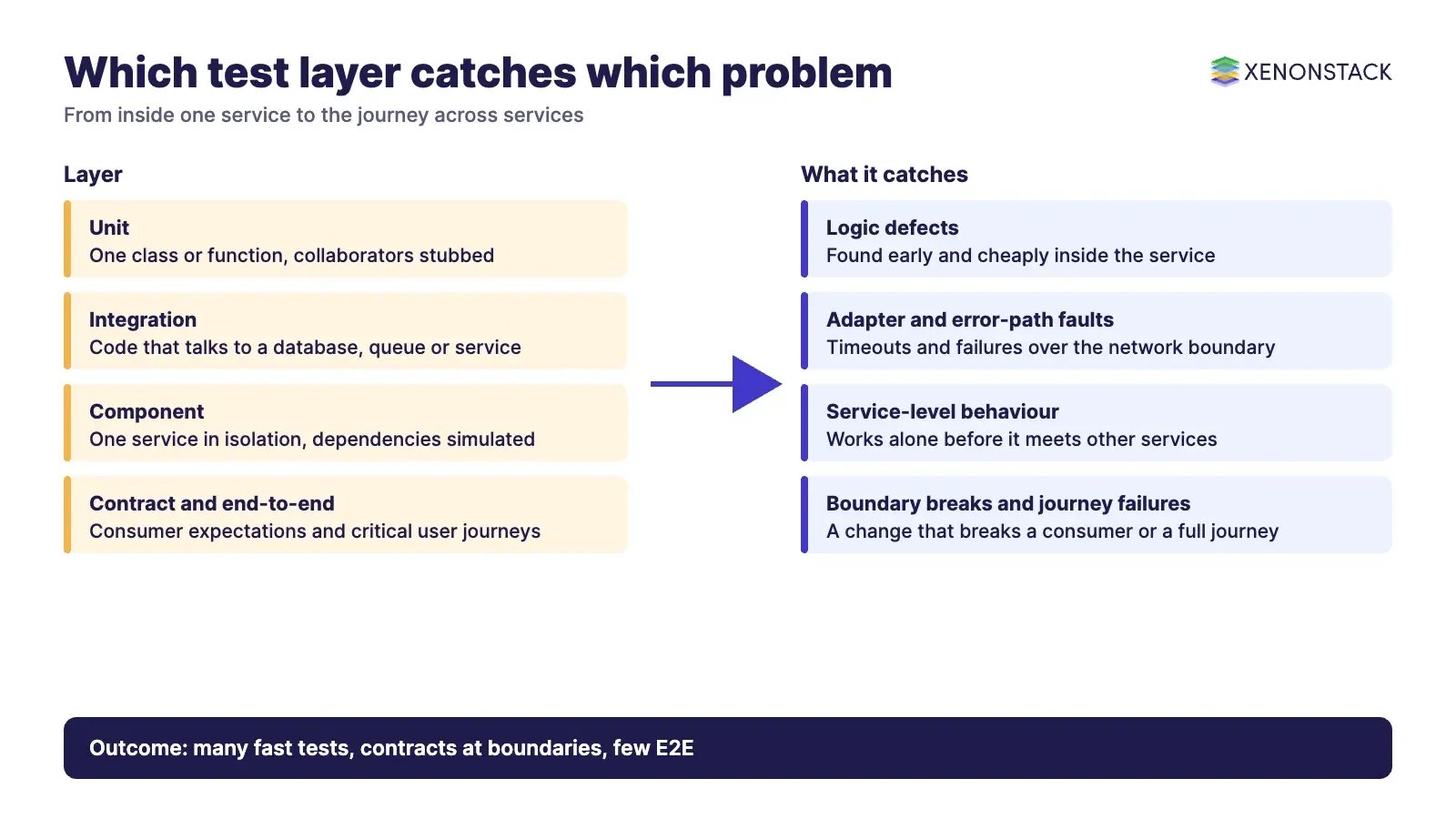
| Layer | What it checks | When it fits | Main trade-off |
|---|---|---|---|
| Unit | One class or function inside a service, with collaborators replaced by stubs or mocks | Always; the base of the suite | Cannot see network or data problems |
| Integration | The code that talks to a database, queue or external service, including error paths such as timeouts | For every adapter to an external component | Needs real or realistic dependencies |
| Component | One service (or a small group) in isolation, with its dependencies simulated | To prove a service works before it meets others | Simulated dependencies can drift from reality |
| Contract | What a consumer expects from a provider, checked on both sides | At every service boundary, especially across teams | Needs agreement on who owns the contract |
| End-to-end | A complete user journey through front end, services and data stores | A few critical journeys only | Slow, brittle and hard to diagnose |
1. Unit tests
Unit tests run inside one service and use stubs or mocks for everything outside it. They are the cheapest way to find defects early. Our guide to unit testing covers techniques in more detail.
2. Integration tests
Integration tests check the code that connects a service to something external: a database, a message broker or another service. They should cover the success path and the error paths over the network boundary. Abnormal behaviour such as a timeout or a slow response is hard to trigger against a real dependency, so write specific tests for it. Testcontainers, an open-source library, starts real services such as databases and message brokers in Docker containers for each test run and removes them afterwards, so tests use the same kinds of dependency as production instead of in-memory substitutes. According to its site (testcontainers.com), it supports Java, Go, .NET, Node.js and Python among other languages.
3. Component tests
A component test exercises one microservice as a whole, with its own database or a stand-in, and replaces the other services with simulated ones. It shows that the service behaves correctly in isolation before it is combined with others.
4. Contract tests
Contract tests protect the boundary between a consuming team and a providing team. They are covered in the next section.
5. End-to-end tests
End-to-end tests exercise a full journey across the front end, services and databases. Keep them few and tied to business-critical paths, because they catch issues that lower layers miss but are the slowest and most fragile layer. Broader quality checks such as load and security sit alongside these; see functional and non-functional testing and regression testing for how those fit.
How does contract testing work?
Pact describes itself as a code-first consumer-driven contract testing tool. According to its docs, the contract is generated during the execution of the automated consumer tests, and it is a set of concrete request and response examples rather than a static schema. Only the parts of the interaction that consumers actually use are tested, so a provider can change unused behaviour without breaking anyone. Source: docs.pact.io, read 13 November 2026.
In practice the consumer tests call a mock provider and generate a pact file from the interactions. That file is then replayed against the real provider, and verification passes if each response contains at least the data the consumer expects (docs.pact.io, how Pact works). Pact also offers a can-i-deploy check, which, according to its docs, inspects the Pact Matrix to confirm there is a successful verification result between a given application version and every integrated application version already in the target environment, exiting with code 0 for yes and 1 for no.
How should teams set up test environments?
There is no single right answer; each option trades realism against cost and speed. Six common approaches are compared below.
| Approach | What it means | When it fits | Watch for |
|---|---|---|---|
| Documentation first | Update and review the API description before any code changes, so breaking changes are caught in review | Teams with many API consumers | Needs discipline; documents can go stale |
| Local stack | Run the services and dependencies together on a developer machine | Small systems, early development | Heavy as the service count grows |
| Personal cloud account | Each developer deploys their own copy to a cloud account | Realistic checks without sharing | Cost and clean-up |
| Shared test instances | Developers run one service locally and point it at shared instances of the rest | Large systems where a full copy is too heavy | Shared instances can be unstable or out of date |
| Stubbed services | Lightweight stand-ins that behave like the real service | Fast component tests | Stubs drift unless backed by contract tests |
| Ephemeral environments | Create a test environment on demand, load known data, run the tests, then discard it | Pre-release checks in CI | Failures are harder to diagnose; confirm cost controls |
Use cloud capacity on demand for test environments and release it when tests finish, rather than limiting tests to a small fixed setup. Test across more than one setup where differences such as library versions or hardware could affect behaviour in production.
How do canary releases and observability support testing?
Tests before release cannot cover everything, so teams also check changes in production in a controlled way. In a canary release a small share of traffic goes to the new version while the old version keeps serving the rest, and monitoring compares error rates, load and responsiveness. Kubernetes documents Deployments, its mechanism for rolling out new versions of a workload (see kubernetes.io); confirm the current canary approach on the Kubernetes documentation before adopting it.
Diagnosis depends on instrumentation. In OpenTelemetry, a trace shows the full path of a request through an application and is made of spans, one unit of work each, that share a trace ID. Context propagation passes trace context between services, so spans from different processes can be linked into one end-to-end view (opentelemetry.io, traces concept page, read 13 November 2026). Our note on observability versus monitoring explains how this differs from monitoring. If you place an API gateway in front of services, KrakenD API gateway for microservices is a related read.
Where do AI agents fit in microservices testing?
Agents can help with the repetitive parts: drafting test cases from API descriptions, re-running suites when a prompt, tool or model changes, and summarising failures for a human to review. They do not remove the need for contract tests or for people to own the decisions. Where the services you test include AI agents, the same layers apply, plus checks on multi-step paths and hand-offs.
ElixirData Context OS keeps governed context, versioned policy and decision traces in one decision layer above AI agents, which helps when you need to show why an automated test or release decision was taken. AgentQA describes itself as quality assurance for agent workflows and regressions, testing agent outputs and workflows continuously. For orchestrating and governing agents, see ElixirClaw, an agentic OS platform to build, orchestrate and govern AI agents and automation workflows while keeping humans in control.
What is a sensible adoption sequence, and when is it too much?
Start with the boundaries that break most often. Add unit and integration tests to each service, then contract tests between the highest-risk pairs of services, then a handful of end-to-end journeys, then canary releases with monitoring. Move checks earlier where you can; our guide to shift-left testing and the note on API testing cover that direction.
Trade-offs to weigh: every extra layer adds maintenance, shared environments add cost and contention, and contract tests need a shared process across teams. For a small system with a handful of services owned by one team, full consumer-driven contracts may be more than you need; component tests plus a few end-to-end checks can be enough. Treat any test data that mirrors production as governed data, and keep secrets out of test environments.
To map one release decision your agents should make, and the context and policy it depends on, book a Context Workshop. See what happens in the workshop.
Frequently asked questions
What is microservices testing?
It is the practice of testing each service in isolation, the agreements between services, and a few full user journeys, so services can be released independently. Most failures occur at the network boundary between services.
Which test layers do microservices need?
Unit, integration, component, contract and end-to-end tests. The test pyramid advice is to have many more low-level tests than high-level tests that run through a user interface.
What is consumer-driven contract testing?
According to the Pact docs, the contract is generated by the consumer's automated tests as concrete request and response examples, then verified against the real provider. Only the parts consumers use are tested.
How do you test microservices without running everything?
Use stubs or mocks for neighbouring services in component tests, real dependencies in containers for integration tests (for example with Testcontainers), and contract tests to keep the stubs honest.
Why do end-to-end tests need to be few?
Fowler describes UI-driven end-to-end tests as brittle, expensive to write and time consuming to run, so they are kept for critical journeys.
How does tracing help with microservices testing?
In OpenTelemetry a trace links the spans of one request across services using shared trace context, so a slow or failing step can be located in an end-to-end view.
Follow XenonStack on LinkedIn: XenonStack on LinkedIn for new guides on agentic AI, data and platform engineering.
Explore the XenonStack platform family: ElixirData · ElixirClaw · ElixirHub · NexaStack · MetaSecure · Neural AI · AgentGRC · AgentSRE · AgentAnalyst · AgentInstruct · AgentRAI · AgentScrum · AgentSearch · AgentForce · AI Aviator · SAIF Aviator · CohortIQ · XenonStack AI · XenonStack UAE