Key takeaway
- AI chatbots in telecom: what they handle in support, how agentic workflows change the design, how operators govern them and when a person takes over.
An AI chatbot in telecom is a conversational layer on the operator's app, website, messaging channels or voice line that answers routine questions, completes simple account requests and hands complex cases to a person with the context attached. Operators such as Vodafone Australia describe exactly this pattern for their own bots: answer common questions, process simple requests and connect to a team member for complex queries. The decision for a CIO or head of customer experience is no longer whether to deploy one, but how far its authority should reach and who is accountable when it acts.
The 2026 shift is from scripted bots that return answers to agents that take actions in billing, CRM and network systems. That raises the bar on governance: the EU AI Act's transparency rule for chatbots applies from 2 August 2026, and automated decisions about customers sit under data protection law. This guide covers what chatbots handle well, how agentic workflows change the design, what operators have published, and how to govern the result. For the network-operations side of the same shift, see our guide to agentic AI in telecom.
What can AI chatbots handle in telecom customer support today?
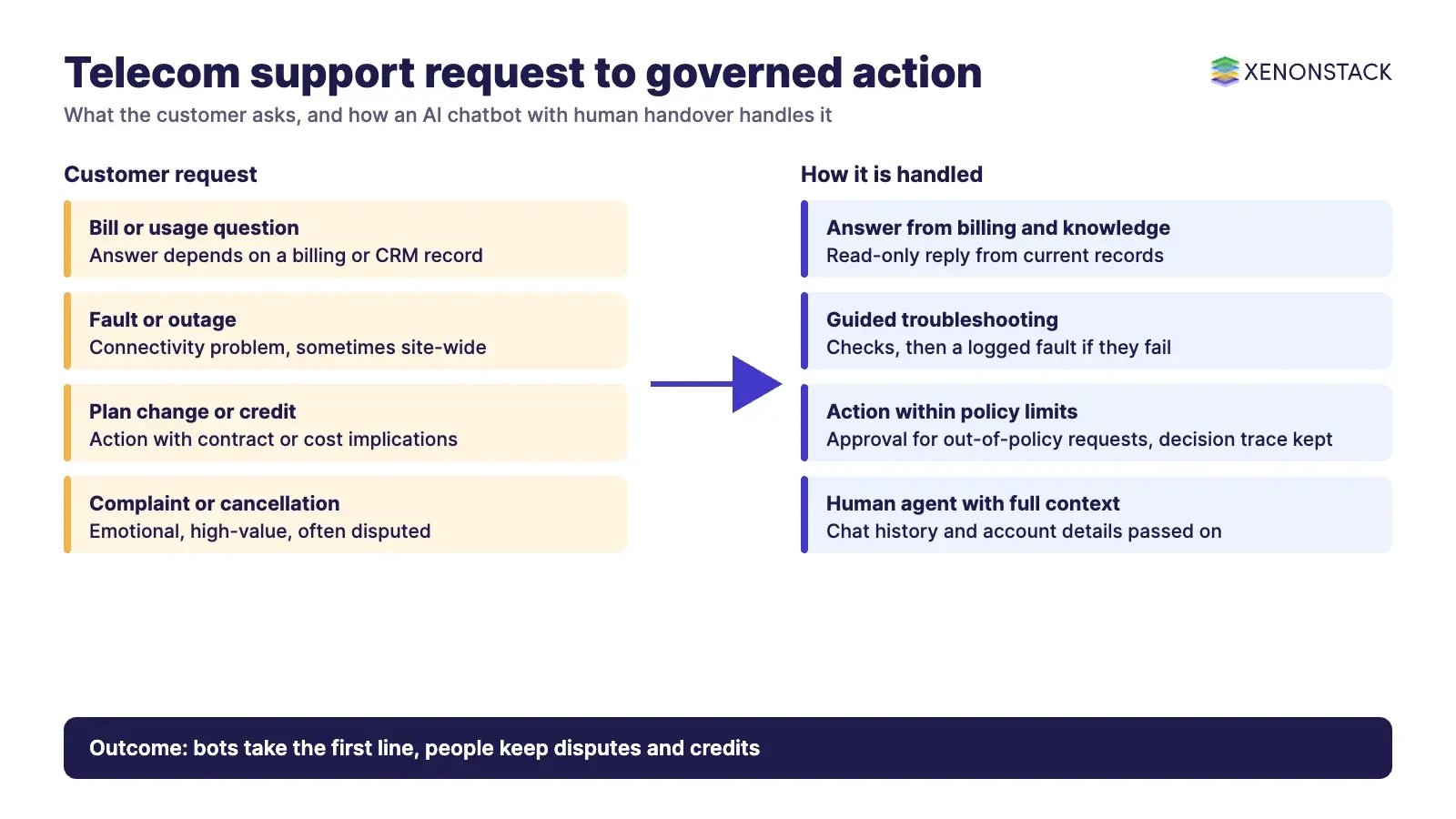
Telecom support is high volume and repetitive: plan and data-balance questions, bill queries, top-ups, connectivity faults and plan changes. These suit a chatbot because the answer sits in a billing or CRM record, and the rules are known. The table shows where a bot fits and where a person should take over.
| Support task | What the chatbot does | Hand over to a person when |
|---|---|---|
| Balance, usage and plan questions | Reads the account record and answers in the customer's language | The record is inconsistent or the customer disputes it |
| Bill explanation | Explains charges line by line from billing data | The customer disputes a charge or asks for a credit |
| Connectivity troubleshooting | Walks through checks such as restarting a router or re-applying settings, then logs a fault | Basic checks fail or a site-wide outage is suspected |
| Plan change and top-up | Confirms eligibility and completes the request within set limits | The change has contract or credit implications |
| Proactive alerts | Sends bill reminders and outage notices | The customer replies with a complaint |
| Complaints and cancellations | Captures the details and raises a case | Always, with chat history and account context passed on |
The pattern that holds across operators is the same: automate the first line, pass context on handover so the customer does not repeat themselves, and keep humans on disputes, retention and vulnerable-customer cases. The underlying language technology is covered in our guide to natural language processing.
How is the telecom chatbot changing from scripted bot to agent?
A scripted bot matches an intent and returns a stored answer. An agentic chatbot plans a few steps, calls tools such as billing, CRM and ticketing, checks the result and escalates when it is outside its limits. The architecture questions change with it.
| Dimension | Scripted chatbot | Agentic chatbot |
|---|---|---|
| Output | Answers and menu paths | Answers plus actions in back-end systems |
| Knowledge | Fixed intents and FAQ content | Retrieval over current knowledge, policy and account data |
| Control | Tested flows | Policy limits, approval steps and decision traces |
| Main risk | Wrong or unhelpful answers | Wrong actions, such as an unauthorised credit or plan change |
| Where it fits | Stable, narrow queries | Multi-step requests across billing, CRM and field service |
Our own view, shared by teams building voice and chat agents for enterprise customers, is that conversation quality is rarely the limiting factor now. Whether the enterprise can trust the decisions and actions the agent takes is. That is why the design starts with what the agent may decide, not what it may say. The video below shows a billing dispute handled by AI agents; it is a general customer-support example, not a telecom deployment.
AI customer support: a billing dispute handled by AI agents (ElixirClaw).
What does a telecom support chatbot need underneath?
The chatbot is the visible layer. Most failures come from the layers below it.
| Component | Role | What to check |
|---|---|---|
| Language understanding | Reads informal, misspelt and multilingual messages | Accuracy in the languages and dialects you serve, tested on real transcripts |
| Speech recognition and text-to-speech | Lets the same service work on voice lines and IVR | Accent coverage and fallback to a person |
| Knowledge retrieval | Finds current policy, tariff and troubleshooting content | Freshness and ownership of every source |
| CRM, billing and ticketing integration | Gives the bot account data and the ability to act | Least-privilege access and an audit log of each call |
| Sentiment and intent signals | Flags frustration and routes to a senior agent | Escalation thresholds agreed with the contact-centre lead |
| Handover | Passes history and customer details to the person | Whether the agent sees the full conversation |
Integration is usually the hardest part. Operators run billing, CRM, order management and network systems from different eras, and the chatbot is only as capable as the interfaces it can call. For the wider platform choices, see our enterprise AI chatbot platform guide.
Which operators have published chatbot examples?
Three operators describe their own support assistants on their own or partner pages. We cite only what those pages say.
| Operator | What the source says | Source |
|---|---|---|
| Vodafone Australia, TOBi | Chat bot in the My Vodafone app that, according to its site, answers common questions, processes simple requests and connects customers to a team member for complex queries. Answers 24/7. | vodafone.com.au |
| Verizon | Customer-facing virtual assistants, including in the My Verizon app, built with Google Cloud Conversational Agents and powered by Gemini models. A separate assistant is deployed to 28,000 customer care reps and retail staff (Google Cloud release, 9 April 2025). | Google Cloud press corner |
| Airtel | Chatbot in the Airtel Thanks app for complaints and support: asks follow-up questions, offers troubleshooting and, if that fails, raises a complaint with a tracking ID. Described as available 24/7. | airtel.in |
Note that none of these pages publishes a resolution rate or cost saving, and we do not quote one. Treat vendor and operator performance percentages without a primary source with caution.
How should operators govern a customer-facing chatbot?
Two rules matter most for customer chat: tell people they are talking to an AI, and keep a person involved in decisions that affect them significantly.
| Risk | What the official source says | Control to apply |
|---|---|---|
| Customers unaware they are dealing with AI | The European Commission says that when using chatbots, humans should be made aware they are interacting with a machine, and that the AI Act's transparency rules come into effect in August 2026. The AI Act text (Article 50) is the legal basis. | Disclose the bot at the start of every chat and voice call, with an easy route to a person |
| Solely automated decisions with significant effect | The UK ICO, on Article 22 of the UK GDPR, says the right applies to decisions based solely on automated processing with legal or similarly significant effects, and that human involvement must be active and not a token gesture. | Keep refunds, credit decisions, disconnections and contract changes behind a human review step or defined policy limits |
| Wrong action in a back-end system | Internal design risk | Least-privilege tool access, spending and credit limits, approval for out-of-policy requests, rollback |
| No evidence after a dispute | Internal design risk | Store a decision trace: question, data used, policy applied, action and outcome |
| Personal data exposure | Internal design risk | Minimise the data passed to the model, mask identifiers and log access |
Sources: European Commission, AI Act policy page (read 12 November 2026) and UK ICO guidance on automated decision-making. Requirements differ by country, so confirm the position in each market with counsel. A decision layer such as ElixirData Context OS keeps governed context, versioned policy and decision traces in one decision layer above AI agents, which is the evidence trail a disputed chatbot action needs. The Decision Review Agent reviews decisions AI agents have made, with their context and outcomes, and flags inconsistent treatment of similar cases.
What is a sensible adoption sequence?
| Phase | Scope | Exit test |
|---|---|---|
| 1. Read-only answers | Top contact reasons from your own data, answered from billing and knowledge sources | Answers match the record on a sampled set of real chats |
| 2. Low-risk actions | Top-ups, plan changes within limits, fault logging | No out-of-policy actions in the trace review |
| 3. Handover quality | Full context passed to agents, sentiment-based escalation | Agents confirm they do not need to re-ask |
| 4. Agentic workflows | Multi-step cases across billing, CRM and field service with approvals | Every action has a decision trace and a rollback |
| 5. Proactive support | Outage and bill alerts tied to network and billing events | Opt-in and opt-out handled correctly |
Start from your own contact-reason data, not a vendor's feature list. Where customer-facing AI agents are the goal, our guide to autonomous customer agents covers the next stage, and AgentForce describes AI agents for sales and customer-facing work. ElixirClaw is an agentic OS platform to build, orchestrate and govern AI agents and automation workflows while keeping humans in control.
When is a chatbot the wrong tool?
- Disputes, retention and vulnerable customers: route to a person early; a bot that loops frustrates customers.
- Outage handling without network data: a bot that cannot see the incident can only apologise. Connect it to incident status first.
- Thin or stale knowledge: a bot built on outdated tariff content spreads errors faster than agents do.
- Languages you cannot test: do not launch a language you cannot evaluate on real transcripts.
- Unclear ownership: if nobody owns policy changes, the bot will keep acting on old rules.
What should leaders expect next?
The direction we see, and not a forecast with numbers, is three-fold: chat and voice on one shared knowledge and policy layer; agents that act across billing, CRM and network incident data under approval limits; and support that starts from network or billing events rather than a customer contact. Each depends on the same foundation: current knowledge, clean integration and a decision trace. Operators moving network operations towards autonomy are on a similar path, described in agentic AI in telecom.
To map one telecom support decision your agents should make, and the context and policy it depends on, book a Context Workshop. See what happens in the workshop.
Frequently asked questions
What is an AI chatbot in telecom?
It is a conversational assistant on an operator's app, web, messaging or voice channel that answers routine questions, completes simple account requests and passes complex cases to a person with the context attached.
Which telecom support tasks suit a chatbot first?
Read-only questions about balances, usage, plans and bills, then low-risk actions such as top-ups and fault logging. Disputes, cancellations and credit decisions should keep a human step.
Do customers have to be told they are talking to an AI?
In the EU, yes in most cases: the European Commission says humans should be made aware they are interacting with a machine, with the AI Act transparency rules applying from August 2026. Check the rules in each market you serve.
Can a chatbot make decisions about a customer on its own?
It can for low-impact matters inside set limits. For decisions with legal or similarly significant effects, the UK ICO says UK GDPR Article 22 applies and human involvement must be active, so keep a review step for refunds, credits and disconnections.
How is an agentic chatbot different from a scripted one?
A scripted bot returns stored answers. An agentic one plans steps, calls billing, CRM and ticketing tools and escalates outside its limits, so it needs policy limits, approvals and decision traces.
Follow XenonStack on LinkedIn: XenonStack on LinkedIn for new guides on agentic AI, data and platform engineering.
Explore the XenonStack platform family: ElixirData · ElixirClaw · ElixirHub · NexaStack · MetaSecure · Neural AI · AgentGRC · AgentSRE · AgentAnalyst · AgentInstruct · AgentRAI · AgentScrum · AgentSearch · AgentForce · AI Aviator · SAIF Aviator · CohortIQ · XenonStack AI · XenonStack UAE