Key takeaway
- How utilities use private 5G and LTE for grid automation, smart metering and field safety: spectrum options, architecture, risks and how to build the case.
Private 5G gives a utility its own cellular network, with dedicated capacity, local control of data and the reliability and security that grid operations need. Utilities use private 5G and LTE to connect substations, distribution automation, smart meters, field crews and drones on a network they control, instead of sharing a public operator's network with consumers.
This guide explains how a private network for utilities works, the spectrum options, the strongest use cases, the risks, and where AI agents add value once the network is live.
What is a private 5G network?
A private 5G network uses the same standards as public mobile networks but is dedicated to one organisation. It has its own radio units, a 5G core (on site, at the edge or in the cloud) and its own SIM credentials, so the operator decides who connects, how traffic is prioritised and where data stays. Many utilities start with private LTE and move to 5G as devices mature. For the basics, see how to build a private 5G network and private 5G enterprise networks.
How does a private 5G network for utilities work?
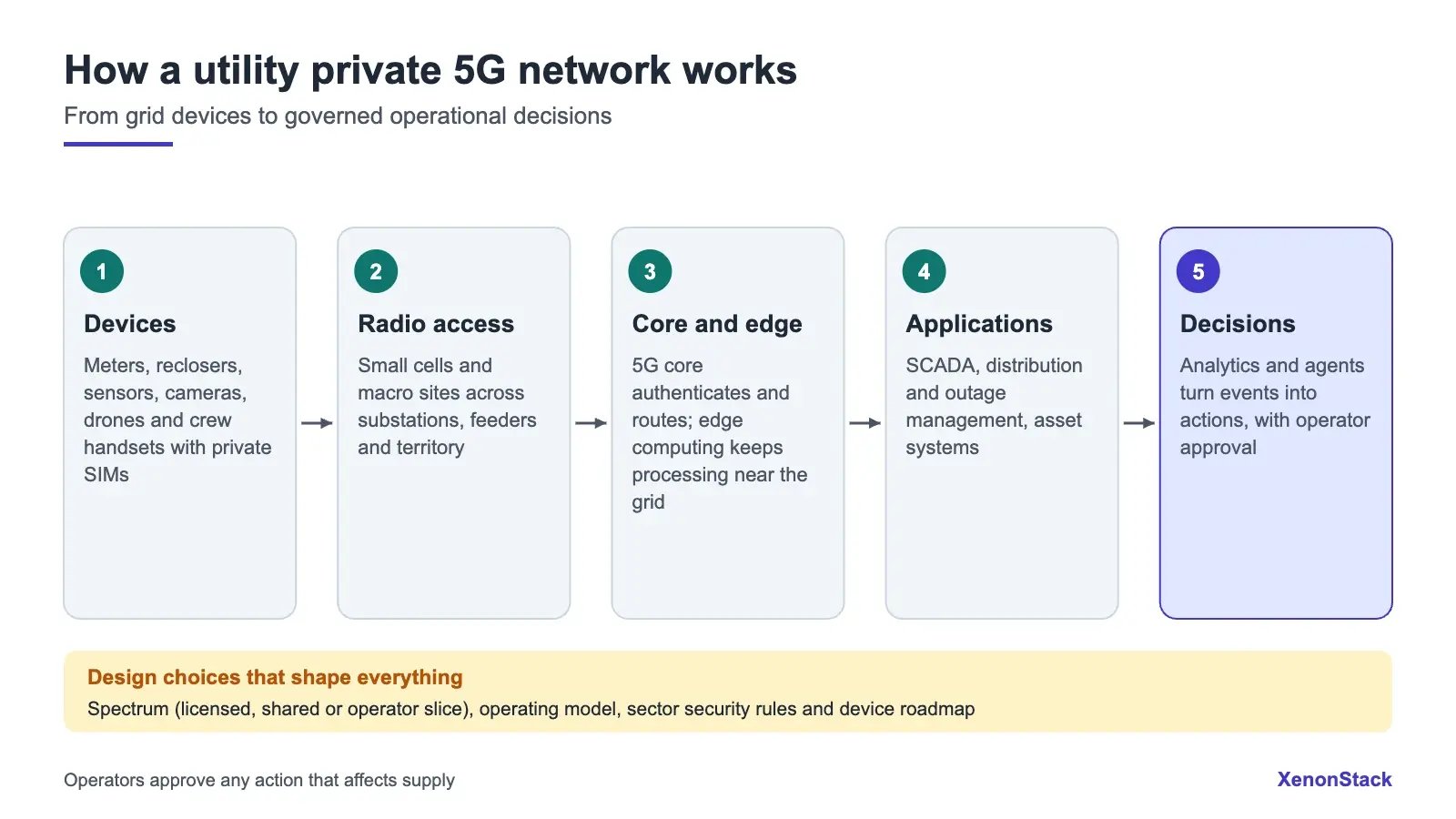
- Devices: meters, reclosers, sensors, cameras, drones and crew handsets carry private SIMs.
- Radio access: small cells and macro sites cover substations, feeders and service territory.
- Core and edge: the 5G core authenticates devices and routes traffic; edge computing keeps time-critical processing close to the grid.
- Applications: SCADA, distribution management, outage management and asset systems consume the data.
- Decisions: analytics and agents turn events into actions, with operators approving anything that affects supply.
Which spectrum can utilities use for private networks?
Spectrum is the first design decision and varies by country. In the United States, the Citizens Broadband Radio Service in the 3.5 GHz band is shared under a three-tier model of Incumbent Access, Priority Access and General Authorized Access, coordinated by approved Spectrum Access Systems, as the FCC 3.5 GHz band overview explains. Other countries offer local or shared licences for industrial use, and some utilities lease spectrum or partner with an operator that provides a dedicated network slice.
| Option | Control | Typical trade-off |
|---|---|---|
| Licensed or priority spectrum | High | Cost and licence process; best for critical grid functions |
| Shared or general access spectrum | Medium | Lower cost; must tolerate coordination and possible interference |
| Operator-managed private network or slice | Medium | Faster to deploy; depends on the operator's service levels |
| Private LTE first, 5G later | High | Mature devices today; plan the upgrade path for the core and radios |
What are the main use cases for utilities?
- Distribution automation: fast, reliable links to reclosers and switches for fault location, isolation and service restoration.
- Advanced metering: a single network for meters, demand response and distributed energy resources.
- Substation monitoring: video, thermal and condition sensors without trenching new fibre.
- Field workforce: push-to-talk, mobile data and lone-worker safety across the service territory.
- Drones and inspection: high-bandwidth uplink for line and vegetation inspection.
- Resilience: a network the utility controls during storms and emergencies.
Edge processing matters for several of these; see edge computing with 5G.
What are the challenges of private 5G for utilities?
- Spectrum access and cost: licences, coordination and radio planning across large territories.
- Device ecosystem: grid devices with 5G modules arrive more slowly than consumer phones.
- Skills: utilities must run a cellular network or contract an operator to do it.
- Security and regulation: the network becomes critical infrastructure and must meet sector security rules.
- Integration: value only appears when network data reaches operational systems and decisions.
Vendor strategies have shifted too: several cloud providers have withdrawn their own private 5G products in favour of partnerships with operators, so choose an architecture that does not depend on a single supplier. See also 5G network concerns and strategies.
Where does XenonStack fit for utilities?
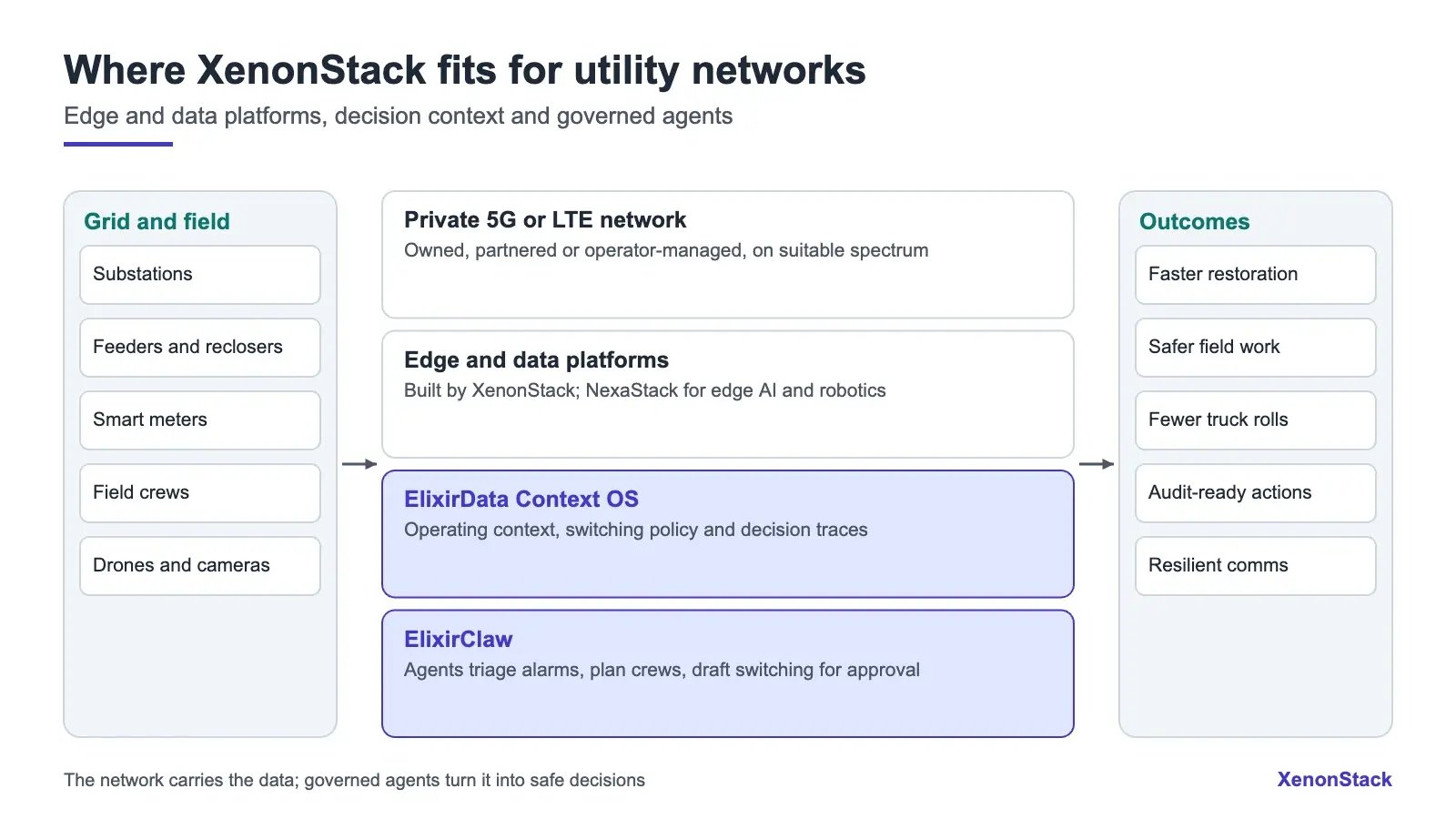
A private network produces a constant stream of grid events. XenonStack builds the edge and data platforms that collect them, ElixirData Context OS holds the operating context and policy behind each decision, such as when a feeder may be switched and who must approve it, and ElixirClaw runs governed agents that triage alarms, plan crews and draft switching actions for operator approval. For edge AI and robotics, see NexaStack.
How should a utility start?
- Pick one operational outcome, such as faster restoration on a set of feeders.
- Confirm spectrum options and the operating model: own, partner or hybrid.
- Pilot in a contained area with the devices that outcome needs.
- Connect network data to operational systems and define who approves automated actions.
- Measure reliability and cost against the existing network before scaling.
To map one grid decision your agents should support, and the context and policy it depends on, book a Context Workshop. See what happens in the workshop.
Frequently asked questions
Why do utilities need private 5G instead of public networks?
Private networks give utilities dedicated capacity, control over security and data, and predictable performance during emergencies, when public networks are often congested.
Is private LTE enough for utilities?
For many uses today, yes. Private LTE supports metering, monitoring and push-to-talk with mature devices. 5G adds lower latency, more device density and network slicing, so many utilities start with LTE and plan an upgrade path.
What spectrum can utilities use in the United States?
Options include licensed spectrum, priority or general access in the 3.5 GHz Citizens Broadband Radio Service band coordinated by Spectrum Access Systems, and partnerships with operators.
Is private 5G secure enough for grid operations?
It can be, with SIM-based authentication, network segmentation, encryption and monitoring, but it must be designed and operated as critical infrastructure under the sector's security requirements.
How do AI agents use private 5G data?
Agents can triage alarms, correlate events across devices, plan field work and draft switching or restoration actions, with operators approving anything that affects supply.
Follow XenonStack on LinkedIn: XenonStack on LinkedIn for new guides on agentic AI, data and platform engineering.
Explore the XenonStack platform family: ElixirData · ElixirClaw · ElixirHub · NexaStack · MetaSecure · Neural AI · AgentGRC · AgentSRE · AgentAnalyst · AgentInstruct · AgentRAI · AgentScrum · AgentSearch · AgentForce · AI Aviator · SAIF Aviator · CohortIQ · XenonStack AI · XenonStack UAE