

Key takeaway
- NLP applications by business function and industry: customer service, HR, finance, healthcare, banking and retail, with EU AI Act risks and how to start.
NLP applications in business fall into a small set of jobs repeated across every function: understanding what customers and employees write or say, pulling facts out of documents, routing and summarising work, and answering questions over company knowledge and data. Customer service, finance, HR, legal, IT operations and analytics teams all use the same building blocks, applied to their own text.
This guide maps those applications by business function and by industry, shows which ones now carry regulatory duties, and suggests an order to adopt them. For the techniques themselves (tokenisation, named entity recognition, transformers, NLP vs LLM and retrieval-augmented generation), read our companion guide to natural language processing techniques and applications.
What are NLP applications in business?
An NLP application is any system that turns unstructured language (emails, chats, calls, contracts, clinical notes, reviews, logs) into a decision, an action or structured data. In 2026 most of these systems combine classic NLP components, such as entity extraction and classification, with large language models (LLMs) for generation and summarisation. The difference between understanding and generating text is explained in NLP vs NLU vs NLG.
This post is about where those systems create value. How to run them reliably once they are live (evaluation, data, guardrails and governance) is covered in NLP best practices for production.
Which NLP applications fit each business function?
The table below lists the applications enterprises most often put into production, by the team that owns the outcome.
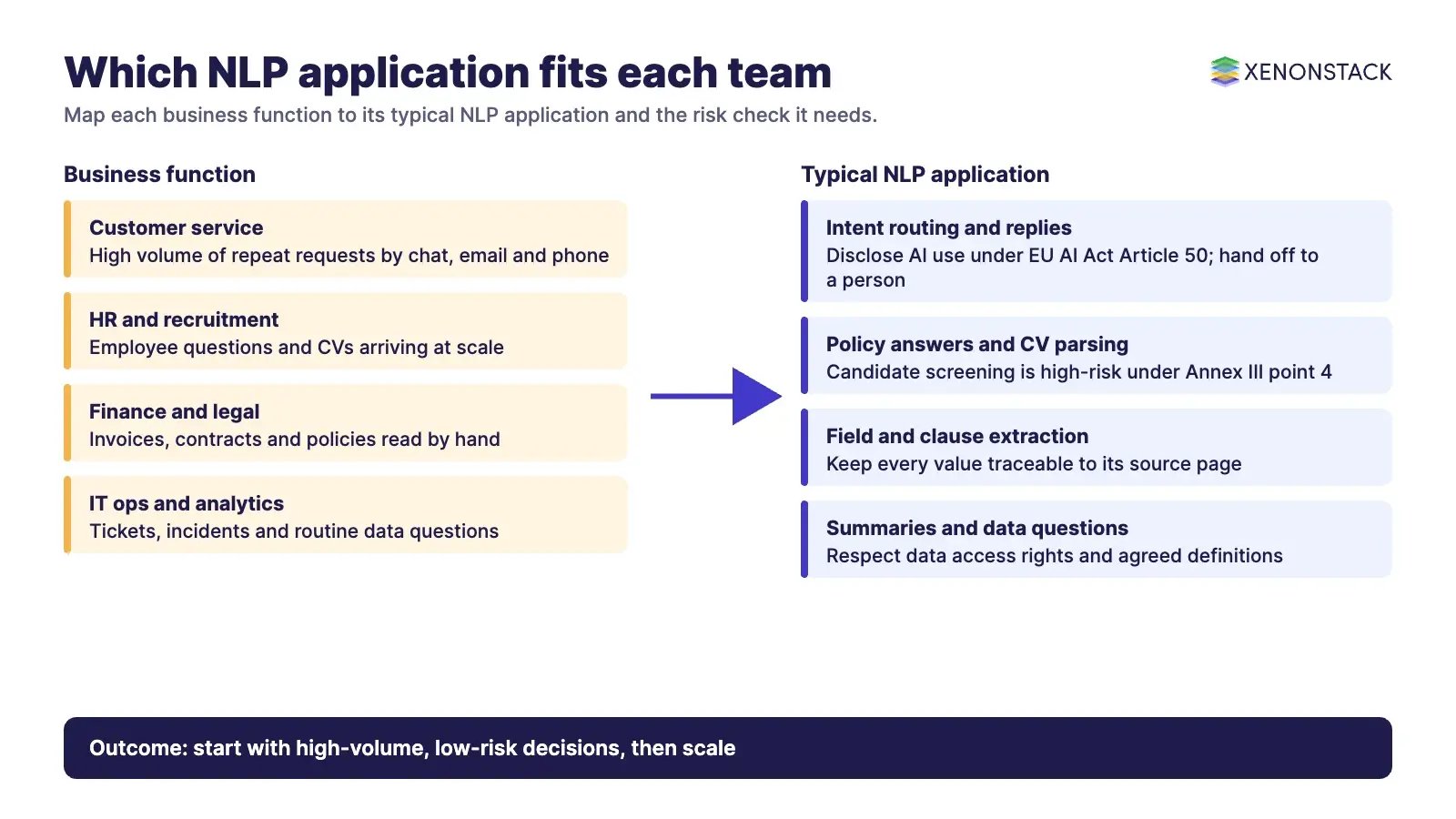
| Function | Typical NLP applications | When it fits | Watch out for |
|---|---|---|---|
| Customer service | Intent detection, ticket routing, assistant replies, call and chat summaries | High contact volume with repeatable request types | Disclosure that customers are talking to AI; hand-off to a person |
| Sales and marketing | Sentiment and voice-of-customer analysis, review mining, lead and email triage | Large volumes of reviews, surveys, social posts or inbound email | Sarcasm, mixed sentiment and language coverage |
| HR and recruitment | Policy question answering, onboarding assistants, job description drafting, CV parsing | Repeated employee questions; structured extraction from CVs | Candidate screening and scoring are high-risk under the EU AI Act |
| Finance and procurement | Invoice and contract extraction, financial sentiment, fraud signals, spend classification | Document-heavy processes with clear target fields | Credit decisions about individuals are high-risk under the EU AI Act |
| Legal and compliance | Clause extraction, obligation tracking, policy search, regulatory change summaries | Large contract or policy estates with known clause types | Summaries must cite sources; lawyers stay accountable |
| IT operations | Log and incident summarisation, ticket classification, knowledge base answers | Noisy alert and ticket streams with recurring patterns | Wrong answers acted on automatically |
| Analytics and leadership | Plain-language questions over business data, report summaries | Teams waiting on analysts for routine questions | Answers must respect data access rights and definitions |
Customer service and contact centres
Customer service is usually the first function to adopt NLP because the text volume is large and the requests repeat. Intent detection routes each message, an assistant drafts or sends the reply, and summaries cut after-call work. Our contact centre intelligence guide covers the full contact-centre picture. AgentForce provides AI teammates with assisted support, recommendations and business knowledge for customer service and sales teams.
Sales, marketing and voice of the customer
Sentiment analysis turns reviews, surveys, social posts and support transcripts into a measurable signal about products and service. Topic and aspect extraction then show which feature or step is driving the sentiment. See our sentiment analytics solution for a worked approach, and text analytics tools and techniques for the methods behind it.
Video: XenonStack explains how sentiment analytics with deep learning turns customer text into product and service insight.
HR and recruitment
Employee-facing assistants answer policy and benefits questions, and extraction models turn CVs into structured profiles. The line to watch is decision-making about people: Annex III of the EU AI Act lists AI systems used to recruit or select people, including analysing and filtering job applications and evaluating candidates, as high-risk.
Finance, procurement, legal and compliance
These functions run on documents. NLP extracts fields from invoices, purchase orders and contracts, classifies spend, flags unusual wording and summarises regulatory changes. The value comes from cutting manual reading time while keeping a person accountable for the decision, with every extracted value traceable to its source page.
IT operations, analytics and leadership
IT teams use NLP to summarise incidents and classify tickets, and business teams increasingly ask questions of data in plain language instead of waiting for a report. Voice interfaces add automatic speech recognition in front of the same pipeline. AgentAnalyst lets teams ask questions of enterprise data in plain language and get real-time insights.
How is NLP applied in each industry?
Industry changes the data, the vocabulary and the regulation more than the technique. The table summarises the main patterns; the sections below give sourced examples.
| Industry | Example applications | Current status (checked November 2026) |
|---|---|---|
| Healthcare | Clinical entity extraction, coding support, ambient documentation, patient question answering | Amazon Comprehend Medical is a HIPAA eligible service; Azure Language lists Text analytics for health as a core feature |
| Banking and finance | Financial sentiment, document processing, fraud signals, customer service | Creditworthiness scoring of individuals is high-risk under EU AI Act Annex III; fraud detection is excluded |
| Retail and e-commerce | Product search, review mining, shopping assistants, support automation | Customer-facing assistants fall under Article 50 transparency duties in the EU |
| Government and defence | Information retrieval, citizen services, multilingual access, analyst support | DARPA's DEFT text programme is complete; public bodies now apply the same methods through modern platforms |
| Telecoms and contact centres | Call summaries, intent routing, quality monitoring | Mature use case; focus has moved to agent assist and governed automation |
Healthcare
Clinical notes, discharge summaries and test results hold most of the detail that coded records miss. Amazon Comprehend Medical detects medical conditions, medications and protected health information in this text and links them to ICD-10-CM, RxNorm and SNOMED CT codes. AWS describes it as a HIPAA eligible service, supports US English only, and states that its output should be reviewed by trained professionals in patient care settings. Microsoft's Azure Language in Foundry Tools lists Text analytics for health as a core feature, and Microsoft completed its acquisition of Nuance, a conversational AI and ambient intelligence company, on 4 March 2022.
Banking and finance
Financial language is specialised, so general models often misread it. FinBERT (Araci, 2019) adapted BERT to financial text and outperformed earlier methods on two financial sentiment datasets, even with less labelled data. Banks also apply NLP to document processing, complaint analysis and fraud signals. Under Annex III of the EU AI Act, AI systems that evaluate the creditworthiness of individuals or set their credit score are high-risk, with an exception for systems used to detect financial fraud.
Retail and e-commerce
Retailers use NLP to understand search queries, mine product reviews, power shopping assistants and automate order and returns support. Because these assistants talk directly to consumers, the EU transparency rule in Article 50 applies (see the regulation section below).
Government and defence
Public bodies use NLP for information retrieval, citizen services and access across many languages. DARPA's Deep Exploration and Filtering of Text (DEFT) programme aimed to address gaps in inference, causal relationships and anomaly detection in large volumes of text; DARPA now lists it as complete. Our guide to NLP in government covers public sector use in more depth.
What has changed since the first wave of NLP applications?
Many older NLP application lists name tools and programmes that have since been acquired, completed or reclassified. Check the current status before you plan around them.
| Earlier pattern | Status in 2026 | What it means for planning |
|---|---|---|
| One narrow model per task (sentiment, spam, entity extraction) | Still used where cost, speed and predictability matter; LLMs now cover drafting, summarising and open questions | Use small task models for high-volume classification, LLMs where language must be generated |
| Separate cloud APIs for each language feature | Azure lists PII detection, NER, language detection and Text analytics for health as core; sentiment, summarisation, CLU and question answering as legacy | Check each vendor feature's lifecycle status before building on it |
| Standalone healthcare speech vendors | Nuance is part of Microsoft (acquisition completed 4 March 2022) | Procure through the current owner's platform and terms |
| Government research programmes such as DARPA DEFT | Programme complete | Cite it as history, not as a current capability |
| NLP treated as unregulated tooling | EU AI Act applies from 2 August 2026, with transparency duties and high-risk categories for recruitment and credit | Classify each application by risk before launch |
Which NLP applications carry regulatory risk?
The EU AI Act (Regulation (EU) 2024/1689) is the clearest reference point for enterprises selling into or operating in the EU. It applies generally from 2 August 2026, according to Article 113 as shown by the European Commission's AI Act Service Desk, which also shows that obligations for high-risk systems listed in Annex III now apply from 2 December 2027 following the Digital Omnibus amendments.
| Application | AI Act position | Practical control |
|---|---|---|
| Chatbots and voice assistants that talk to customers or citizens | Article 50(1): people must be informed they are interacting with an AI system, unless obvious from context | Clear disclosure at the start of the conversation; easy route to a person |
| CV screening, candidate ranking, performance monitoring | High-risk under Annex III point 4 | Human review of every decision, bias testing, logs and documentation |
| Credit scoring of individuals | High-risk under Annex III point 5(b); fraud detection excluded | Explainable features, appeal route, audit trail |
| Internal search, summarisation, ticket routing | Generally outside the high-risk list | Access controls, evaluation and source citations |
The Article 50 text also exempts systems authorised by law to detect, prevent, investigate or prosecute criminal offences, unless they are available for the public to report a crime. For a fuller view of Article 50, read the regulation section of our NLP techniques guide.
How should an enterprise choose and sequence NLP applications?
List the text-heavy decisions. Find where people spend hours reading, routing or retyping language, and estimate volume per week.
Score risk and value. Rank each use case by business value and by regulatory and customer risk. Start with high value, low risk.
Check the data. Confirm you hold enough real, permitted examples, and that personal data can be handled lawfully.
Pilot one function. Build for one team, with a person reviewing outputs, and measure accuracy against their judgement.
Add governance before scale. Put evaluation, access control, logging and disclosure in place, then extend to the next function. Our NLP production best practices cover this step.
When is NLP the wrong tool?
The data is already structured. If the answer sits in a database field, a query or rule is cheaper and more reliable.
The volume is low. A few dozen documents a month rarely justify a model, its evaluation and its upkeep.
Errors are costly and cannot be reviewed. Where a wrong output harms a person and no one can check it, keep a human decision.
Language coverage is thin. Accuracy can fall for minority languages, dialects and specialist jargon unless you test on them.
How can XenonStack help?
XenonStack's natural language processing services help enterprises select, build and run NLP applications by function and industry. For applications that act on what they read, ElixirClaw is an agentic OS platform to build, orchestrate and govern AI agents and automation workflows while keeping humans in control.
To map one language-driven decision your agents should make, and the context and policy it depends on, book a Context Workshop. See what happens in the workshop.
Frequently asked questions about NLP applications
What are the most common NLP applications in business?
The most common are customer service assistants and ticket routing, sentiment and voice-of-customer analysis, document and information extraction, enterprise search and question answering, summarisation, and plain-language questions over business data. Most enterprises start with one of these in a single function before scaling.
How is NLP used in healthcare?
Healthcare uses NLP to extract conditions, medications and protected health information from clinical text and to link them to coding systems. Amazon Comprehend Medical, for example, links entities to ICD-10-CM, RxNorm and SNOMED CT, and AWS states that its output should be reviewed by trained professionals in patient care settings.
How is NLP used in banking and finance?
Finance teams use NLP for financial sentiment analysis, document processing, fraud signals and customer service. FinBERT (2019) showed that adapting BERT to financial text improved results on two financial sentiment datasets. Under the EU AI Act, AI used to evaluate the creditworthiness of individuals is high-risk, while fraud detection is excluded from that category.
Are NLP applications in recruitment regulated?
Yes, in the EU. Annex III of the AI Act lists AI systems used to recruit or select people, including analysing and filtering job applications and evaluating candidates, as high-risk. Treat CV screening and candidate scoring as regulated decisions with human review and audit trails.
Do customers have to be told they are talking to an AI?
Under Article 50(1) of the EU AI Act, providers must design AI systems that interact directly with people so that those people are informed they are interacting with an AI system, unless that is obvious from the context. The AI Act applies generally from 2 August 2026.
Where should an enterprise start with NLP applications?
Start where text volume is high, the decision is low-risk and the outcome is measurable, such as ticket routing or document extraction. Prove accuracy on your own data, add human review for edge cases, then move to higher-stakes uses once evaluation and governance are in place.


