Key takeaway
- How sentiment and intent analytics turn customer text into insight with NLP, machine learning and deep learning, and where AI agents fit in the workflow.
Sentiment analytics is the use of natural language processing and machine learning to classify text as positive, negative or neutral, so organisations can see what customers, voters or audiences feel. Intent analysis goes a step further and asks what the writer wants to do next.
This page is for analytics, customer care and marketing leaders. It covers the problem, the processing steps, where AI agents fit, how the main approaches compare and what to check before adopting it.
What problem does sentiment analytics solve?
Sentiment analysis, also called opinion mining, uses software to process large volumes of text and decide whether it expresses a positive, negative or neutral view. Organisations use it in elections, customer care, marketing and advertising to understand the social sentiment around a brand or campaign. The practical difficulties are sarcasm detection, predicting emotion from text, processing massive volumes in parallel and improving the precision of the algorithm. IBM notes that software has a hard time with irony and sarcasm because tone of voice is missing from text, and that negation and idioms can also be misread.
How does sentiment analysis work step by step?
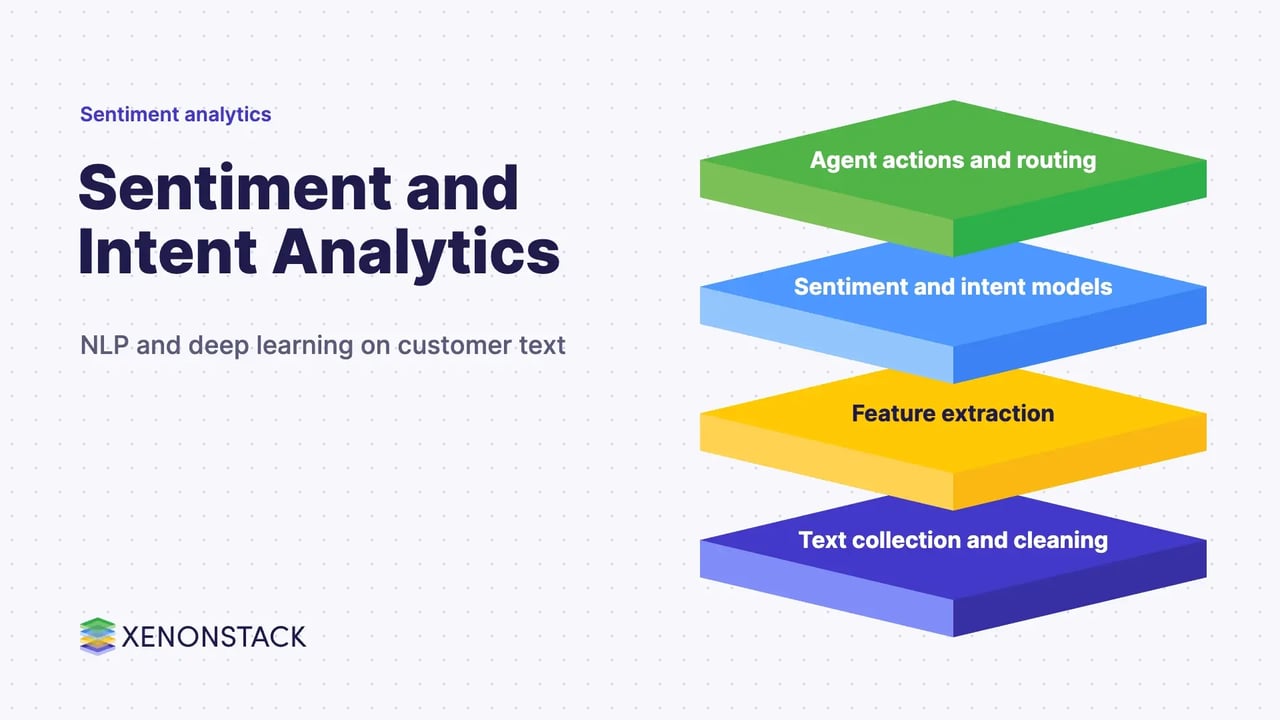
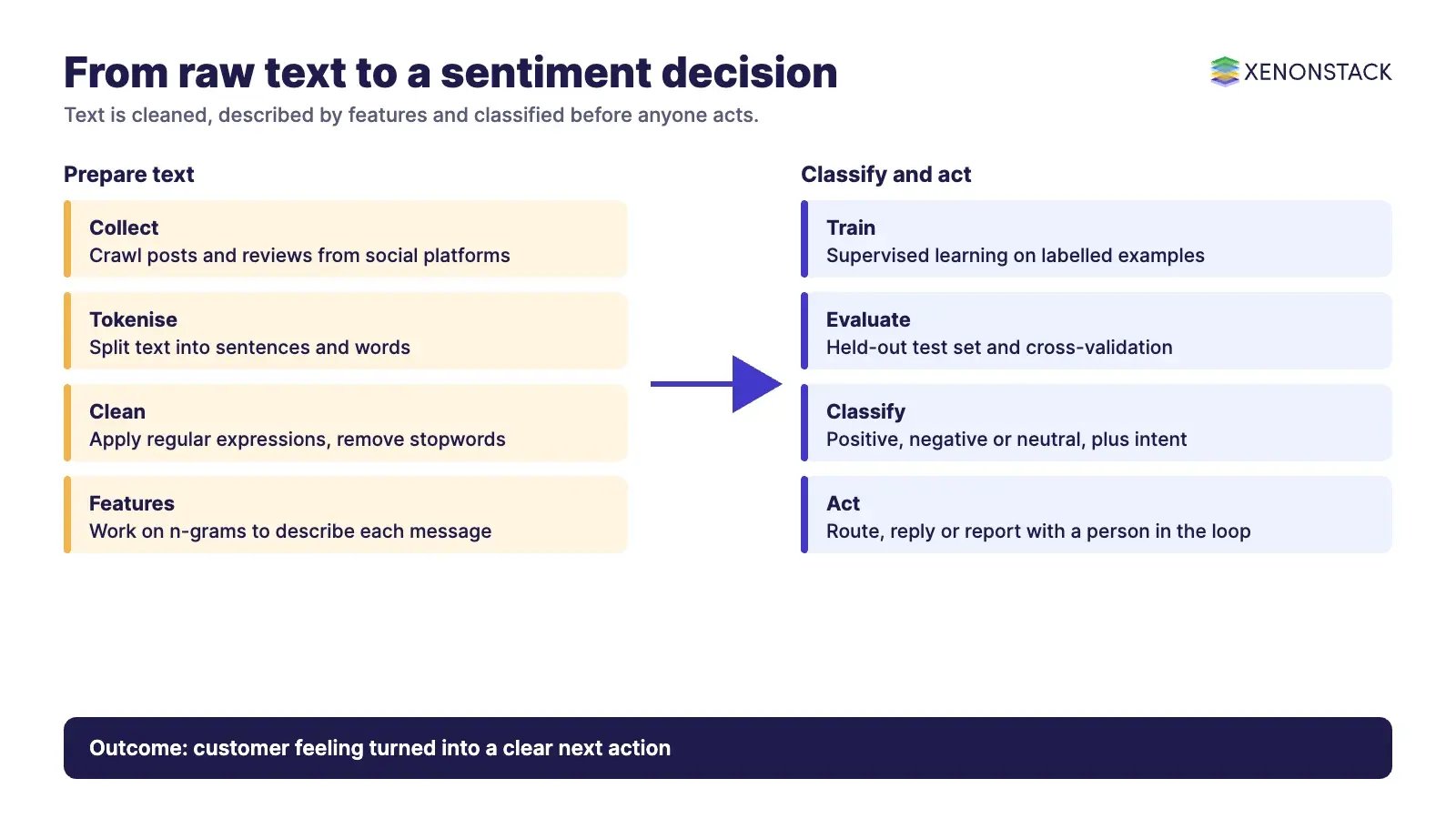
A real-time build for social media trends and posts follows these steps.
- Collect: crawl posts from a social platform, for example with Tweepy in Python.
- Clean: split text into sentences and words, apply regular expressions and remove stopwords.
- Extract features: work on n-grams and other features that describe each message.
- Train: use supervised learning, where a classifier learns from labelled examples, on a large body of data.
- Evaluate: keep a test set separate from training data and use cross-validation and evaluation metrics.
- Apply: classify new text and summarise sentiment for dashboards and reports.
The NLTK book explains why the test set must be distinct from the training corpus: reusing training data as test data rewards models that memorise. It also warns that accuracy can mislead when one label dominates.
What is intent analysis and how does it differ from sentiment?
Intent analysis looks at the emotions and intent behind a message. It involves choosing the right events, tracking behaviour against retention, identifying what the user needs and using predictive analytics on real-time data. Text classification can be supervised, learning from labelled examples, or unsupervised, and deep learning approaches such as convolutional neural networks can be applied to intent.
| Aspect | Sentiment analysis | Intent analysis |
|---|---|---|
| Question answered | How does the writer feel? | What does the writer want or need? |
| Typical output | Positive, negative or neutral | A need or next action |
| Typical use | Brand and campaign monitoring | Retention, support routing, personalisation |
| Methods | Supervised learning, neural networks, deep learning | Supervised and unsupervised classification, convolutional networks |
How do rule-based, machine learning and deep learning approaches compare?
| Approach | How it works | Trade-off |
|---|---|---|
| Rule-based | Scores text against lists of positive and negative words | Fast, but weaker on complex text |
| Machine learning | Learns from labelled examples, including word order | Handles complex text better, needs training data |
| Deep learning | Neural networks learn features from large volumes of text | Needs more data and compute |
| Hybrid | Combines rules with machine learning | Better accuracy, more effort |
IBM describes the first, second and fourth approaches in its guide. Deep learning is listed there as one machine learning method.
Where do AI agents fit in sentiment analytics?
Agents turn scores into action. An agent can watch incoming reviews and messages, flag a sudden drop in sentiment, route an unhappy customer to the right team with the context attached and draft a reply for a person to approve. Agents can also summarise conversation threads and prepare campaign reports. ElixirClaw is XenonStack's AI agents computing platform for running agents like these. Keep a human in the loop for sensitive cases, because sarcasm and context still cause errors.
What should you check before adopting it?
- Define the decision the sentiment score will change and who owns it.
- Check that you may collect and process the text, and respect platform terms and privacy rules.
- Build a labelled sample from your own domain, because language varies by industry and region.
- Test on sarcasm, negation and idioms, and on every language you serve.
- Measure with held-out data and review errors regularly.
To map one decision your agents make on customer feedback, and the data and policy it depends on, book a Context Workshop. See what happens in the workshop.
Frequently asked questions
What is sentiment analytics?
It is the use of natural language processing and machine learning to classify text as positive, negative or neutral so you can see what people feel.
What is the difference between sentiment and intent analysis?
Sentiment analysis measures how the writer feels, while intent analysis identifies what the writer needs or wants to do next.
Why is sarcasm hard to detect?
Text often lacks tone of voice, so software struggles to tell irony and sarcasm from sincere statements.
How do you evaluate a sentiment model?
Train on one set of labelled text and test on a separate one, use cross-validation, and look beyond accuracy when one label dominates.
How can AI agents use sentiment analysis?
Agents can flag sentiment drops, route unhappy customers with context and draft replies for a person to approve.
Ready to put AI agents to work? See an ElixirClaw demo: the agentic OS to build, orchestrate and govern AI agents across your enterprise systems.
Explore the XenonStack platform family: ElixirData · ElixirClaw · ElixirHub · NexaStack · MetaSecure · Neural AI · AgentGRC · AgentSRE · AgentAnalyst · AgentInstruct · AgentRAI · AgentScrum · AgentSearch · AgentForce · AI Aviator · SAIF Aviator · CohortIQ · XenonStack AI · XenonStack UAE