Key takeaway
- How ServiceNow AI agents work in ITSM: what the vendor says, which workflows to automate, governance, trade-offs and an adoption sequence for IT leaders.
How do ServiceNow AI agents change IT service management?
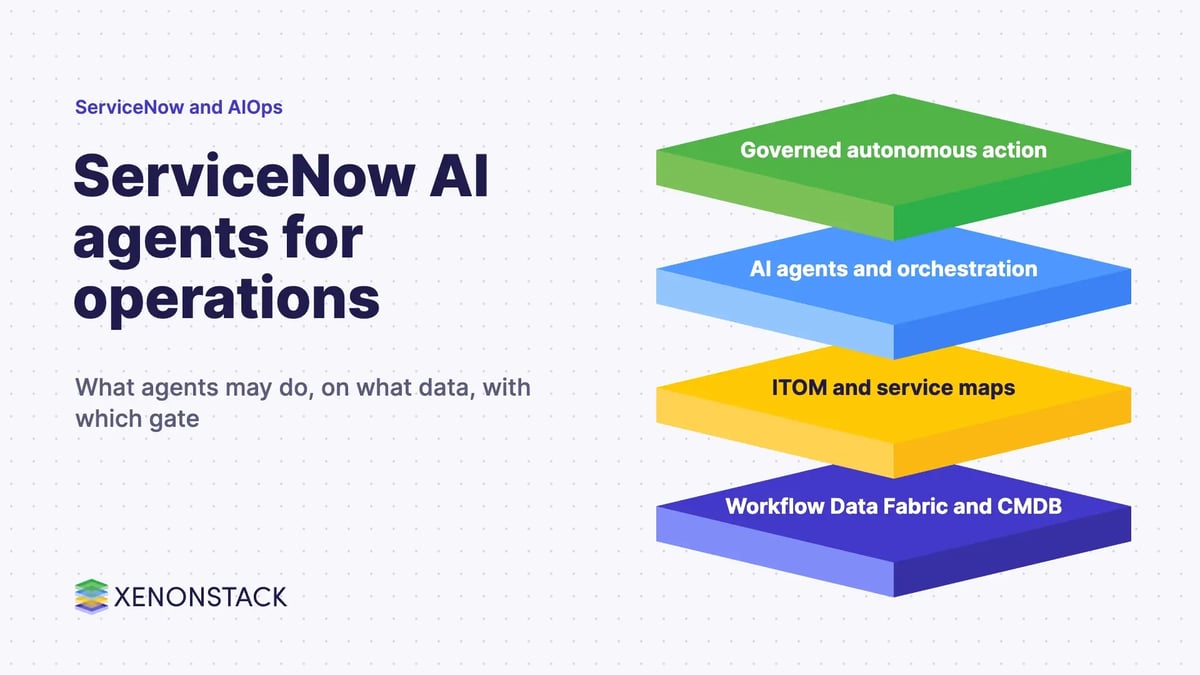
ServiceNow AI agents change IT service management (ITSM) by moving routine incident, request and change work from people clicking through forms to agents that plan, act and hand over. According to its site, the ServiceNow ITSM page offers AI agents and agentic workflows to "triage, investigate, and resolve routine incidents", and the ServiceNow AI Agents page says an agent "can make decisions, take actions, and interact with their environment without continuous human intervention".
For a CIO or head of IT operations the decision is which ITSM workflows an agent may close alone, which need a person, and what evidence you keep. This guide covers what the vendor says, where agents fit by workflow, governance, trade-offs and an adoption sequence. It sits beside our posts on ITIL 4 practices, user experience and the wider pattern in agentic workflows.

Key Benefits of ITSM for Companies
48% of companies use IT Service Management (ITSM) to ensure the quality of IT services, while 35% leverage ITSM to enhance the Customer Experience

Widespread Impact of ITSM Programs
89% of businesses experience added benefits across all ITSM programs, demonstrating its broad effectiveness and value
What does ServiceNow say its ITSM platform and AI agents do?
The table lists claims from ServiceNow's own pages, read on 12 November 2026. The pages give customer figures without dates or method, so we do not repeat them.
| Area | What the page says (according to its site) | Page |
|---|---|---|
| AI agents in ITSM | Deploy AI agents and agentic workflows to proactively resolve routine requests; password resets, software provisioning and troubleshooting are named as end-to-end examples | ITSM |
| Incident management | Use AI agents and agentic workflows to triage, investigate and resolve routine incidents | ITSM |
| Change management | Assess change impact with real CMDB dependencies; automated risk scoring and approvals that improve over time | ITSM |
| Problem management | Detect patterns, route issues to problem management and prevent repeat tickets | ITSM |
| CMDB | Consolidate incidents, changes, problems and requests on one CMDB | ITSM |
| Agent platform | AI Agent Studio builds and customises agents; AI Agent Orchestrator coordinates teams of agents; Super Intelligence Control Tower is a central hub to manage, monitor and optimise AI | AI Agents |
| Virtual Agent | Conversational AI in collaboration tools, portals and apps such as Slack and Microsoft Teams; chat history and context transfer to staff; users can trigger workflows performed by AI agents | Virtual Agent |
ServiceNow also says on the ServiceNow ITSM page that it is a Gartner Magic Quadrant Leader in AI IT Service Management, without giving a year on that page. Treat analyst status as a shortlist input and check the current report yourself.
What is the difference between Now Assist skills and AI agents in ITSM?
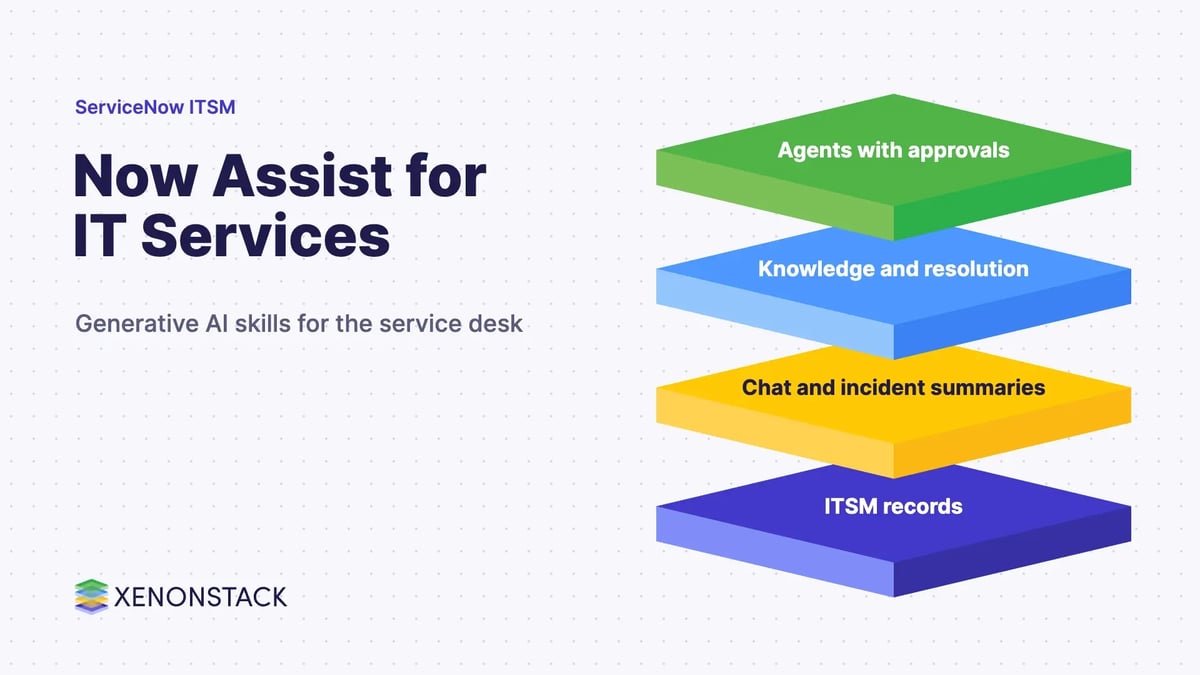
The old term "Now Assist" covers generative AI skills that help a human. The Now Assist for ITSM data sheet names five: AI Search Summarization, Chat Summarization, Incident Summarization, Resolution Notes Generation and Knowledge Generation. AI agents go further, because they plan and take actions. The data sheet lists benefits such as increased incident deflection rates, lower incident MTTR and decreased resolution wrap time, but gives no figures.
| Capability | Helps a person | Acts on its own | Where it fits |
|---|---|---|---|
| Incident Summarization | Yes: issue, actions taken and next steps for the next agent | No | Hand-offs between service desk tiers |
| Resolution Notes Generation | Yes: drafts notes from steps taken | No | Closing incidents consistently |
| Knowledge Generation | Yes: articles drafted from resolved work | No | Keeping knowledge current; see knowledge management with Now Assist |
| AI agent for routine incidents | Reduces queue work | Yes, within set guardrails | Password resets, access, troubleshooting |
| Orchestrated agent team | Coordinates steps | Yes, across several agents | Multi-step requests; see autonomous incident resolution |
ServiceNow lists Brazil as its current release on the ServiceNow AI Agents page. Confirm which release and which licences your instance has before you plan features.
Which ITSM workflows should agents handle first?
Start where work is repeatable, documented and reversible. Keep people on anything that carries risk to customers, money or access.
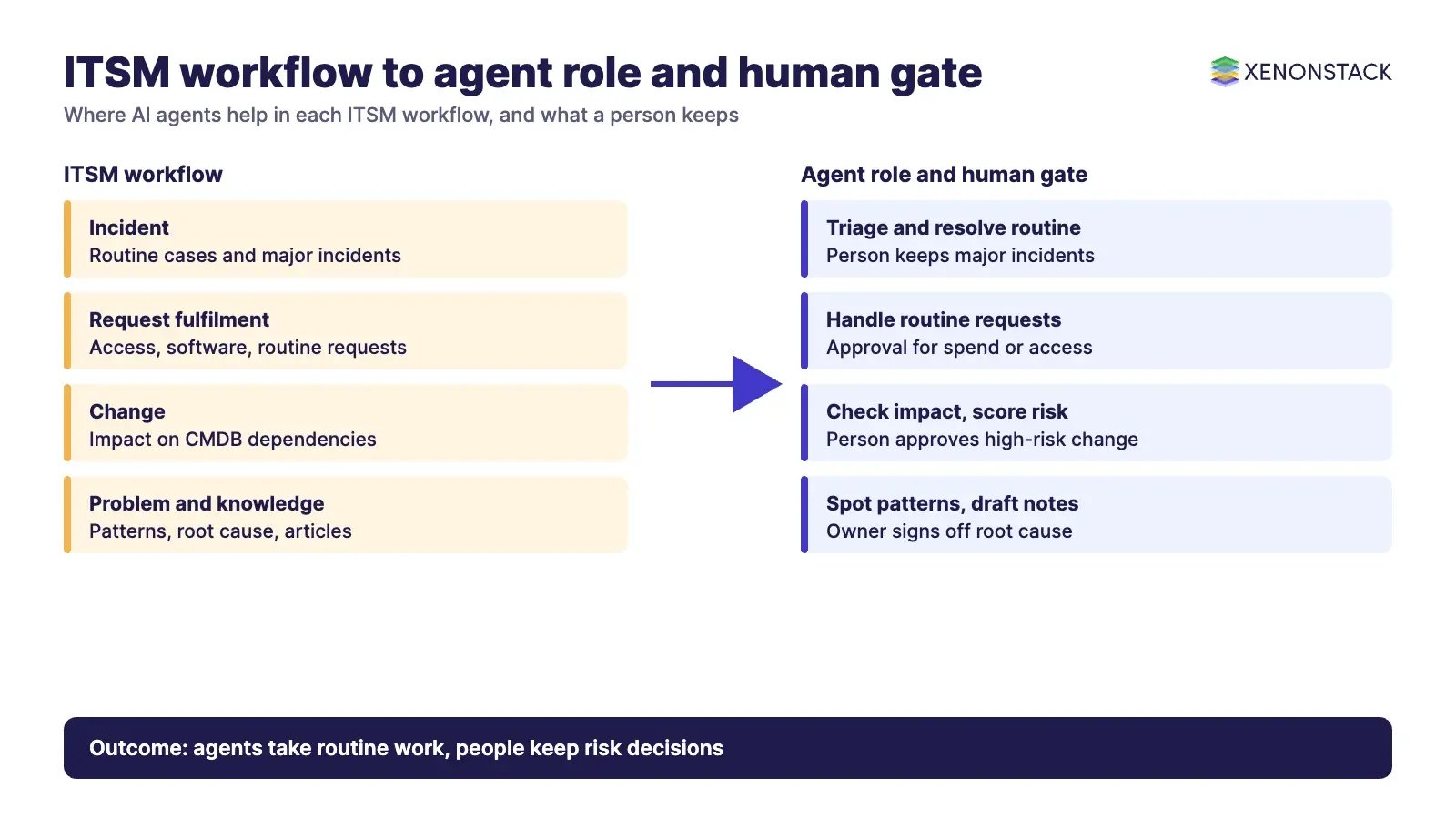
| Workflow | Agent role to consider | Keep a human for |
|---|---|---|
| Incident | Triage, gather context, resolve routine cases, write notes | Major incidents and unclear root cause |
| Request fulfilment | Handle routine requests such as access or software | Requests needing approval or spend |
| Change | Check impact against CMDB dependencies, score risk | Approval of high-risk or emergency changes |
| Problem | Spot patterns and route to problem management | Root cause sign-off |
| Knowledge | Draft articles and resolution notes | Review and ownership of published content |
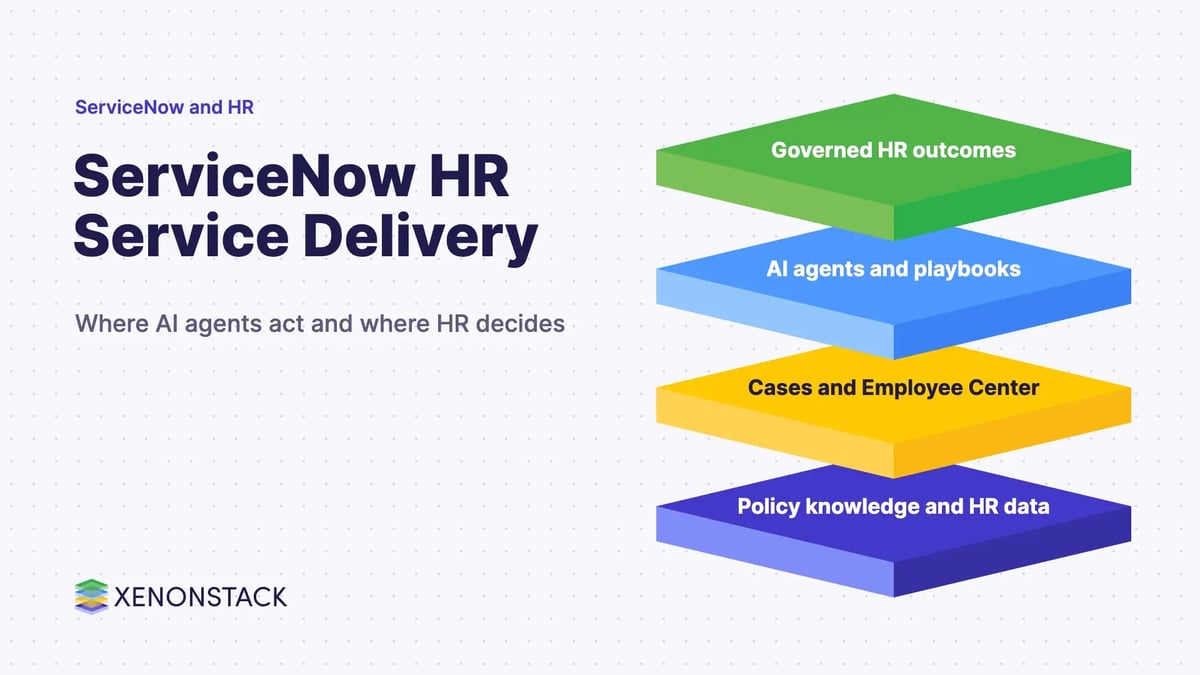
The same pattern extends to HR requests, covered in HR service delivery, and to the digital transformation programmes that ITSM often anchors.
How do you govern ITSM agents for security and cost?
ServiceNow says guardrails are set in AI Agent Studio and AI is monitored from the Control Tower. Whatever platform you use, decide four things before launch: the actions each agent may take, who approves exceptions, how decisions are logged, and how failures are reviewed. A CMDB with gaps will make agents wrong with confidence, so fix data quality first.
On cost, the pages we read show no pricing, so confirm licensing and usage terms with ServiceNow. For the governance layer, ElixirData Context OS keeps governed context, versioned policy and decision traces in one decision layer above AI agents, and ElixirClaw is an agentic OS platform to build, orchestrate and govern AI agents and automation workflows while keeping humans in control. AgentGRC keeps autonomous agent actions inside policy, with the audit trail risk teams need.
What are the trade-offs, and when should you not use agents?
| Situation | Choose | Avoid when |
|---|---|---|
| Routine, well-documented tickets | Agent with guardrails and a log | Knowledge is thin or duplicated |
| Emergency or high-risk change | Human approval with agent risk input | The agent would approve its own change |
| Low ticket volume | Skills that summarise and draft notes | The effort exceeds the saving |
| Poor CMDB data | Fix data first | You expect the agent to correct it |
Agents add cost, new failure modes and a need for ownership. Track hand-off rate, repeat contacts and reopened tickets, not only deflection.
What is a sensible adoption sequence?
Fix the foundations. Clean the CMDB, assign knowledge owners and name an owner for each agent.
Start with skills. Use summaries and resolution notes in one service desk queue.
Add one agent. Pick a routine incident type, with human approval on every action at first.
Measure, then widen. Review hand-offs, errors and user feedback before adding agents or workflows.
To map one ITSM decision your agents should make, and the context and policy it depends on, book a Context Workshop. See what happens in the workshop.
FAQ
Do ServiceNow AI agents replace the service desk?
No. According to ServiceNow, agents resolve routine incidents and requests. Major incidents, high-risk changes and sensitive cases still need people, and ownership of each agent stays with your team.
What is the difference between Now Assist and AI agents?
Now Assist skills such as incident summarisation and resolution notes help a person. AI agents plan and take actions, and an orchestrator coordinates several of them.
Which ITSM processes can AI agents support?
ServiceNow names incident, change and problem management, routine requests and a single CMDB. Start with routine, reversible work.
Does ServiceNow publish results for these agents?
Its ITSM page lists customer figures with no date or method, and the Now Assist data sheet gives none. Measure results in your own pilot.
How do you govern ServiceNow AI agents?
ServiceNow describes guardrails in AI Agent Studio and a Control Tower for monitoring. Add your own rules for permitted actions, approvals and logging.
Where should an ITSM team start?
With CMDB and knowledge quality, then summaries in one queue, then one agent with human approval.
Follow XenonStack on LinkedIn: XenonStack on LinkedIn for new guides on agentic AI, data and platform engineering.
Explore the XenonStack platform family: ElixirData · ElixirClaw · ElixirHub · NexaStack · MetaSecure · Neural AI · AgentGRC · AgentSRE · AgentAnalyst · AgentInstruct · AgentRAI · AgentScrum · AgentSearch · AgentForce · AI Aviator · SAIF Aviator · CohortIQ · XenonStack AI · XenonStack UAE