Key takeaway
- How generative AI and AIOps cut incident volumes: alert correlation, triage, summaries, runbook automation and post-incident learning, with guardrails.
AIOps reduces incident volumes by correlating alerts and detecting anomalies early; generative AI adds plain-language triage, incident summaries, runbook drafting and post-incident learning. Together they cut duplicate tickets, shorten the time to find the cause and stop the same incident recurring.
This guide explains how the two work together across the incident lifecycle, where the gains come from, and the guardrails needed before AI acts on production systems.
Why do incident volumes keep rising?
Distributed applications, more monitoring tools and more change mean more alerts. Much of the volume is noise: one fault triggers dozens of alerts and several tickets, and known problems recur because lessons stay in individual heads. Our guide to incident management covers the process basics.
What is the difference between AIOps and generative AI in incident management?
| AIOps | Generative AI | |
|---|---|---|
| Main job | Find patterns in telemetry | Understand and produce language |
| Typical techniques | Anomaly detection, event correlation, topology analysis | Large language models, retrieval over runbooks and tickets |
| Output | Grouped incidents, probable cause, predictions | Summaries, triage notes, runbook steps, post-incident drafts |
| Main risk | Missed or noisy correlations | Confident but wrong explanations |
For background, see AIOps for IT operations and, on Azure specifically, AIOps on Azure.
How do generative AI and AIOps reduce incidents together?
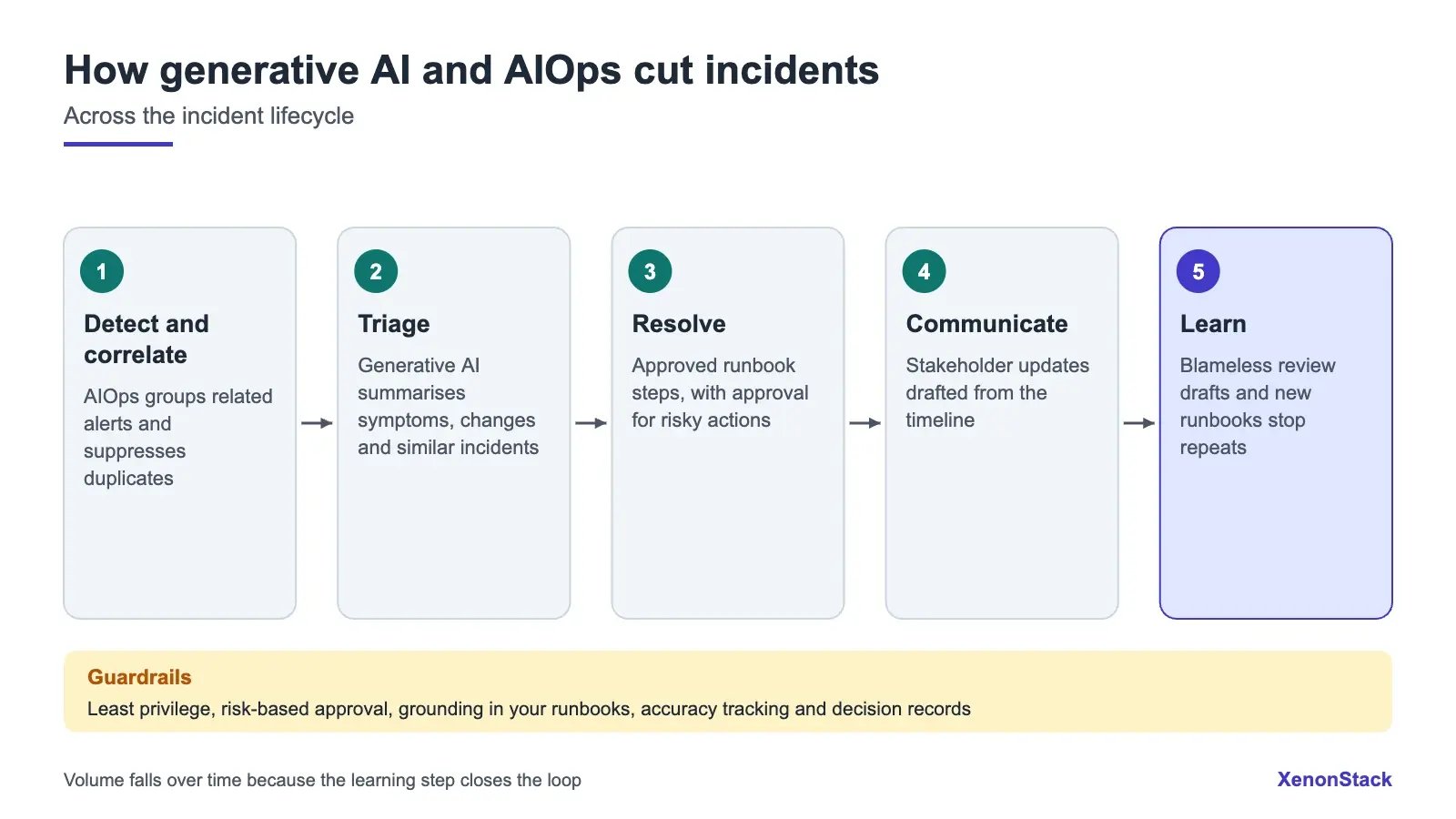
- Detect and correlate: AIOps groups related alerts into one incident and suppresses duplicates.
- Triage: generative AI summarises symptoms, recent changes and similar past incidents for the on-call engineer.
- Resolve: the system suggests or runs approved runbook steps, with approval for risky actions.
- Communicate: status updates for stakeholders are drafted from the incident timeline.
- Learn: a blameless post-incident draft and new runbook entries stop the incident recurring.
The learning step is where volume falls over time. Google's SRE guidance on postmortem culture explains why blameless reviews matter.
Where do the biggest gains come from?
- Fewer duplicate tickets through correlation and automatic linking.
- Faster triage because context is gathered before an engineer opens the ticket.
- Consistent resolution from shared, approved runbooks instead of individual memory.
- Self-service for common requests, so they never become incidents.
- Better documentation because summaries and reviews are drafted automatically.
Related reading: automating incident triage and autonomous incident resolution with ServiceNow AI agents.
What guardrails do AI-driven incident workflows need?
- Least-privilege access for every tool the AI can call.
- Approval gates scaled to risk: read-only diagnosis runs freely; changes to production need a named approver.
- Grounding in your own runbooks, topology and change records, with links to the evidence.
- Accuracy tracking: compare AI triage with engineers' conclusions and act on drift.
- A decision record for every automated action, kept for audit and review.
Where does XenonStack fit?
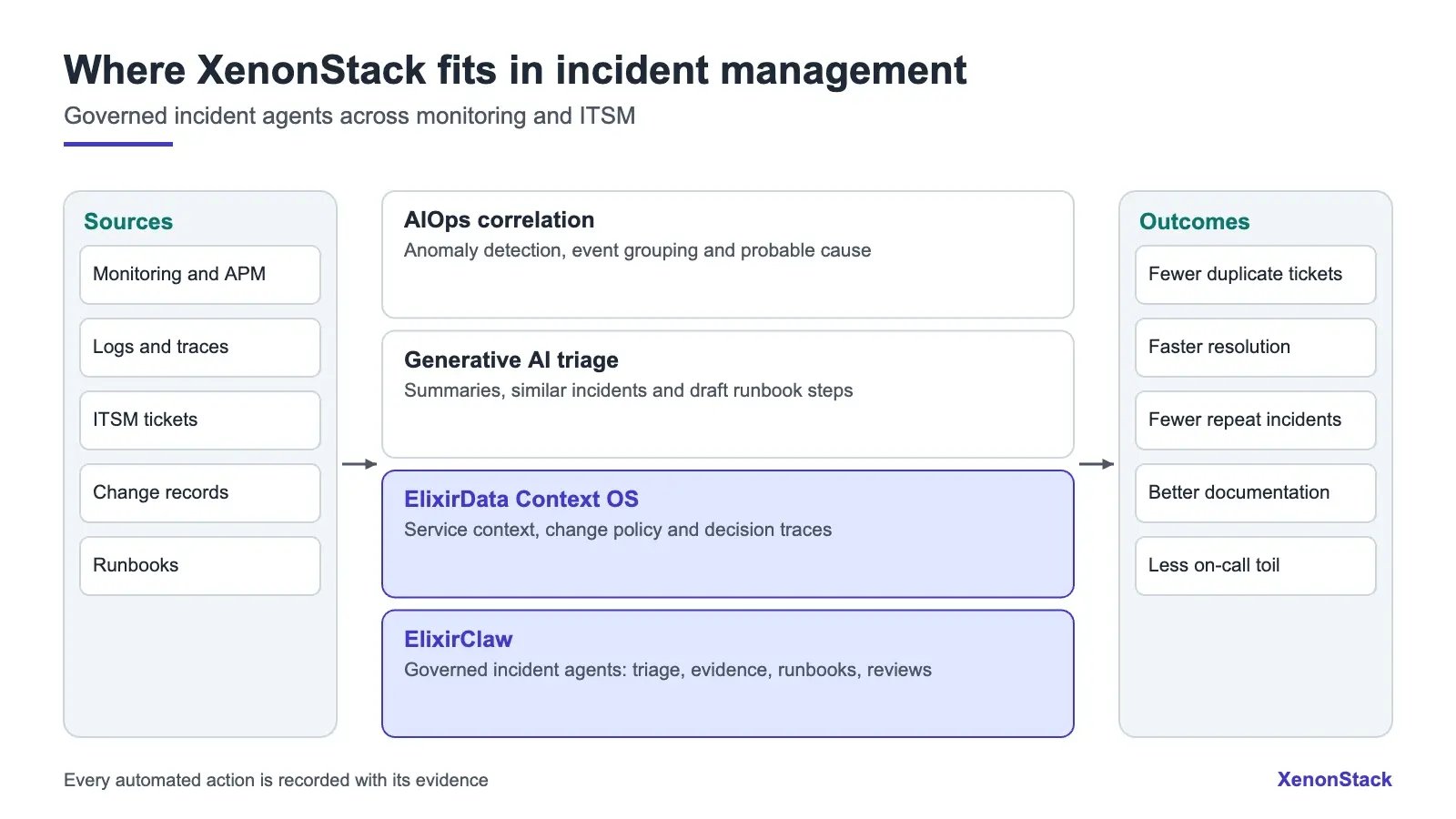
ElixirClaw runs governed incident agents across monitoring and ITSM tools: triage, evidence gathering, runbook execution and post-incident drafts. ElixirData Context OS supplies service context and change policy, and records a decision trace for every action the agents take.
To map one incident decision your agents should make, and the context and policy it depends on, book a Context Workshop. See what happens in the workshop.
Frequently asked questions
How does AIOps reduce incident volume?
By correlating related alerts into a single incident, suppressing duplicates, detecting anomalies before users are affected and highlighting recurring causes so they can be fixed permanently.
What does generative AI add to AIOps?
Language: plain-language triage notes, incident summaries, stakeholder updates, runbook drafts and post-incident reviews grounded in your own data.
Can generative AI resolve incidents automatically?
It can run approved runbook steps for well-understood problems. Changes with higher risk should require a named human approver, and every action should be recorded.
How do you measure success?
Track incident and alert volumes, duplicate tickets, time to acknowledge and resolve, repeat incidents and the accuracy of AI triage against engineers' conclusions.
What data does generative AI need for incident management?
Alerts and telemetry, service topology, change records, runbooks, past incidents and post-incident reviews, with access controls and redaction of sensitive data.
Follow XenonStack on LinkedIn: XenonStack on LinkedIn for new guides on agentic AI, data and platform engineering.
Explore the XenonStack platform family: ElixirData · ElixirClaw · ElixirHub · NexaStack · MetaSecure · Neural AI · AgentGRC · AgentSRE · AgentAnalyst · AgentInstruct · AgentRAI · AgentScrum · AgentSearch · AgentForce · AI Aviator · SAIF Aviator · CohortIQ · XenonStack AI · XenonStack UAE