Key takeaway
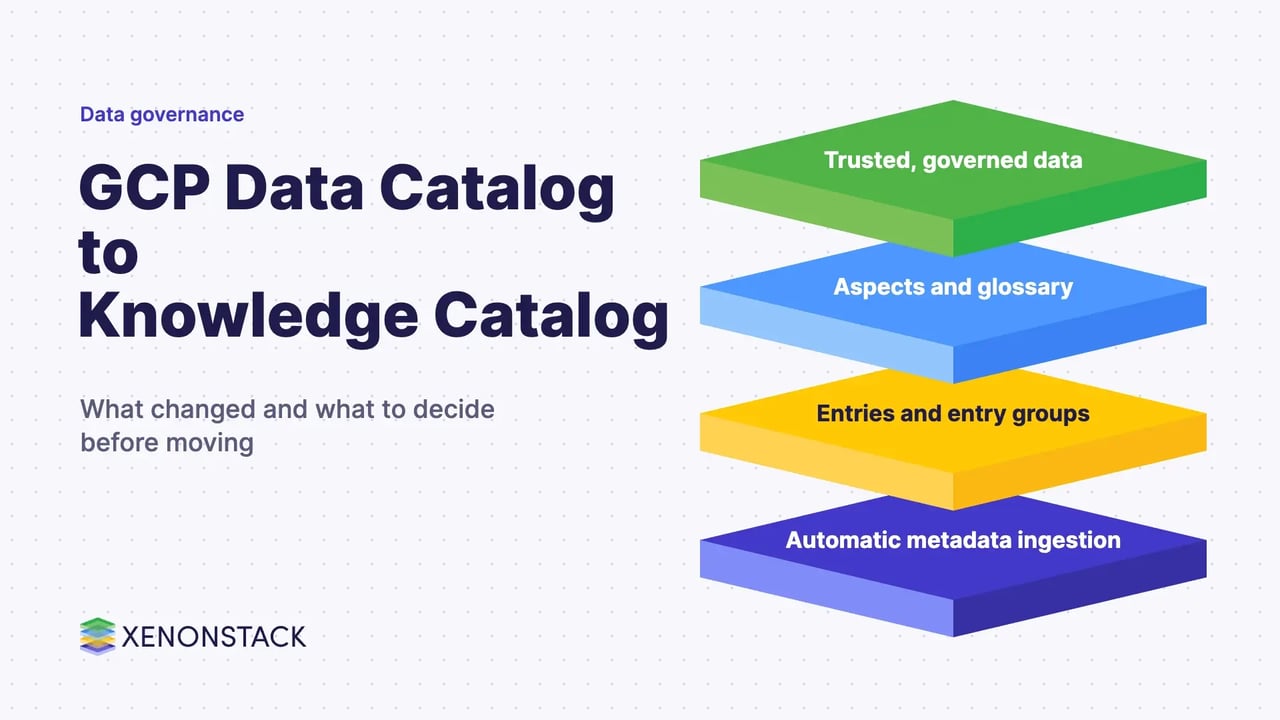
- GCP Data Catalog is deprecated. See what Knowledge Catalog (ex Dataplex Universal Catalog) does, how tags map to aspects, and what to decide before moving.
GCP Data Catalog is the older name for Google Cloud's metadata service. According to Google's documentation, Data Catalog is deprecated and the work has moved to Knowledge Catalog, which was called Dataplex Universal Catalog until 10 April 2026. It still does the same core job: it finds data assets across your Google Cloud estate and holds the technical and business context that people need to trust them.
This guide explains what the catalog does, how the old Data Catalog terms map to the current ones, and what leaders should decide before moving. If you are planning a wider programme, read our guides to data catalog architecture and metadata management alongside it.
What happened to GCP Data Catalog?
Google's Data Catalog release notes record the sequence. Data Catalog became part of Dataplex on 20 July 2022. Dataplex Catalog was renamed BigQuery universal catalog on 9 April 2025, and the product then became Dataplex Universal Catalog. Google's Knowledge Catalog overview states that, as of 10 April 2026, Dataplex Universal Catalog is called Knowledge Catalog, and that the API, client library, CLI and IAM names remain unchanged.
| Name | Status according to Google's docs |
|---|---|
| Data Catalog | Deprecated. Its pages say it will be discontinued on 1 June 2026, and point to a transition guide. An earlier release note gave 30 January 2026, so confirm the current position in the guide. |
| Dataplex Universal Catalog | Renamed Knowledge Catalog on 10 April 2026. |
| Knowledge Catalog | Current name. The place to build new work. |
If your team still has Data Catalog tags, tag templates or scripts, treat them as migration work, not as a stable platform. Google publishes Transition from Data Catalog to Knowledge Catalog for users, workloads and content.
What is a data catalog, and why does it matter?
A data catalog is a central inventory of an organisation's data assets. Google describes Data Catalog the same way, and says that once data is cataloged you can add your own metadata to it. In practice a catalog lets an analyst search for a dataset, see what it contains, and judge whether to trust it, without asking the data engineering team each time.
For leaders, the value is control as much as speed. A catalog shows who owns an asset, how it is classified and where it comes from. Those answers sit behind most data governance, audit and AI readiness work, which we cover in our guide to data governance best practices.
What does Knowledge Catalog do?
According to Google's overview, Knowledge Catalog automatically discovers and indexes technical structures, business context and data quality metrics across your data estate. It ingests metadata automatically from Google Cloud sources, including BigQuery, Vertex AI, Looker, Bigtable, Spanner, Pub/Sub, Datastream, Cloud Storage, AlloyDB (Preview at the time of reading) and Cloud SQL. Confirm the current source list on the official page before you plan around a specific one.
How do the old Data Catalog terms map to the new ones?
Google's API mapping page sets out the changes. It describes aspects as the successor to Data Catalog tags, and aspect types as the successor to tag templates.
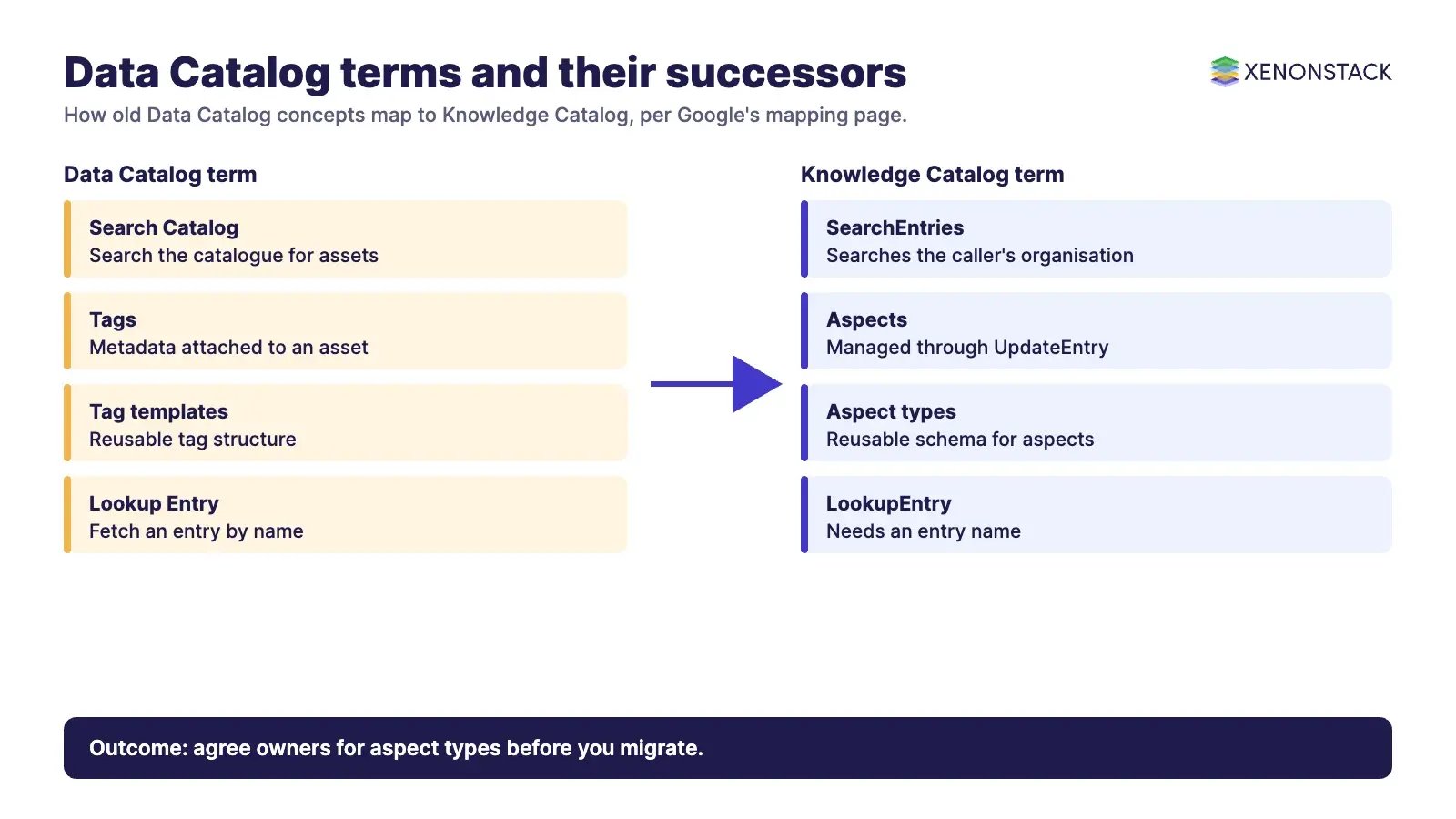
| Data Catalog term | Knowledge Catalog term | What to know |
|---|---|---|
| Search Catalog | SearchEntries | Searches the caller's organisation. Searching another organisation needs a separate call. |
| Get Entry | GetEntry | Same method name. Filter the aspects returned with views, aspect types and paths. |
| Lookup Entry | LookupEntry | Needs an entry name. To translate a SQL or fully qualified name, call SearchEntries first. |
| Tags | Aspects | Managed through UpdateEntry. |
| Tag templates | Aspect types | Template fields map to the aspect type's metadata template. |
What are entries, aspects and aspect types?
An entry represents a single data asset, such as a table or a model. An aspect is a set of related metadata fields. An aspect type is the reusable template that defines the fields and validation rules for an aspect. Entry groups are regional containers that act as an administrative and security boundary. An entry type is a governance template for custom entries and can require specific aspects.
How does search work?
Google's search documentation says search accepts natural language or keyword queries. Semantic search is switched on with a parameter in the API or a flag in the gcloud CLI. Results are scoped to your access: you need read permission on an asset in its source system to find it. Public data assets and aspects attached to entry links are outside the scope of natural language search.
What is the difference between technical and business metadata?
Technical metadata describes how data is stored: the source, the location, the schema and the attributes. Business metadata describes what the data means to the organisation: ownership, classification, definitions and the relationships between assets. Knowledge Catalog covers both. Its business glossary lets you define glossaries, categories and business terms, and entry links can connect entries or columns through relationships such as synonym, related, definition or schema join.
Does Knowledge Catalog track data lineage?
Yes. According to Google's data lineage page, lineage records where data originates, how it transforms and where it moves. Google Cloud services such as BigQuery, Dataflow and Vertex AI Pipelines report lineage automatically once the Data Lineage API is enabled. External databases and on-premises pipelines can be recorded through the API, and OpenLineage events can be imported. The page also states that lineage information is retained for only 30 days, so plan for that if auditors ask for a longer history. Our guide to data lineage tools and best practices covers the wider design.
Which decisions should leaders make before moving?
| Decision | Why it matters |
|---|---|
| Inventory existing tags and templates | They become aspects and aspect types, so ownership and naming need agreeing first. |
| Check scripts and integrations that call the Data Catalog API | Method names and request shapes differ, as the mapping table shows. |
| Decide who owns each aspect type | Aspect types are shared templates; unowned ones drift. |
| Set lineage retention expectations | Lineage is kept for 30 days, per Google's page. |
| Decide what sits outside Google Cloud | Automatic ingestion lists Google Cloud sources, so other systems need custom entries or lineage records. |
When is a catalog alone not enough?
A catalog describes data; it does not decide how an AI agent may use it. If agents will read your catalogued assets, you also need governed context and policy around them. ElixirData Context OS keeps governed context, versioned policy and decision traces in one decision layer above AI agents. For asking questions of enterprise data in plain language, AgentAnalyst is one option. For Google Cloud delivery support, see our Google Cloud solutions.
To map one data decision your agents should make, and the catalogued context and policy it depends on, book a Context Workshop. See what happens in the workshop.
Frequently asked questions
Is GCP Data Catalog still available?
Google's Data Catalog pages say it is deprecated and will be discontinued on 1 June 2026, and direct users to a transition guide. That date has passed, so confirm the current status on the official page before relying on it.
What replaced Data Catalog?
Knowledge Catalog, formerly Dataplex Universal Catalog. Google renamed it on 10 April 2026 and kept the API, client library, CLI and IAM names unchanged.
What are aspects in Knowledge Catalog?
An aspect is a set of related metadata fields that follows an aspect type. Google describes aspects as the successor to Data Catalog tags and aspect types as the successor to tag templates.
Can Knowledge Catalog search in plain language?
Yes. Search accepts natural language or keyword queries, and semantic search can be enabled through the API or the gcloud CLI. Results are limited to assets you have permission to read.
How long does Knowledge Catalog keep lineage?
Google's lineage page states that lineage information is retained for 30 days.
Ready to put AI agents to work? See an ElixirClaw demo: the agentic OS to build, orchestrate and govern AI agents across your enterprise systems.
Explore the XenonStack platform family: ElixirData · ElixirClaw · ElixirHub · NexaStack · MetaSecure · Neural AI · AgentGRC · AgentSRE · AgentAnalyst · AgentInstruct · AgentRAI · AgentScrum · AgentSearch · AgentForce · AI Aviator · SAIF Aviator · CohortIQ · XenonStack AI · XenonStack UAE