

Key takeaway
- Why enterprise AI agents need skills: consistent execution, control, approvals and audit, plus what skills cannot solve without human oversight.
Enterprise AI agents need skills because a skill turns "do it the way we do it" into a written, reviewable procedure the agent loads when a task calls for it. That gives a company more consistent results, a clear owner for each procedure and a trail to audit. A skill does not make an agent safe by itself: approvals, permissions and logging must sit around it.
This guide is for anyone who has heard about agent skills and wants a plain answer to why a company would bother. You will learn what a skill is, what it adds to consistency, control and human oversight, and what it cannot do. Sources, including Claude's official documentation, NIST and the EU AI Act text, were read on 13 November 2026.
What is an agent skill, in plain words?
Think of a recipe card kept in a kitchen drawer. A new cook does not memorise every recipe. They open the card when the order comes in. A skill works the same way for an AI agent.
A skill is a folder with one required file called SKILL.md. The file has a short header (a name and a description) and then plain instructions. The folder can also hold scripts, which are small programs, and reference documents. Anthropic describes skills as organised folders of instructions, scripts and resources that agents discover and load dynamically, and it published the format as an open standard on 18 December 2025.
According to the Agent Skills overview, the agent loads a skill in stages. At start-up it sees only the name and description, about 100 tokens per skill. A token is a small chunk of text, roughly a word. When a request matches a description, it reads the full instructions. Extra files are opened only if needed, and for a script only its output enters the agent's working memory, not the code itself.
Why do enterprise AI agents need skills?
Without skills, an agent works from whatever a person typed into the chat that day. Two people asking for the same task can get two different methods. Nobody can say which method was used, who approved it or when it last changed.
A skill fixes the method in one place. The table shows the difference.
| Question a manager asks | Instructions typed into a chat | A skill |
|---|---|---|
| Is the task done the same way each time? | Depends on who typed it | The same written steps are loaded each time the task matches |
| Who owns the method? | Nobody in particular | A named owner can review and approve changes |
| Can we see what changed? | Rarely | Yes, if the folder is kept under version control |
| Who can use it? | The person who pasted it | Everyone the skill is shared with |
The documentation for Claude Code shows how sharing works in practice. Skills can be saved for one person, committed to a project so the whole team gets them, or placed by administrators in a managed location for machines where the organisation deploys it. For the Claude apps, the announcement page says Team and Enterprise admins must first enable skills organisation-wide. The Help Center adds that Owners on those plans can provision skills so they appear in every team member's list, and can set them to be on or off by default.
How do skills keep execution consistent and under control?
Consistency comes from three habits that the best-practice guide describes.
- Match the freedom to the risk. The guide compares this to a robot on a path. An open field lets it choose its own route. A narrow bridge needs exact guardrails. A skill for brainstorming can be loose. A skill that moves money or edits records should name the exact script and say not to change it.
- Use scripts for work that must be exact. The guide says ready-made scripts are more reliable than code the agent writes on the spot, and keep results consistent between uses. A calculation done by a script gives the same answer each time.
- Plan, validate, then act. For batch or destructive changes, the guide suggests the agent first writes a plan file, a script checks it and reports clear errors, and only then are changes applied.
Control also comes from settings around the skill. According to the Claude Code documentation, a skill with side effects, such as a deployment, can be marked so the agent cannot start it on its own. The same page says the allowed-tools setting lets listed tools run without a prompt for that turn but does not restrict the other tools. That is a useful reminder: a convenience setting is not a security wall.
The guide also asks for testing. It recommends writing at least three evaluations, which are sample tasks with a description of what a good result looks like, and checking the skill with each model you plan to use.
Where do human oversight and approvals fit?
A skill can tell an agent to stop and ask. For example, a refund skill can say "if the amount is above the limit, prepare the case and hand it to a named approver." That makes the pause part of the procedure rather than an afterthought.
Two public sources frame why this matters. Both pages were read on 13 November 2026, and neither summary here is legal advice.
| Source | What it says, in short | Where a skill helps |
|---|---|---|
| NIST AI Risk Management Framework 1.0 (2023) | A voluntary framework with four functions: govern, map, measure and manage. According to the page, govern applies to all stages of an organisation's AI risk processes. The page also says a revision is in progress. | A skill library with owners, review and tests is one concrete way to practise "govern" for agents |
| EU AI Act, Article 14 (human oversight) | High-risk AI systems must be designed so people can oversee them. Overseers should be able to understand the system, avoid over-trusting its output, interpret it, override it and stop it. | A skill can build in review points and tell the agent when to stop. It cannot give the overseer the power or training to do so |
Article 14 applies to systems classed as high-risk under the Act. Whether an agent in your company falls in that class is a legal question, so confirm it on the official page and with your own advisers.
What do skills not solve?
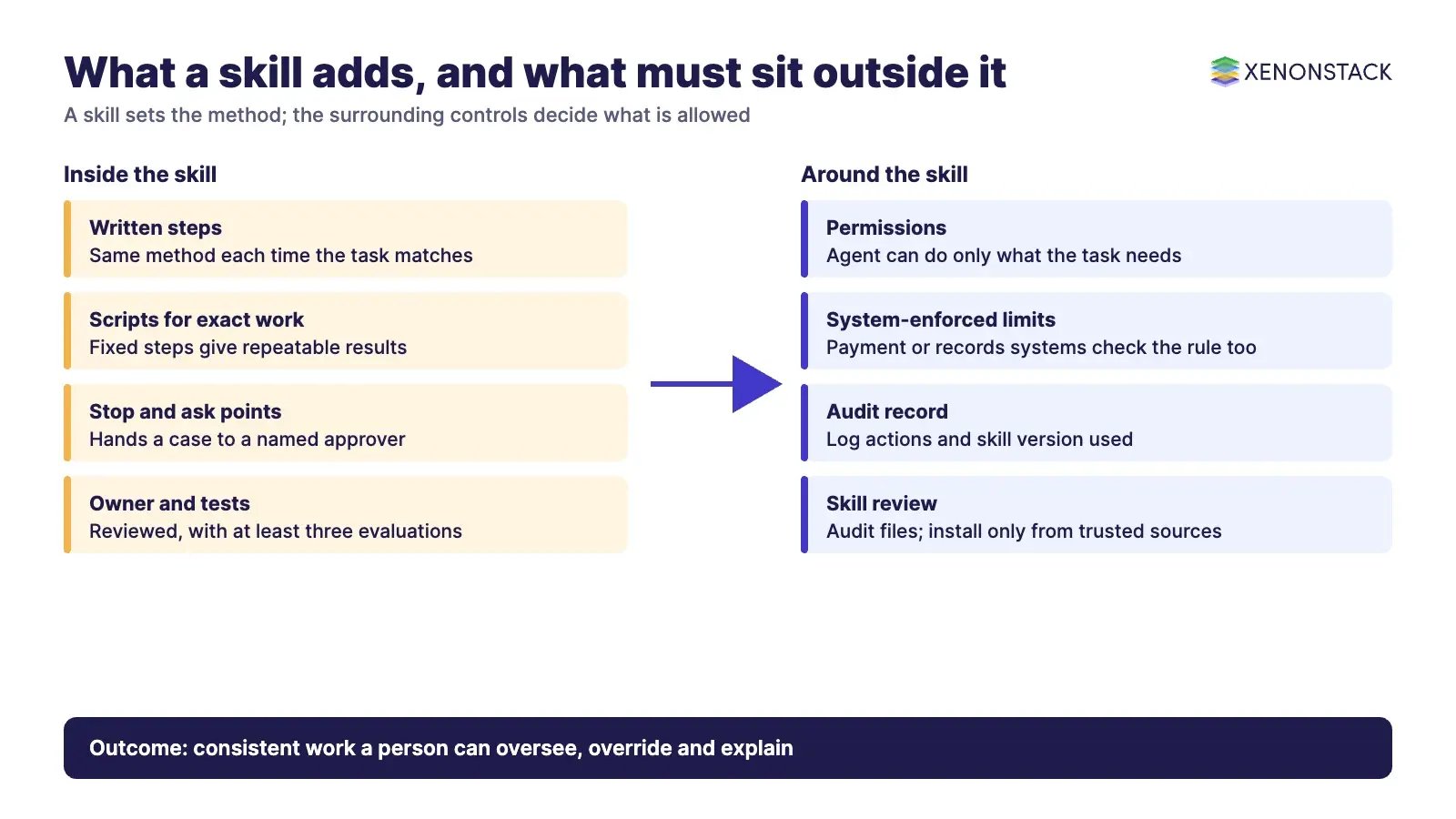
A skill tells an agent how to work. It does not, by itself, decide whether an action is allowed. A written instruction is a request to the model, and models can misread or skip instructions. Four things must exist outside the skill.
- Permissions. The agent's account should be able to do only what the task needs, so a mistake cannot reach further than intended.
- Approvals enforced by the system. A refund limit written in a skill should also be checked by the payment system, not left to the model's good behaviour.
- Audit records. Log what the agent did and which skill version it used, so a past result can be explained.
- Review of the skill itself. A skill can carry scripts and instructions. The Agent Skills overview warns that a malicious skill can direct the agent to call tools or run code in ways that do not match its stated purpose, and advises using trusted sources and auditing the files, including checking for unexpected network calls. It also warns about skills that fetch content from external addresses, since that content may hide instructions.
The overview adds that Enterprise organisations can turn on scanning for custom skills uploaded in claude.ai and Claude Cowork, but scanning does not cover skills uploaded through the Skills API or the Claude Console. Check what your own platform covers.
The same thinking applies to data. An agent that follows a perfect skill on wrong or stale data still gives a wrong answer, which is why our agentic analytics guide treats trusted data and decision context as part of the design.
Related reading
These posts in the series cover the neighbouring questions.
- Skill Files: Tools, Business Rules and Decisions: The three jobs of a skill file: tools, rules and bounded decisions.
- AI Agent Skills: Enterprise-Ready Digital Workers: How skills turn a chat model into a dependable digital worker.
- The Skill Layer for Agentic AI Explained: Where the skill layer sits between the model, tools and rules.
Try it on one decision first
ElixirData is a XenonStack product company, and it offers the Context Workshop and Context OS mentioned here. If you want to see where skills fit with policy, approval and audit, bring one live decision to the free half-day Context Workshop. ElixirData architects help your team map it, and you leave with a one-page decision map and a go or no-go call. You can request a Context OS demo or book the Context Workshop.
Sources
- Anthropic engineering: Equipping agents for the real world with Agent Skills
- Agent Skills specification
- Claude documentation: Agent Skills overview
- Claude documentation: Skill authoring best practices
- Claude Code documentation: Skills
- Claude: Skills announcement page
- Claude Help Center: What are skills?
- NIST AI Resource Center: AI RMF 1.0
- European Commission AI Act Service Desk: Article 14, Human oversight
Frequently asked questions
What is an agent skill?
It is a folder with a SKILL.md file that tells an AI agent how to do one kind of task. The agent sees a short name and description first and loads the full instructions only when a request matches.
Why do enterprises need skills instead of prompts?
A skill keeps the method in one reviewable place with an owner, so the task is done the same way each time. A prompt typed into a chat lives with whoever wrote it and is hard to review or track.
Do skills make AI agents compliant with the EU AI Act?
No. Article 14 asks that high-risk systems be designed so people can oversee, override and stop them. A skill can include review points, but compliance depends on how the whole system is built and used. Confirm the rules on the official page.
Can a skill enforce an approval limit on its own?
No. A skill is an instruction to the model. A limit that matters should also be enforced by the systems the agent calls, with permissions and an audit log around it.
Are skills safe to install?
Only from trusted sources. According to the Claude documentation, a malicious skill can direct an agent to run code or call tools in ways that do not match its stated purpose, so audit the files before use.
How should a company test a skill?
The best-practice guide recommends at least three evaluations, meaning sample tasks with a description of a good result, and testing with each model you plan to use.
Follow XenonStack on LinkedIn: XenonStack on LinkedIn for new guides on agentic AI, data and platform engineering.
Ready to put AI agents to work? Explore ElixirClaw, the agentic OS platform to build, orchestrate and govern AI agents.
Explore the XenonStack platform family: ElixirData · ElixirClaw · ElixirHub · NexaStack · MetaSecure · Neural AI · AgentGRC · AgentSRE · AgentAnalyst · AgentInstruct · AgentRAI · AgentScrum · AgentSearch · AgentForce · AI Aviator · SAIF Aviator · CohortIQ · XenonStack AI · XenonStack UAE


