

Key takeaway
- How AI agent skills give a chat model a job manual, tools, checks and handover rules, and three ways to test a digital worker: accuracy, escalation, audit.
AI agent skills turn a general chat model into a dependable digital worker by giving it what a new employee gets on day one: a written procedure, the right tools, checks to run and a clear point to hand a case to a person. The model supplies the reasoning. The skill supplies the know-how of your particular job.
This guide is for anyone who has used a chat assistant and wondered why it is not yet trusted with real work, including people who find skill files hard to follow. You will learn what a skill is in plain words, how it works through a customer service and a finance back office example, and three simple measures of readiness: accuracy, escalation rate and audit record. Sources, including Anthropic's official documentation, were read on 13 November 2026.
What is an agent skill, in plain words?
A skill is a folder holding a job manual for an AI agent. The manual is a file called SKILL.md. It starts with a short header, then the instructions in ordinary text. Think of a recipe card pinned above a kitchen station: it says what dish it covers, the steps, and what to check before the plate goes out.
According to Anthropic's Agent Skills overview, the header must have a name (up to 64 characters, using lowercase letters, numbers and hyphens) and a description (up to 1,024 characters) that says what the skill does and when to use it. The folder can also hold longer reference notes and small programs, called scripts.
The agent does not read everything at once. The documentation says that, at start-up, the agent sees only each skill's name and description, about 100 tokens (small chunks of text) per skill. It opens the full instructions only when a request matches the description. Other files load only when the instructions point to them, and only a script's output, not its code, enters what the agent is reading.
Why is a chat model not yet a dependable worker?
A chat model is like a very well-read stranger. It knows a great deal in general and nothing about how your team handles a refund, a purchase order or a complaint. Ask the same question twice and you may get two different routines. It has no rule for when to stop and no record of what it did.
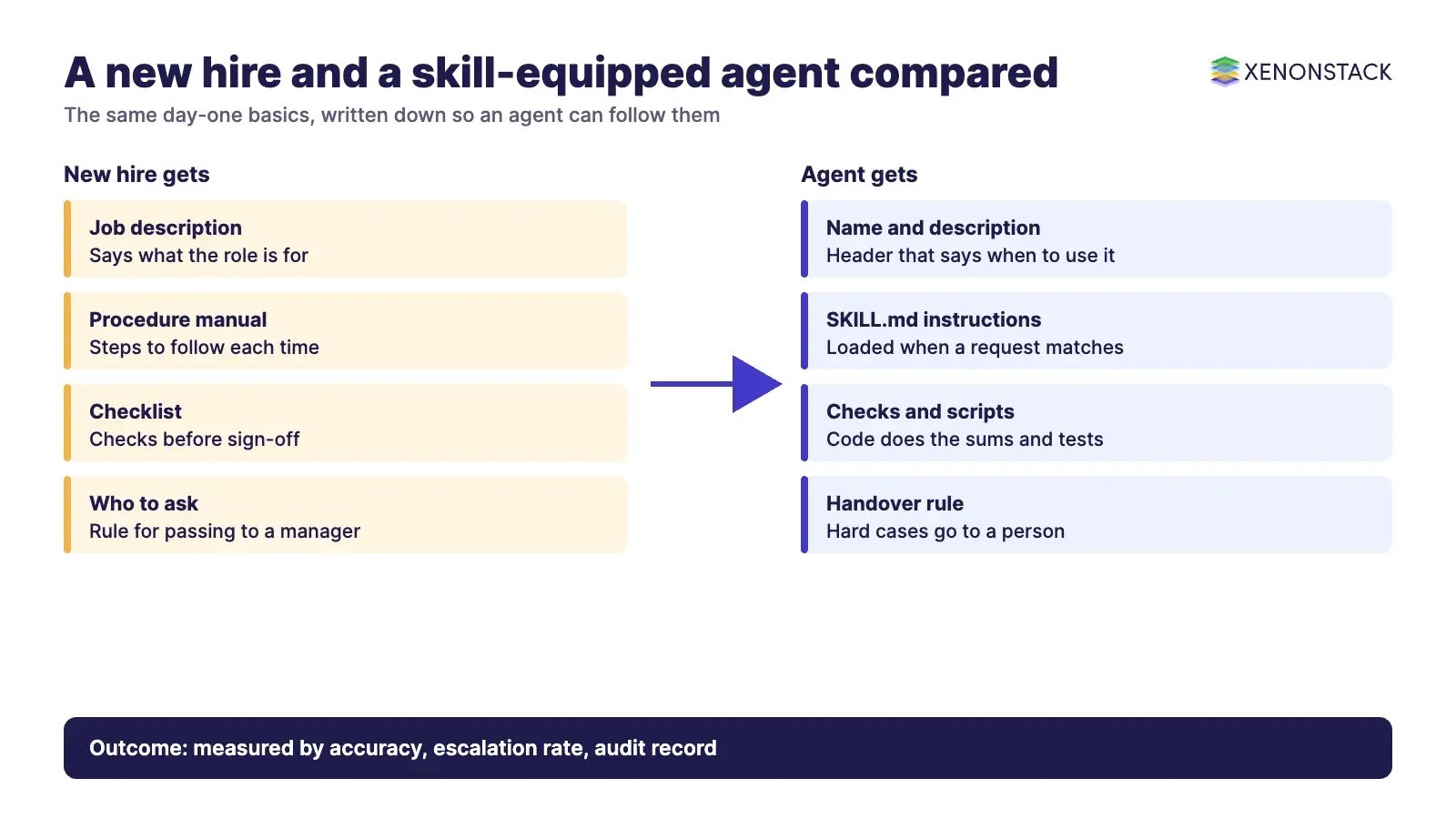
A new hire has the same gap on day one. Companies close it with a job description, system access, a checklist, a buddy to ask and a rule for what goes to the manager. A skill-equipped agent can be set up the same way.
| What a new hire gets | What the agent gets | Where it lives |
|---|---|---|
| Job description | The skill's name and description | SKILL.md header |
| Procedure manual | Step-by-step instructions | SKILL.md body |
| Access to systems | Tools and scripts it may run | scripts folder, connected tools |
| Checklist before sign-off | Checks to pass before finishing | Checklist in the instructions |
| Who to ask when unsure | A handover rule to a person | Escalation step, plus approval outside the skill |
| Performance review | Tests and a log of what it did | Evaluations and audit record |
What does a digital worker look like in customer service?
Anthropic's engineering post on building effective agents describes customer support as a promising use for agents, because it mixes conversation with access to customer records, order history and help articles, and because success can be measured by whether a problem is resolved. That is the kind of job where a written procedure helps.
Here is an illustrative refund skill. It is an example, not a real company's file.
- Confirm who the customer is before discussing the order.
- Look up the order and check it against the refund policy in a reference file.
- If the refund is inside the limit set by the company, process it and tell the customer in plain words.
- If it is above the limit, the customer is upset beyond a set point, or the policy is unclear, stop and pass the case to a person with a short summary.
- Write down what was done and why.
What does it look like in a finance back office?
Finance back office work is full of repeatable checks: matching an invoice to a purchase order, coding an expense, preparing a month-end reconciliation. In Anthropic's announcement, Rakuten's general manager of AI says a task that once took a day now takes about an hour with skills. That is the partner's own statement about its own work, not an independent study.
An illustrative invoice-check skill might say:
- Compare the invoice to the purchase order and delivery note, line by line.
- Run a script that checks totals and tax, so the arithmetic is done by code, not by guesswork. The documentation notes that scripts are more reliable than text the model generates, and save effort.
- Pass the invoice if every line matches within the tolerance your finance team sets.
- Send any mismatch, new supplier or unusually large amount to a named person, with the evidence attached.
How do you measure whether a digital worker is enterprise-ready?
You measure it the way you would review a new hire: by looking at results, at how it handled doubt, and at the paper trail. Three measures cover most of the ground.
A very low escalation rate can mean confidence or missed handovers, and there is no universal target, so set the range with the business owner. According to the best-practice guide, test a skill with every model you plan to use.
| Measure | The plain question | How to check it |
|---|---|---|
| Accuracy | Did it get the job right? | Run test cases with known answers and score the result, such as refund processed correctly |
| Escalation rate | Did it hand over the right cases? | Count cases passed to a person, and review both missed handovers and needless ones |
| Audit record | Can we explain what happened? | Keep the steps, tool calls, skill version and outcome for each case |
Anthropic's article on evaluating agents, published 9 January 2026, suggests starting with 20 to 50 simple tests drawn from real failures. It names three kinds of scorer: code checks, model-based scorers and human reviewers. Its customer support example, which it labels theoretical, checks that identity was verified, the refund stayed within a limit and the ticket was resolved.
The same article makes a point about reliability. Because agent answers vary, it describes running several trials. If an agent succeeds 75 percent of the time on each try, the chance it succeeds on all three of three tries is roughly 42 percent.
For wider governance, NIST's voluntary AI Risk Management Framework (version 1.0, released 26 January 2023) names four functions: Govern, Map, Measure and Manage. NIST's page says the framework is being revised, so confirm the current version on the official page.
What can a skill not do?
A skill tells an agent how to work. It does not, by itself, decide whether an action is allowed. A line in SKILL.md saying "never refund above the limit" is a request, not a lock. If the limit matters, enforce it outside the model too, in the payment system, with approvals and a log.
- Permissions: Anthropic's Claude Code documentation describes permission rules that allow or deny specific skills. Its allowed-tools setting pre-approves tools while a skill runs but does not restrict the others, so your normal permission settings still apply.
- Trust: the overview says to treat skills like installing software: use trusted sources, and review the instructions, scripts and any network calls before use. Take extra care before connecting a skill to sensitive data.
- Where it runs: according to the overview, custom skills do not sync between claude.ai, the API and Claude Code, so each place needs its own copy. It also says Agent Skills is not covered by zero data retention and is not HIPAA eligible, so check your data rules first.
- Ownership: a named person should own and review each skill.
These controls sit around the agent, which is a design problem our agentic analytics guide looks at from the data side.
Related reading
These posts in the series cover the neighbouring questions.
- Why Enterprise AI Agents Need Skills and Oversight: Why a company needs skills: consistency, control and human oversight.
- How AI Agent Skills Automate Complex Industry Workflows: How to turn a written procedure into an agent skill.
- AI Agent Skills: Turning General AI into Specialists: How to make a general model act like a sector specialist, and test it.
Try it on one decision first
If you want to see where a digital worker fits with policy, approval and audit, bring one live decision to the free half-day Context Workshop. ElixirData, a XenonStack product company, offers the Context Workshop and Context OS. Its architects help your team map that one decision, and you leave with a one-page decision map and a go or no-go call. You can request a Context OS demo or book the Context Workshop.
Sources
- Agent Skills overview (Claude documentation)
- Agent Skills best practices (Claude documentation)
- Extend Claude with skills (Claude Code documentation)
- What are skills? (Claude support)
- Introducing Agent Skills (Anthropic announcement)
- Building effective agents (Anthropic engineering)
- Demystifying evals for AI agents (Anthropic engineering)
- AI Risk Management Framework (NIST)
Frequently asked questions
What is an AI agent skill?
It is a folder with a SKILL.md file that works like a job manual for an AI agent. It says what the skill is for, when to use it and the steps to follow, and it can include reference notes and small scripts.
How is a digital worker different from a chatbot?
A chatbot answers questions from general knowledge. A digital worker follows your written procedure, uses approved tools, runs checks, hands difficult cases to a person and leaves a record of what it did.
How do I know if a digital worker is ready for real work?
Test it on real cases with known answers, review how often it hands cases to a person and whether those handovers were right, and check that every action leaves a record. Anthropic suggests starting with 20 to 50 simple tests drawn from real failures.
Can a skill stop an agent from doing something it should not?
Not on its own. A skill is guidance. Limits that matter must also be enforced outside the model, through permissions, approvals and logging in the systems the agent uses.
Do I need to write code to create a skill?
No. Most of a skill is plain written instructions. Scripts are optional and useful when a step, such as checking totals, is better done by a program.
Is it safe to install skills from anywhere?
No. Anthropic's documentation advises using skills you wrote yourself or got from trusted sources, and reviewing the instructions and scripts before use, especially before connecting them to sensitive data.
Follow XenonStack on LinkedIn: XenonStack on LinkedIn for new guides on agentic AI, data and platform engineering.
Ready to put AI agents to work? Explore ElixirClaw, the agentic OS platform to build, orchestrate and govern AI agents.
Explore the XenonStack platform family: ElixirData · ElixirClaw · ElixirHub · NexaStack · MetaSecure · Neural AI · AgentGRC · AgentSRE · AgentAnalyst · AgentInstruct · AgentRAI · AgentScrum · AgentSearch · AgentForce · AI Aviator · SAIF Aviator · CohortIQ · XenonStack AI · XenonStack UAE


