

Key takeaway
- Digital twin technology explained for enterprise leaders: ISO 23247 and Digital Twin Consortium definitions, twin types, the stack and industrial uses.
Digital twin technology creates a data-driven virtual representation of a physical asset, process or system that stays synchronised with the real thing, so teams can monitor it, test changes and predict problems without touching the physical original. The Digital Twin Consortium defines a digital twin as "an integrated data-driven virtual representation of real-world entities and processes" with synchronised interaction "at a specified frequency and fidelity". That last part is what separates a twin from a static 3D model or a one-off simulation.
In 2026 the term is backed by formal standards: ISO 23247 sets out a digital twin framework for manufacturing, and ISO/IEC 30173:2023 fixes the core concepts and terminology. This post takes a vendor-neutral view of what a digital twin is, the main types, the technology stack and where it pays off in industry. If you are evaluating Microsoft's service specifically, read our companion guide to the Azure Digital Twins platform, its architecture and 2026 status.
What is digital twin technology?
A digital twin has three parts: the physical entity, its virtual representation, and the data connection that keeps the two in step. Sensors, control systems and business applications feed the twin with current state; models and analytics turn that state into insight; and the results flow back to people or systems that act on the physical asset. The Digital Twin Consortium stresses that twins are "motivated by outcomes, driven by use cases", which is a useful test: a twin without a decision it improves is just an expensive model.
The consortium also defines a digital twin system as "a system-of-systems that implements a digital twin". In practice this means a twin is rarely one product. It is an architecture that combines connectivity, data platforms, models, visualisation and workflow.
How is a digital twin different from a simulation or a 3D model?
| Artefact | Connected to live data? | Typical use |
| 3D or CAD model | No; shows design geometry | Design, documentation and visualisation |
| Simulation | Usually no; runs on assumed or historical inputs | Testing a design or scenario offline |
| Digital twin | Yes; synchronised at a defined frequency and fidelity | Monitoring, prediction, what-if testing and closed-loop decisions on a running asset or process |
Which standards define digital twins?
Standards matter because twins usually combine equipment and software from many vendors. Three references are worth knowing:
| Reference | What it covers | Status |
| ISO 23247-1 | Overview and general principles of a digital twin framework for manufacturing, including terms and framework requirements | Published October 2021 |
| ISO 23247-2 | Reference architecture for the digital twin in manufacturing, with domain, entity and functional views | Published October 2021 |
| ISO/IEC 30173 | Digital twin concepts and terminology, a functional view and stakeholders, for use across all types of organisations | Published November 2023 |
| Digital Twin Consortium definition | Industry definition of a digital twin and a digital twin system | Published by the consortium; widely used in vendor-neutral work |
For plant connectivity, OPC UA is the common interoperability layer: the OPC Foundation describes it as a platform-independent service-oriented architecture with encryption, authentication and auditing among its design goals.
What are the main types of digital twins?
Twins are usually grouped by the scope of what they represent. The scope decides how much data, modelling effort and integration the twin needs.
| Type | What it represents | Typical decisions | When it fits |
| Component or asset twin | A single machine or part, such as a pump, motor or turbine | Condition monitoring, failure prediction, maintenance timing | High-value equipment where downtime is costly |
| Product twin | A product across design, testing, production and use | Virtual prototyping, design changes, field performance feedback | Engineered products in automotive, aerospace and electronics |
| Process twin | A workflow such as a production line or logistics flow | Bottleneck removal, scheduling, what-if testing before changes | Operations with many interacting steps |
| System twin | An interconnected environment such as a plant, building, grid or city district | Energy optimisation, capacity planning, resilience | Large estates where local changes have system-wide effects |
What technology stack does a digital twin need?
Whatever the vendor, the stack has the same layers. Each layer can be bought or built, and the choice at one layer constrains the others.
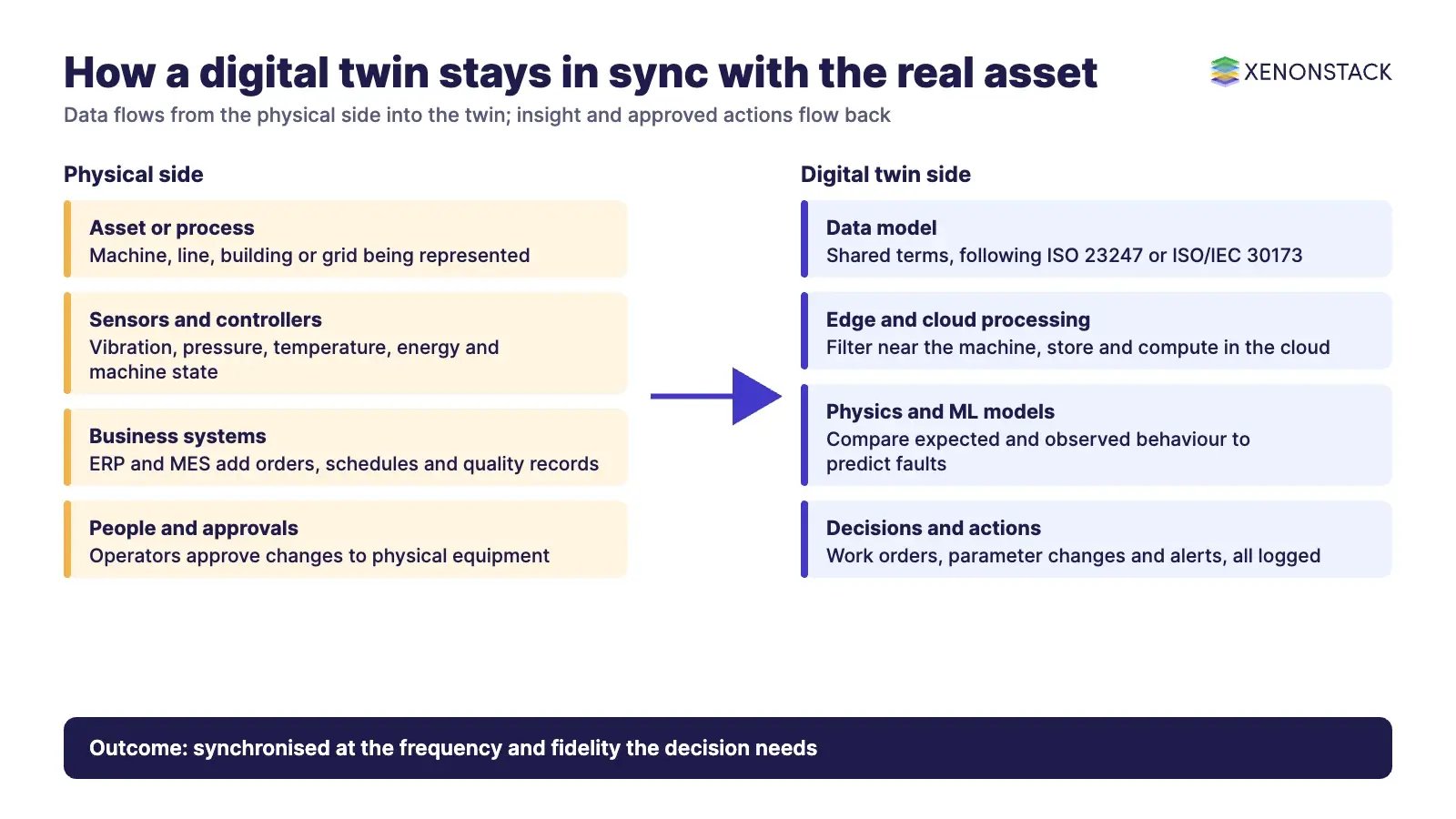
Connectivity and data capture
Industrial IoT sensors measure vibration, pressure, temperature, energy use and location. Controllers and SCADA systems provide machine state, and ERP and MES systems add orders, schedules and quality records. Our guide to industrial IoT applications covers the device side in more depth.
Edge and cloud processing
Streaming platforms such as Apache Kafka move data from the edge into the twin. Edge processing filters and aggregates data close to the machine, which cuts bandwidth and latency, while cloud platforms provide storage and compute for models and history. See our post on edge data management for the governance side of this layer.
Models and analytics
Twins combine physics-based simulation with data-driven models. Physics models capture how the asset should behave; machine learning models learn from history to detect anomalies and predict failures. The value usually comes from comparing the two: when observed behaviour drifts from the expected, something has changed.
Visualisation and decisions
Dashboards, 3D views and AR or VR interfaces show operators the state of the twin. The final layer routes recommendations into action, whether that is a work order, a parameter change or an alert to a person. NexaStack, for example, is an agentic operating platform for physical AI that runs across on-premises, cloud and hybrid environments, which suits twins that span plant and cloud.
Where do digital twins pay off in industry?
The strongest cases share three traits: an expensive asset or process, enough sensor data to describe its state, and a decision that can be improved by seeing problems earlier or testing changes safely first.
- Predictive maintenance: an asset twin compares live vibration, temperature and load data with expected behaviour and flags degradation before failure.
- Production line optimisation: a process twin tests new schedules, layouts or product mixes before they reach the shop floor. Our article on Industry 4.0 digital twins in smart manufacturing covers these applications.
- Product design and quality: a product twin links design models with test and field data, so engineers can see how design choices behave in use.
- Energy and buildings: a system twin models energy flows across a site or grid to reduce waste and plan capacity.
- Supply chain: a twin of the logistics network tests the effect of delays and rerouting before committing to a plan.
ElixirClaw's article on digital twin simulations with AI agents shows how agents can act on these simulations in manufacturing.
What has changed in digital twin platforms?
The platform market has moved quickly, and several services that older articles recommend have been retired or repositioned. Check status before you design around any managed service.
| Service | Current status (checked November 2026) |
| Azure Digital Twins | Available as a platform service for twin graphs of whole environments; no retirement notice on Microsoft Learn |
| Microsoft Fabric digital twin builder | In preview; a low-code ontology item in Fabric Real-Time Intelligence that stores data in OneLake |
| Azure Time Series Insights | Retired on 7 July 2024 |
| Azure IoT Central | New applications unavailable from 23 September 2026; existing applications supported until 20 September 2029 |
| AWS IoT TwinMaker | Available; AWS describes it as a service to "build operational digital twins of physical and digital systems" and states it is not intended for operating hazardous environments or critical systems |
The other change is in how twins are used. Early twins were mostly dashboards. Newer designs connect the twin to AI agents that read its state, propose or take actions and log why. That raises the bar for governance, covered below.
Video: XenonStack's overview of digital twin technology and its solutions.
What governance, security and cost questions should leaders ask?
- Who owns the twin's data and models? A twin spans operations, engineering and IT. Name an owner for the data model, the analytics and the actions the twin can trigger.
- Which actions can run without a person? Keep a human approval step for any action that changes physical equipment, and log every recommendation and decision. AWS's own guidance for IoT TwinMaker says its data should not replace human monitoring for safety purposes. ElixirData Context OS keeps governed context, versioned policy and decision traces in one decision layer above AI agents.
- How is operational technology protected? Use authenticated, encrypted protocols such as OPC UA, separate plant and corporate networks, and give every service and agent its own identity with least privilege.
- Does the twin hold personal data? Twins of buildings, workforces or patients can capture personal data, which brings regulations such as the GDPR into scope. Minimise and anonymise where possible.
- What will it cost to run? Costs come from sensors and connectivity, data storage, model compute and platform fees. Synchronisation frequency is a major cost lever: sample only as often as the decision needs.
How should an enterprise adopt digital twins?
- Pick one decision with a measurable outcome, such as unplanned downtime on a critical asset class.
- Define the twin's scope, the data it needs and the frequency and fidelity of synchronisation.
- Audit data sources: sensors, controllers, historians, MES and ERP, and close gaps in connectivity and data quality.
- Choose the platform after the data model, and check its current status and roadmap.
- Build a pilot twin with read-only access and compare its predictions with what actually happens.
- Add actions in stages, with human approval first and automation only for low-risk, well-tested changes.
- Scale to related assets or processes, reusing the data model and following ISO 23247 or ISO/IEC 30173 terms so teams share one vocabulary.
When is a digital twin not the right choice?
A twin is overkill when a simple threshold alert or a monthly report answers the question, when the asset is cheap to replace, or when there is no reliable data feed to keep the twin in sync. It also fails when no one owns the decision it is meant to improve. Start with the decision and the data; if both are weak, fix those first.
The trade-off to watch is fidelity against cost. Higher fidelity and faster synchronisation improve accuracy but raise data, compute and integration costs. Many successful programmes start with a low-fidelity asset twin and add detail only where it changes decisions.
To map one asset or process decision your twin and agents should support, and the context and policy it depends on, book a Context Workshop. See what happens in the workshop.
Frequently asked questions
What is digital twin technology in simple terms?
It is a virtual representation of a physical asset, process or system that is kept in sync with the real thing through data, so teams can monitor it, predict problems and test changes without touching the original.
What is the difference between a digital twin and a simulation?
A simulation usually runs offline on assumed or historical inputs. A digital twin is connected to live data and synchronised at a specified frequency and fidelity, so it reflects the current state of the asset or process.
Which standards apply to digital twins?
ISO 23247 (published 2021) sets out a digital twin framework and reference architecture for manufacturing, and ISO/IEC 30173 (published 2023) defines digital twin concepts and terminology. The Digital Twin Consortium also publishes a widely used definition.
What are the main types of digital twins?
Twins are usually grouped by scope: component or asset twins, product twins, process twins and system twins covering whole plants, buildings, grids or districts.
Is Azure Time Series Insights still used for digital twins?
No. Microsoft retired Azure Time Series Insights on 7 July 2024, so designs that relied on it need another time-series store.
Explore the XenonStack platform family: ElixirData · ElixirClaw · ElixirHub · NexaStack · MetaSecure · Neural AI · AgentGRC · AgentSRE · AgentAnalyst · AgentInstruct · AgentRAI · AgentScrum · AgentSearch · AgentForce · AI Aviator · SAIF Aviator · CohortIQ · XenonStack AI · XenonStack UAE


