Key takeaway
- How IoT sensors, an MQTT pipeline and analytics replace manual part counts, support asset management and move maintenance from reactive to predictive.
IoT data analytics for maintenance uses sensors on machines to stream production and condition data into an analytics platform, so teams can track assets, schedule maintenance breaks and act before a failure. It replaces manual counting and after-the-fact reports with live data.
This page is for manufacturing, operations and maintenance leaders. It covers the part-count problem, the sensor and data pipeline, how asset management differs from predictive maintenance, where AI agents fit and what to check before you start.
What is IoT data analytics for maintenance?
Industrial plants use IoT to track assets more easily, to need fewer resources for monitoring and to plan scheduled maintenance breaks. Sensors report the state of each machine, and analytics turns those readings into decisions about what to service and when. For the wider concept, see the Internet of Things and the XenonStack overview of IoT solutions.
What problem does it solve?
The starting problem is counting the parts that several manufacturing machines produce. When counts were entered into spreadsheets by hand, errors and gaps led to a serious loss for the business. Manual records are slow, they are only as accurate as the person entering them, and they say nothing about the condition of the machine that made the parts. A plant needs automatic part counts and machine state captured at source.
How does the IoT data pipeline work?
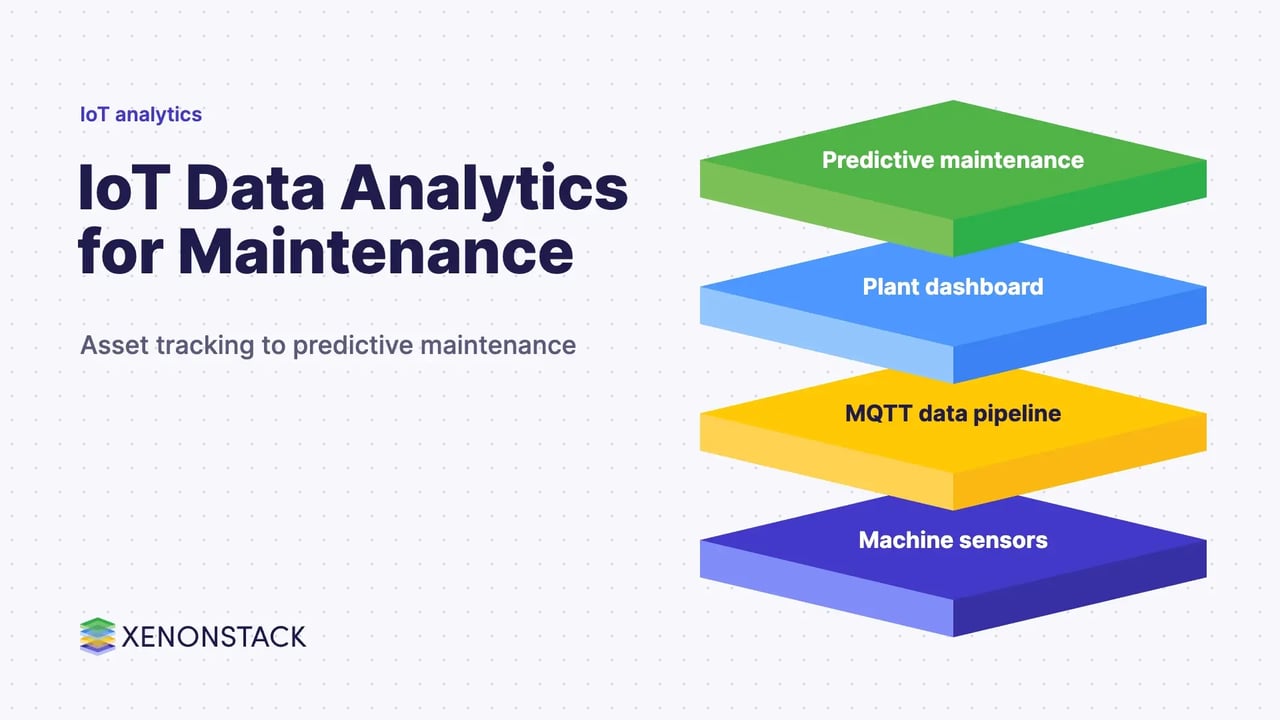
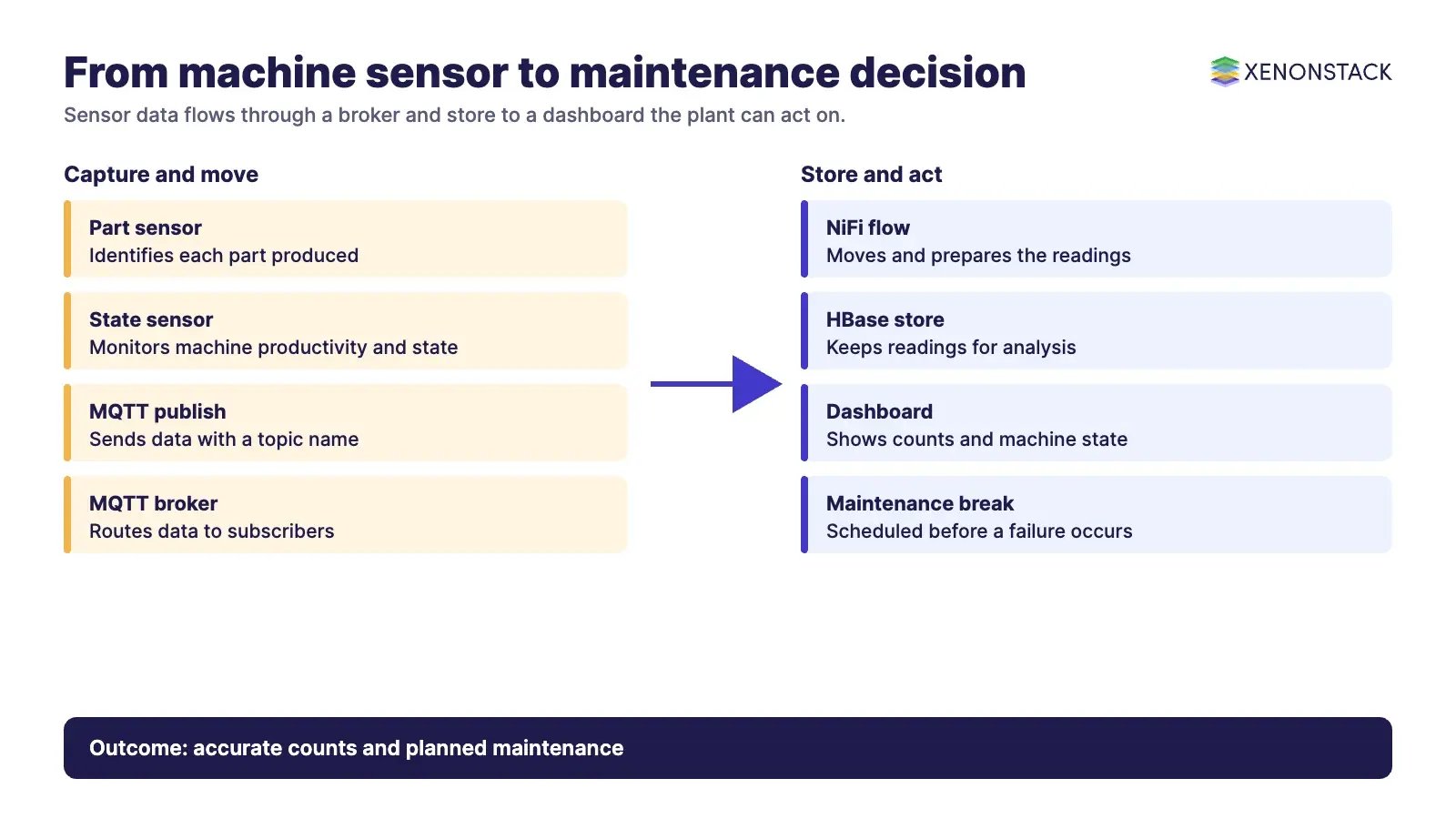
- Sensors. A sensor on each machine identifies each part produced, and a sensor monitors the productivity and state of the machine.
- Transport. The sensors push data over MQTT. MQTT.org describes MQTT as an OASIS standard messaging protocol for IoT and a lightweight publish/subscribe transport.
- Broker. Devices publish to a central MQTT broker, and each message includes a topic name so that subscribers receive the data they asked for. The IBM Developer article on MQTT explains why this suits IoT.
- Flow and storage. A data flow tool moves and prepares the readings, and a store keeps them for analysis. The Apache NiFi site describes NiFi as a system to process and distribute data, with lineage of information from beginning to end. The Apache HBase site describes HBase as a distributed, scalable big data store for random, realtime read and write access, and lists IoT telemetry among suited workloads.
- Dashboard. A web interface built with React.JS shows part counts and machine state to the people who run the plant.
The stack used in this design is MQTT, Apache HBase, Apache NiFi and React.JS. Other stacks can do the same job, so treat it as one working example.
How do asset management and predictive maintenance compare?
Asset management tracks what you own and what state it is in. Predictive maintenance goes further: it uses monitoring tools to watch the state of assets and takes action before a failure if they detect abnormal behaviour. Read more in predictive maintenance with IoT analytics.
| Question | Asset management | Predictive maintenance |
|---|---|---|
| Main purpose | Track assets, counts and state | Act before a failure occurs |
| Typical data | Part counts, status, location | Condition readings over time |
| Output | Accurate records and scheduled breaks | Warning signals and planned repairs |
| Needs | Reliable sensors and a data store | Stored history and analytics on it |
| Best first step | Replace manual counting | Add analytics once data is trusted |
Both belong to the same programme. Accurate asset data comes first, because predictions depend on it.
Where do AI agents fit?
An AI agent can sit on top of the pipeline and handle the follow-up work. It can notice that a machine's output has dropped, pull the machine's maintenance history, group related alerts, draft a maintenance request and ask a supervisor to approve it. The agent works within rules set by the plant, and a person approves any action that stops production. ElixirClaw is the AI agents computing platform from XenonStack.
Where does IoT asset management apply?
- Real-time location prediction and analysis
- Production flows in manufacturing plants
- Diagnosis in healthcare
- Agriculture
- Electronic devices that use sensors
The services around it usually include enterprise asset management, predictive maintenance, real-time data analytics, asset monitoring and tracking, and intelligent automation applications.
What should you check before you start?
- Sensor accuracy. Test that part counts match a manual check before you retire the spreadsheet.
- Identifiers. Give every machine and part type a stable identifier and topic name.
- Delivery. Decide what happens to readings if the network drops.
- Ownership. Name who responds to an alert and who changes a threshold.
- Security. Control which devices can publish and who can read the data.
To map one maintenance decision your agents make, and the data and policy it depends on, book a Context Workshop. See what happens in the workshop.
Frequently asked questions
What is IoT data analytics for maintenance?
It uses sensors on machines to stream production and condition data into an analytics platform, so teams can track assets, schedule maintenance and act before a failure.
Why use MQTT for IoT data?
MQTT is an OASIS standard messaging protocol for IoT. It is a lightweight publish/subscribe transport, so small devices can send readings to a broker with little overhead.
What is the difference between asset management and predictive maintenance?
Asset management tracks assets and their state. Predictive maintenance uses monitoring to detect abnormal behaviour and acts before a failure occurs.
What replaces manual part counts?
Sensors on each machine identify the parts produced and send the counts automatically, so records no longer depend on manual spreadsheets.
How do AI agents help with maintenance?
They can group alerts, retrieve maintenance history and draft requests, while a person approves actions that stop production.
Ready to put AI agents to work? See an ElixirClaw demo: the agentic OS to build, orchestrate and govern AI agents across your enterprise systems.
Explore the XenonStack platform family: ElixirData · ElixirClaw · ElixirHub · NexaStack · MetaSecure · Neural AI · AgentGRC · AgentSRE · AgentAnalyst · AgentInstruct · AgentRAI · AgentScrum · AgentSearch · AgentForce · AI Aviator · SAIF Aviator · CohortIQ · XenonStack AI · XenonStack UAE