Key takeaway
- Contact center intelligence in 2027: AI capabilities, Amazon Connect, Dynamics 365 and Google updates, agent autonomy limits, EU AI Act rules and rollout.
Contact center intelligence is the use of AI to understand every customer conversation, guide human agents while they work, automate routine requests and turn interaction data into better decisions. In 2026 it combines speech and language analytics with generative AI and, increasingly, AI agents that can resolve a request from start to finish.
For enterprise leaders the choice is no longer whether to add AI to the contact center, but which contacts AI should handle on its own, which it should only assist, and how to govern data, disclosure and cost. This guide explains the capabilities, what has changed on the main cloud platforms, governance, an adoption sequence and when AI is the wrong answer.
What does contact center intelligence include?
The term covers five groups of capability that work on the same conversation data. The table shows what each does, when it fits and how mature it is.
| Capability | What it does | When it fits | Current status |
|---|---|---|---|
| Conversation analytics | Transcribes calls and chats and finds intent, sentiment, compliance risks and trends | Any center with recorded interactions | Mature; often the first step |
| Agent assist | Suggests answers, surfaces knowledge, summarises calls and drafts follow-ups in real time | Complex products or long knowledge bases | Mature; built into the main platforms |
| Self-service virtual agents | Handles common intents by voice or chat with generative AI and hands off to people | High-volume, repeatable requests | Widely deployed; quality depends on knowledge and integration |
| Intelligent routing | Matches each contact to the best queue or person using intent, history and skills | Multiple queues, skills or languages | Mature |
| Agentic resolution | AI agents take actions in back-end systems, such as changing a booking or raising a credit, within limits | Well-defined processes with clear rules | Emerging; needs strong governance |
Many of these build on the ideas in our guide to agentic AI in customer service. The difference now is that AI is moving from advising a human agent to completing parts of the work itself.
What has changed on the main contact center AI platforms?
Product names and scope have moved quickly since 2023, so older comparisons of AWS, Azure and Google are out of date. The table summarises the current position from each vendor's own pages, read on 11 November 2026.
| Vendor | Current offer | What changed |
|---|---|---|
| AWS | Amazon Connect Customer | On 28 April 2026 Amazon said Amazon Connect is now a family of four agentic AI solutions and the original product is now called Amazon Connect Customer |
| Microsoft | Dynamics 365 Contact Center | A Copilot-first cloud contact center with voice and digital channels, Copilot summaries and drafts, self-service AI and autonomous service agents, and a Customer Intent Agent |
| Microsoft (building blocks) | Foundry Tools and Microsoft Foundry | Azure AI services (formerly Cognitive Services) are now Foundry Tools; generative models and agents sit in Microsoft Foundry |
| Google Cloud | Gemini Enterprise for Customer Experience | Includes Customer Experience Agent Studio, Agent Assist with AI Coach and AI Trainer, and Customer Experience Insights |
| Google Cloud (building blocks) | Conversational Agents | The Conversational Agents console replaces the Dialogflow CX console, which Google marks as deprecated |
If you already run Amazon Connect, our walkthrough on building a customer contact center with AWS Connect covers the base set-up. When comparing platforms, judge them on integration with your CRM and back-end systems, data residency, how agents are governed and how hand-off to people works, rather than on lists of features.
How far can AI agents go in the contact center?
Gartner predicts that by 2029 agentic AI will autonomously resolve 80% of common customer service issues without human intervention, leading to a 30% reduction in operational costs. The words that matter are common issues: complex, emotional or high-value contacts still need people, and every automated journey needs a clean route to a human.
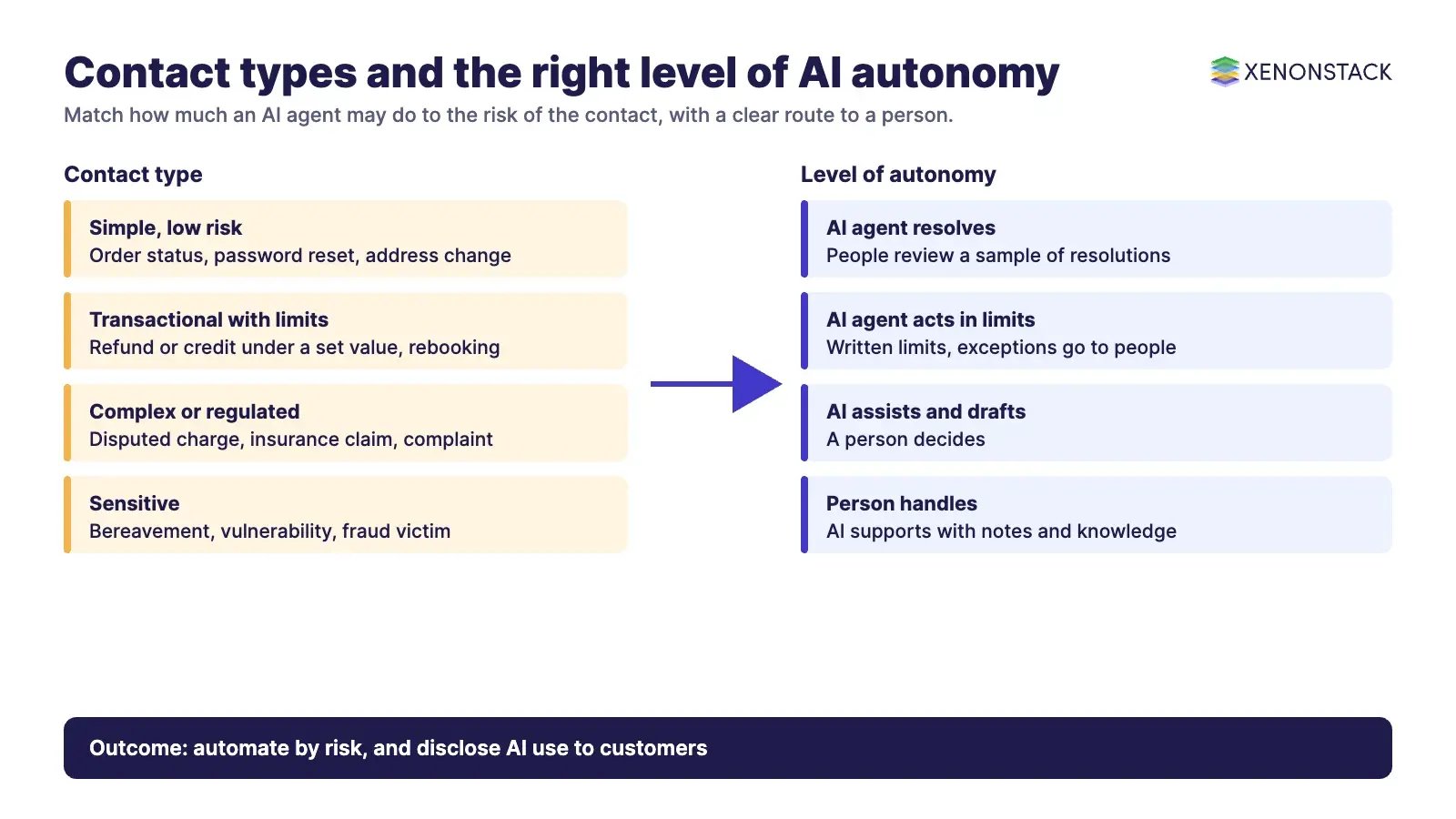
| Contact type | Example | Suggested level of autonomy |
|---|---|---|
| Simple, low risk | Order status, password reset, address change | AI agent resolves, people review samples |
| Transactional with limits | Refund or credit under a set value, rebooking | AI agent acts inside written limits, exceptions to people |
| Complex or regulated | Disputed charge, insurance claim, complaint | AI assists and drafts, a person decides |
| Sensitive | Bereavement, vulnerability, fraud victim | Person handles, AI supports with notes and knowledge |
Agents that take actions need the same controls as staff. For sales and service teams, AgentForce provides AI teammates with assisted support, recommendations and business knowledge. To build and run these agents across CRM, billing and order systems, ElixirClaw is an agentic OS platform to build, orchestrate and govern AI agents and automation workflows while keeping humans in control.
Video: ElixirClaw shows AI agents working through a customer billing dispute from first contact to resolution.
How should leaders govern data, disclosure, security and cost?
Contact center data is personal by nature: voices, account details, payment and sometimes health information. Good governance starts with knowing what is recorded, where it is processed and who or what can act on it. In the EU, Article 50(1) of the AI Act requires AI systems that interact directly with people to be designed so users are informed they are interacting with an AI, and these obligations apply from 2 August 2026.
| Area | What to put in place | Why |
|---|---|---|
| Disclosure | Tell customers when they are speaking to an AI and offer a route to a person | Required in the EU from 2 August 2026 and builds trust |
| Data protection | Redact payment and sensitive data from transcripts; set retention per channel and region | Transcripts feed models and analytics, so leaks multiply |
| Decision rights | Written limits per AI agent: refund values, account changes, which systems it may write to | Keeps autonomous actions inside policy |
| Quality and audit | Log prompts, knowledge used, actions and hand-offs; sample-check AI resolutions | Lets you prove what happened in a complaint or audit |
| Cost | Measure cost per resolved contact, not per automated contact; watch repeat contacts | Automation that causes call-backs costs more, not less |
Conversation data is also a source of insight for the wider business. AgentAnalyst lets teams ask questions of enterprise data in plain language and get real-time insights, which helps product and operations teams act on what customers are saying. Combining it with a customer data platform gives agents and analysts the same view of each customer.
What is a sensible adoption sequence?
- Analyse what you already have. Transcribe and analyse existing calls and chats to find the top intents, failure points and repeat contacts.
- Add agent assist. Give human agents real-time knowledge, summaries and drafted follow-ups, and measure handle time and quality.
- Automate a few intents. Pick high-volume, low-risk intents, launch virtual agents with clear disclosure and a fast route to a person.
- Let agents act within limits. Connect AI agents to back-end systems for defined actions, with written limits and audit logs.
- Close the loop. Feed insights to product, billing and operations teams so the causes of contacts are fixed, not just handled faster.
- Review quarterly. Use resolution, repeat-contact and complaint data to decide which intents to automate next and which to return to people.
When is AI the wrong answer?
AI does not fix broken processes. If customers call because bills are confusing or deliveries fail, automating the call only moves the cost. AI is also a poor fit where contacts are rare and complex, where the knowledge base is out of date, or where customers are vulnerable and need empathy and judgement.
| Trade-off | Benefit | Cost or risk |
|---|---|---|
| Automation vs experience | Lower cost per contact and 24/7 cover | Frustration and repeat contacts if hand-off is poor |
| Platform suite vs best of breed | Faster set-up, one vendor | Lock-in and less control over models and data |
| Real-time assist vs agent focus | Faster, more consistent answers | Prompt overload if suggestions are noisy |
| Rich analytics vs privacy | Deep insight from every conversation | More personal data to protect and govern |
What should you plan for in 2027?
EU AI Act dates moved in 2026, so check which applies to your contact center AI.
- 2 December 2027: the European Commission says high-risk AI systems in areas including employment will apply from this date. Check whether any agent monitoring or scoring tools you use fall in scope.
- 2 August 2028: the same page gives this date for high-risk systems integrated into products.
- Keep a register of every AI agent and tool, its purpose and its owner, so you can classify each one quickly.
What should contact center leaders do next?
Treat contact center intelligence as a programme of decisions rather than a platform purchase. Start with analytics and agent assist, automate where risk is low, give AI agents written limits and an audit trail, and disclose AI use to customers. Our article on agentic AI in customer experience covers how this fits a wider customer experience strategy.
To map one service decision your agents should make, and the context and policy it depends on, book a Context Workshop. See what happens in the workshop.
Frequently asked questions about contact center intelligence
What is contact center intelligence?
Contact center intelligence is the use of AI, including speech recognition, natural language processing, generative AI and AI agents, to understand customer conversations, help human agents in real time, automate routine requests and turn interaction data into decisions about service, staffing and products.
What is the difference between contact center AI and conversation intelligence?
Contact center AI is the broader set of capabilities, including virtual agents, routing and agent assist. Conversation intelligence is the analytics part: transcribing and analysing conversations to find intent, sentiment, compliance issues and trends.
Will AI agents replace human contact center agents?
Not for every contact. Gartner predicts that by 2029 agentic AI will autonomously resolve 80% of common customer service issues without human intervention, which leaves complex, sensitive and high-value contacts with people, supported by AI.
What are the main contact center AI platforms in 2026?
The large cloud options are Amazon Connect Customer (formerly Amazon Connect), Microsoft Dynamics 365 Contact Center with Copilot and AI agents, and Google's Gemini Enterprise for Customer Experience, which includes Customer Experience Agent Studio, Agent Assist and Customer Experience Insights.
Do customers have to be told they are talking to an AI?
In the EU, Article 50(1) of the AI Act requires providers to design AI systems that interact directly with people so that users are informed they are interacting with an AI, unless this is obvious. These obligations apply from 2 August 2026.
Where should a contact center AI programme start?
Start with conversation analytics and agent assist on existing interactions, then automate a few high-volume, low-risk intents with clear hand-off to people, and only then let agents take actions such as refunds within written limits.
Follow XenonStack on LinkedIn: XenonStack on LinkedIn for new guides on agentic AI, data and platform engineering.
Explore the XenonStack platform family: ElixirData · ElixirClaw · ElixirHub · NexaStack · MetaSecure · Neural AI · AgentGRC · AgentSRE · AgentAnalyst · AgentInstruct · AgentRAI · AgentScrum · AgentSearch · AgentForce · AI Aviator · SAIF Aviator · CohortIQ · XenonStack AI · XenonStack UAE