Key takeaway
- Agentic AI for customer experience lets AI agents resolve requests and hand over to people. See use cases by industry, best practice and challenges.
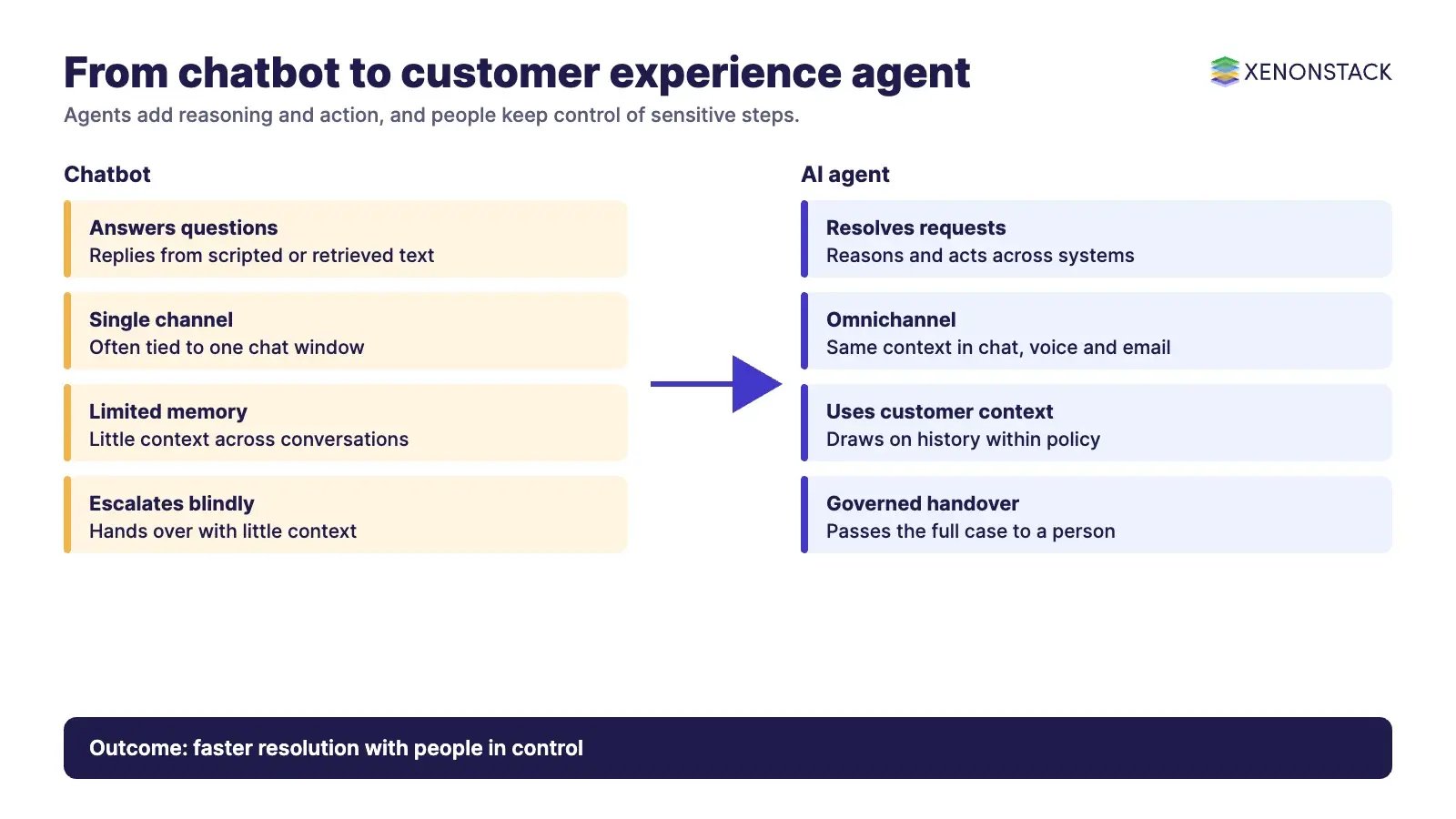
Agentic AI for customer experience means AI agents that perceive a customer request, reason about it and take action across your systems, with people stepping in when the case needs judgement. It goes beyond a chatbot that only answers questions.
This guide is for customer experience, service and digital leaders. It explains what agents add, where they are used by industry, how to implement them, the challenges to plan for, and what to do first. For a related view of service desks, see how agentic AI is transforming customer service.
What are AI agents in customer experience?
The NVIDIA blog on AI agents in customer service describes agentic AI as "semi-autonomous tools that have the ability to perceive, reason and act on more complex problems", and says chatbots have "become table stakes". Agents can handle routine requests, draw on an organisation's knowledge bases and leave complex issues to people. Our introduction to AI agents covers the building blocks.
Customer experience (CX) covers the whole relationship a customer has with a company, while user experience (UX) concerns how easy a specific product is to use. Agents mostly work on CX, because they sit across channels, records and processes.
How does agentic AI change customer experience?
| Capability | What the agent does | What you must still decide |
|---|---|---|
| Query resolution | Handles routine requests end to end, such as status checks or simple changes | Which requests it may close without a person |
| Personalisation | Uses past interactions and customer data to tailor replies | What data it may use and for how long |
| Real-time support | Answers at any hour and keeps context across a conversation | When and how it hands over to a person |
| Speech analytics | Uses natural language understanding and emotional tone to review calls | How findings feed coaching and quality checks |
| Feedback analysis | Reads surveys, reviews and tickets for patterns | Who owns the fixes it points to |
| Omnichannel support | Keeps the same context across chat, voice and email | Which systems of record it can read and write |
In its examples, NVIDIA notes that ServiceNow's agents "get live agent approvals when needed", which shows the pattern to copy: let the agent act, and keep a person in the loop for sensitive steps.
Where are AI agents used in customer experience?
| Industry | Typical agent tasks |
|---|---|
| Retail and e-commerce | Order tracking, returns, product questions and recommendations |
| Banking and financial services | Account queries, card issues and guided service journeys under strict controls |
| Travel and hospitality | Bookings, changes and disruption handling |
| Healthcare | Appointment scheduling, reminders and patient questions with clinical safeguards |
| Telecommunications | Plan changes, outage updates and billing questions |
| Enterprise and SaaS platforms | Onboarding, in-product help and support triage |
For contact centres specifically, read our list of use cases for the contact centre with agentic AI and our guide to building chatbots with agentic AI.
How do you implement AI agents in customer experience?
A workable digital customer experience strategy starts with a narrow journey, not a platform. Pick one high-volume, low-risk request type, connect the agent only to the systems it needs, and measure resolution and handover quality before adding channels. Write down the policies the agent must follow, such as refund limits or identity checks, so that they can be enforced and audited rather than left in a prompt.
What challenges should you plan for?
Plan for privacy of customer data, clean handover to people, bias in responses, integration with legacy systems, and a clear view of return on investment. The IBM responsible AI overview frames responsible AI around principles such as technology that should "augment human capabilities", rest on "responsible data governance" and be "open and transparent". Those principles translate directly into service design: show customers when they are talking to an agent, and give them a route to a person.
How do AI agents depend on context and governance?
An agent that resolves a billing question needs the right customer record, the current policy and a record of what it did. Without that, quality varies by channel. ElixirClaw is XenonStack's AI agents computing platform for building and running agents, and the same governance questions apply whichever platform you choose.
What should you do first?
- Choose one customer journey with high volume and low risk.
- Write the policies and approval points the agent must follow.
- Connect only the data and systems that journey needs.
- Test handover to a person before launch.
- Review resolution, complaints and handover results after a pilot, then widen scope.
- To talk through your case, contact us or talk to a specialist.
To map one customer decision your agents make, and the data and policy it depends on, book a Context Workshop. See what happens in the workshop.
Frequently asked questions
How is agentic AI different from a chatbot?
A chatbot answers questions in a conversation. An agentic system can also reason about a request and take actions in other systems, with people approving sensitive steps.
Which customer experience tasks suit AI agents first?
Start with high-volume, low-risk requests such as order status, simple changes and appointment scheduling, where mistakes are easy to catch and fix.
When should an AI agent hand over to a person?
Hand over when the request is sensitive, the customer asks for a person, or the agent cannot resolve the issue within its approved limits. Test this route before launch.
What are the main challenges of using AI agents for customer experience?
Customer data privacy, human handover, bias, integration with existing systems and proving return on investment.
How do you keep AI agents trustworthy with customers?
Tell customers when they are dealing with an agent, govern the data it uses, set clear policies and approval points, and keep a record of what it did.
Follow XenonStack on LinkedIn: XenonStack on LinkedIn for new guides on agentic AI, data and platform engineering.
Ready to put AI agents to work? Explore ElixirClaw, the agentic OS platform to build, orchestrate and govern AI agents.
Explore the XenonStack platform family: ElixirData · ElixirClaw · ElixirHub · NexaStack · MetaSecure · Neural AI · AgentGRC · AgentSRE · AgentAnalyst · AgentInstruct · AgentRAI · AgentScrum · AgentSearch · AgentForce · AI Aviator · SAIF Aviator · CohortIQ · XenonStack AI · XenonStack UAE