

Key takeaway
- Compare Splunk, Sentinel, Elastic, Google SecOps, QRadar and ElixirData for national security teams on sovereignty, audit and classification handling.
The best security analytics platform for a national security team is the one that lets you prove where data sits, who touched it and how it was handled, not the one with the longest feature list. For most agencies that means shortlisting established SIEM and security analytics platforms (Splunk Enterprise Security, Microsoft Sentinel, Elastic Security, Google Security Operations and IBM QRadar SIEM), then testing each against sovereignty, audit and classification handling before you look at detection features.
This guide is defensive and procurement focused. It compares options on stated criteria, uses vendor claims only as the vendor's own pages state them, and takes policy statements only from official government sources. Disclosure: XenonStack sells one of the options below (ElixirData Context OS). It is a governance layer that sits beside a SIEM, not a replacement for one, and we say so where it matters.
What should a national security team ask of a security analytics platform?
Start with the questions an accreditation board or procurement panel will ask, then map features to them. Detection quality still matters, but it is the easiest criterion to demonstrate in a pilot. The hard ones are evidence, location and control.
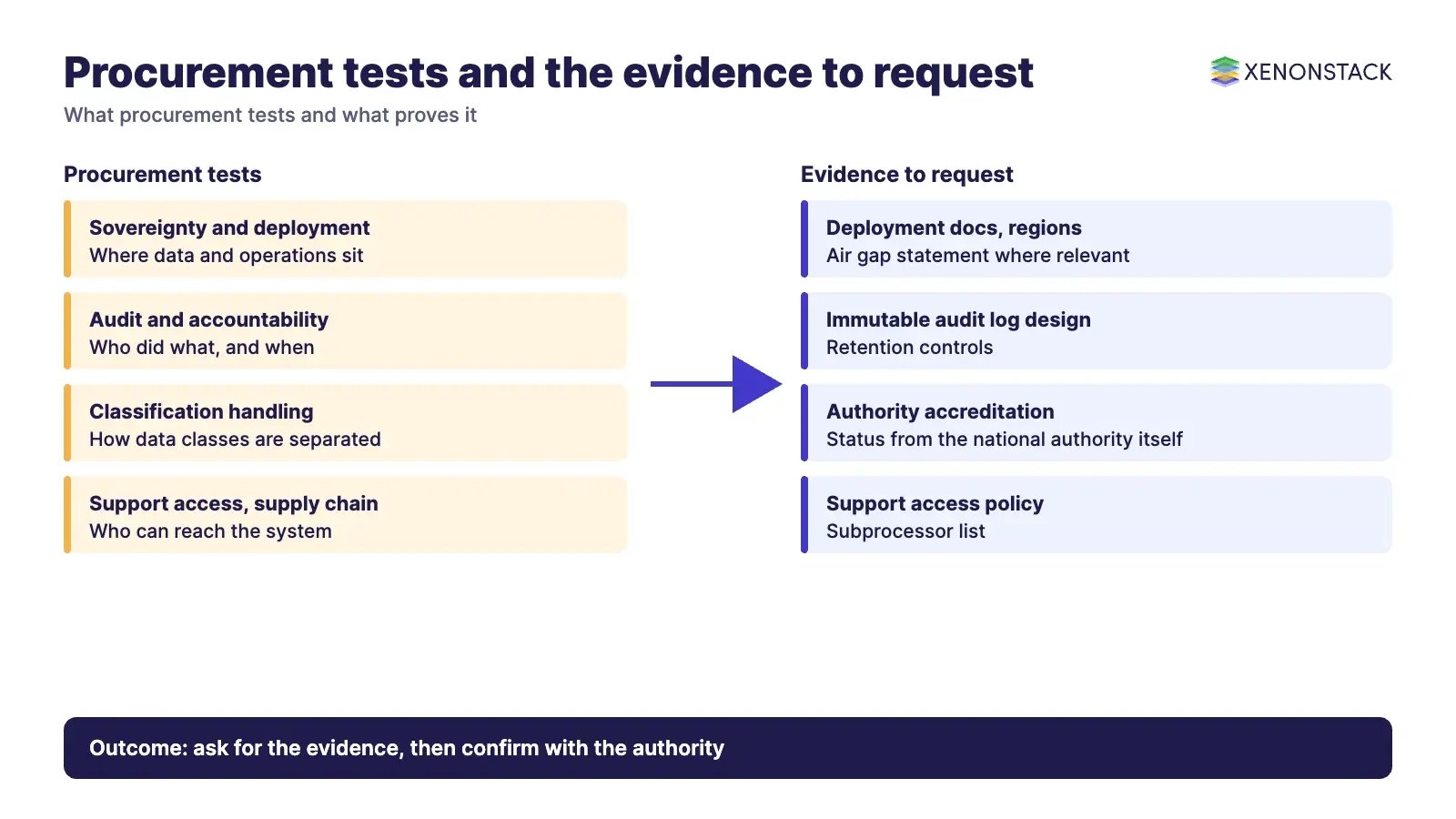
| Criterion | The question to ask | Evidence to request |
|---|---|---|
| Data sovereignty | Can we choose where data is stored, processed and administered, including fully on premises or air-gapped? | Deployment documentation, region lists, support access model |
| Audit and accountability | Can we reconstruct who queried, changed or exported what, and can the log itself be tampered with? | Audit log schema, immutability design, retention controls |
| Classification handling | Can data of different handling levels be separated, and can the platform run inside an accredited enclave? | Accreditation status from your national authority, separation design |
| Real time monitoring | How quickly do events become searchable alerts at our expected volume? | Pilot results on your own telemetry |
| Supply chain and support | Who can access the system for support, and from which jurisdictions? | Support access policy, subprocessor list |
| Decision support | Can analysts see why an alert fired and what policy governed the response? | Investigation workflow demo, explainability of automated actions |
What do official sources say that should shape the shortlist?
Use these as the yardstick for your requirements document. All are government or standards body pages, and each is worth reading in full before you issue a tender.
- Audit controls. NIST Special Publication 800-53 Rev. 5 is a catalogue of security and privacy controls and includes an Audit and Accountability family. If your programme is mapped to it, your platform must produce evidence for those controls. See NIST SP 800-53 Rev. 5.
- Log management fundamentals. NIST SP 800-92 gives practical guidance on building and running log management across an enterprise. It dates from 2006, so treat it as foundations, not current tooling guidance.
- Logging and detection baseline. An Australian Cyber Security Centre led publication, with CISA, the FBI, the NSA and the UK NCSC among its partners, sets a baseline for event logging best practice. Read it at CISA. The page does not show a publish date, so confirm the current version.
- Cloud authorisation level. FedRAMP defines Low, Moderate and High baselines, and describes High as covering the government's most sensitive unclassified data in cloud environments. FedRAMP does not describe classified handling, so confirm the route with your national accreditation authority.
- Cloud principles. The UK NCSC Cloud Security Principles include asset protection and resilience (covering physical tampering, loss, damage or seizure), separation between customers, supply chain security, and audit information and alerting for customers. Those map neatly onto a sovereignty checklist.
- Incident reporting in the EU. The European Commission's NIS2 page says medium and large entities in critical sectors must notify national authorities of significant incidents. Confirm exact obligations on EUR-Lex (Directive 2022/2555).
Which security analytics platforms should procurement compare?
The six options below are a starting shortlist, not a ranking. Descriptions come from each vendor's own page, read on 13 November 2026. Where a page is silent on a point, we say so rather than guess.
Splunk Enterprise Security
According to its site, Splunk describes Enterprise Security as a unified threat detection, investigation and response platform combining SIEM, SOAR, UEBA and agentic AI. Its site says Splunk Enterprise can be deployed on premises, in a private cloud or in a hybrid setup. The product page itself makes no public sector claims, so confirm sovereignty and accreditation details directly. Performance figures on the page are vendor reported and we have not repeated them.
Microsoft Sentinel
Microsoft Learn describes Sentinel as a cloud native SIEM providing scalable security across multicloud and multiplatform environments, with AI, automation and threat intelligence for detection, investigation, response and hunting. On audit, the same documentation says Sentinel inherits Azure Monitor tamper proofing and immutability practices, and notes that the underlying store includes provisions to delete data for compliance purposes. The overview page does not discuss government clouds or data residency, so check those on Microsoft's compliance documentation.
Elastic Security
According to its site, Elastic Security deploys on premises, in the cloud or in air gapped environments, and federated search can query distributed deployments without centralising data. It also says its AI reasoning supports on premises language models for air gapped use. The site lists FedRAMP among Elastic Cloud certifications but does not specify which deployment options carry it, so confirm on the Elastic Trust Center. For teams that need to keep data in place, this is the clearest air gap statement of the group.
Google Security Operations
According to its site, Google Security Operations is cloud native, ingests telemetry from on premises environments and major cloud providers, and supports data residency for specific regions (the page points to a separate list). Google also promotes Cybershield for government agencies. The page does not mention FedRAMP or a sovereign deployment model, so confirm both with Google's compliance documentation.
IBM QRadar SIEM
According to its site, IBM says QRadar SIEM centralises security visibility, enables real time threat detection, streamlines compliance and reduces operational cost, with user behaviour analytics and Sigma rule support. The product page does not list deployment options, so confirm on premises and hosted availability with IBM before shortlisting for sovereignty sensitive work.
ElixirData Context OS (XenonStack)
XenonStack sells this option, so weigh it accordingly. According to the ElixirData site, Context OS is a governance layer for enterprise AI agents that compiles context, checks policy before an agent acts, and records decision histories it calls Decision Traces. The site lists managed SaaS, customer VPC and on premises or hybrid deployment, and states SOC 2 attestation and ISO/IEC 27001 certification. It is not a SIEM and does not collect or correlate raw security telemetry. It fits where a team already runs a SIEM and now wants automated or agent assisted actions to be policy checked and auditable. Performance figures on its site are self reported from its own deployments and we have not repeated them. We have not verified any classified or national accreditation status, so confirm on the official page.
How do the options compare on sovereignty, audit and classification?
The table records only what each vendor's own page says. "Not stated" means the page we read was silent, not that the capability is absent.
| Option | Deployment stated on its page | Audit or tamper evidence stated | Government or classification statement |
|---|---|---|---|
| Splunk Enterprise Security | Splunk Enterprise on premises, private cloud or hybrid (site navigation) | Not stated on product page | Not stated on product page |
| Microsoft Sentinel | Cloud native | Inherits Azure Monitor tamper proofing and immutability practices | Not stated on overview page |
| Elastic Security | On premises, cloud or air gapped | Not stated on page | FedRAMP listed for Elastic Cloud, which option is not specified |
| Google Security Operations | Cloud native with on premises ingestion | Not stated on page | Cybershield for government agencies, no FedRAMP or sovereign claim on page |
| IBM QRadar SIEM | Not stated | Not stated | Not stated |
| ElixirData Context OS | Managed SaaS, customer VPC, on premises or hybrid | Decision Traces record context, policy, authority, action and outcome | No national accreditation stated, confirm on the official page |
Many "not stated" cells will be answered in vendor security documentation, trust centres or under NDA. The point of the table is to show which questions go into your tender, not to score the products.
How should you run the procurement?
- Write requirements from controls, not features. Map each requirement to the control set your authority already uses, such as the NIST 800-53 audit family.
- Fix the data boundary first. Decide which data classes may leave the enclave, if any, and eliminate options that cannot respect that line.
- Ask for the audit trail of the audit tool. Request evidence that administrator actions, queries and exports are logged and that the logs resist tampering.
- Test on your own telemetry. A pilot on representative volume shows ingestion lag and cost better than any datasheet.
- Review support access. Ask who can reach the system for support and under which jurisdiction, in line with the supply chain and asset protection themes in the NCSC principles.
- Plan the human decision layer. Automated response needs rules for who authorises what. Our guides on data governance and agentic AI security cover the control questions in more depth.
Two further XenonStack explainers help with the surrounding design: agentic analytics for how autonomous agents run analytics workflows, data observability for keeping real time pipelines trustworthy, and agentic AI frameworks for the wider architecture.
When should you not use these platforms?
- Do not choose a cloud native SIEM if your data handling rules forbid any off premises processing and the vendor cannot show an approved enclave or on premises route.
- Do not rely on a vendor page for accreditation. Product pages are marketing. Accreditation decisions sit with your national authority.
- Do not buy a governance layer to replace a SIEM. ElixirData Context OS does not ingest and correlate security telemetry. If you have no detection platform yet, start there.
- Do not turn on autonomous response before you have written rules for which actions need a human approval.
- Do not use third party "best of" lists as your shortlist. Some are published by vendors that appear in them. Use them to find candidates, then verify on official pages.
Where does a decision governance layer fit?
A SIEM tells you what happened. A governance layer records why an automated action was allowed, which policy applied and who held authority. For defensive teams adding agent assisted triage, that second record is what auditors ask for. It complements the platforms above and does not compete with them, which is why we list it as one option and not as the winner.
Next step. If you want to test how a policy checked, auditable decision layer would sit beside your current analytics, book a Context OS demo or join a Context Workshop, where ElixirData says it maps one AI decision in half a day.
Frequently asked questions
What is a security analytics platform?
It is software that collects security telemetry such as logs and events, correlates it, raises alerts and supports investigation and response. SIEM platforms are the most common form, often with SOAR and behaviour analytics added.
How is a national security deployment different from a commercial one?
The main differences are data location, who can administer the system, how data of different handling levels is separated, and how the platform's own activity is audited. Features matter less than evidence on those points.
Does FedRAMP High cover classified data?
FedRAMP describes its High baseline as covering the government's most sensitive unclassified data in cloud environments. Classified handling follows separate national routes, so confirm with your accreditation authority.
Can a security analytics platform run air gapped?
Some can. According to its site, Elastic says its SIEM deploys in air gapped environments, and Splunk's site says Splunk Enterprise can be deployed on premises. Confirm the exact scope and feature parity with each vendor.
Is ElixirData a SIEM replacement?
No. ElixirData Context OS is a governance layer for AI agent decisions. It is meant to sit beside a detection platform and record policy checks and decision histories.
Which official sources should shape our requirements?
Start with NIST SP 800-53 Rev. 5 for audit controls, FedRAMP for cloud baselines, the NCSC Cloud Security Principles for sovereignty themes, and the ACSC led event logging baseline published with CISA. Add your own national rules.
Ready to put AI agents to work? Explore ElixirClaw, the agentic OS platform to build, orchestrate and govern AI agents.
Explore the XenonStack platform family: ElixirData · ElixirClaw · ElixirHub · NexaStack · MetaSecure · Neural AI · AgentGRC · AgentSRE · AgentAnalyst · AgentInstruct · AgentRAI · AgentScrum · AgentSearch · AgentForce · AI Aviator · SAIF Aviator · CohortIQ · XenonStack AI · XenonStack UAE


