

Key takeaway
- Compare eight real-time analytics platforms for government on freshness, FedRAMP posture, deployment and reporting, plus a decision table and when to skip.
The best real-time analytics platform for a government agency is the one that meets your authorisation level, keeps data fresh enough for the decision it supports, and can run where your data is allowed to live. For most agencies that means shortlisting on four criteria before comparing features: data freshness, governance, deployment flexibility and agency reporting. A dashboard tool, a streaming layer and a governed data platform solve different parts of the problem, and few agencies can buy just one.
This guide compares eight options for public-sector service dashboards and agency decision-making: Microsoft Power BI, Tableau, Amazon QuickSight, Databricks, Snowflake, Elastic, Confluent and ElixirData Context OS. Disclosure: XenonStack sells one of the options below, ElixirData Context OS, and we have placed it in the same table and criteria as the others. Every vendor claim here is worded "according to its site" and was read on 13 November 2026. Confirm each on the vendor's official page and the FedRAMP Marketplace before you buy.
How should a government agency judge a real-time analytics platform?
Judge it on what the agency must prove, not on what the demo shows. We used four criteria, taken from the questions procurement and security teams ask first.
- Data freshness: how quickly an event becomes visible on a dashboard, and whether the product streams natively or relies on scheduled refresh.
- Governance: who can see what, whether lineage and audit trails exist, and whether policy is enforced or only documented. Our guides on data governance and data quality management cover the foundations.
- Deployment flexibility: government cloud regions, customer cloud accounts, on-premises or air-gapped options.
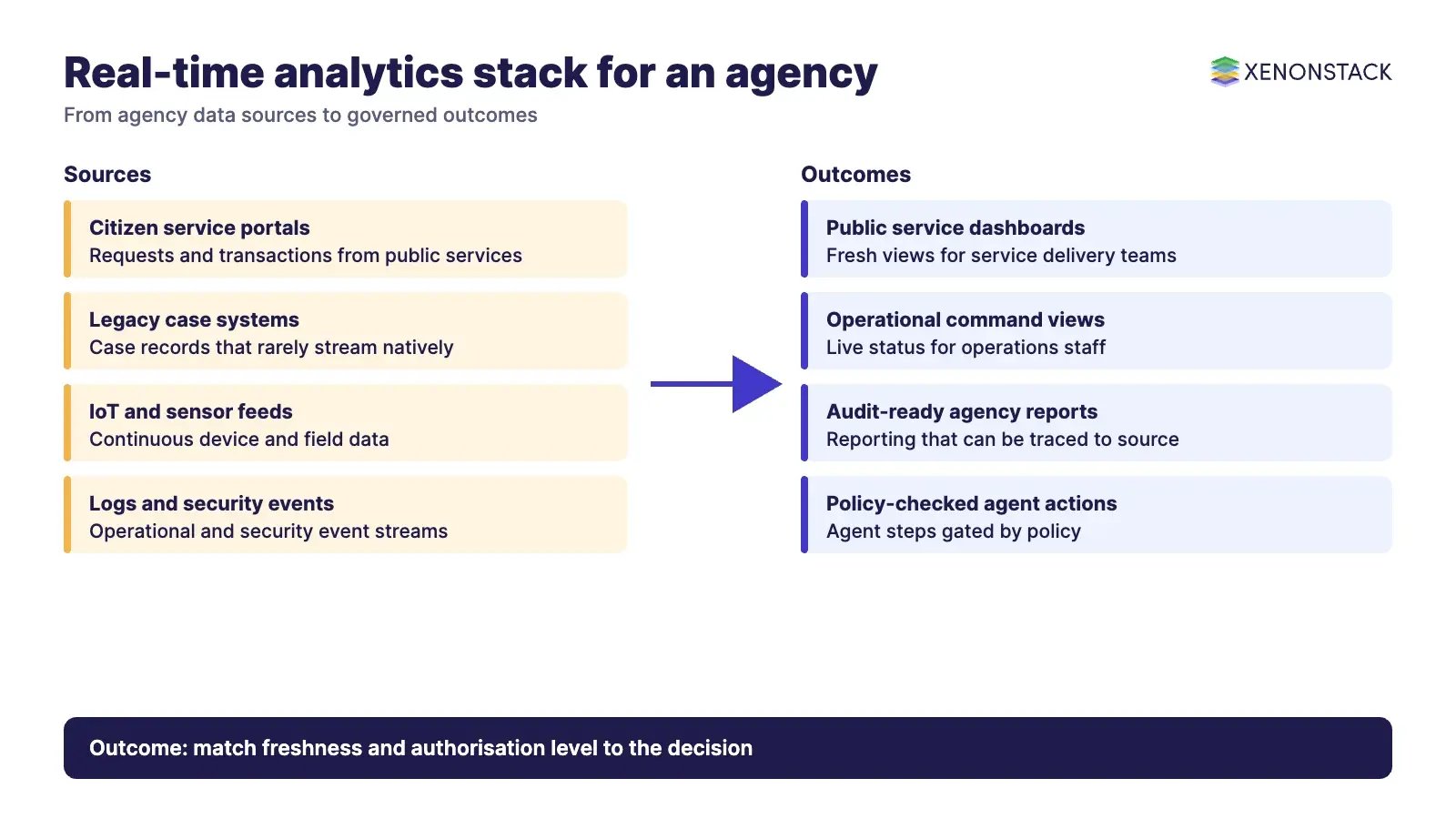
- Agency reporting: how well the product serves public-facing service dashboards, internal operational views and audit-ready reports.
FedRAMP status matters most for cloud services. The FedRAMP Marketplace, run by GSA, listed 557 certified services on 10 November 2026, so always check the product and the exact deployment, not only the vendor name.
Which platforms are the best real-time analytics options for government?
The table gives a quick read. Detail for each option follows. "Per its site" applies to every cell.
| Platform | Best role | Government posture (per its site) | Real-time signal (per its site) | Deployment (per its site) |
|---|---|---|---|---|
| Microsoft Power BI | Dashboards and reports | GCC, GCC High and DoD environments | Push, streaming and PubNub models; creation ends 31 Oct 2027 | Government cloud tenants |
| Tableau | Visual analytics | Tableau Next FedRAMP High | Not stated on the page we read | Tableau Cloud and Server named |
| Amazon QuickSight | Embedded dashboards | "Can support" FedRAMP; GovCloud not stated | Not stated on the page we read | AWS managed service |
| Databricks | Unified data and AI platform | Runs on AWS GovCloud and Azure Government | Batch and streaming ETL | Gov and commercial clouds |
| Snowflake | Governed data sharing | FedRAMP High in select regions | Near real-time views mentioned | AWS GovCloud, Azure Government |
| Elastic | Search, logs, observability | Elastic Cloud Hosted FedRAMP Moderate and High on AWS GovCloud (US) | Large, fast-moving data streams | Hosted, serverless, self-managed, air-gapped |
| Confluent | Streaming backbone | Confluent Cloud for Government FedRAMP Moderate | Event streaming as the core product | Cloud, on-premises, private cloud |
| ElixirData Context OS | Governed decision layer | SOC 2 attested, ISO 27001 certified; FedRAMP not claimed on the page we read | Policy checked before an agent reasons and acts | Managed SaaS, customer VPC, on-prem or hybrid |
Is Microsoft Power BI a good fit for government dashboards?
It is a strong fit if the agency already runs Microsoft 365 or Azure in a government tenant. According to its site, Microsoft offers Power BI in three US government environments: GCC for federal, state and local government, GCC High for organisations holding controlled unclassified information, ITAR or DFARS data, and a DoD environment for the Department of Defense. Government plans need a Pro or Premium Per User licence, and some features differ by environment. For example, Autoscale is not available in GCC, and marketplace apps are not available.
The real-time caveat is important. Microsoft's documentation says creation of streaming semantic models remains enabled until 31 October 2027, after which new ones will not be supported, and recommends Real-Time Intelligence in Microsoft Fabric. Confirm whether that service is available in your government environment before you design around it.
What does Tableau offer public-sector teams?
Tableau is a visual analytics tool with a clear public-sector presence. According to its site, Tableau Next has FedRAMP High authorization for US organisations, and its government page names customers such as the State of Indiana. The page we read does not describe live connections or deployment details, so ask which product (Tableau Next, Tableau Cloud or Tableau Server) holds the authorisation you need and how it connects to streaming sources.
Where does Amazon QuickSight fit?
QuickSight suits agencies already on AWS that want embedded dashboards inside their own portals. According to its site, it can support FedRAMP, HIPAA, PCI DSS, ISO and SOC compliance. The page does not state GovCloud availability, so confirm that on the official page. Its pricing page lists per-user pricing (Reader from $3 per user per month) and capacity pricing from $250 per month, and says capacity pricing is required for programmatic dashboard refresh. That matters for public-facing dashboards with many occasional viewers.
When does Databricks make sense?
Databricks makes sense when analytics, data engineering and machine learning must share one governed platform. According to its site, it runs on AWS GovCloud, Azure Government and commercial clouds, handles batch and streaming ETL, and uses Unity Catalog for governance across data, analytics and AI assets. The public-sector page we read did not state FedRAMP status, so confirm it for your region. It is a platform for engineering teams, not a ready-made dashboard for service managers.
How does Snowflake handle real-time and shared government data?
Snowflake is strongest where several agencies need to share governed data without copying it. According to its site, it has dedicated government regions on AWS GovCloud and Azure Government, and FedRAMP High is available in select regions. Its page talks about near real-time views and secure live data sharing, but does not explain ingestion mechanisms. Ask for the exact streaming ingestion path and latency you will get.
Is Elastic a good choice for operational and security analytics?
Yes, where the data is logs, events, search and observability. According to its site, Elastic Cloud Hosted is FedRAMP authorised at Moderate and High levels on AWS GovCloud (US), and Elastic can also be self-managed on-premises, air-gapped, in a private cloud or at the edge. That range makes it one of the more flexible options for sensitive environments. It is less natural for finance-style reporting. Our note on data observability in streaming explains why pipeline health belongs in the same design.
Does Confluent count as an analytics platform?
Not on its own. Confluent is the streaming layer that feeds the dashboards. According to its site, Confluent Cloud for Government has FedRAMP Moderate authorisation, and the product family also includes Confluent Platform for on-premises use and Confluent Private Cloud. If your sources are legacy systems that produce events, a streaming backbone often matters more than the dashboard tool. You will still need a BI or search layer on top.
Where does ElixirData Context OS fit?
As a disclosed option, ElixirData Context OS is not a dashboard tool. According to its site, it is a decision harness for enterprise AI agents that compiles context, checks policy and authority before an agent acts, and records a decision trace for each action. It lists three deployment options: managed SaaS, deployment in the customer's cloud account, and on-premises or hybrid. The site names SOC 2 attestation and ISO 27001 certification, and we found no FedRAMP claim on the pages we read. Its vendor-reported figures, such as faster audit preparation, should be treated as claims to test. It suits agencies that want AI agents acting on live data with an audit trail. For the wider idea, see our guide to agentic analytics.
What questions should you ask every vendor?
Use the same short list with every vendor so the answers can be compared side by side.
- Which exact product and deployment holds the authorisation we need, and where is that shown on the FedRAMP Marketplace?
- What is the measured delay between an event and a dashboard update at our data volume?
- Can we export an audit trail that shows who viewed or changed which dataset?
- Which features are missing in the government environment compared with the commercial one?
- What happens to our streaming dashboards if a product feature is retired, as Microsoft has announced for Power BI streaming models?
Which platform should you pick? A decision table
| If your main need is | Start with | Check first |
|---|---|---|
| Citizen service dashboards on Microsoft | Power BI | Environment (GCC, GCC High) and streaming roadmap |
| Dashboards embedded in an AWS portal | QuickSight | GovCloud availability and refresh pricing |
| Cross-agency governed data sharing | Snowflake | Region, FedRAMP level, ingestion latency |
| Engineering plus machine learning on one platform | Databricks | FedRAMP status for your region |
| Logs, events, security and search | Elastic | Hosted versus air-gapped |
| Event backbone from legacy systems | Confluent | Moderate versus High needs |
| Policy-checked AI agents on live data | ElixirData Context OS | Authorisation level and data residency |
When should you not use a real-time analytics platform?
- The decision is made weekly or monthly. Scheduled reporting is cheaper and simpler.
- Source data is not trustworthy yet. Real time only shows bad data faster. Fix data quality first.
- Ownership is unclear. If no team owns each dataset, consider a data mesh operating model before tooling.
- Your authorisation level rules the product out. A strong demo does not replace the right FedRAMP level or environment.
- You have no architecture yet. Start with the layers described in our big data architecture guide.
Try it on one decision first
If you are weighing governed, agent-driven analytics, bring one live decision to the free half-day Context Workshop. ElixirData architects help your team map it, and you leave with a one-page decision map and a go or no-go call. You can request a Context OS demo or book the Context Workshop.
Frequently asked questions
What is real-time analytics in government?
It is analysis of data within seconds or minutes of an event, used for service dashboards, incident response and operational decisions. The right latency depends on the decision, not on the technology.
Does the platform need FedRAMP authorisation?
Usually yes for cloud services that handle federal data, and the level (Low, Moderate or High) depends on the data. Check the specific product on the FedRAMP Marketplace, not only the vendor.
Can a state or local agency use these platforms?
Yes. Power BI GCC, for instance, is described as designed for federal, state and local government. Requirements differ by state, so confirm with your security office.
Do I need a streaming layer as well as a dashboard tool?
Often yes. A tool like Confluent moves events, and a BI or search tool displays them. Some platforms, such as Databricks and Elastic, cover parts of both.
How do I keep real-time dashboards trustworthy?
Add data quality checks, lineage and pipeline monitoring before you add speed. See our guides on data quality and data observability.
Where does ElixirData fit among these options?
It is a governed decision layer for AI agents, not a dashboard or streaming product. It is the option XenonStack sells, so test its claims in a workshop as you would any vendor's.
Ready to put AI agents to work? Explore ElixirClaw, the agentic OS platform to build, orchestrate and govern AI agents.
Explore the XenonStack platform family: ElixirData · ElixirClaw · ElixirHub · NexaStack · MetaSecure · Neural AI · AgentGRC · AgentSRE · AgentAnalyst · AgentInstruct · AgentRAI · AgentScrum · AgentSearch · AgentForce · AI Aviator · SAIF Aviator · CohortIQ · XenonStack AI · XenonStack UAE


