

Key takeaway
- Compare Snowflake, Databricks, Microsoft Fabric, Qlik, Collibra and ElixirData for federal data governance: FedRAMP, lineage, NIST and OMB duties.
The best analytics platform for federal data governance is the one whose authorisation level, catalogue and lineage, and policy enforcement match the sensitivity of your data and your agency's own authority to operate (ATO). No single product wins across every agency. Snowflake, Databricks, Microsoft Fabric with Purview, Qlik Cloud Government, Collibra and ElixirData each cover a different part of the problem, and the right shortlist depends on whether you need a data platform, a dashboard layer, a governance catalogue or control over AI decisions.
Federal buyers have a fixed policy backdrop. The Evidence Act requires each agency to designate a Chief Data Officer and keep a comprehensive data inventory. OMB memorandum M-25-21 asks agencies to "ensure access to quality data for AI and data traceability". NIST SP 800-53 Rev. 5 supplies the control catalogue, and FedRAMP supplies the cloud authorisation evidence. Disclosure: XenonStack sells one of the options below (ElixirData). We compare every option on the same stated criteria, and vendor claims are worded "according to its site".
What do federal data governance rules actually require of an analytics platform?
Federal rules rarely name a product category. They set duties for agencies, and a platform helps or hinders those duties. Four sources matter most.
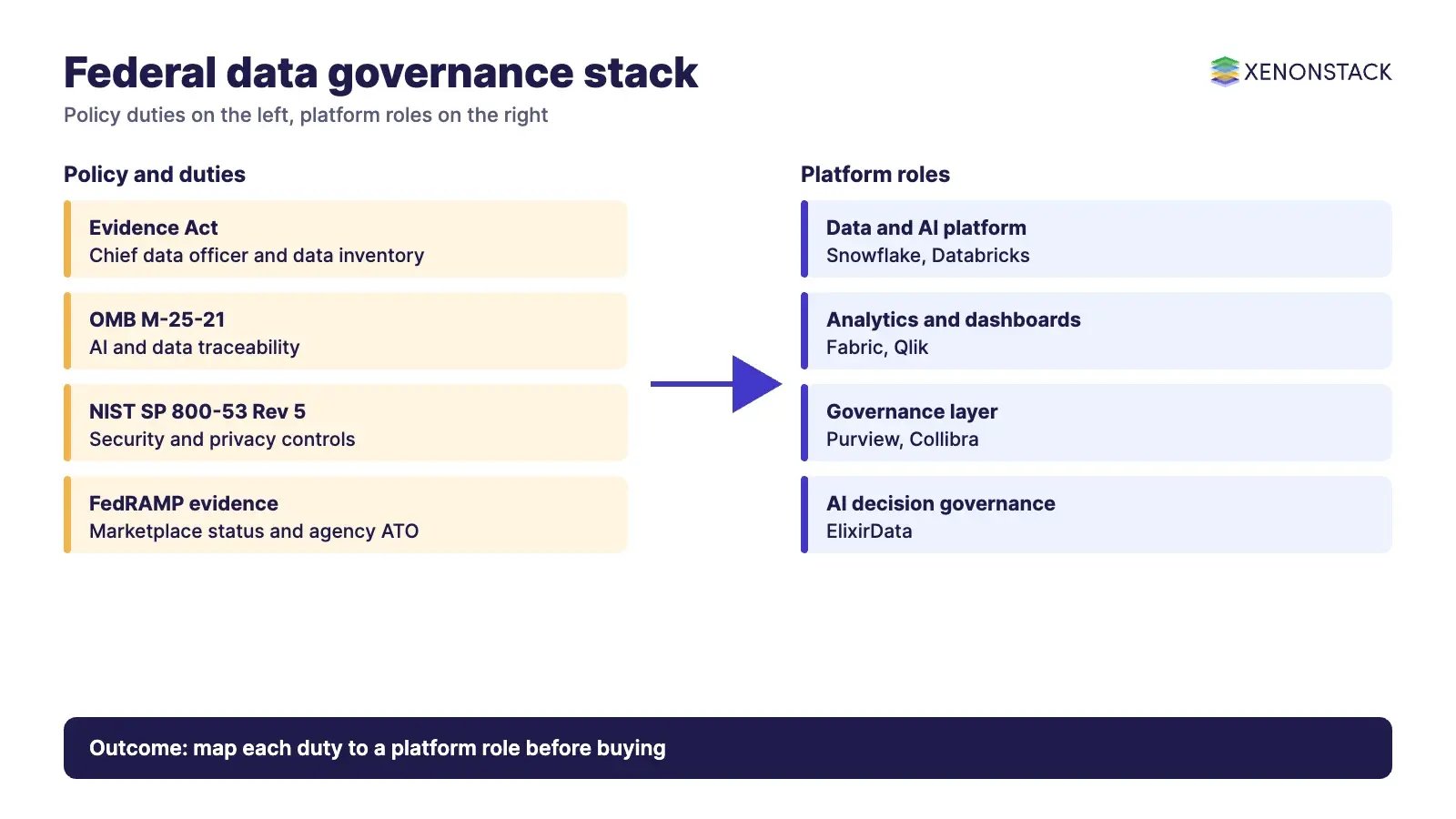
- Evidence Act (Public Law 115-435). Under the OPEN Government Data Act title, each agency must develop a comprehensive data inventory and designate a Chief Data Officer. GSA maintains the federal data catalogue, and OMB establishes a Chief Data Officer Council. Congress.gov carries the text.
- Federal Data Strategy. GSA's Technology Transformation Services manages it with OMB and the CDO Council. The 2020 and 2021 Action Plans are published, and the site content is moving to resources.data.gov (strategy.data.gov). According to GSA's Centers of Excellence, it sets out 10 principles and 40 practices, and OMB M-19-23 calls for an agency data governance body chaired by the CDO (GSA CoE).
- OMB M-25-21. Issued on 3 April 2025, it replaces M-24-10. It requires Chief AI Officers, AI strategies and compliance plans, and documented minimum practices for high-impact AI. It also directs agencies to update policies on data inventories, representativeness and lawful access to data (OMB memorandum). Confirm the exact deadlines on the memorandum itself.
- NIST. SP 800-53 Rev. 5 is the catalogue of security and privacy controls (NIST CSRC). The NIST Privacy Framework is at version 1.0, with 1.1 in draft. The AI Risk Management Framework was released on 26 January 2023 and is being revised.
Translate that into platform needs: an inventory and catalogue, lineage you can show an auditor, access control that follows the data across agencies, audit logs, and a cloud environment with the authorisation level your data class needs. FedRAMP does not grant an ATO. According to the FedRAMP Marketplace guide, certification makes security materials available for your agency's own ATO decision, and the agency issues the ATO. The guide uses classes A (Pilot), B (Low), C (Moderate) and D (High). Always check current status on the marketplace before you commit.
Which criteria should you compare on?
We used six criteria, each tied to a duty above.
- Federal hosting and authorisation: what the vendor's own page states, and what you must still confirm on the FedRAMP Marketplace.
- Catalogue and inventory: supports the Evidence Act data inventory duty.
- Lineage and traceability: supports the "data traceability" language in M-25-21.
- Access, policy and audit: maps to the NIST SP 800-53 control families you will be assessed on.
- Cross-agency sharing: data stays governed when more than one agency uses it.
- AI readiness: can you govern models and agents that consume the data?
What are the best analytics platforms for federal data governance?
The order below is not a ranking. Claims come from each vendor's own page, read on 13 November 2026.
1. Snowflake: a governed data platform with stated FedRAMP High support
According to its public sector page, Snowflake supports "FedRAMP High, available in select government cloud regions, including AWS GovCloud and Microsoft Azure Government". It also states DoW IL4 and IL5 authorisations "in select deployments" and promises "built-in governance capabilities and compliance support". The wording "select" matters: confirm that your region, edition and features are in the authorised boundary. A good fit when your agency wants one governed platform for analytics and AI workloads.
2. Databricks: open lakehouse with Unity Catalog governance
According to its public sector page, Databricks runs "across AWS GovCloud, Azure Government and commercial clouds" and offers "unified governance for all data, analytics and AI assets" through Unity Catalog. That page names no specific certifications, so confirm authorisation on the official page and the FedRAMP Marketplace. A good fit for data engineering and machine learning teams that want open table formats and one governance layer across them.
3. Microsoft Fabric with Purview: catalogue and lineage inside a Microsoft estate
Microsoft's documentation says the OneLake catalogue is the primary place to discover and govern Fabric data, lineage traces data from source to report, and Purview adds sensitivity labels, data loss prevention, audit and insider risk indicators (Microsoft Learn). Azure Government holds a FedRAMP High provisional authorisation, and Fabric and Power BI are marked FedRAMP High in the Azure public audit scope table (audit scope). We could not confirm Fabric coverage inside the Azure Government regions, so confirm on the official page. A good fit for agencies already standardised on Microsoft 365 and Azure.
4. Qlik Cloud Government: analytics and dashboards with stated FedRAMP Moderate
According to its public sector page, Qlik Cloud Government is "authorized at the FedRAMP Moderate Impact Level (IL) and Department of Defense (DOD) IL2". Governance features are listed only briefly ("Data Quality and Governance"), so test depth in a proof of concept. A good fit when the main need is a governed analytics and dashboard layer for moderate impact data.
5. Collibra: a governance layer, not an analytics engine
According to its data governance page, Collibra automates workflows and centralises policies, and describes a "FedRAMP ready" public sector foundation. "Ready" is not the same as authorised, so check the marketplace. Catalogue and lineage appear as separate Collibra products, so budget for them separately. A good fit as a policy and stewardship layer over whichever analytics platform you pick.
6. ElixirData Context OS: governing the decisions AI agents make on your data
XenonStack sells this option. According to the ElixirData site, Context OS is a decision harness for enterprise AI agents. It checks policy before an agent reasons and again before it acts, and each action can be allowed, modified, escalated or blocked. Every decision is stored with its context, policies, authority and outcome. It can run as managed SaaS, in a customer's cloud account or on premises, and the public sector page emphasises sovereign deployment, tenant isolation and data residency controls. We found no FedRAMP authorisation claim on the site, so treat it as a layer that complements an authorised platform rather than a replacement for one. A good fit when your concern is accountability for AI-driven decisions under M-25-21 style oversight, not storage or dashboards. Its own listed results come from its customer deployments and are not independently verified.
How do the options compare?
| Option | Primary role | Stated federal posture (vendor's own page) | Governance strength | Best for |
|---|---|---|---|---|
| Snowflake | Data and AI platform | FedRAMP High in select government regions; IL4 and IL5 in select deployments | Built-in governance | Single governed platform |
| Databricks | Lakehouse | Runs on AWS GovCloud and Azure Government; no certification named on page | Unity Catalog | Engineering and ML teams |
| Microsoft Fabric with Purview | Analytics suite with governance | Azure Government FedRAMP High; Fabric Government coverage to confirm | Catalogue, lineage, labels, DLP, audit | Microsoft estates |
| Qlik Cloud Government | Analytics and dashboards | FedRAMP Moderate and DoD IL2 | Brief on page; test it | Moderate impact dashboards |
| Collibra | Governance layer | "FedRAMP ready", not authorised | Policy workflows | Stewardship across tools |
| ElixirData Context OS | AI decision governance | No FedRAMP claim found; flexible deployment | Policy checks and decision records | Accountable AI agents |
How should a multi-agency programme choose?
Start from the data class, not the logo. Work through these questions in order.
| If your situation is... | Start with | Why |
|---|---|---|
| High impact data and one analytics platform for many mission teams | Snowflake or Databricks, plus a check of the marketplace | Both state government cloud deployments |
| Already on Microsoft 365 and Azure Government | Fabric with Purview, after confirming regional coverage | Native catalogue, lineage and audit |
| Mainly dashboards for moderate impact data | Qlik Cloud Government | Stated FedRAMP Moderate |
| Several platforms already exist across agencies | A governance layer such as Collibra | One policy view above many tools |
| AI agents will act on data and you need audit of each decision | Add a decision governance layer such as ElixirData | Policy checks before reasoning and action, with records |
For cross-agency work, GSA's guidance recommends tagging datasets with standard metadata, including origin, security controls and handling rules, so that access decisions travel with the data. Ask every vendor how that metadata is exported when an agency leaves a shared environment. For deeper background, see our guides on agentic analytics, agentic AI governance and compliance, metadata management, data lineage tools, big data platforms, agentic data quality and data governance.
When should you not use these platforms?
- When open data is the goal. If your only duty is publishing public datasets, the federal catalogue at Data.gov (535,191 datasets on the day we read it) and plain machine-readable files may be enough.
- When no one owns the data. A platform cannot replace a CDO, a data governance body and named stewards. Fix ownership first.
- When authorisation is unclear. Do not move controlled data onto any option until your security team has checked the marketplace entry, the authorisation boundary and your ATO path.
- When you only need a decision layer. If you have no AI agents in production, a decision governance product adds cost without benefit yet.
- When the pilot has no success measure. Agree benchmarks before any trial, or you will compare demonstrations instead of results.
Want to test your own decision governance?
If AI agents will act on federal data, the hardest question is which recurring decision you trust them with. ElixirData runs a free half-day Context Workshop where your team maps one recurring AI decision, traces it across systems and owners, and ends with a written go or no-go. The page states that no data access is needed. You can request a Context OS demo or book the Context Workshop. As noted above, XenonStack sells ElixirData.
Frequently asked questions
What is the best analytics platform for federal data governance?
There is no single best. Choose by data impact level, authorisation evidence on the FedRAMP Marketplace, catalogue and lineage depth, and how well policy follows data across agencies. Many programmes pair an analytics platform with a separate governance layer.
Does FedRAMP authorisation mean an agency can use a platform immediately?
No. According to the FedRAMP Marketplace guide, FedRAMP does not grant an ATO. The agency issues its own ATO using the security materials, so each agency still has work to do.
Which federal laws drive data governance requirements?
The Evidence Act of 2018 requires Chief Data Officers, data inventories and a federal catalogue. OMB M-25-21 adds AI governance and data traceability expectations, and NIST SP 800-53 Rev. 5 supplies the security and privacy controls.
Do analytics platforms need data lineage for federal AI use?
M-25-21 asks agencies to ensure access to quality data for AI and data traceability, so lineage is a practical way to show it. Check how each platform records lineage across tools, not only inside its own.
Is a governance catalogue the same as an analytics platform?
No. A catalogue such as Collibra manages policies, stewardship and metadata, while platforms such as Snowflake, Databricks or Qlik store and analyse data. Most federal programmes need both roles filled.
Where does ElixirData fit among these options?
It governs the decisions AI agents make by checking policy before reasoning and before action and storing decision records. The site describes it as a layer around agents, not a data platform, and we found no FedRAMP claim there.
Ready to put AI agents to work? Explore ElixirClaw, the agentic OS platform to build, orchestrate and govern AI agents.
Explore the XenonStack platform family: ElixirData · ElixirClaw · ElixirHub · NexaStack · MetaSecure · Neural AI · AgentGRC · AgentSRE · AgentAnalyst · AgentInstruct · AgentRAI · AgentScrum · AgentSearch · AgentForce · AI Aviator · SAIF Aviator · CohortIQ · XenonStack AI · XenonStack UAE


