

Key takeaway
- Compare seven AI predictive maintenance platforms on industrial fit, data, workflow, agent governance and readiness, with a sourced 2030 outlook.
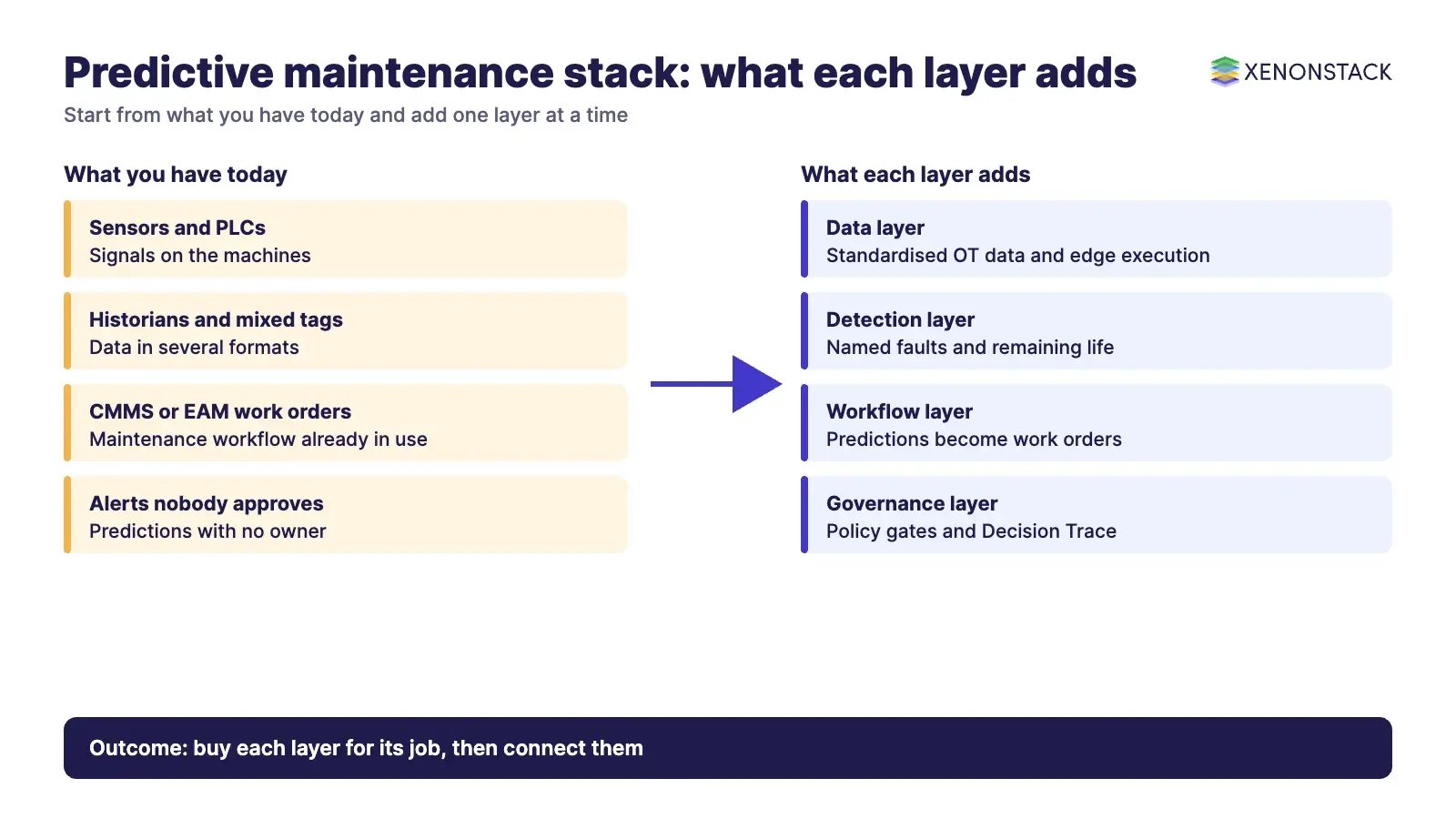
The best AI platform for predictive maintenance depends on which layer of the problem you are missing. Sensor-led diagnostic tools such as Augury and Tractian suit teams that need early fault detection on rotating equipment. Suite platforms such as Siemens Senseye, GE Vernova APM and IBM Maximo suit enterprises that need predictions tied to work orders, multiple plants and an existing asset system. Industrial data platforms such as Litmus fix the data layer underneath. A governance layer such as ElixirData sits above all of them and decides which maintenance decisions an AI agent may take on its own.
This guide compares seven options on the criteria that decide production success: industrial fit, data and connectivity, workflow integration, agent governance, deployment flexibility and production readiness. Disclosure: XenonStack sells one of the options below (ElixirData), so we describe it by what it does and where it does not apply. Every vendor claim here comes from that vendor's own page and is worded as such. Confirm current capabilities and pricing with each vendor before you shortlist.
What should you compare before choosing an AI predictive maintenance platform?
Most buying mistakes come from comparing feature lists instead of operating fit. Three published buyer guides, from Tractian, IFS and Litmus, overlap on the same ideas. All three are written by vendors that appear in their own comparisons, so treat the rankings with care and borrow the criteria. We use six:
- Industrial fit. Which assets and failure modes does it handle: rotating equipment, process plant, discrete lines? Does it classify named faults, or only alert when a threshold is crossed?
- Data and connectivity. Can it use the historians, PLCs and sensors you already have, or does it need new hardware and plant network access?
- Workflow integration. Does a prediction become a work order in your CMMS or EAM, or does it stay a dashboard?
- Agent governance. If AI agents recommend or take maintenance actions, who approves them, and is each decision traceable?
- Deployment flexibility. Edge, cloud, hybrid, single site or many? Reuse across plants matters more once you pass about three sites, as the Litmus guide notes.
- Production readiness. Is the capability live now or on a roadmap, and is there customer evidence beyond vendor claims?
Which AI platforms for predictive maintenance are worth shortlisting?
1. Siemens Senseye Predictive Maintenance
According to its site, Senseye is a cloud application that forecasts machine failures, estimates remaining useful life and prioritises risks so teams know where to act first. It states that it works with data from legacy machines, historians, IoT platforms, databases or new sensors, and that it standardises insights across thousands of assets and multiple sites. Its page cites BlueScope Steel as a case. Best for multi-site manufacturers that want a packaged predictive layer, especially inside Siemens estates. Confirm on the official page: time to value, hardware needs and data requirements, which its FAQ headings list without answers.
2. GE Vernova Asset Performance Management
According to its site, GE Vernova offers a modular APM suite covering asset strategies, risk, condition-based and predictive maintenance, with SmartSignal analytics and APM Health for condition monitoring. It says the applications can be deployed individually or together, integrate with EAM, CMMS and historians, and run on AWS services. It also notes that Verdantix named it a leader in its 2024 APM Green Quadrant. The efficiency ranges on its page come from a US Department of Energy O&M guide, not from its own deployments, so do not read them as a promise. Best for asset-intensive process industries with an existing reliability programme.
3. IBM Maximo Application Suite (Asset Performance Management)
According to its site, IBM Maximo predicts emerging issues from historical asset health data, operating conditions and failure patterns, then connects the prediction to maintenance execution in one platform. IBM footnotes figures from an IDC study of 47% less unplanned downtime, 17% longer asset life and 6.3% lower maintenance cost. These are study averages, not guarantees. The page does not state deployment options, so confirm on the official page. Best for organisations already running Maximo for work management who want predictions inside the same system of record.
4. Augury
According to its site, Augury provides prescriptive AI diagnostics for industrial machines, with alerts ranked by priority that explain root cause, urgency and recommended action. It cites more than 1.1 billion hours of machine readings, 170 or more manufacturers, and a 310% ROI figure from a Forrester Total Economic Impact study. Customer results on its page are vendor-reported. Best for teams that want diagnostics on critical rotating equipment without building data science capacity. Confirm on the official page: work order integration and pricing, which are not stated.
5. Tractian
According to its own guide, Tractian combines sensors, AI diagnostics and native work orders, and its sensor connects over cellular so it does not need plant Wi-Fi. Its guide also says a platform is only truly AI if it classifies deviations into named fault types. Its ROI figures come from a study the vendor commissioned. Best for plants that want a sensor-to-work-order package and have limited network access on the shop floor.
6. Litmus (industrial data layer)
Litmus is not a predictive maintenance application, and its own comparison says it does not supply packaged AI applications. According to that article, it offers more than 250 OT connectors, asset models, lineage and edge execution. It matters in this list because most failed predictive maintenance pilots fail on data, not models. Best for multi-site operators that must standardise data from mixed PLCs and historians before any model can be trusted. Pair it with an application from the list above.
7. ElixirData Context OS (governance and decision layer)
ElixirData does not analyse vibration or sensor signals. According to its Context OS page, it sits between enterprise data systems and AI agents, compiles the context for a decision, enforces policy before an action runs, and records a Decision Trace for each action. Its Exception Handling Agent page describes detecting cases that need human judgement, assembling context and routing them to the right decision-maker. In maintenance terms, that is the layer that decides who may approve a shutdown, a parts order or a deferred repair when an agent recommends one. Figures on its pages (4-week deployment, 60% cost reduction, 100% decision traceability) are vendor-reported and not independently verified. Best for enterprises that already have a detection tool and now need governed, auditable agent decisions on top. ElixirData is the XenonStack option in this list.
How do the seven options compare at a glance?
| Option | Primary layer | Data and connectivity (per vendor) | Workflow link | Agent governance | Evidence to ask for |
|---|---|---|---|---|---|
| Siemens Senseye | Predictive application | Legacy machines, historians, IoT, new sensors | Confirm on official page | Not stated | BlueScope Steel case, time to value |
| GE Vernova APM | APM suite | Integrates with EAM, CMMS, historians; built on AWS | Yes, via EAM and CMMS integration | Not stated | Customer references, own deployment data |
| IBM Maximo APM | APM within EAM suite | Historical asset health and operating data | Native, same platform | Not stated | Deployment options, IDC study scope |
| Augury | Machine health diagnostics | Sensor-based monitoring | Confirm on official page | Analyst-style prescriptive alerts | Forrester study scope, pricing |
| Tractian | Sensors plus diagnostics | Cellular sensor, no plant Wi-Fi needed | Native work orders | Not stated | Independent ROI evidence |
| Litmus | Industrial data layer | 250+ OT connectors, edge execution | Not an application | Not its role | Multi-site rollout references |
| ElixirData Context OS | Governance and decision layer | Integrates with enterprise systems | Routes decisions to approvers | Policy gates and Decision Trace | Workshop output, pilot results |
Which option fits which situation?
| If your situation is... | Start with | Why |
|---|---|---|
| Critical rotating equipment, little data science capacity | Augury or Tractian | Sensor-led diagnostics with named faults and actions |
| Many plants, mixed PLCs and historians | Litmus plus an application layer | Fix the data standardisation first |
| Siemens automation estate, several sites | Siemens Senseye | Packaged prediction that reuses existing data sources |
| Process plant with a reliability programme | GE Vernova APM | Strategy, risk and condition monitoring in one suite |
| Maximo already runs maintenance | IBM Maximo APM | Predictions land in the system of record |
| Agents will recommend or take maintenance actions | ElixirData Context OS over your detection tool | Approvals, authority limits and audit trail |
Our guide to agentic AI in manufacturing explains how to rank maintenance decisions by reversibility, and why advise-only mode is the safe place to start.
When should you not buy an AI predictive maintenance platform?
- Your data is not ready. If sensor tags are unlabelled, historians have gaps, or asset hierarchies conflict, a model will learn noise. Start with data quality management and data observability.
- The failure modes are rare or already cheap. If an asset is inexpensive, redundant and easy to replace, run-to-failure or time-based servicing may cost less than a platform.
- You have no one to act on alerts. A prediction without a planner, spares and a maintenance window is a notification nobody uses.
- You want an agent to control machines or safety functions. Predictive maintenance platforms advise on maintenance. Closed-loop machine control and safety functions belong to engineered control systems, not agents.
- You need proof before one plant is stable. Do not scale to many sites until one site shows a measured change in unplanned downtime.
What will change in AI predictive maintenance over the next 3 to 5 years?
Three shifts matter for a purchase made today, and each is sourced. Treat them as analyst forecasts, not certainties.
Agents move from pilots to production. Gartner's 2026 Magic Quadrant for Global Industrial AIoT Platforms, as reported by Virtualization Review, puts the share of platform providers' AI agents in production at 3% in 2026 and forecasts that by 2030, 65% will be running in production across asset-intensive industries. The article frames trust as the main hurdle. That makes decision approval and traceability a buying criterion now, not later.
Edge AI grows fastest. MarketsandMarkets estimates the predictive maintenance market at USD 9.71 billion in 2026 and USD 16.74 billion by 2031, a compound annual growth rate of 11.5%, with edge computing and edge AI growing fastest at 14.2%. Expect more analysis to run on or near the machine, which favours vendors with real edge deployment options.
Automation ambition rises. A PwC survey of 443 senior executives, reported by ICTbusiness.biz, found that the share of industrial manufacturers expecting to highly automate key processes would rise from 18% to 50% by 2030. More automation means more actions taken without a person in the loop, which raises the value of policy limits and audit trails.
What this means for you: choose a detection tool on merit today, keep the data layer open so you can swap it, and add governance before agents act. Our digital twin explainer covers the modelling side, and our MLOps guide covers keeping models healthy after launch.
How should you run a 90-day evaluation?
- Weeks 1 to 2: pick one line or asset class with a known downtime cost. Apply pass or fail gates first (network rules, security, CMMS integration), then score the rest.
- Weeks 3 to 8: run in advise-only mode. Log every alert, whether it was correct, and what it would have cost to ignore.
- Weeks 9 to 12: measure false alarms, lead time before failure and work orders raised. Decide whether to extend, switch or stop.
For the wider context on agents that act on analytics, see agentic analytics and our overview of agentic AI frameworks and use cases.
If your detection tool already works and the open question is who approves what an AI agent recommends, book the Context OS demo or join the Context Workshop. According to its page, the workshop is a free half-day session that traces one AI decision across your systems and ends with a one-page decision map and a written go or no-go.
Frequently asked questions
What is the best AI platform for predictive maintenance?
There is no single best platform. Augury and Tractian suit sensor-led diagnostics on rotating equipment, Siemens Senseye, GE Vernova APM and IBM Maximo suit enterprise multi-site programmes, and Litmus fixes the data layer. Choose by the layer you are missing and the systems you already run.
How is an AI predictive maintenance platform different from condition monitoring?
Basic condition monitoring alerts when a reading crosses a fixed limit, which often happens late in a failure. AI platforms learn normal behaviour per asset and, according to Tractian's guide, should classify deviations into named fault types so teams know what is wrong and what to do.
Do I need new sensors to start?
Not always. Siemens states that Senseye works with data from legacy machines, historians, IoT platforms and databases as well as new sensors. Sensor-led tools such as Tractian ship their own hardware. Confirm current hardware needs with each vendor.
Where does ElixirData fit alongside a predictive maintenance tool?
ElixirData does not detect faults. According to its site, Context OS governs decisions: it compiles context, enforces policy before an action runs and records a Decision Trace. It suits enterprises that want agent recommendations approved and audited. XenonStack sells ElixirData.
Should AI agents be allowed to act on maintenance decisions automatically?
Only for reversible, low-risk actions, and only after a period in advise-only mode. Actions that change physical equipment should need human approval and be logged. Safety functions and real-time machine control should stay with engineered control systems.
What will predictive maintenance look like by 2030?
Gartner, as reported by Virtualization Review, forecasts that 65% of industrial AIoT platform providers' AI agents will run in production by 2030, up from 3% in 2026. MarketsandMarkets expects edge AI to be the fastest growing segment. These are forecasts, so plan for trust and governance rather than assuming results.
Ready to put AI agents to work? Explore ElixirClaw, the agentic OS platform to build, orchestrate and govern AI agents.
Explore the XenonStack platform family: ElixirData · ElixirClaw · ElixirHub · NexaStack · MetaSecure · Neural AI · AgentGRC · AgentSRE · AgentAnalyst · AgentInstruct · AgentRAI · AgentScrum · AgentSearch · AgentForce · AI Aviator · SAIF Aviator · CohortIQ · XenonStack AI · XenonStack UAE


