
Key takeaway
- Compare AI platforms for legacy modernisation on governance, compliance, integration and audit evidence, with decision tables and when not to buy.
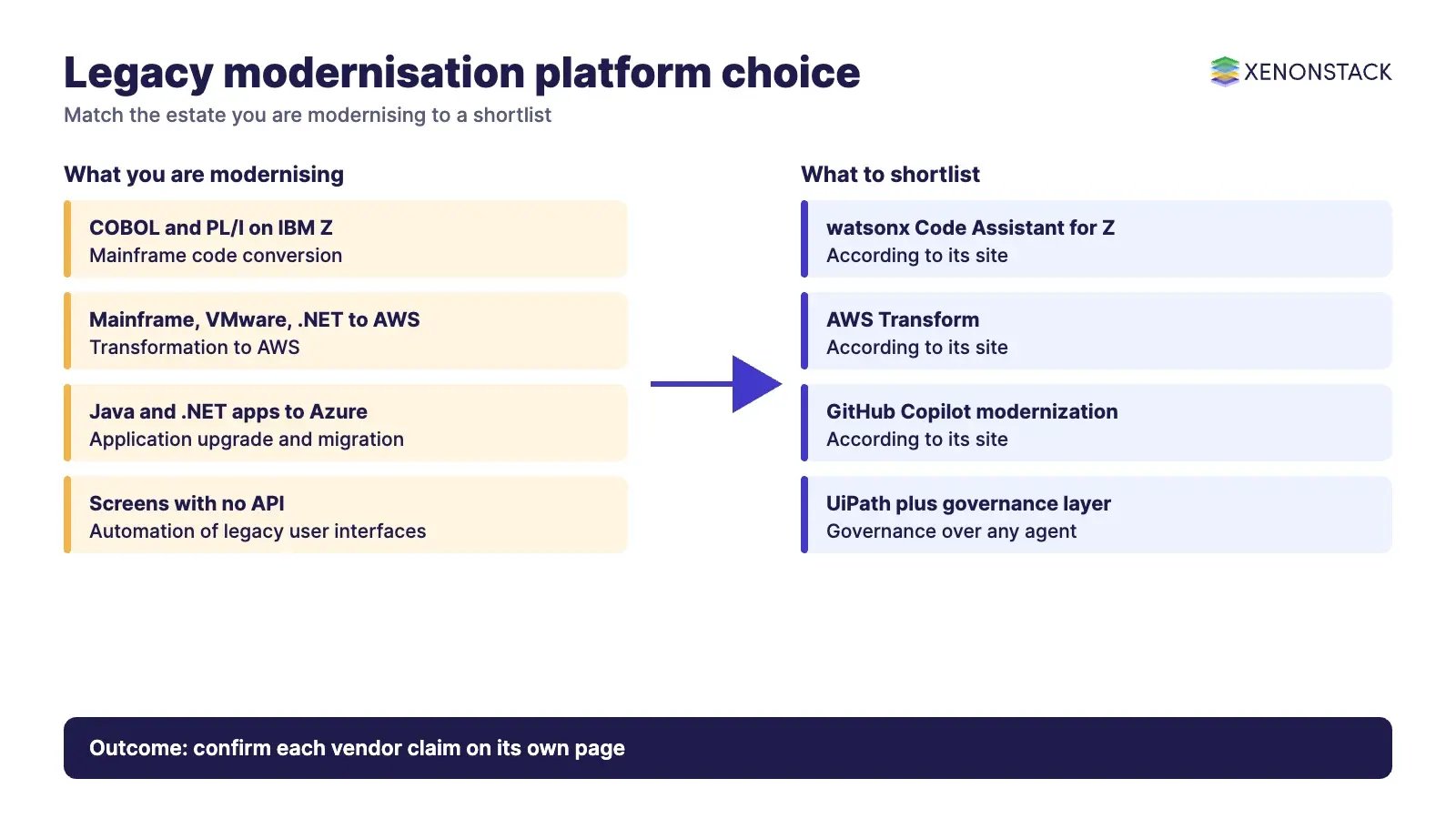
The best AI automation platform for legacy modernisation depends on what you are modernising. Code transformation tools (AWS Transform, IBM watsonx Code Assistant for Z, GitHub Copilot modernization) help you understand and convert old code. Automation platforms such as UiPath let agents work through legacy screens and mainframes that have no API. A governance layer such as ElixirData Context OS sits across both and records who authorised what. Most enterprises need one tool from the first group, sometimes one from the second, and a clear answer to the third.
This guide is for CIOs, CTOs and architects in governed industries such as banking, insurance, healthcare and the public sector. It compares five options on stated criteria: what they modernise, how they reach legacy systems, how humans stay in control, what audit evidence they produce, and where they run. XenonStack sells one of the options below (ElixirData Context OS), so we have limited it to claims from its own page and treated every vendor the same way. All vendor statements are "according to its site" and are marketing claims unless stated.
What does "AI automation for legacy modernisation" actually mean?
The phrase covers three different jobs, and vendors often blur them. A fair comparison starts by separating them.
- Understanding and converting code. Reading COBOL, PL/I, old .NET or Java estates, extracting business rules, and producing modern code and tests.
- Automating around legacy systems. Keeping the old system running while agents and bots drive it through screens, files and APIs, so work gets done without a rewrite.
- Governing what the AI does. Deciding which actions an agent may take, who approves them, and keeping evidence you can show an auditor.
An article from V2Soft on legacy tooling, for example, groups tools into code level modernisation, integration and architecture mapping, automated testing, and multi agent platforms, and warns that code level tools may miss integration behaviour and system wide performance. That matches what we see: the hard part is rarely the syntax. It is the undocumented rule and the batch job nobody dares touch.
Our post on agentic process automation covers the second job in more depth, and agentic workflows covers the patterns agents follow once they are running.
How should you compare these platforms?
Use criteria that reflect legacy risk, not demo polish. We used five.
- Modernisation scope: code conversion, automation around the old system, or governance.
- Legacy reach: which old systems and languages it says it handles.
- Human control: where a person reviews or approves.
- Audit evidence: whether the vendor describes a record of what happened and why.
- Deployment: where it runs, which matters for regulated data.
We did not score vendors out of ten. Scores from outside the system would be opinion dressed as data. Instead the table below records what each vendor says on its own page, and the "confirm" column marks what you must verify before buying.
Which AI platforms are worth shortlisting for legacy modernisation?
AWS Transform
According to its site, AWS Transform uses agentic AI across mainframe, VMware and Windows (.NET and SQL Server) modernisation. For mainframes it describes analysis and planning, code refactoring and "reimagining", including extraction of business rules with traceability. It says teams stay in control with "human review at each step" and that every requirement is traceable to source code. It also describes continuous modernisation that detects end of life dependencies and outdated frameworks. The page gives speed and cost figures (for example "up to 5x faster" for Windows modernisation) without a methodology, so treat them as claims to test in a pilot. Best fit: organisations already committed to AWS as the target.
IBM watsonx Code Assistant for Z
According to its site, this is an AI coding assistant for mainframe applications. It converts COBOL to Java, explains code in natural language, helps refactor COBOL and PL/I applications into modular services, and generates unit tests to check that the new Java service behaves like the original. The page says converted services can keep IBM Z runtimes through interoperability. The page we read does not describe governance features for this product, so confirm on the official page how review, approvals and audit records work. Best fit: IBM Z estates where the mainframe stays part of the target architecture.
GitHub Copilot modernization (Microsoft)
According to Microsoft Learn, GitHub Copilot modernization is an agentic solution that analyses and upgrades Java, .NET and C++ applications and helps migrate supported applications to Azure. A modernisation agent handles assessment, planning and upgrade automation across multiple applications, then hands plans to developers working in the IDE. The documentation states that humans remain in the loop and that every change is reviewable. Best fit: application estates in Java and .NET moving to Azure. It does not claim to cover COBOL mainframes; confirm scope for your languages.
UiPath agentic automation
According to its site, UiPath offers one execution layer that reaches "modern APIs, legacy UIs, mainframes, and systems that will never have an API", and positions existing automations as a foundation to build on. It describes an agent registry where agents can be catalogued, versioned, paused and rolled back, and "business transaction" audit records covering agent actions, human decisions and applied policies. The page does not explain the technical mechanism for legacy UI work, and its ROI figures have no stated methodology, so we do not repeat them. Best fit: processes that must keep running through an old screen while the replacement is built.
ElixirData Context OS (disclosure: XenonStack sells this option)
According to its site, Context OS is an infrastructure layer between systems of record and AI agent execution. It assembles context, builds policy into the decision path instead of the prompt, and records a decision trace for each decision: the context used, the policies evaluated, the authority verified and the outcome. Oversight scales with risk, with low risk actions approved automatically and high risk actions sent for human review. Its page says it can run on premises, in a VPC, at the edge or as a managed service, and lists connectors to systems such as SAP, Oracle and ServiceNow. Note the limits: it does not convert code and it does not replace the tools above. It governs the agents that use them. The related Audit Agent assembles audit evidence such as decision lineage, policy versions and approvals. Vendor reported results on its homepage are not used here.
How do the options compare side by side?
| Platform | Main job | Legacy reach (per its site) | Human control | Audit evidence described | Confirm before buying |
|---|---|---|---|---|---|
| AWS Transform | Convert and migrate | Mainframe, VMware, .NET, SQL Server | Human review at each step | Traceability from source to target | Speed claims, target lock in to AWS |
| IBM watsonx Code Assistant for Z | Convert and explain code | COBOL, PL/I to Java | Not described on the page read | Not described | Governance and review workflow |
| GitHub Copilot modernization | Upgrade and migrate apps | Java, .NET, C++ | Every change reviewable | Not described as an audit record | Scope for older stacks |
| UiPath agentic automation | Automate around legacy | Legacy UIs, mainframes, no API systems | Human decisions captured | Business transaction record | How legacy UI access works |
| ElixirData Context OS | Govern agent decisions | Connectors to listed systems of record | Risk tiered approvals | Decision trace per decision | Connector coverage for your estate |
Which platform fits which situation?
| Your situation | Start with | Why |
|---|---|---|
| COBOL on IBM Z, mainframe stays | IBM watsonx Code Assistant for Z | Built for COBOL and PL/I, keeps IBM Z runtimes |
| Mainframe, VMware or .NET moving to AWS | AWS Transform | Covers several estates in one agentic flow |
| Java or .NET apps moving to Azure | GitHub Copilot modernization | Developer led, reviewable changes |
| Processes stuck behind screens with no API | UiPath | Reaches legacy UIs while the rewrite runs |
| Regulated agents acting across old and new systems | Add a governance layer such as Context OS | Decision records and risk tiered approvals |
These are not mutually exclusive. A common shape is a code transformation tool for the rewrite, an automation platform for the interim, and a governance layer over any agent that can change a record. Our agentic AI overview and AI agents guide explain the building blocks.
What governance and compliance questions should you ask every vendor?
The recommendation behind this guide asks for governance and compliance compared, so put these to each vendor in writing.
- Who approves what? Which agent actions need a human, and is that enforced by the platform or only by instruction?
- What is recorded? Can you replay why a change was made: the input, the rule applied, the approver and the result?
- Where does code and data go? Does source code leave your environment, and which regions and deployment options exist?
- Can you stop it? Is there a pause, rollback and an inventory of every agent running?
- How are generated changes tested? Look for generated tests that prove behaviour matches the old system, as IBM describes for COBOL to Java.
- What are the exit terms? Can you keep the generated code and records if you leave?
Prompt level rules are not a control. We explain why in who controls what agents can do, and our agentic AI security post covers data protection risks. For wider data controls see data governance best practices.
When should you not buy an AI modernisation platform?
- You cannot describe the current system. If nobody knows what the old application does, buy discovery first, not conversion. Converted code inherits undocumented behaviour.
- The system is stable, small and rarely changed. Wrapping it with an API may cost less than any platform.
- You lack tests. Without a way to prove the new system behaves like the old one, speed claims are meaningless.
- Your regulator needs evidence you cannot yet produce. Fix the audit trail before you scale agents.
- The pilot has no owner. Pilots stall when nobody defines what the agent may decide. See getting pilots into production.
How can you test a platform on your own estate?
Run a four to six week pilot on one real, contained workload. Week one: agree the success measures (behavioural match, defects found, review hours saved). Weeks two and three: run the tool in read only or review mode against code or processes you know well, so you can check its output. Week four: inject a bad record or an edge case from your own history. Final week: ask for the audit record of one decision and see whether a reviewer who was not there can follow it. Compare against a manual baseline, not against the vendor's figures.
Want to see where governance fits in your modernisation plan?
If you are deciding where agents may act inside a legacy estate, the free half day Context Workshop maps your decisions, ranks them and ends with a written go or no go. You can see a Context OS demo or book the Context Workshop. Our agentic analytics post shows how the same decision records feed reporting.
Frequently asked questions
What is the best AI automation platform for legacy modernisation?
There is no single best platform. Choose by job: code conversion (AWS Transform, IBM watsonx Code Assistant for Z, GitHub Copilot modernization), automation around legacy systems (UiPath), or governance of agent decisions (ElixirData Context OS). Most enterprises combine two or three.
Can AI convert COBOL to Java safely?
According to IBM, watsonx Code Assistant for Z converts COBOL to Java and generates unit tests to check behaviour matches the original. Safe use still needs your own regression tests, human review and a pilot before production.
Do I need to replace a legacy system to use AI agents?
No. Automation platforms such as UiPath say they reach legacy UIs and mainframes without APIs, and governance layers sit over existing systems. Replacement becomes a separate decision.
How do I keep AI agents compliant during modernisation?
Enforce policy before an action runs, tier approvals by risk, keep an inventory of agents, and record context, policy, approver and outcome for each decision.
What should a modernisation pilot measure?
Behavioural match with the old system, defects found, reviewer hours, failure handling on bad data, and whether an outsider can replay one decision from the audit record.
Is ElixirData Context OS a modernisation tool?
No. It does not convert code. It governs the agents that act on your systems and records decision evidence. XenonStack sells it, which is why we recommend testing it alongside alternatives.
Ready to put AI agents to work? Explore ElixirClaw, the agentic OS platform to build, orchestrate and govern AI agents.
Explore the XenonStack platform family: ElixirData · ElixirClaw · ElixirHub · NexaStack · MetaSecure · Neural AI · AgentGRC · AgentSRE · AgentAnalyst · AgentInstruct · AgentRAI · AgentScrum · AgentSearch · AgentForce · AI Aviator · SAIF Aviator · CohortIQ · XenonStack AI · XenonStack UAE


