

Key takeaway
- AI agent skills explained in plain words, with one worked example each for healthcare, manufacturing, finance and government, and who checks each one.
AI agent skills are reusable instruction folders. Each one teaches an AI agent how to do one job the way your organisation wants it done. In healthcare, manufacturing, finance and government, a skill turns a written procedure into something an agent can load when needed. The legal and safety rules around that procedure still need people and controls outside the skill.
This guide is for business readers, not only engineers. You will see what a skill is in plain words, then one worked example for each of the four sectors: what the skill file would say, who checks it, and which official rules sit around it. All sources were read on 13 November 2026.
What is an agent skill, in plain words?
Think of a recipe card pinned inside a kitchen cupboard. The cook does not memorise every recipe. They read the card when the dish is ordered. An agent skill works the same way. It is a folder with one main file called SKILL.md, plus optional helper files, that tells an agent how to do one job.
According to the Agent Skills overview in Claude's documentation, the agent reads only the name and a short description of each skill at start-up, about 100 tokens each. A token is a small chunk of text. The full instructions load only when the task matches.
The same documentation says the description must say what the skill does and when to use it. The best practices page adds that descriptions should include key terms and trigger situations.
What would a healthcare skill look like?
Example: a skill that drafts a patient-facing summary of a visit for a clinic's administrative team. The skill file would say:
- When to use it: when staff ask for a visit summary or after-care letter.
- Steps: use only the fields in the template and write at a plain reading level.
- Stop rules: never add a diagnosis or dose that is not in the record, and pass every draft to a named staff member before it is sent.
The rules around it come from privacy law, not from the skill. According to the US Department of Health and Human Services (HHS), the HIPAA Privacy Rule sets national standards for when protected health information can be used or shared. It covers health plans, clearinghouses and providers who send certain electronic transactions, and reaches their vendors through contracts. HHS also explains a minimum necessary requirement: reasonable efforts to limit the information used or shared to what the purpose needs. A skill can list the allowed fields, but the organisation must set and enforce access policy.
One vendor-side limit: the Agent Skills overview says Agent Skills are not HIPAA eligible. Confirm the current position before putting patient data near a skill.
Who checks it: a clinical or compliance owner approves the skill, and a staff member reviews each output.
What would a manufacturing skill look like?
Example: a skill that helps a maintenance planner prepare a work order for servicing a machine. The skill file would say:
- When to use it: when a planner asks for a service work order for a named machine.
- Steps: pull the machine's approved energy control procedure from a reference file and list the isolation steps in order.
- Stop rules: never invent or change an isolation step, and mark the work order "draft" until an authorised person signs it.
The rules around it come from workplace safety law. OSHA explains that lockout and tagout are practices that protect workers from the unexpected start-up or release of hazardous energy while machines are serviced. Its page on the standard 29 CFR 1910.147, which applies to general industry, says it covers energy control procedures and that employers must train each worker. A skill can help prepare paperwork. It cannot lock a machine.
Who checks it: the safety lead owns the reference procedure files, and an authorised employee signs the final work order.
What would a finance skill look like?
Example: a skill that prepares a first-pass summary of a credit model's monitoring results for a risk committee. The skill file would say:
- When to use it: when an analyst asks for the quarterly monitoring pack for a listed model.
- Steps: run the approved script on the monitoring data, compare predicted and actual outcomes, and place the figures in the committee template.
- Stop rules: never change a threshold, never mark a model as passed, and flag any result outside the agreed range for a human reviewer.
The rules around it come from supervisory guidance on model risk. This one has changed recently. According to the Federal Reserve's page, SR 26-2, dated 17 April 2026, issues revised model risk guidance and replaces the older SR 11-7. The revised guidance describes a model as a complex quantitative method that turns input data into estimates. It asks for effective challenge, meaning review by objective experts who are independent of the builders. It also expects a model inventory and tougher oversight for higher-risk models.
One limit matters here. The attached guidance says generative and agentic AI are not within its scope. So the credit model is covered, but the agent that prepares the pack is not. The principle still travels well: the checker should not be the builder. Whether a skill or its script counts as a "model" is a question for a firm's own risk team.
Who checks it: an independent team reviews the skill and its script, and a named analyst signs off each pack.
What would a government skill look like?
Example: a skill that helps a public service team draft replies to routine questions about a benefit application. The skill file would say:
- When to use it: when a caseworker asks for a draft reply to a status or document question.
- Steps: use the approved wording library, quote the official guidance page for the answer, and keep a plain, polite tone.
- Stop rules: never state an eligibility decision, never promise a payment date, and hand every case with a dispute to a caseworker.
The rules around it vary by country. As one example, the US Office of Management and Budget memorandum M-25-21, dated 3 April 2025, covers federal agency use of AI. Confirm on the official page that it is still current. It describes "high-impact" AI as use where the output is a principal basis for decisions with significant effects on rights, safety or access to services. For those uses it asks agencies to document minimum practices such as pre-deployment testing, impact assessment, ongoing monitoring, operator training and human oversight. Other governments publish their own guidance, so check the official page for your jurisdiction.
This skill deliberately stays out of decisions. Who checks it: the programme owner approves the wording library, and a caseworker approves each reply.
What do all four examples have in common?
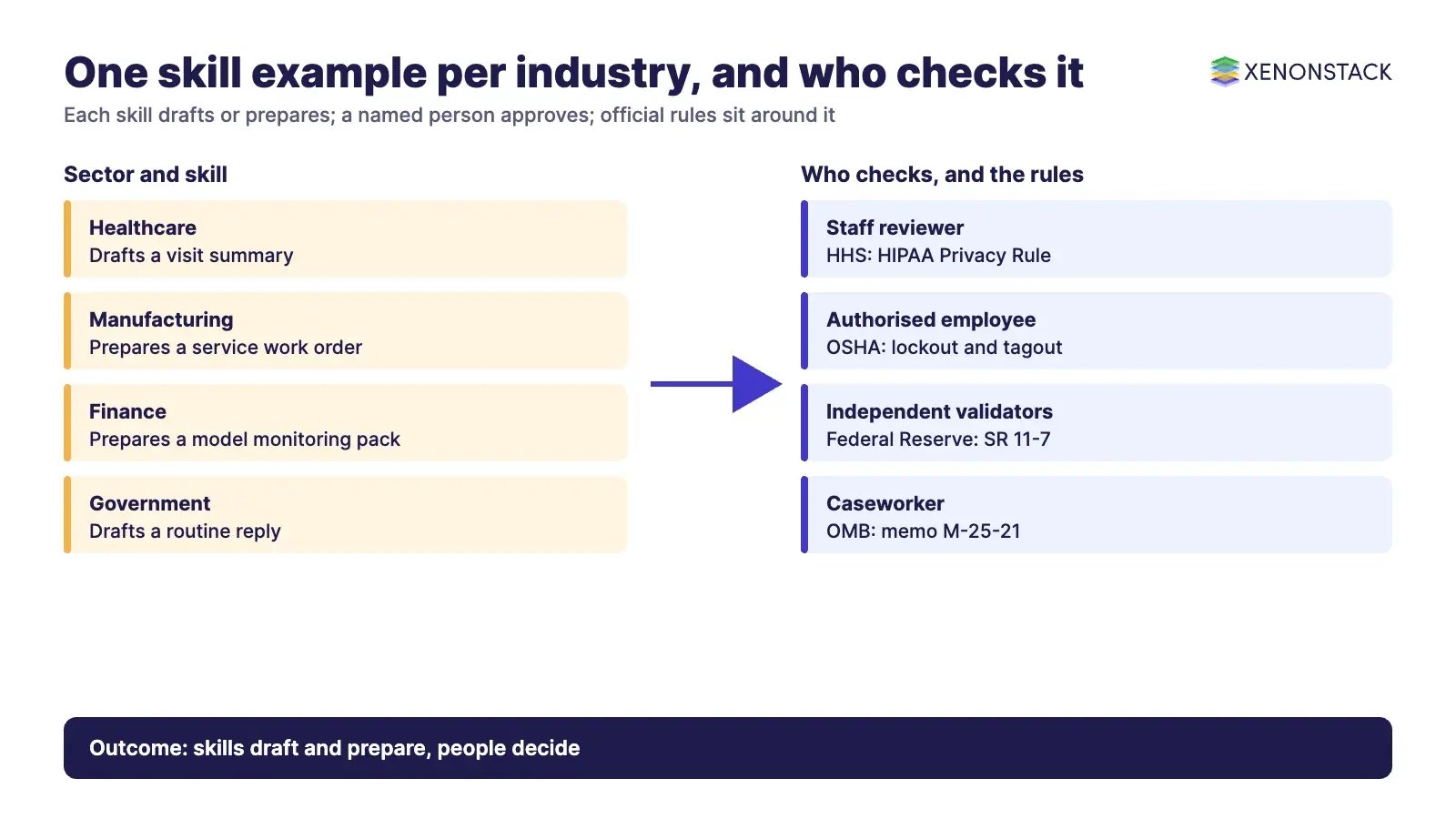
| Sector | What the skill does | What it must not do | Who checks it | Official source |
|---|---|---|---|---|
| Healthcare | Drafts a visit summary | Add facts not in the record | Compliance owner, staff reviewer | HHS, HIPAA Privacy Rule |
| Manufacturing | Prepares a service work order | Change an isolation step | Safety lead, authorised employee | OSHA, lockout and tagout |
| Finance | Prepares a model monitoring pack | Change a threshold or pass a model | Independent reviewers, analyst | Federal Reserve, SR 26-2 |
| Government | Drafts a routine reply | State an eligibility decision | Programme owner, caseworker | OMB, M-25-21 |
Three habits repeat: each skill is narrow, each has a "never" list, and each ends with a named person. The best practices page also advises exact steps where mistakes are costly.
Here is the honest limit. A skill tells an agent how to work. It does not decide whether an action is allowed. Permissions, approvals and an audit record must sit around the agent, in systems the agent cannot talk its way past. Our agentic analytics guide looks at that data and control side.
How should you check a skill before using it?
According to the Agent Skills overview, you should use skills you wrote yourself or that come from Anthropic, read everything inside them, including scripts, and watch for unexpected network calls or behaviour that does not match the stated purpose. It singles out skills that fetch data from outside web pages as a particular risk.
Where a skill runs also matters. According to the overview, skills on the API run in a sandbox with no network access. In Claude Code they have the same network access as any program on the computer. On claude.ai, network access depends on user and admin settings. Custom skills also do not sync across these places, so each copy needs its own review.
The best practices page recommends running the task without the skill first to see where it fails, then writing just enough instructions to fix those gaps. In a regulated setting, add a named owner and a review date to each skill.
Related reading
These posts in the series cover the neighbouring questions.
- AI Agent Skills: Turning General AI into Specialists: How to make a general model act like a sector specialist, and test it.
- Why Enterprise AI Agents Need Skills and Oversight: Why a company needs skills: consistency, control and human oversight.
- Reusable AI Skills for Enterprise Automation: How one skill is reused across teams and tools, and what does not travel.
Try it on one decision first
Disclosure: ElixirData is a XenonStack product company, and it offers the Context Workshop and Context OS mentioned here.
Bring one live decision to the free half-day Context Workshop. ElixirData architects help your team map the decision, and you leave with a one-page decision map and a go or no-go call. You can request a Context OS demo or book the Context Workshop.
Sources
- Agent Skills overview, Claude documentation
- Skill authoring best practices, Claude documentation
- HIPAA Privacy Rule, HHS
- Minimum necessary requirement, HHS
- Control of hazardous energy, OSHA
- SR 26-2 revised guidance on model risk management, Federal Reserve and its attached guidance
- OMB Memorandum M-25-21
Frequently asked questions
What is an AI agent skill?
It is a folder with a main SKILL.md file that tells an AI agent how to do one job. The agent loads it only when a task matches its description, like reading a recipe card when a dish is ordered.
Can a skill make an agent follow HIPAA or other laws?
No. A skill can list allowed fields and stop rules, but legal compliance needs organisational policy, access control, contracts and audit. The Claude documentation also says Agent Skills are not HIPAA eligible, so confirm the current position on the official page.
Who should approve a skill in a regulated industry?
The owner of the underlying procedure, such as a compliance, safety or risk lead, with an independent reviewer where stakes are high, in the spirit of the Federal Reserve's SR 26-2.
Are skills safe to install from the internet?
Treat them like installed software. The Claude documentation advises using skills you made or that come from Anthropic, and auditing every file, including scripts, before use.
Should a skill make final decisions?
For high-impact matters, no. The examples here draft, prepare and flag, and a named person decides. Government guidance such as OMB M-25-21 asks for human oversight where AI output is a principal basis for significant decisions.
Follow XenonStack on LinkedIn: XenonStack on LinkedIn for new guides on agentic AI, data and platform engineering.
Ready to put AI agents to work? Explore ElixirClaw, the agentic OS platform to build, orchestrate and govern AI agents.
Explore the XenonStack platform family: ElixirData · ElixirClaw · ElixirHub · NexaStack · MetaSecure · Neural AI · AgentGRC · AgentSRE · AgentAnalyst · AgentInstruct · AgentRAI · AgentScrum · AgentSearch · AgentForce · AI Aviator · SAIF Aviator · CohortIQ · XenonStack AI · XenonStack UAE


