Key takeaway
- Agentic AI in oil palm: where agents fit in disease detection, harvest, mills and RSPO and EU deforestation evidence, plus governance and adoption steps.
Agentic AI in oil palm means software agents that watch plantation, transport and mill data, decide what needs doing next and act within limits that people set. The useful starting points are early disease detection, harvest and mill scheduling, maintenance of mill equipment and evidence for sustainability certification. Each of these is a decision with a cost when it is late or wrong, which is why it suits an agent more than a dashboard. For the wider pattern, see our guide to agentic AI frameworks, tools and use cases.
The hard part is not the model. It is deciding which actions an agent may take alone, which need a manager's approval and what evidence is kept. This guide is for CTOs, chief digital officers and plantation and mill operations leaders. It sets out where agents fit, how they relate to RSPO and the EU deforestation rules, and a sequence for adopting them. The analytics behind crop planning are covered separately in agricultural data analytics for crop planning and risk.
What does an agentic oil palm operation decide?
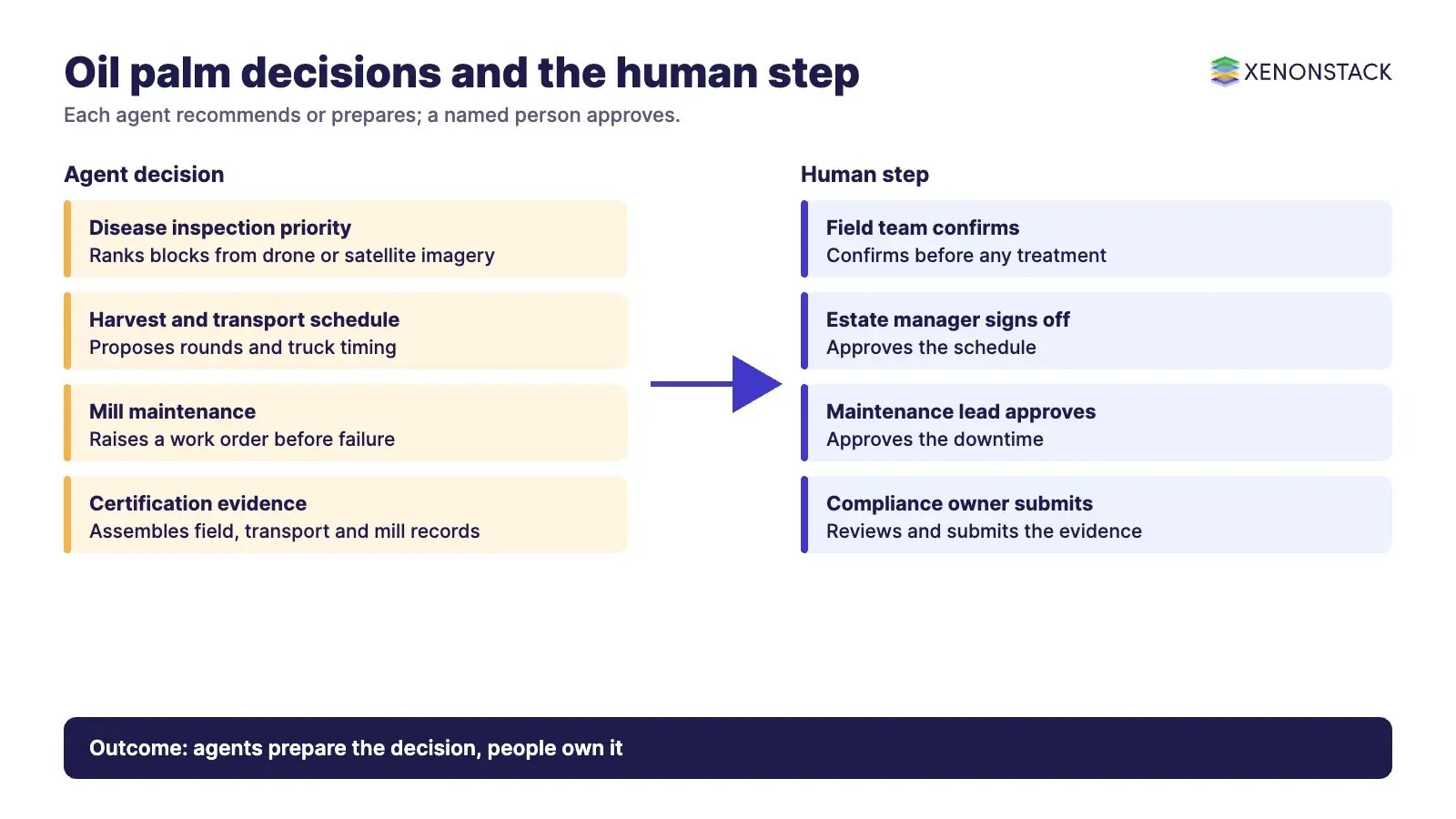
An agent is useful where a repeatable decision depends on data that changes daily. The table lists the decisions we see as the strongest candidates, and the human step that should stay in place.
| Decision | Data the agent reads | Agent action | Human step |
|---|---|---|---|
| Block-level fertiliser and irrigation | Soil, moisture and weather readings; past yield | Recommends a site-specific plan | Agronomist approves changes to the plan |
| Disease inspection priority | Drone or satellite imagery; field inspection records | Ranks blocks for a field check | Field team confirms before treatment |
| Harvest and transport schedule | Fruit maturity, weather, mill intake capacity | Proposes rounds and truck timing | Estate manager signs off the schedule |
| Mill maintenance | Vibration, temperature and running hours | Raises a work order before failure | Maintenance lead approves downtime |
| Certification evidence | Field, transport and mill records | Assembles audit-ready records | Compliance owner reviews and submits |
Field sensing and edge processing matter here because estates often have patchy connectivity. NexaStack is an agentic operating platform for physical AI that runs across on-premises, cloud and hybrid environments, which is the kind of deployment a remote estate needs.
How early can agents spot Ganoderma?
Basal stem rot, caused by Ganoderma boninense, is usually found late through manual inspection. A 2022 study in Remote Sensing by Kurihara and colleagues tested drone-mounted hyperspectral imaging on 1,113 oil palms, about 13 years old, on an 8 ha plantation in Segamat, Johor, Malaysia. The imager covered 460 to 780 nm in 33 bands and the team classified trees as healthy, early-stage, late-stage or dead using a random forest model. The bands that mattered most for early detection were in the red-edge region, 690 to 750 nm (source: Remote Sensing 14(3):799).
Treat this as evidence that early detection is feasible, not as a product guarantee. The study covered one site with trees of one age, and the article text does not state the accuracy for the early-stage class. An agent built on this kind of model should therefore rank blocks for a field visit rather than order treatment on its own.
How do agents improve harvest, yield and mill decisions?
Yield forecasts feed three schedules: harvesting rounds, truck movements and mill intake. When a disease alert changes the expected yield of a block, an orchestrating agent can update the forecast and propose new transport timing for approval. This works only when the agents share the same current data and the same rules. Without that, each agent optimises its own step and the mill still sees queues and late fruit.
Scenario runs, such as harvesting earlier because rain is forecast, help managers compare options before committing. Keep the forecast inputs and the chosen option on record so that the reasoning can be reviewed after the season.
How do agents help with RSPO and EU deforestation rules?
Two sets of rules shape the evidence a producer must hold. The Roundtable on Sustainable Palm Oil lists the 2024 Principles and Criteria (version 4.2), the 2024 Independent Smallholder Standard (version 2.2) and the 2020 Supply Chain Certification Standard as its current standards (source: RSPO standards page). The EU deforestation regulation lists oil palm among its seven covered commodities. According to the European Commission, large and medium-sized operators must comply from 30 December 2026 and micro and small enterprises from 30 June 2027, and a simplification review was published on 4 May 2026 (source: European Commission).
| Requirement | What an agent can do | What stays with people | Current status |
|---|---|---|---|
| RSPO certification evidence | Collects field, transport and mill records and flags gaps | Auditor-facing decisions and sign-off | 2024 P&C version 4.2 current per RSPO |
| EU deforestation regulation | Checks plot location records against land-clearing signals | Legal interpretation and operator declarations | Large and medium operators from 30 Dec 2026 |
| Internal audit trail | Logs each agent action with inputs and approver | Policy ownership | Your own design choice |
Agents are good at keeping this evidence continuous, because the checks run before an action rather than after a shipment. The ElixirData Compliance Agent runs compliance checks before actions execute, so AI activity can be reviewed at any time. It supports the record; it does not replace certification or legal advice.
Where do agents fit in mills, maintenance and biomass energy?
Fresh fruit bunch handling, tractors and mill equipment all produce vibration, temperature and usage data. A maintenance agent can compare that data with normal behaviour and raise a work order before a breakdown, so repairs are planned instead of forced. The same data helps schedule spare parts. Palm biomass such as empty fruit bunches, kernel shells and fibre can also feed bioenergy, and an agent can help plan collection against plant demand. Whether that pays back depends on the plant and local power prices, so model it before committing.
What do governance, security and cost look like?
Agents in a plantation touch equipment, labour schedules and compliance records, so set the rules first.
- Autonomy levels: read-only advice first, then low-risk actions such as alerts, then approved actions such as work orders.
- Decision record: store the inputs, the rule applied and the approver for every agent action.
- Connectivity and security: design for offline operation at the estate edge and limit each agent to the systems it needs.
- Cost: sensors, imagery, connectivity and integration with ERP and mill systems usually cost more than the model itself. Start with one decision and measure it.
For an orchestration layer that builds, runs and governs agents with humans in control, see ElixirClaw, an agentic OS platform to build, orchestrate and govern AI agents and automation workflows while keeping humans in control. Our guide to agentic AI for risk management and the overview of autonomous digital operations cover the control design in more depth.
In what order should a plantation adopt agentic AI?
| Step | Scope | Exit test |
|---|---|---|
| 1. Data baseline | Block maps, yield history, sensor and mill data in one place | Agents can read current, trusted data |
| 2. Advice only | One decision, such as disease inspection priority | Managers agree with most recommendations |
| 3. Approved actions | Work orders and schedules with sign-off | Approvals are fast and overrides are rare |
| 4. Linked agents | Yield, transport and mill agents share one decision record | Fewer queues at the mill and fewer late deliveries |
| 5. Compliance evidence | Records assembled for RSPO and EU rules | Audit preparation takes less manual effort |
When is agentic AI not the right answer?
Do not start with agents if block records are incomplete, if the estate has no reliable connectivity plan or if no one owns the decision being automated. A simple threshold alert or a better maintenance schedule may be enough. Smallholders with limited data may gain more from shared advisory services than from a custom agent. Avoid giving an agent authority over treatment, payments or declarations to regulators without human review.
To map one oil palm decision your agents should make, and the context and policy it depends on, book a Context Workshop. See what happens in the workshop.
Frequently asked questions
What is agentic AI in oil palm?
It is software agents that read plantation, transport and mill data, decide the next action and act within limits set by people, for example ranking blocks for disease inspection or proposing harvest and truck schedules.
Can AI detect Ganoderma early?
A 2022 Remote Sensing study used drone hyperspectral imaging on 1,113 oil palms in Johor, Malaysia and found red-edge bands from 690 to 750 nm most useful for early detection. It covered one site, so results need validating on your estate.
Does the EU deforestation regulation cover palm oil?
Yes. The European Commission lists oil palm among seven covered commodities. Large and medium-sized operators must comply from 30 December 2026 and micro and small enterprises from 30 June 2027.
Which RSPO standards are current?
RSPO lists the 2024 Principles and Criteria (version 4.2), the 2024 Independent Smallholder Standard (version 2.2) and the 2020 Supply Chain Certification Standard.
Which decisions should stay with people?
Treatment of diseased palms, approval of downtime, certification sign-off and any declaration to a regulator. Agents prepare the evidence and recommendation; a named person decides.
Where should a plantation start?
With one decision that has clear data and a clear owner, such as disease inspection priority or mill maintenance, run in advice-only mode before any action is automated.
Explore the XenonStack platform family: ElixirData · ElixirClaw · ElixirHub · NexaStack · MetaSecure · Neural AI · AgentGRC · AgentSRE · AgentAnalyst · AgentInstruct · AgentScrum · AgentSearch · AgentForce · AI Aviator · SAIF Aviator · CohortIQ · XenonStack AI · XenonStack UAE