Key takeaway
- XenonStack's AI Reasoning Stack explained for enterprise leaders: four layers, governance controls, EU AI Act timing, use cases and when not to use it.
An AI reasoning stack is the set of layers that lets an autonomous AI agent perceive its environment, reason about it, decide within policy and act, with every step recorded. XenonStack describes its AI Reasoning Stack as four such layers (perception, cognition, decision and action) built on its products ElixirData, ElixirClaw, MetaSecure and NexaStack. The aim is agents whose actions can be explained, audited and stopped when needed.
This guide is for CTOs, Chief AI Officers, CISOs and enterprise architects deciding how much autonomy an agent should get and what must sit around it. It covers what each layer does, how observability and governance fit, where the stack applies, and when not to use it. For the wider pattern behind it, see our guide to AI agents. ElixirClaw is an agentic OS platform to build, orchestrate and govern AI agents and automation workflows while keeping humans in control.
Why does reasoning matter for autonomous AI systems?
A model that matches patterns can draft text or classify an image. An agent that must act in a changing environment also needs to break a goal into steps, weigh alternatives, check its own output and know when to hand over to a person. That is the practical meaning of reasoning here, and it is what turns a model into a system a risk team can approve.
The business case is moving quickly. As reported by CampusTechnology from Gartner's 2025 technology trends, Gartner expects 33% of enterprise software applications to include agentic AI by 2028, up from less than 1% in 2024, and 15% of day-to-day work decisions to be made autonomously. If those decisions are made by agents, leaders need to be able to see why each one was made.
What are the four layers of the XenonStack AI Reasoning Stack?
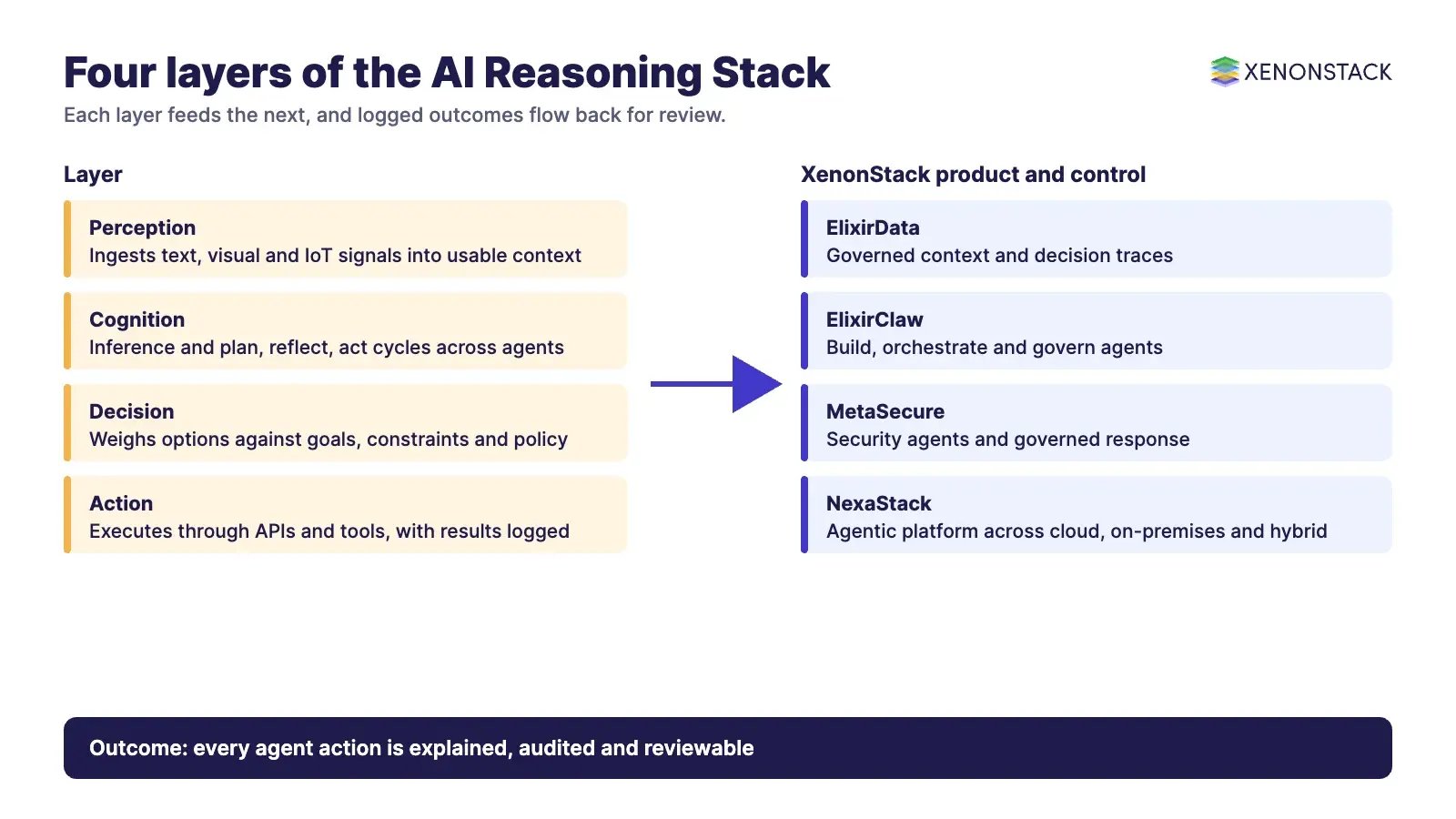
XenonStack's stack runs from sensing to action. Each layer feeds the next, and outcomes flow back so the system can be reviewed and improved. The product mapping below is XenonStack's own description of the stack on this page.
| Layer | What it does | XenonStack product | Fits when |
|---|---|---|---|
| Perception | Ingests text, visual and IoT signals and cleans them into usable context | ElixirData | Data arrives from many sources and needs shared context |
| Cognition | Inference and pattern recognition, with agents coordinated through plan, reflect and act cycles | ElixirClaw | Tasks need several steps or several agents |
| Decision | Weighs options against goals, constraints and security policy | MetaSecure | Actions carry security, compliance or safety risk |
| Action | Executes through tool integrations such as APIs and bots, with results logged | NexaStack | Agents must change real systems or equipment |
In the perception layer, agentic analytics supplies the real-time context. ElixirData Context OS keeps governed context, versioned policy and decision traces in one decision layer above AI agents. For the action layer, NexaStack is an agentic operating platform for physical AI that runs across on-premises, cloud and hybrid environments, and infrastructure as code keeps that estate repeatable and auditable.
MetaSecure describes itself on its own site as coordinating security agents for alert triage, investigation, compliance and governed incident response, which is the role it plays at the decision layer: MetaSecure.
How does it relate to MLOps and LLMOps?
XenonStack describes the stack as building on MLOps (model lifecycle and deployment) and LLMOps (tuning and operating language models), and adding ReasonOps as its term for improving and documenting an agent's plans and decisions. ReasonOps is a XenonStack term, not an industry standard, so check that your teams share the definition before using it in a programme plan.
How do observability and feedback loops keep reasoning trustworthy?
An agent that cannot be traced cannot be trusted with consequential work. Observability should capture each agent's inputs, the steps it took, the tools it called and the outcome. Feedback loops then use reviews, by people or by automated checks, to correct behaviour. XenonStack describes NexaStack dashboards that track agent paths in real time for debugging and audit. Our guide to AI agent observability and evaluation tools covers the tooling choices in more detail.
Regulation is part of the reason. The European Commission's AI Act page states that the Act became applicable generally on 2 August 2026, and that, following the AI Omnibus, high-risk obligations for Annex III systems apply from 2 December 2027 and for Annex I products from 2 August 2028. Which obligations apply to a given agent depends on its use case. Sector expectations differ too; see what GCC, India and EU regulators expect from AI agents in banking.
What do explainability, traceability and governance need in practice?
| Control | What it should record or enforce | Who owns it |
|---|---|---|
| Explainability | The reasoning trail behind each decision, readable by a reviewer | AI platform lead |
| Traceability | Inputs, tool calls, policy version and outcome, kept as evidence | Architecture and audit |
| Policy enforcement | Which actions an agent may take alone, which need approval | CISO and risk |
| Human oversight | Named approvers and escalation paths for high-impact actions | Business owner |
XenonStack's own video intelligence platform at xenonstack.ai shows the same idea in a concrete form: a decision boundary that applies confidence and policy controls and routes each action as Auto, Confirm or Escalate, with evidence minimums. ElixirData's Audit Agent collects the reasoning trail behind each decision, the policy version that applied, who approved it and the chain of authority, packaged as evidence for auditors.
Where does the reasoning stack apply?
The stack suits work where an agent must sense, decide and act across several systems, and where the decision needs a record.
| Use case | How the layers apply | Main control |
|---|---|---|
| Predictive maintenance | Telemetry is perceived, wear is reasoned about, a repair is decided and a work order is raised | Approval before any repair that stops a line |
| Security operations | Alerts are correlated, an investigation is run and a containment step is proposed | Human sign-off on containment |
| Finance and operations analytics | Data is gathered, anomalies are explained and an action is recommended | Audit trail for each recommendation |
Root-cause analysis is a good example of reasoning over noisy evidence rather than simple rules. The short video below shows an agent tracing the cause of an incident instead of reacting to the loudest alert.
Video: Root Cause Analysis AI, from ElixirClaw.
How should an enterprise adopt a reasoning stack?
- Pick one decision. Choose a single agent decision with clear inputs, an owner and a measurable outcome.
- Set the autonomy level. Decide what the agent may do alone, what needs approval and what is off limits.
- Build the trace first. Capture inputs, steps, tool calls and outcomes before widening scope.
- Add review loops. Sample decisions, compare them with outcomes and tune policy. The Decision Review Agent examines past AI decisions and their outcomes and tracks decision quality over time.
- Scale by decision, not by tool. Add the next decision only when the previous one has stable controls.
When is a full reasoning stack not the right choice?
A fixed, low-risk workflow with stable rules does not need four layers; a rules engine or simple automation is cheaper and easier to audit. The same applies when you cannot yet name an owner for the decision, or when the data is too poor to reason over. Fix the data and ownership first.
What is the outlook for reasoning systems?
Expect agents to take on more multi-step work, with enterprises asking for evidence of control before they extend autonomy. The practical direction is not more freedom but better-governed freedom: clear boundaries, recorded reasoning and review. Treat any vendor figure for accuracy or downtime gains with caution until it is measured in your own environment.
To map one decision your agents should make, and the context and policy it depends on, book a Context Workshop. See what happens in the workshop.
Frequently Asked Questions (FAQs)
Answers on the XenonStack AI Reasoning Stack for building reliable, autonomous AI systems.
What is an AI reasoning stack?
It is the set of layers that lets an autonomous agent perceive, reason, decide within policy and act, with each step recorded. XenonStack describes four: perception, cognition, decision and action.
Which XenonStack products map to the four layers?
XenonStack maps ElixirData to perception, ElixirClaw to cognition, MetaSecure to decision and NexaStack to action.
How does the stack keep agent behaviour safe?
By recording each decision, enforcing policy on what an agent may do alone and routing high-impact actions to a person for approval.
What is ReasonOps?
It is XenonStack's term for improving and documenting an agent's plans and decisions, added to MLOps and LLMOps. It is not an industry standard.
Does the EU AI Act affect autonomous agents?
It can. The Act became applicable generally on 2 August 2026, with high-risk obligations for Annex III systems from 2 December 2027. Which duties apply depends on the use case.
When should we not use a full reasoning stack?
When the workflow is fixed and low risk, when no one owns the decision or when the data is too poor to reason over.
Follow XenonStack on LinkedIn: XenonStack on LinkedIn for new guides on agentic AI, data and platform engineering.
Explore the XenonStack platform family: ElixirData · ElixirClaw · ElixirHub · NexaStack · MetaSecure · Neural AI · AgentGRC · AgentSRE · AgentAnalyst · AgentInstruct · AgentRAI · AgentScrum · AgentSearch · AgentForce · AI Aviator · SAIF Aviator · CohortIQ · XenonStack AI · XenonStack UAE