Key takeaway
- Agentic AI in architecture for building and urban design: where agents help, what Autodesk Forma offers in 2026, risks and how to start. Read the guide.
Agentic AI in architecture means software agents that take a design brief, such as site constraints, daylight, energy and cost targets, then analyse options, check them against rules and hand the results to human architects for decision. This guide is about the architecture of buildings and cities. If you are looking for enterprise or software architecture, read our guide to agentic AI frameworks, tools and use cases instead.
In 2026 the practical picture is narrower than the headlines. Vendors such as Autodesk now ship AI analyses for site design and AI assistance for drawings, and have previewed agent-style assistants. The decisions that carry liability still sit with licensed professionals. The sections below show where agents fit, what is already available, what to govern and how a design or construction firm should sequence adoption.
What does agentic AI mean for building and urban design?
An agent differs from a single-purpose AI tool in that it pursues a goal over several steps. In design practice that means reading a brief, running analyses, comparing results with constraints, proposing a change and repeating, while logging what it did. A rendering tool or an energy-simulation plug-in waits for a prompt. An agent coordinates several of them.
Architecture suits this pattern because the work is multi-variable: massing, sun, wind, noise, structure, cost, programme and planning rules interact. The same pattern extends to construction, where schedule, materials and site records change daily.
How did design technology reach agentic AI?
| Stage | What it added | Who decides |
|---|---|---|
| Manual drafting | Hand-drawn plans and sections | Architect |
| CAD | Digital precision and faster revision | Architect |
| BIM | Data inside the model, shared across disciplines | Project team |
| Parametric and generative design | Rule-based options from parameters a designer sets | Designer sets rules, then reviews |
| Machine learning analysis | Fast predictions for sun, wind or noise | Architect reads the results |
| Agentic AI | Multi-step work across tools with logged actions | Architect approves defined decisions |
What has changed in 2026?
At Autodesk University in September 2026, as reported by Architosh, Autodesk said it is consolidating its cloud products under the Forma brand, added AI features to Revit and Forma such as Drawing Compliance and automated documentation, and previewed a next-generation Autodesk Assistant described as an AI agent combining specialised agents, Autodesk tools and project information. For construction it introduced Forma Bid in beta and a mobile Daily Log Agent that turns a spoken site update into a structured log. Autodesk also said AI for the built environment needs "the right data, project context, and industry expertise."
Autodesk's own page for Forma Site Design describes AI-powered analyses for sun hours, daylight potential, wind, noise and microclimate, used in pre-design and schematic design. Forma Site Design combined many of Spacemaker's capabilities from May 2023, and Spacemaker software has been retired. The name Spacemaker should now be read as a predecessor, not a current product.
Where can agents help in design and construction?
| Use | What an agent does | When it fits | Current status |
|---|---|---|---|
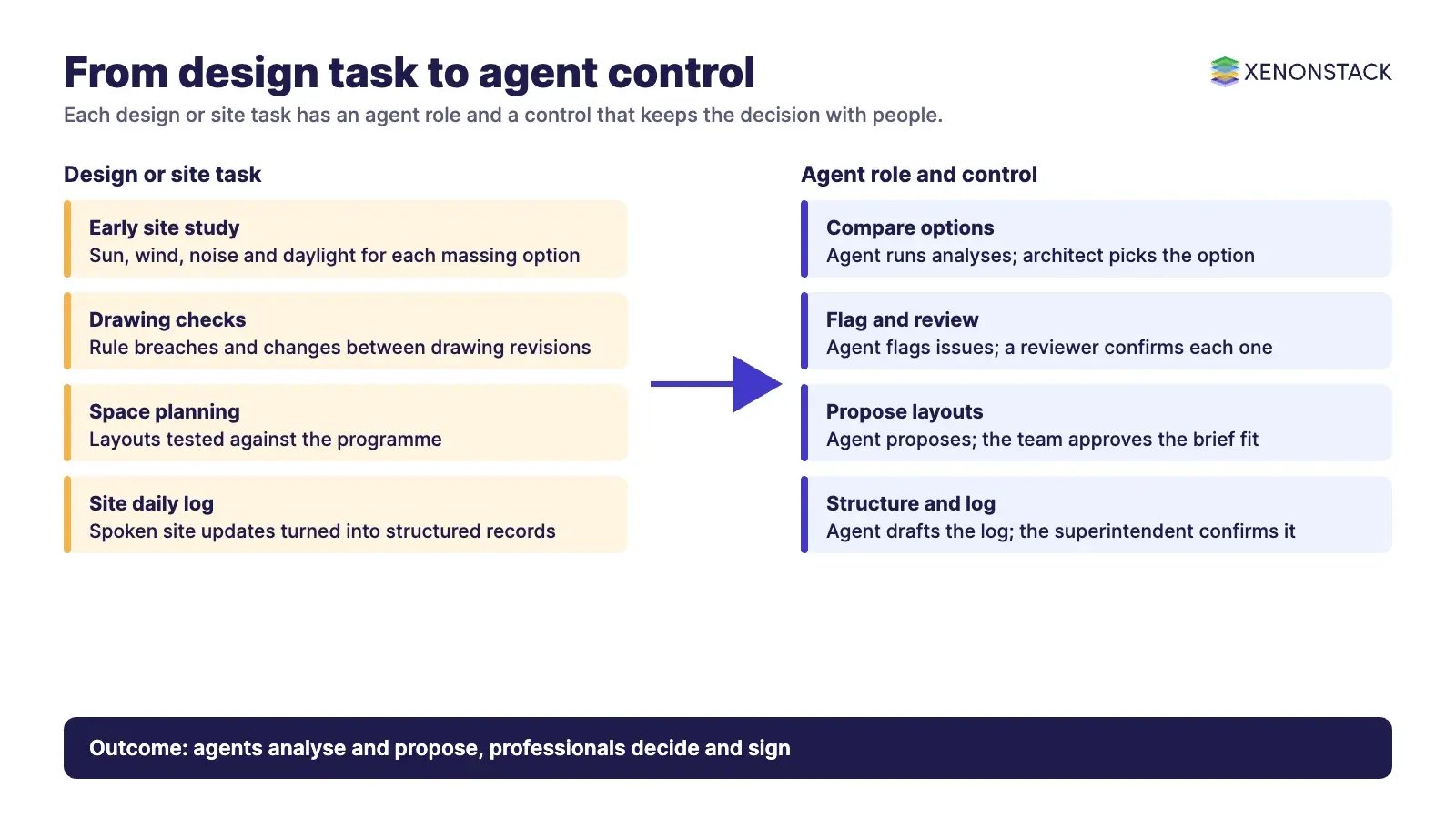
| Early site and massing study | Runs sun, wind, noise and daylight analyses on options and compares them with the brief | Pre-design and schematic design | Analyses available in Forma Site Design |
| Drawing and rule checks | Flags clashes and rule breaches, and compares drawing revisions | Documentation stage | Drawing Compliance and Change Analysis announced at AU 2026 |
| Space planning | Tests layouts against programme requirements | Briefing and feasibility | Hypar positions itself as space planning software with Revit import and export |
| Urban and sustainability studies | Combines climate, mobility and land-use data to compare scenarios | Masterplans and planning submissions | Mostly analyst-led today; agent workflows are emerging |
| Site and bid operations | Structures daily logs and compares bids against estimates | Construction administration | Daily Log Agent and Forma Bid (beta) announced |
| Building operation | Reads sensor data and proposes adjustments to space, lighting or ventilation | Buildings with reliable sensor feeds | Project-specific; often linked to digital twin work |
What do real firms say about AI in design?
As reported by DeepLearning.AI in May 2023, Zaha Hadid Architects principal Patrik Schumacher said the firm used image generators including DALL-E 2, Midjourney and Stable Diffusion for concept imagery, used only a small share of the output, and had 3D artists build the actual models with traditional methods. That is a useful pattern: AI widens the option space, and people still own the design.
What are the risks and limits of agentic AI in design?
| Risk | Why it matters | Control |
|---|---|---|
| Performance without context | Options can score well on energy or cost and still miss cultural or local meaning | Architect review at each gate |
| Biased or thin data | Training and site data can reinforce existing patterns | Document data sources and test across contexts |
| Ownership and liability | Copyright, authorship and professional liability for AI-assisted design vary by jurisdiction and contract | Agree terms in the appointment and keep a decision log |
| Privacy | Urban, occupancy and biometric data can identify people | Minimise data, restrict access and record purpose |
| Integration cost | Agents need clean model, cost and schedule data and a way into existing tools | Start with one workflow and measure it |
When should a firm not use design agents yet?
Hold back where the model data is inconsistent, where no one can review the agent's output, or where a decision is statutory, such as a structural sign-off. In those cases use the agent for analysis only and keep the decision, the record and the signature with the responsible professional.
How should a design or construction firm adopt agentic AI?
- Pick one bounded workflow, such as early site analysis or site log structuring.
- Fix the data first: consistent models, naming and cost codes.
- Define decision boundaries: what the agent may do alone and what needs approval.
- Log every action so a reviewer can trace why an option was proposed.
- Measure and expand only when review time and error rates improve.
Firms ready to run design agents inside policy limits, with human approvals, can look at ElixirClaw, XenonStack's agentic AI platform for enterprise agents.
How does XenonStack help design and construction teams adopt agentic AI?
Design agents are useful only when they work from trusted project context and stay inside limits that architects and engineers control. ElixirData keeps governed context, versioned policy and decision traces in one decision layer above AI agents. ElixirClaw is an agentic OS platform to build, orchestrate and govern AI agents and automation workflows while keeping humans in control. For approvals, the Decision Review Agent checks AI decisions before they run, routes them to the right approver and keeps an audit-ready record. Our agentic AI consulting team can help scope the first workflow.
To map one design or construction decision your agents should make, and the context and policy it depends on, book a Context Workshop. See what happens in the workshop.
Frequently Asked Questions (FAQs)
What is agentic AI in architecture?
It is the use of AI agents that take a design brief and constraints, run analyses across tools, propose options and log their actions, while human architects approve the decisions.
Does it mean enterprise architecture or building architecture?
This post covers building and urban architecture. Enterprise architecture, meaning the structure of an organisation's systems, is a different subject covered in our agentic AI guide.
How is agentic AI different from generative design?
Generative design produces options from rules a designer sets. An agent plans several steps, calls different tools, checks results against constraints and repeats.
Will agentic AI replace architects?
No. Agents speed up analysis and iteration, but design intent, cultural judgement, client relationships and professional accountability stay with people.
Where should a firm start?
Start with one bounded workflow, such as early site analysis or site log structuring, keep a human approval step and expand once results are measured.
Explore the XenonStack platform family: ElixirData · ElixirClaw · ElixirHub · NexaStack · MetaSecure · Neural AI · AgentGRC · AgentSRE · AgentAnalyst · AgentInstruct · AgentRAI · AgentScrum · AgentSearch · AgentForce · AI Aviator · SAIF Aviator · CohortIQ · XenonStack AI · XenonStack UAE