Key takeaway
- Learn how agentic AI supports data analytics, governance and trust: a four-stage workflow, least-privilege access, trust scores and audit trails.
Agentic AI for data analytics, governance and trust means using AI agents that plan and carry out data tasks, such as checking permissions, validating quality and logging actions, inside rules the organisation sets and can audit. The aim is analytics that people can trust because every step has an owner, a policy and a record.
This guide is for chief data officers, heads of analytics and AI leaders who want agents in their data estate without losing control. It covers what agents add to governance, a four-stage workflow, how access control and explainability work in practice, and what to do first. It builds on our guide to agentic analytics.
Why does data trust matter more with AI agents?
A dashboard error is seen by a person who can question it. An agent error can flow into a decision, a message or a payment before anyone looks. Trust therefore has to be built into the data path, not checked afterwards. The NIST AI Risk Management Framework is a useful reference point: NIST says it helps organisations incorporate trustworthiness considerations into the design, development, use and evaluation of AI systems, and that its use is voluntary. NIST released it on 26 January 2023, notes that version 1.0 is being revised, and published a Generative AI Profile (NIST-AI-600-1) on 26 July 2024.
What do AI agents add to data governance?
Traditional governance relies on policies, catalogues and periodic reviews. Agents let some of those checks run continuously at the moment data is used. The table shows the shift.
| Governance task | Traditional approach | With governed AI agents |
|---|---|---|
| Access control | Roles assigned at onboarding, reviewed yearly | Role and context checked on each request |
| Data quality | Scheduled reports and manual checks | Continuous checks with anomalies flagged to an owner |
| Lineage and audit | Documented after the fact | Actions and sources logged as they happen |
| Explainability | Analyst reconstructs a decision | Evidence trail stored with each output |
This is a design pattern, and each control still needs rules a person has approved. Our notes on responsible AI and reasoning loops and data observability show how monitoring supports it.
How does a governed agent workflow run end to end?
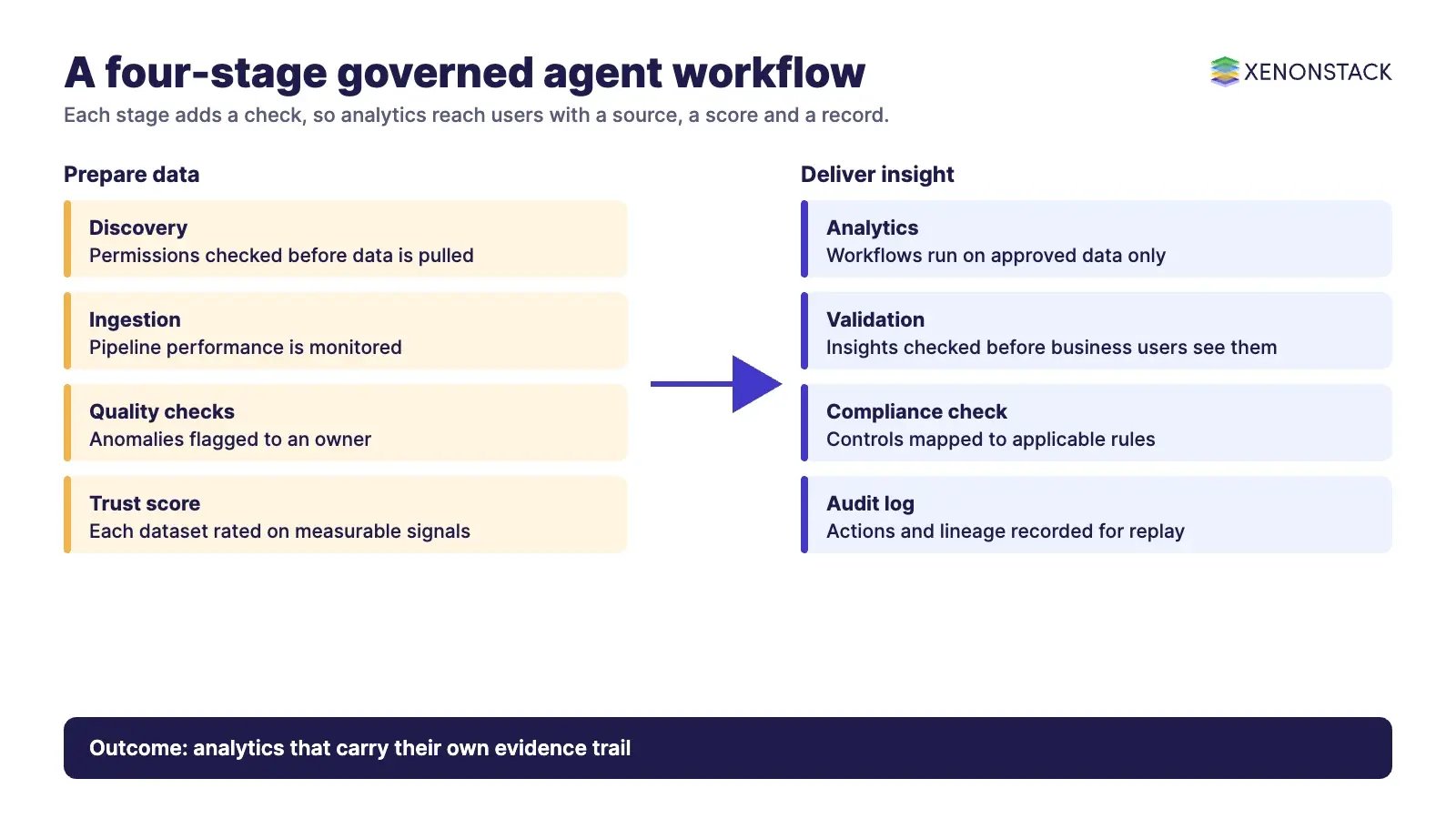
One way to organise it is in four stages, with a distinct agent role at each stage. The roles below are a pattern for design, and a platform may combine or split them.
| Stage | What happens | Role involved |
|---|---|---|
| 1. Discovery and ingestion | Permissions are checked before data is pulled, and ingestion is monitored | Governance, ingestion and operations roles |
| 2. Processing and quality | Anomalies are flagged and each dataset gets a trust score | Auditor and trust roles |
| 3. Analytics and insight | Workflows are triggered, and insights are validated before reaching business users | Orchestrator and auditor roles |
| 4. Governance and compliance | Alignment with applicable rules is checked, lineage tracked and actions logged | Governance, trust and auditor roles |
The trust score deserves care. It should combine measurable signals such as freshness, completeness and lineage, and it should be explainable, so an analyst can see why a source scored low.
How do you control who and what an agent can access?
Start with least privilege. The HHS guidance on the minimum necessary requirement says covered entities must generally take reasonable steps to limit use and disclosure of protected health information to the minimum needed for the purpose. It says policies must identify the persons or classes of persons who need access and the categories of information they need, with conditions. That is the same logic you apply to an agent: define its role, the data classes it may read, and the conditions.
- Role-based and attribute-based access, so context such as location or time can narrow what is allowed.
- Masking of personal or health data at the point of use.
- An automated audit log of every read, decision and exception.
- Human review for non-routine requests, as HHS requires for non-routine disclosures.
Check which regulations apply to your sector and region on the regulator's own pages, and map each control to a requirement you can show an auditor.
What does this look like in practice?
Three illustrative scenarios show the pattern. They are examples of design, not results.
- Smart city data: agents watch streaming sensor feeds, compare them with history and correlate anomalies with outside events. See our notes on IoT sensor data for smart cities.
- Healthcare: access is restricted by role and location, personal data is masked, and lineage is tracked for audit.
- Financial services: credit decisions carry provenance and a bias check, so each one can be explained and reviewed.
Where data cannot leave your environment, a private cloud AI deployment keeps models and data inside your boundary.
How do AI agents and the data platform fit together?
Agents sit above existing systems rather than replacing them. Typical integration points include warehouses and lakehouses such as Snowflake and Databricks, catalogues such as Microsoft Purview or Collibra, and security tooling. The missing piece is often the shared context: which policy applies, which version of a definition is current, and what evidence an action produced. XenonStack's Context OS, ElixirData, is a decision layer for that governed context above the data platform.
What should you do first?
- Choose one analytics decision that an agent will influence, and name its owner.
- List the data it uses, its sensitivity and the policy that applies.
- Define the agent role, its allowed data classes and its approval points.
- Log every action and source, and test that an auditor can replay one decision.
- Review after a month and widen scope only if the evidence trail holds up.
To map one analytics decision your agents make, and the data and policy it depends on, book a Context Workshop. See what happens in the workshop.
Frequently asked questions
What is agentic AI in data analytics?
It is the use of AI agents that plan and carry out data tasks, such as checking permissions, validating quality and logging actions, within rules the organisation sets and can audit.
How do AI agents improve data governance?
They let checks such as access control, quality validation and audit logging run at the moment data is used, instead of only in periodic reviews. The rules still need human approval.
What is a data trust score?
It is a rating for a dataset based on measurable signals such as freshness, completeness and lineage. It should be explainable so analysts can see why a source scored low.
Is the NIST AI Risk Management Framework mandatory?
No. NIST states that the framework is intended for voluntary use and aims to help organisations incorporate trustworthiness into the design, development, use and evaluation of AI systems.
How does least privilege apply to AI agents?
Give each agent a defined role, limit it to the data classes it needs and add conditions. HHS describes the same idea for health information: limit access to the minimum necessary for the purpose.
Follow XenonStack on LinkedIn: XenonStack on LinkedIn for new guides on agentic AI, data and platform engineering.
Ready to put AI agents to work? Explore ElixirClaw, the agentic OS platform to build, orchestrate and govern AI agents.
Explore the XenonStack platform family: ElixirData · ElixirClaw · ElixirHub · NexaStack · MetaSecure · Neural AI · AgentGRC · AgentSRE · AgentAnalyst · AgentInstruct · AgentRAI · AgentScrum · AgentSearch · AgentForce · AI Aviator · SAIF Aviator · CohortIQ · XenonStack AI · XenonStack UAE