

Key takeaway
- Compare six security AI automation platforms for compliance-driven SOC teams: governance, audit trail, workflow automation and when not to buy.
The best security AI automation platform depends on what your SOC already runs and how much an AI agent is allowed to do without a person. Palo Alto Networks Cortex, Microsoft Sentinel with Security Copilot, CrowdStrike Falcon Fusion, Splunk SOAR from Cisco and Torq all pair workflow automation with AI agents. MetaSecure from XenonStack targets the same job as an agentic SOC layer. No single product fits every team, and for a compliance-driven SOC the deciding question is usually not speed. It is what each platform records when an agent acts.
This guide is for CISOs, SOC leads and the architects who answer to auditors. It compares six options on five criteria and says when not to buy. For the design side, see our guides to SOC automation for remote workforces and human-in-the-loop SOC automation.
Disclosure: XenonStack sells MetaSecure, one of the six. Every competitor claim comes from the vendor's own page or a named trade report and is worded "according to its site". Anything we could not confirm is marked "confirm with the vendor". Figures are vendor claims, not our tests.
How should you evaluate a security AI automation platform?
We used five criteria.
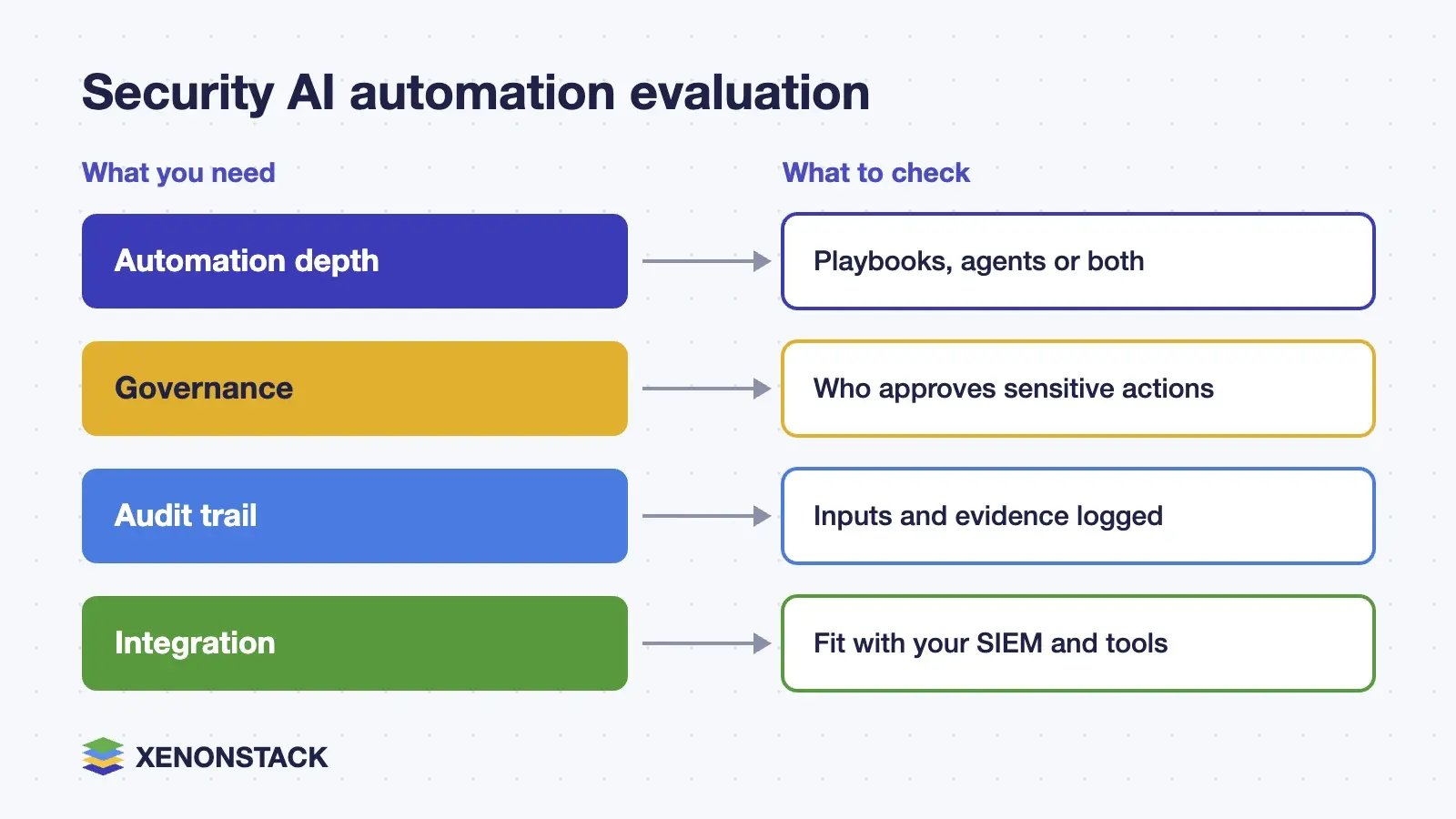
- Automation depth: does it run fixed playbooks, let an AI agent reason inside a workflow, or both?
- Governance: who approves sensitive actions, and can you limit what an agent may trigger?
- Audit trail: is each AI decision logged with its inputs, so you can answer an auditor later?
- Fit with your stack: does it need you to already run its SIEM or endpoint product?
- Production evidence: named customers and measured results, not demo claims.
Alert volume is the usual reason to buy. Audit readiness is the reason that decides the shortlist in regulated firms, because an agent that closes an alert without a reason on record creates a new problem.
Which platforms are compared here?
| Platform | Main job | Best fit | What to check |
|---|---|---|---|
| Palo Alto Networks Cortex XSOAR and AgentiX | Playbook automation, moving to governed AI agents | Teams that want a dedicated automation layer across many tools | A large library of prebuilt playbooks and integrations (vendor claim); which AgentiX features are available, confirm with the vendor |
| Microsoft Sentinel with Security Copilot agents | SIEM with built-in AI agents and playbook generator | Microsoft-centred estates | Which agents are generally available and which are in preview, confirm with Microsoft |
| CrowdStrike Falcon Fusion and Charlotte Agentic SOAR | No-code workflows with LLM steps and agents | Falcon endpoint and Next-Gen SIEM customers | Depends on the Falcon platform |
| Splunk SOAR (Cisco) with Splunk AI Assistant | SOAR and AI on top of Splunk Enterprise Security | Existing Splunk SIEM shops | Version requirements; which AI features are live |
| Torq HyperSOC and Socrates | AI SOC analyst plus hyperautomation | Teams wanting a vendor-neutral automation layer | Vendor-published results; customer evidence |
| MetaSecure (XenonStack) | Agentic SOC: triage, investigation, response, compliance agents | Teams adding governed agents and audit logging | Vendor claims only; hosting model not stated on the page reviewed |
What does Palo Alto Networks Cortex XSOAR offer?
According to its site, Cortex XSOAR builds playbooks in a visual drag-and-drop editor with thousands of automatable actions, conditional paths, manual tasks and human approval for sensitive automations. The Cortex page cites a large library of prebuilt playbooks and integrations and claims a sharp reduction in manual work; treat that as a vendor claim to test. Palo Alto describes Cortex AgentiX as the next generation of XSOAR, built to build, deploy and govern a workforce of AI agents, starting with the SOC.
Choose it when you want automation as its own layer across many security tools. Watch for the effort of moving existing playbooks if you adopt AgentiX. We could not load the official AgentiX page on 13 November 2026, so confirm with Palo Alto which AgentiX features are generally available.
What does Microsoft Sentinel with Security Copilot offer?
According to Microsoft, Security Copilot agents ship ready to use inside Defender and other workloads, with examples such as a phishing triage agent and a threat hunting agent. Customers can also build their own agents, and partner agents are offered through the Microsoft Security Store. A Sentinel playbook generator that creates automation from natural language was announced in public preview at RSAC 2026. Microsoft has said the standalone Azure portal experience for Sentinel retires on 31 March 2027, so plan for the unified security operations portal.
Choose it when your estate is already Microsoft. Watch for which agents are generally available and which are preview. We could not load Microsoft's agent overview page on 13 November 2026, so confirm with Microsoft before you budget coverage around them. A third-party review in July 2026 made the same point about preview agents.
What does CrowdStrike Falcon Fusion offer?
According to CrowdStrike, Falcon Fusion SOAR is a no-code automation engine, and Charlotte AI Agentic Workflows let you insert large language models into workflows to analyze, reason and respond within boundaries you define. Its Charlotte Agentic SOAR describes agent orchestration with a visual builder and unified case management in Falcon Next-Gen SIEM. A Workflow Generation Agent turns natural-language descriptions into Fusion workflows.
Choose it when Falcon is already your endpoint or SIEM platform. It is less natural as a standalone automation layer for a mixed estate.
What does Splunk SOAR from Cisco offer?
Cisco packages Splunk SOAR with Splunk Enterprise Security 8.2, UEBA and the Splunk AI Assistant in its Premier Edition. Cisco announced AI Playbook Authoring, which turns natural-language intent into tested SOAR playbooks, with several agentic features due in 2026; confirm with Cisco which are live. Splunk's documentation for the AI SOC analyst agent in Enterprise Security says it needs Splunk Platform 10.2 or higher and Enterprise Security 8.7 or higher, and that the agent inherits the permissions of the SOAR connectors it runs. That last point is a useful governance control: the agent cannot do more than the connector permissions allow.
Choose it when Splunk is your SIEM. Watch for version and licence requirements, and check Splunk's release notes for the current status of the classic playbook editor before you plan a migration.
What does Torq HyperSOC offer?
According to its site, Torq HyperSOC combines hyperautomation with Socrates, an AI SOC analyst that coordinates specialised agents for runbooks, investigation, remediation and case management. Torq says Socrates can automate most Tier-1 tasks and escalates cases that need a human decision. In launch coverage, Torq's CTO said Socrates can only trigger Torq workflows, which limits what the agent can do to actions the team has built.
Choose it when you want automation that is not tied to one SIEM or endpoint vendor. Watch for named customers and the measurement method behind the percentage claims.
Where does MetaSecure fit?
According to the XenonStack MetaSecure announcement, MetaSecure is an agentic SOC platform with composable agents for triage, enrichment, investigation, case management, compliance and incident command. It says agents coordinate through Model Context Protocol and secure agent-to-agent messaging, with human-in-the-loop controls including policy approvals, overrides and rollback by design. The compliance agent enforces guardrails and logs approvals, and the audit logs are queryable. The announcement claims faster detection and round-the-clock autonomous coverage; it gives no independent figures, and it does not state a hosting model (cloud or on-premises) or name customers. The MetaSecure product page describes the platform as trust, compliance and defense with AI-BOMs, risk scoring and agentic security.
Choose it when you want governed agents with queryable audit logs and are willing to validate the claims in a pilot. We have not benchmarked it against the other five.
How do the options compare on governance and audit?
| Platform | Human approval | Agent limits | Audit evidence |
|---|---|---|---|
| Cortex XSOAR / AgentiX | Human approval step in playbooks | Defined by the playbook; confirm AgentiX controls | Case and playbook records; confirm the AI-decision log |
| Sentinel / Security Copilot | Analyst-in-the-loop for high-impact actions in vendor material | Agent scope per agent type | Confirm decision logging per agent |
| Falcon Fusion / Charlotte | Customer-defined boundaries | Workflow guardrails | Case management; confirm AI-step logging |
| Splunk SOAR / AI Assistant | Playbook and permissions | Agent inherits SOAR connector permissions | Splunk and SOAR logs; confirm AI-step logging |
| Torq HyperSOC | Escalation to analysts for critical cases | Socrates triggers only Torq workflows | Confirm per-decision record |
| MetaSecure | Policy approvals, overrides, rollback | Compliance agent guardrails | Queryable audit logs, per vendor announcement |
"Confirm" means we did not find a public statement on the pages reviewed. Ask each vendor to show the record produced for one agent decision.
Which platform should you pick for your situation?
- Microsoft estate: start with Sentinel and the generally available Security Copilot agents; add a separate layer only for gaps.
- Falcon customer: Falcon Fusion keeps automation in the platform you already run.
- Splunk SIEM: Splunk SOAR and the AI Assistant, after checking version requirements.
- Mixed estate, want one automation layer: Cortex XSOAR or Torq.
- Need governed agents with queryable audit logs: shortlist MetaSecure and test the log on a real case.
Most teams will combine two. The question to settle is which layer owns the audit record.
When should you not buy a security AI automation platform?
- Your alert volume is low and a few good playbooks cover it.
- Your detection quality is poor. Automating noise makes noise faster.
- You cannot yet say which actions an agent may take alone. Settle that policy first.
- Your integrations and asset data are incomplete. Agents act on what they can see.
How can you test a platform on your own SOC?
Run a four-week pilot on one alert type, such as phishing triage. Measure time to triage, false closures found on review, analyst overrides and, for each agent decision, whether you can reproduce the reason from the log. Make the vendor show the record for a decision they did not choose in advance.
To agree which SOC decisions an agent may make alone and what evidence each must leave, book a Context Workshop or see what happens in the workshop. To see how governed agents and audit logging could fit your SOC, explore our agentic SOC solution or book a strategy call.
Frequently asked questions
What is a security AI automation platform?
It is software that automates SOC work such as alert triage, enrichment, investigation and response, using playbooks, AI agents or both.
Is SOAR the same as an agentic SOC?
No. SOAR runs predefined playbooks. Agentic tools let an AI agent reason within limits and choose steps, which makes governance and logging more important.
Which platform is best for a Microsoft or Splunk estate?
Usually the vendor's own platform first, for integration reasons. Check which AI features are generally available.
Can AI agents close alerts without a human?
Some products allow it for defined cases. Decide in advance which alert types qualify and keep a record of each closure.
What should a buyer ask a vendor?
Which agent actions need approval, what is logged for each AI decision, how long logs are kept, and which customers run it in production.
Where does MetaSecure fit?
It is an agentic SOC layer with compliance and audit-log features, per its own announcement. Validate it in a pilot, since we have no independent results.
Follow XenonStack on LinkedIn: XenonStack on LinkedIn for new guides on agentic AI, data and platform engineering.
Ready to put AI agents to work? Explore ElixirClaw, the agentic OS platform to build, orchestrate and govern AI agents.
Explore the XenonStack platform family: ElixirData · ElixirClaw · ElixirHub · NexaStack · MetaSecure · Neural AI · AgentGRC · AgentSRE · AgentAnalyst · AgentInstruct · AgentRAI · AgentScrum · AgentSearch · AgentForce · AI Aviator · SAIF Aviator · CohortIQ · XenonStack AI · XenonStack UAE


