What is your Key focus areas? *
AI Workflow and Operations
Data Management and Operations
AI Governance
Analytics and Insights
Observability
Security Operations
Risk and Compliance
Procurement and Supply Chain
Private Cloud AI
Vision AI

Get Started with your requirements and primary focus, that will help us to make your solution
of enterprises cite lack of AI transparency as a top barrier to adoption across regulated domains
improvement in audit readiness when integrating trust score metrics into AI lifecycle governance
of AI incidents in production are caused by drift, unexplainable predictions, or inadequate monitoring
of businesses want independent metrics to evaluate fairness, bias, and accountability in deployed models
Helps organizations assess and monitor the ethical and operational integrity of AI models across their lifecycle
Consolidate multiple dimensions—performance, fairness, robustness, and explainability—into a single, interpretable AI trust score for each model
Continuously monitor models in production to detect anomalies, drifts, or trust violations before they impact outcomes
Automate audits across sensitive attributes using fairness metrics (e.g., disparate impact, equalized odds) for ethical model deployment
Leverage built-in support for SHAP, LIME, and custom explainers to surface human-readable justifications for AI outputs at scale

Embed policy-driven checkpoints and scoring benchmarks directly into the MLOps lifecycle

Support all model types (black-box, glass-box, ensemble) across ML, NLP, CV, and LLM use cases

Quantify trust using a unified score that reflects performance, robustness, fairness, bias, and drift

Provide actionable explanations, risk levels, and visual diagnostics to empower human decision-makers
Integrate with SageMaker, CloudWatch, and AWS-native model governance tools for continuous trust monitoring
Leverage Azure ML interpretability and fairness APIs along with role-based scoring models
Align trust score metrics with Google’s Vertex AI and What-If Tool for auditing and observability
Embed trust metrics in your model delivery lifecycle with GitOps and automated scoring gates
Discover More


Score and explain outputs from LLMs to mitigate bias, hallucination, and response variability
Discover More
Monitor bias and drift in recommendation models to ensure fairness and improve customer trust
Discover More
Justify and audit every decision in regulated risk scoring environments using trust analytics

Configure scoring rules for performance, fairness, explainability, and security using domain-specific policies
Build and deploy AI pipelines with trust checkpoints using Airflow, Kubeflow, and MLflow
Export model report cards, drift dashboards, and explainability visualizations for stakeholders and regulators
Correlate model behavior with input/output drift, real-world impact, and live feedback loops
Continuously improve model trust scores with labeled feedback, retraining triggers, and closed-loop evaluation


Ensure responsible AI use by evaluating model fairness, transparency, and reliability. It promotes accountability, reduces risk, and builds stakeholder confidence by continuously monitoring ethical and operational standards across the AI lifecycle.



Learn how AI accelerates decision-making, automates workflows, and enhances operational intelligence across modern data-driven enterprises
Explore Further

Explore how autonomous agents optimize data integration, governance, and warehousing with intelligent orchestration and self-healing pipelines
Explore Further
AI continuously monitors systems for risks before they escalate. It correlates signals across logs, metrics, and traces. This ensures faster detection, fewer incidents, and stronger reliability
 Proactive detection of performance and availability issues
 Root-cause analysis across microservices and environments
 Automated remediation playbooks to reduce MTTR

AI converts camera feeds into instant situational awareness. It detects unusual motion and unsafe behavior in real time. Long hours of video become searchable and summarized instantly
 Real-time detection of suspicious motion or intrusion
 Natural language video search and instant playback
 Smart summaries for audits, investigations, and compliance
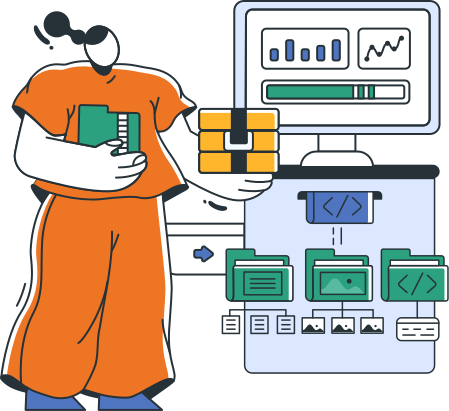
Your data stack becomes intelligent and conversational. Agents surface insights, detect anomalies, and explain trends. Move from dashboards to autonomous, always-on analytics
 Connects to warehouses, lakes, and streaming sources
 Question-answering in natural language
 Continuous monitoring for anomalies and KPI deviations

Agents identify recurring failures and performance issues. They trigger workflows that resolve common problems automatically. Your infrastructure evolves into a self-healing environment
 Automated diagnostics for recurring errors
 Playbook execution: restart services, scale pods, clear queues
 Feedback loop for improving remediation strategies

AI continuously checks controls and compliance posture. It detects misconfigurations and risks before they escalate. Evidence collection becomes automatic and audit-ready
 Continuous control checks across infrastructure and SaaS
 Automated evidence collection for audits
 Risk scoring and prioritized remediation recommendations

Financial and procurement workflows become proactive and insight-driven. Agents monitor spend, vendors, and contracts in real time. Approvals and sourcing decisions become faster and smarter
 Real-time visibility into spend and commitments
 Anomaly detection on invoices and vendor performance
 Intelligent workflows for approvals and sourcing decisions