Key takeaway
- Learning analytics explained: definition, the four analysis types, standards such as xAPI and Caliper, governance and a staged adoption plan.
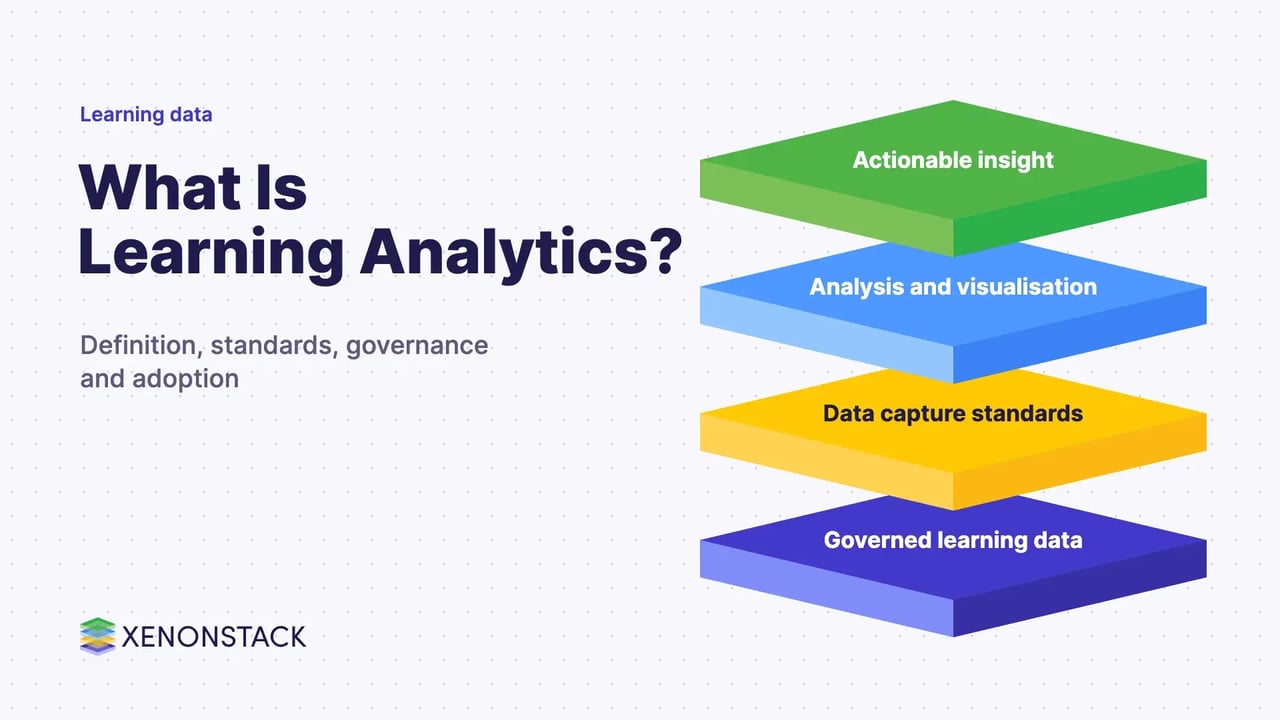
Learning analytics is the collection, analysis, interpretation and communication of data about learners and their learning, so that teachers and organisations can act on what the data shows. That is the definition published by the Society for Learning Analytics Research (SoLAR), and it is the one used in this guide.
For a CIO, CDO or head of learning, the practical question is how to turn learning data into decisions without creating a privacy or compliance problem. This guide covers how a learning analytics pipeline works, which standards and tools collect the data, what governance applies, and how to adopt it in steps. If you are also looking at AI-led learning, read how AI personalises learning paths and agentic AI in education.
What is learning analytics?
According to SoLAR, learning analytics is "the collection, analysis, interpretation and communication of data about learners and their learning that provides theoretically relevant and actionable insights to enhance learning and teaching". Its page says the field took shape at the first International Conference on Learning Analytics and Knowledge (LAK) in 2011, and that it draws on education research, analytics and human-centred design.
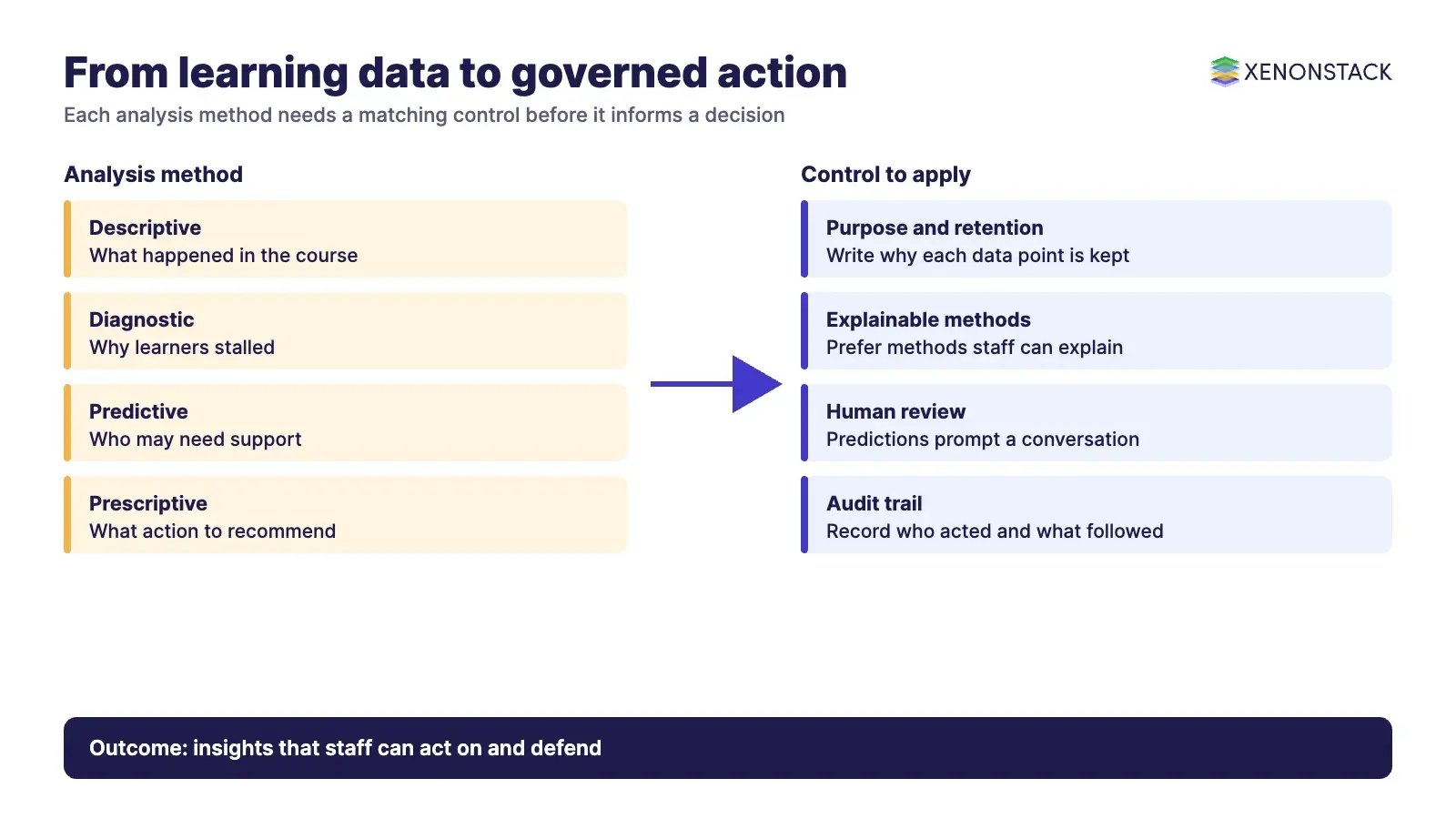
The same page describes four kinds of analysis. Each answers a different question, and most programmes start with the first two.
| Method | Question it answers | Typical use |
|---|---|---|
| Descriptive | What happened? | Course completion and engagement reports |
| Diagnostic | Why did it happen? | Finding where learners drop out of a module |
| Predictive | What is likely to happen? | Flagging learners who may need support early |
| Prescriptive | What should we do? | Recommending an action to an instructor or learner |
Learning analytics sits on top of a wider digital platform strategy, because the data only exists if learning happens on systems that record it.
How does a learning analytics pipeline work?
Whatever the tooling, the pipeline follows the same sequence. Skipping the first step is the most common reason programmes produce reports that nobody uses.
| Step | What happens | Decision for leaders |
|---|---|---|
| 1. Define the question | State the learning or business problem, the benefit expected and the risks | Who owns the question and who acts on the answer |
| 2. Collect data | Capture activity from the learning management system and other learning tools, with a clear purpose for each data point | Which data is justified, and for how long it is kept |
| 3. Process and store | Clean the data, resolve identities and handle missing or inconsistent records | Where the data lives and who may access it |
| 4. Analyse | Apply descriptive, diagnostic or predictive methods such as clustering, relationship mining and prediction | Which methods are explainable enough to be trusted |
| 5. Visualise and act | Present patterns to instructors, learners or managers and record what action followed | How each insight leads to a documented intervention |
Which standards and tools collect the data?
Learning data comes from many tools, so open standards matter. The table lists the ones named on their own sites, with a note on when each fits. Confirm current versions on the official pages before you commit.
| Standard or tool | What it is, according to its site | When it fits |
|---|---|---|
| xAPI (ADL) | A data and interface standard that lets software applications capture and share data on human performance | Tracking activity across several learning tools, not only the LMS |
| Caliper Analytics (1EdTech) | Enables institutions to collect learning data from digital resources; the page lists version 1.2 as current | Institutions that standardise on 1EdTech specifications |
| Moodle Analytics | Software algorithms that predict or detect unknown aspects of the learning process, with built-in models such as students at risk of dropping out | Teams already running Moodle; models must be enabled and trained on site data |
Which tool you pick matters less than the data model behind it. Agree what counts as an activity, a learner and an outcome before you integrate sources, so results can be compared across courses and systems.
What can students, educators and organisations gain?
The benefits below describe what learning analytics is designed to support. They are not guaranteed outcomes, and each should be measured against a baseline before the programme starts.
| Group | What it can support | How to check it works |
|---|---|---|
| Students | Timely feedback and earlier support when engagement drops | Compare support requests and completion against a baseline cohort |
| Educators | Evidence on which materials and activities engage learners, to improve future courses | Review course changes against engagement and assessment data |
| Organisations | Evidence on whether training changes job performance, and where to invest | Link learning records to agreed business measures, with consent and a clear purpose |
What should governance cover?
SoLAR lists privacy, opaque algorithms, biased training data and inaccurate predictions about learners as the main ethical concerns. Regulation adds to this. Under the EU AI Act, Annex III point 3 lists education and vocational training uses as high-risk, including systems that evaluate learning outcomes, including when those outcomes steer the learning process, and systems that monitor and detect prohibited behaviour of students during tests (see the Annex III text; confirm on the official page). In the United States, the Family Educational Rights and Privacy Act (FERPA) protects the privacy of student education records. This is not legal advice, so take it to counsel before you collect data.
| Risk | Control to put in place |
|---|---|
| Data collected without a clear purpose | Write the purpose for each data point and delete data when the purpose ends |
| Predictions treated as facts | Use predictions to prompt a human conversation, not to decide outcomes automatically |
| Biased or unexplainable models | Test models across learner groups and prefer methods you can explain |
| No record of what was decided | Keep an audit trail of each insight, who acted on it and what happened |
The last control is where agentic systems need the most care. ElixirData Context OS keeps governed context, versioned policy and decision traces in one decision layer above AI agents, and AgentGRC keeps autonomous agent actions inside policy, with the audit trail risk teams need. For plain-language questions on learning data, AgentAnalyst lets teams ask questions of enterprise data in plain language and get real-time insights, according to its site.
How should an organisation adopt learning analytics?
A staged approach limits risk and shows value early.
- Pick one course or programme and one question, such as where learners stall.
- Agree the data, the purpose, the retention period and the owner, and record learner consent where it applies.
- Start with descriptive and diagnostic reports before any prediction.
- Add prediction only where staff can act on it, and test it for bias first.
- Review the audit trail every term, then extend to more courses.
For a worked example, see our use case on a big data analytics platform for e-learning, our page on agentic AI for the education industry, and the related guide on education with AI agents.
When is learning analytics not the right approach?
Hold back if you cannot state a purpose for the data, if learners have not been told how their data is used, or if no one has time to act on the insights. A dashboard without an owner adds cost and risk, not learning. Small cohorts also give weak statistical signals, so a conversation with the instructor can serve better than a model.
To map one learning decision your agents should make, and the context and policy it depends on, book a Context Workshop. See what happens in the workshop.
Frequently asked questions
What is learning analytics in simple terms?
It is the collection, analysis, interpretation and communication of data about learners and their learning, so that teaching and learning can improve (SoLAR definition).
What are the four types of learning analytics?
Descriptive, diagnostic, predictive and prescriptive analysis, which answer what happened, why, what is likely next and what to do.
Which standards collect learning data?
xAPI from ADL and Caliper Analytics from 1EdTech are two open standards named on their own sites. Moodle also ships built-in analytics models.
Is learning analytics regulated?
Rules depend on the country. The EU AI Act Annex III lists some education uses as high-risk, and FERPA covers student education records in the United States. Confirm on the official pages and take legal advice.
Where should an enterprise start?
Start with one question and one course, agree purpose, data and owner, begin with descriptive reports, and add prediction only where staff can act on it.
Ready to put AI agents to work? See an ElixirClaw demo: the agentic OS to build, orchestrate and govern AI agents across your enterprise systems.
Explore the XenonStack platform family: ElixirData · ElixirClaw · ElixirHub · NexaStack · MetaSecure · Neural AI · AgentGRC · AgentSRE · AgentAnalyst · AgentInstruct · AgentRAI · AgentScrum · AgentSearch · AgentForce · AI Aviator · SAIF Aviator · CohortIQ · XenonStack AI · XenonStack UAE